Skip to content

SAT practice test

SAT Equivalent Expressions Full Real Collegeboard Questions for Practice

  • 98 questions
  • Untimed
  • Answers and explanations
Embed on your site
  • 98 questions
  • No time limit
  • Every answer explained at the end
  1. Question 1

    Which expression is equivalent to \(12 x + 27\)?

    Correct answer: C

    Choice C is correct. Each term in the given expression, \(12 x + 27\), has a common factor of \(3\). Therefore, the expression can be rewritten as \(3(4 x)+ 3(9)\), or \(3(4 x + 9)\). Thus, the expression \(3(4 x + 9)\) is equivalent to the given expression. Choice A is incorrect. This expression is equivalent to \(108 x + 12\), not \(12 x + 27\). Choice B is incorrect. This expression is equivalent to \(324 x + 27\), not \(12 x + 27\). Choice D is incorrect. This expression is equivalent to \(27 x + 72\), not \(12 x + 27\).
  2. Question 2

    Which of the following expressions is equivalent to the sum of and ?

    Correct answer: D

    Choice D is correct. Grouπng like terms, the given expressions can be rewritten as . This can be rewritten as .Choice A is incorrect and may result from adding the two sets of unlike terms, and as well as and, and then adding the respective exponents. Choice B is incorrect and may result from adding the unlike terms and as if they were and and adding the unlike terms and as if they were and . Choice C is incorrect and may result from errors when combining like terms.
  3. Question 3

    Which expression is equivalent to \(x ^2 + 3 x -40\)?

    Correct answer: B

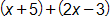
    Choice B is correct. The given expression may be rewritten as \(x ^2 + 8 x -5 x -40\). Since the first two terms of this expression have a common factor of \(x\) and the last two terms of this expression have a common factor of \(-5\), this expression may be rewritten as \(x(x)+ x(8)-5(x)-5(8)\), or \(x(x + 8)-5(x + 8)\). Since each term of this expression has a common factor of \((x + 8)\), it may be rewritten as \((x -5)(x + 8)\). Alternate approach: An expression of the form \(x ^2 + b x + c\), where \(b\) and \(c\) are constants, can be factored if there are two values that add to give \(b\) and multiply to give \(c\). In the given expression, \(b = 3\) and \(c = -40\). The values of \(-5\) and \(8\) add to give \(3\) and multiply to give \(-40\), so the expression can be factored as \((x -5)(x + 8)\). Choice A is incorrect. This expression is equivalent to \(x ^2 + 6 x -40\), not \(x ^2 + 3 x -40\). Choice C is incorrect. This expression is equivalent to \(x ^2 -3 x -40\), not \(x ^2 + 3 x -40\). Choice D is incorrect. This expression is equivalent to \(x ^2 -6 x -40\), not \(x ^2 + 3 x -40\).
  4. Question 4

    Which expression is equivalent to \(12 x cubed -5 x cubed\)?

    Correct answer: C

    Choice C is correct. The given expression shows subtraction of two like terms. The two terms can be subtracted as follows: \(12 x cubed -5 x cubed =(12 -5)x cubed\), or \(7 x cubed\). Choice A is incorrect and may result from conceptual or calculation errors. Choice B is incorrect. This is the result of adding, not subtracting, the two like terms. Choice D is incorrect and may result from conceptual or calculation errors.
  5. Question 5

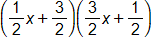
    Which of the following is equivalent to the expression above?

    Correct answer: B

    Choice B is correct. Expanding all terms yields (x – 11y)(2x – 3y) – 12y(–2x + 3y), which is equivalent to 2x2 – 22xy – 3xy + 33y2 + 24xy – 36y2. Combining like terms gives 2x2 – xy – 3y2.Choice A is incorrect and may be the result of using the sums of the coefficients of the existing x and y terms as the coefficients of the x and y terms in the new expressions. Choice C is incorrect and may be the result of incorrectly combining like terms. Choice D is incorrect and may be the result of using the incorrect sign in front of the 12y term.
  6. Question 6

    Which expression is equivalent to \(16(x + 15)\)?

    Correct answer: B

    Choice B is correct. The expression \(16(x + 15)\) can be rewritten as \(16(x)+ 16(15)\), which is equivalent to \(16 x + 240\). Choice A is incorrect and may result from conceptual or calculation errors. Choice C is incorrect and may result from conceptual or calculation errors. Choice D is incorrect and may result from conceptual or calculation errors.
  7. Question 7

    Which expression is equivalent to \(RootIndex 7 √x Superscript 9 Baseline y Superscript 9 Baseline\), where \(x\) and \(y\) are positive?

    Correct answer: B

    Choice B is correct. For positive values of \(a\) and \(b\), \(a Superscript m Baseline b Superscript m Baseline =(a b)Superscript m\), \(RootIndex n √a =(a)Superscript 1/n\), and \((a Superscript j Baseline)Superscript k Baseline = a Superscript j k\). Therefore, the given expression, \(RootIndex 7 √x Superscript 9 Baseline y Superscript 9 Baseline\), can be rewritten as \(RootIndex 7 √(x y)Superscript 9 Baseline\). This expression is equivalent to \(((x y)Superscript 9 Baseline)Superscript 1 seventh\), which can be rewritten as \((x y)Superscript 9 dot 1 seventh\), or \((x y)Superscript 9 sevenths\). Choice A is incorrect and may result from conceptual or calculation errors. Choice C is incorrect and may result from conceptual or calculation errors. Choice D is incorrect and may result from conceptual or calculation errors.
  8. Question 8

    Which of the following is equivalent to the given expression?

    Correct answer: A

    Choice A is correct. Since 5 is a factor of both terms, and 15, the given expression can be factored and rewritten as .Choice B is incorrect and may result from subtracting 5 from the constant when factoring 5 from the given expression. Choice C is incorrect and may result from factoring 5 from only the first term, not both terms, of the given expression. Choice D is incorrect and may result from adding 5 to the constant when factoring 5 from the given expression.
  9. Question 9

    Which expression is equivalent to \(256 w ^2 -676\)?

    Correct answer: D

    Choice D is correct. The given expression follows the difference of two squares pattern, \(x ^2 -y ^2\), which factors as \((x -y)(x + y)\). Therefore, the expression \(256 w ^2 -676\) can be written as \((16 w)^2 -26 ^2\), or \((16 w)(16 w)-(26)(26)\), which factors as \((16 w -26)(16 w + 26)\). Choice A is incorrect. This expression is equivalent to \(256 w ^2 -832 w + 676\). Choice B is incorrect. This expression is equivalent to \(64 w ^2 -169\). Choice C is incorrect. This expression is equivalent to \(64 w ^2 -208 w + 169\).
  10. Question 10

    Which expression is equivalent to \(34 x + 34 y\)?

    Correct answer: B

    Choice B is correct. Since \(34\) is a common factor of each term in the given expression, the expression can be rewritten as \(34(x + y)\). Choice A is incorrect and may result from conceptual or calculation errors. Choice C is incorrect. This expression is equivalent to \(34 y + 34 y\). Choice D is incorrect. This expression is equivalent to \(34 x + 34 x\).
  11. Question 11

    Which expression is equivalent to \(9 x + 6 x + 2 y + 3 y\)?

    Correct answer: D

    Choice D is correct. Combining like terms in the given expression yields \((9 x + 6 x)+(2 y + 3 y)\), or \(15 x + 5 y\). Choice A is incorrect and may result from conceptual or calculation errors. Choice B is incorrect and may result from conceptual or calculation errors. Choice C is incorrect and may result from conceptual or calculation errors.
  12. Question 12

    \((5 x cubed -3)-(-4 x cubed + 8)\) The given expression is equivalent to \(b x cubed -11\), where \(b\) is a constant. What is the value of \(b\)?

    Correct answer: C

    The correct answer is \(9\). The given expression can be rewritten as \((5 x cubed -3)+(-1)(-4 x cubed + 8)\). By applying the distributive property, this expression can be rewritten as \(5 x cubed -3 + 4 x cubed +(-8)\), which is equivalent to \((5 x cubed + 4 x cubed)+(-3 +(-8))\). Adding like terms in this expression yields \(9 x cubed -11\). Since it's given that \((5 x cubed -3)-(-4 x cubed + 8)\) is equivalent to \(b x cubed -11\), it follows that \(9 x cubed -11\) is equivalent to \(b x cubed -11\). Therefore, the coefficients of \(x cubed\) in these two expressions must be equivalent, and the value of \(b\) must be \(9\).
  13. Question 13

    Which expression is equivalent to \(17(x ^2 -100 y ^2)\)?

    Correct answer: D

    Choice D is correct. Expressions in the form \(a ^2 -b ^2\) follow the difference of two squares pattern and can be factored as \((a -b)(a + b)\). In the given expression, \(17(x ^2 -100 y ^2)\), the expression \(x ^2 -100 y ^2\) follows the difference of two squares pattern. It follows that the expression \(x ^2 -100 y ^2\) can be rewritten as \((x -10 y)(x + 10 y)\). Therefore, the expression \(17(x -10 y)(x + 10 y)\) is equivalent to \(17(x ^2 -100 y ^2)\). Choice A is incorrect. This expression is equivalent to \(17(x ^2 -52 x y + 100 y ^2)\), not \(17(x ^2 -100 y ^2)\). Choice B is incorrect. This expression is equivalent to \(17(x ^2 + 48 x y -100 y ^2)\), not \(17(x ^2 -100 y ^2)\). Choice C is incorrect. This expression is equivalent to \(17(x ^2 -20 x y + 100 y ^2)\), not \(17(x ^2 -100 y ^2)\).
  14. Question 14

    If \(k -x\) is a factor of the expression \(-x ^2 + 1 20 ninth n k ^2\), where \(n\) and \(k\) are constants and \(k > 0\), what is the value of \(n\)?

    Correct answer: D

    Choice D is correct. If \(k -x\) is a factor of the expression \(-x ^2 +(1 20 ninth)n k ^2\), then the expression can be written as \((k -x)(a x + b)\), where \(a\) and \(b\) are constants. This expression can be rewritten as \(a k x + b k -a x ^2 -b x\), or \(-a x ^2 +(a k -b)x + b k\). Since this expression is equivalent to \(-x ^2 +(1 20 ninth)n k ^2\), it follows that \(-a = -1\), \(a k -b = 0\), and \(b k =(1 20 ninth)n k ^2\). Dividing each side of the equation \(-a = -1\) by \(-1\) yields \(a = 1\). Substituting \(1\) for \(a\) in the equation \(a k -b = 0\) yields \(k -b = 0\). Adding \(b\) to each side of this equation yields \(k = b\). Substituting \(k\) for \(b\) in the equation \(b k =(1 20 ninth)n k ^2\) yields \(k ^2 =(1 20 ninth)n k ^2\). Since \(k\) is positive, dividing each side of this equation by \(k ^2\) yields \(1 =(1 20 ninth)n\). Multiplying each side of this equation by \(29\) yields \(29 = n\). Alternate approach: The expression \(x ^2 -y ^2\) can be written as \((x -y)(x + y)\), which is a difference of two squares. It follows that \((1 20 ninth)n k ^2 -x ^2\) is equivalent to \(((√1 20 ninth n )k -x)((√1 20 ninth n )k + x)\). It’s given that \(k -x\) is a factor of \(-x ^2 +(1 20 ninth)n k ^2\), so the factor \((√1 20 ninth n )k -x\) is equal to \(k -x\). Adding \(x\) to both sides of the equation \((√1 20 ninth n )k -x = k -x\) yields \((√1 20 ninth n )k = k\). Since \(k\) is positive, dividing both sides of this equation by \(k\) yields \(√1 20 ninth n = 1\). Squaring both sides of this equation yields \(1 20 ninth n = 1\). Multiplying both sides of this equation by \(29\) yields \(n = 29\). Choice A is incorrect. This value of \(n\) gives the expression \(-x ^2 +(1 20 ninth)(-29)k ^2\), or \(-x ^2 -k ^2\). This expression doesn't have \(k -x\) as a factor. Choice B is incorrect. This value of \(n\) gives the expression \(-x ^2 +(1 20 ninth)(-1 20 ninth)k ^2\), or \(-x ^2 +(-1/841)k ^2\). This expression doesn't have \(k -x\) as a factor. Choice C is incorrect. This value of \(n\) gives the expression \(-x ^2 +(1 20 ninth)(1 20 ninth)k ^2\), or \(-x ^2 +(1/841)k ^2\). This expression doesn't have \(k -x\) as a factor.
  15. Question 15

    Which of the following expressions is equivalent to ?

    Correct answer: B

    Choice B is correct. Applying the distributive property to the given expression yields, or . Adding the like terms and 2 results in the expression .Choice A is incorrect and may result from multiplying by 2 without multiplying by 2 when applying the distributive property. Choices C and D are incorrect and may result from computational or conceptual errors.
  16. Question 16

    Which expression is equivalent to \(8 + d ^2 + 3\)?

    Correct answer: B

    Choice B is correct. The given expression can be rewritten as \(d ^2 + 8 + 3\). Adding \(8\) and \(3\) in this expression yields \(d ^2 + 11\). Choice A is incorrect. This expression is equivalent to \(d ^2 + 8(3)\). Choice C is incorrect. This expression is equivalent to \(8 + d ^2 -3\). Choice D is incorrect. This expression is equivalent to \(-8 + d ^2 -3\).
  17. Question 17

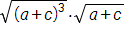
    If a and c are positive numbers, which of the following is equivalent to ?

    Correct answer: C

    Choice C is correct. Using the property that for positive numbers x and y, with x = (a + c)3 and y = a + c, it follows that . By rewriting (a + c)4 as ((a + c)2)2, it is possible to simplify the square root expression as follows: . Choice A is incorrect and may be the result of . Choice B is incorrect and may be the result of incorrectly rewriting (a + c)2 as a2 + c2. Choice D is incorrect and may be the result of incorrectly applying properties of exponents.
  18. Question 18

    Which of the following is equivalent to, where ?

    Correct answer: D

    Choice D is correct. The given expression can also be written as . The trinomial can be rewritten in factored form as . Thus, the entire expression can be rewritten as . Simplifying the exponents yields .Choices A, B, and C are incorrect and may result from errors made when simplifying the exponents in the expression .
  19. Question 19

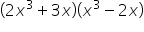
    Which of the following expressions is equivalent to the expression above?

    Correct answer: B

    Choice B is correct. Using the distributive property, the given expression can be rewritten as . Combining like terms, this expression can be rewritten as, which is equivalent to .Choices A, C, and D are incorrect and may result from an error when applying the distributive property or an error when combining like terms.
  20. Question 20

    Which of the following is equivalent to the expression above?

    Correct answer: A

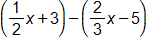
    Choice A is correct. By distributing the minus sign through the expression, the given expression can be rewritten as, which is equivalent to . Combining like terms gives, or .Choice B is incorrect and may be the result of failing to distribute the minus sign appropriately through the second term and simplifying the expression . Choice C is incorrect and may be the result of multiplying the expressions and . Choice D is incorrect and may be the result of multiplying the expressions and .
  21. Question 21

    \(f(x)= x ^2 + b x\) \(g(x)= 9 x ^2 -27 x\) Functions \(f\) and \(g\) are given, and in function \(f\), \(b\) is a constant. If \(f(x)dot g(x)= 9 x Superscript 4 Baseline -26 x cubed -3 x ^2\), what is the value of \(b\)?

    Correct answer: C

    Choice C is correct. Multiplying the given functions \(f\) and \(g\) yields \(f(x)dot g(x)=(x ^2 + b x)(9 x ^2 -27 x)\). Applying the distributive property to the right-hand side of this equation yields \(f(x)dot g(x)=(x ^2)(9 x ^2 -27 x)+(b x)(9 x ^2 -27 x)\). Applying the distributive property once again to the right-hand side of this equation yields \(f(x)dot g(x)=(x ^2)(9 x ^2)-(x ^2)(27 x)+(b x)(9 x ^2)-(b x)(27 x)\), which is equivalent to \(f(x)dot g(x)= 9 x Superscript 4 Baseline -27 x cubed + 9 b x cubed -27 b x ^2\). Factoring out \(x cubed\) from the second and third terms yields \(f(x)dot g(x)= 9 x Superscript 4 Baseline +(-27 + 9 b)x cubed -27 b x ^2\). Since the left-hand sides of \(f(x)dot g(x)= 9 x Superscript 4 Baseline +(-27 + 9 b)x cubed -27 b x ^2\) and \(f(x)dot g(x)= 9 x Superscript 4 Baseline -26 x cubed -3 x ^2\) are equal, it follows that \((-27 + 9 b)x cubed = -26 x cubed\), or \(-27 + 9 b = -26\), and \(-27 b x ^2 = -3 x ^2\), or \(-27 b = -3\). Adding \(27\) to each side of \(-27 + 9 b = -26\) yields \(9 b = 1\). Dividing each side of this equation by \(9\) yields \(b = 1 ninth\). Similarly, dividing each side of \(-27 b = -3\) by \(-27\) yields \(b = 1 ninth\). Therefore, the value of \(b\) is \(1 ninth\). Choice A is incorrect and may result from conceptual or calculation errors. Choice B is incorrect and may result from conceptual or calculation errors. Choice D is incorrect and may result from conceptual or calculation errors.
  22. Question 22

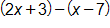
    Which of the following is equivalent to the given expression?

    Correct answer: C

    Choice C is correct. Distributing the negative sign to the terms in the second parentheses yields . This expression can be rewritten as . Combining like terms results in .Choice A is incorrect and may result from not distributing the negative sign to the 7. Choice B is incorrect and may result from adding to instead of subtracting . Choice D is incorrect and may result from adding the product of and x to the product of 3 and 7.
  23. Question 23

    Which of the following is equivalent to ?

    Correct answer: B

    Choice B is correct. Multiplying (1 – p) by each term of the polynomial within the second pair of parentheses gives (1 – p)1 = 1 – p; (1 – p)p = p – p2; (1 – p)p2 = p2 – p3; (1 – p)p3 = p3 – p4; (1 – p)p4 = p4 – p5; (1 – p)p5 = p5 – p6; and (1 – p)p6 = p6 – p7. Adding these seven expressions together and combining like terms gives 1 + (p – p) + (p2 – p2) + (p3 – p3) + (p4 – p4) + (p5 – p5) + (p6 – p6) – p7, which can be simplified to 1 – p7.Choices A, C, and D are incorrect and may result from incorrectly identifying the highest power of p in the expressions or incorrectly combining like terms.
  24. Question 24

    Which of the following is equivalent to the expression above?

    Correct answer: C

    Choice C is correct. Using the distributive property to multiply the terms in the parentheses yields, which is equivalent to . Combining like terms results in .Choices A and D are incorrect and may result from conceptual errors when multiplying the terms in the given expression. Choice B is incorrect and may result from adding, instead of multiplying, and .
  25. Question 25

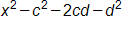
    If, which of the following is equivalent to the expression ?

    Correct answer: C

    Choice C is correct. Factoring –1 from the second, third, and fourth terms gives x2 – c2 – 2cd – d2 = x2 – (c2 + 2cd + d2). The expression c2 + 2cd + d2 is the expanded form of a perfect square: c2 + 2cd + d2 = (c + d)2. Therefore, x2 – (c2 + 2cd + d2) = x2 – (c + d)2. Since a = c + d, x2 – (c + d)2 = x2 – a2. Finally, because x2 – a2 is the difference of squares, it can be expanded as x2 – a2 = (x + a)(x – a).Choices A and B are incorrect and may be the result of making an error in factoring the difference of squares x2 – a2. Choice D is incorrect and may be the result of incorrectly combining terms.
  26. Question 26

    Which expression represents the product of \((x Superscript -6 Baseline y cubed z Superscript 5 Baseline)\) and \((x Superscript 4 Baseline z Superscript 5 Baseline + y Superscript 8 Baseline z Superscript -7 Baseline)\)?

    Correct answer: D

    Choice D is correct. The product of \((x Superscript -6 Baseline y cubed z Superscript 5 Baseline)\) and \((x Superscript 4 Baseline z Superscript 5 Baseline + y Superscript 8 Baseline z Superscript -7 Baseline)\) can be represented by the expression \((x Superscript -6 Baseline y cubed z Superscript 5 Baseline)(x Superscript 4 Baseline z Superscript 5 Baseline + y Superscript 8 Baseline z Superscript -7 Baseline)\). Applying the distributive property to this expression yields \((x Superscript -6 Baseline y cubed z Superscript 5 Baseline)(x Superscript 4 Baseline z Superscript 5 Baseline)+(x Superscript -6 Baseline y cubed z Superscript 5 Baseline)(y Superscript 8 Baseline z Superscript -7 Baseline)\), or \(x Superscript -6 Baseline x Superscript 4 Baseline y cubed z Superscript 5 Baseline z Superscript 5 + x Superscript -6 Baseline y cubed y Superscript 8 Baseline z Superscript 5 Baseline z Superscript -7\). This expression is equivalent to \(x Superscript -6 + 4 Baseline y cubed z Superscript 5 + 5 + x Superscript -6 Baseline y Superscript 3 + 8 Baseline z Superscript 5 -7\), or \(x Superscript -2 Baseline y cubed z Superscript 10 + x Superscript -6 Baseline y Superscript 11 Baseline z Superscript -2\). Choice A is incorrect and may result from conceptual or calculation errors. Choice B is incorrect and may result from conceptual or calculation errors. Choice C is incorrect and may result from conceptual or calculation errors.
  27. Question 27

    If the given expression is rewritten in the form, where k is a constant, what is the value of k ?

    Correct answer: C

    The correct answer is 4. It’s given that can be rewritten as ; it follows that . Expanding the left-hand side of this equation yields . Subtracting from both sides of this equation yields . Using properties of equality, and . Either equation can be solved for k. Dividing both sides of by yields . The equation can be rewritten as . It follows that . Solving this equation for k also yields . Therefore, the value of k is 4.
  28. Question 28

    The expression \(6 RootIndex 5 √3 Superscript 5 Baseline x Superscript 45 Baseline dot RootIndex 8 √2 Superscript 8 Baseline x\) is equivalent to \(a x Superscript b\), where \(a\) and \(b\) are positive constants and \(x > 1\). What is the value of \(a + b\)?

    Correct answer: B

    The correct answer is \(361/8\). The rational exponent property is \(RootIndex n √y Superscript m Baseline = y Superscript m/n\), where \(y > 0\), \(m\) and \(n\) are integers, and \(n > 0\). This property can be applied to rewrite the given expression \(6 RootIndex 5 √3 Superscript 5 Baseline x Superscript 45 Baseline dot RootIndex 8 √2 Superscript 8 Baseline x\) as \(6(3 Superscript 5 fifths Baseline)(x Superscript 45/5 Baseline)(2 Superscript 8 eighths Baseline)(x Superscript 1 eighth Baseline)\), or \(6(3)(x Superscript 9 Baseline)(2)(x Superscript 1 eighth Baseline)\). This expression can be rewritten by multiplying the constants, which gives \(36(x Superscript 9 Baseline)(x Superscript 1 eighth Baseline)\). The multiplication exponent property is \(y Superscript n Baseline dot y Superscript m Baseline = y Superscript n + m\), where \(y > 0\). This property can be applied to rewrite the expression \(36(x Superscript 9 Baseline)(x Superscript 1 eighth Baseline)\) as \(36 x Superscript 9 + 1 eighth\), or \(36 x Superscript 73/8\). Therefore, \(6 RootIndex 5 √3 Superscript 5 Baseline x Superscript 45 Baseline dot RootIndex 8 √2 Superscript 8 Baseline x = 36 x Superscript 73/8\). It's given that \(6 RootIndex 5 √3 Superscript 5 Baseline x Superscript 45 Baseline dot RootIndex 8 √2 Superscript 8 Baseline x\) is equivalent to \(a x Superscript b\); therefore, \(a = 36\) and \(b = 73/8\). It follows that \(a + b = 36 + 73/8\). Finding a common denominator on the right-hand side of this equation gives \(a + b = 288/8 + 73/8\), or \(a + b = 361/8\). Note that 361/8, 45.12, and 45.13 are examples of ways to enter a correct answer.
  29. Question 29

    The expression above can be written in the form, where a and b are constants. What is the value of ?

    Correct answer: B

    The correct answer is 6632. Applying the distributive property to the expression yields . Then adding together and and collecting like terms results in . This is written in the form, where and . Therefore .
  30. Question 30

    Which of the following is equivalent to the sum of and ?

    Correct answer: D

    Choice D is correct. Adding the two expressions yields . Because the pair of terms and and the pair of terms and each contain the same variable raised to the same power, they are like terms and can be combined as and, respectively. The sum of the given expressions therefore simplifies to .Choice A is incorrect and may result from adding the coefficients and the exponents in the given expressions. Choice B is incorrect and may result from adding the exponents as well as the coefficients of the like terms in the given expressions. Choice C is incorrect and may result from multiplying, rather than adding, the coefficients of the like terms in the given expressions.
  31. Question 31

    Which of the following expressions is equivalent to ?

    Correct answer: D

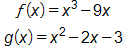
    Choice D is correct. The numerator of the given expression can be rewritten in terms of the denominator,, as follows:, which is equivalent to . So the given expression is equivalent to . Since the given expression is defined for, the expression can be rewritten as .Long division can also be used as an alternate approach. Choices A, B, and C are incorrect and may result from errors made when dividing the two polynomials or making use of structure.
  32. Question 32

    Which expression is equivalent to \((8 x cubed + 8)-(x cubed -2)\)?

    Correct answer: B

    Choice B is correct. The given expression is equivalent to \(8 x cubed + 8 -x cubed -(-2)\), or \(8 x cubed + 8 -x cubed + 2\). Combining like terms in this expression yields \(7 x cubed + 10\). Choice A is incorrect. This expression is equivalent to \((8 x cubed + 8)-2\), not \((8 x cubed + 8)-(x cubed -2)\). Choice C is incorrect. This expression is equivalent to \((8 x cubed + 8)-(-2)\), not \((8 x cubed + 8)-(x cubed -2)\). Choice D is incorrect. This expression is equivalent to \((8 x cubed + 8)-(x cubed + 2)\), not \((8 x cubed + 8)-(x cubed -2)\).
  33. Question 33

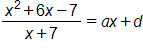
    The equation is true for all, where a and d are integers. What is the value of ?

    Correct answer: C

    Choice C is correct. Since the expression can be factored as, the given equation can be rewritten as . Since, is also not equal to 0, so both the numerator and denominator of can be divided by . This gives . Equating the coefficient of x on each side of the equation gives . Equating the constant terms gives . The sum is .Choice A is incorrect and may result from incorrectly simplifying the equation. Choices B and D are incorrect. They are the values of d and a, respectively, not .
  34. Question 34

    Which expression is equivalent to \((2 x ^2 + x -9)+(x ^2 + 6 x + 1)\)?

    Correct answer: D

    Choice D is correct. The given expression is equivalent to \((2 x ^2 + x +(-9))+(x ^2 + 6 x + 1)\), which can be rewritten as \((2 x ^2 + x ^2)+(x + 6 x)+(-9 + 1)\). Adding like terms in this expression yields \(3 x ^2 + 7 x +(-8)\), or \(3 x ^2 + 7 x -8\). Choice A is incorrect and may result from conceptual or calculation errors. Choice B is incorrect and may result from conceptual or calculation errors. Choice C is incorrect and may result from conceptual or calculation errors.
  35. Question 35

    Which expression is equivalent to \(9 x ^2 + 7 x ^2 + 9 x\)?

    Correct answer: D

    Choice D is correct. In the given expression, the first two terms, \(9 x ^2\) and \(7 x ^2\), are like terms. Combining these like terms yields \(9 x ^2 + 7 x ^2\), or \(16 x ^2\). It follows that the expression \(9 x ^2 + 7 x ^2 + 9 x\) is equivalent to \(16 x ^2 + 9 x\). Choice A is incorrect and may result from conceptual or calculation errors. Choice B is incorrect and may result from conceptual or calculation errors. Choice C is incorrect and may result from conceptual or calculation errors.
  36. Question 36

    One of the factors of \(2 x cubed + 42 x ^2 + 208 x\) is \(x + b\), where \(b\) is a positive constant. What is the smallest possible value of \(b\)?

    Correct answer: D

    The correct answer is \(8\). Since each term of the given expression, \(2 x cubed + 42 x ^2 + 208 x\), has a factor of \(2 x\), the expression can be rewritten as \(2 x(x ^2)+ 2 x(21 x)+ 2 x(104)\), or \(2 x(x ^2 + 21 x + 104)\). Since the values \(8\) and \(13\) have a sum of \(21\) and a product of \(104\), the expression \(x ^2 + 21 x + 104\) can be factored as \((x + 8)(x + 13)\). Therefore, the given expression can be factored as \(2 x(x + 8)(x + 13)\). It follows that the factors of the given expression are \(2\), \(x\), \(x + 8\), and \(x + 13\). Of these factors, only \(x + 8\) and \(x + 13\) are of the form \(x + b\), where \(b\) is a positive constant. Therefore, the possible values of \(b\) are \(8\) and \(13\). Thus, the smallest possible value of \(b\) is \(8\).
  37. Question 37

    Which expression is equivalent to \(y + 12/x -8 + y(x -8)/x ^2 y -8 x y\)?

    Correct answer: C

    Choice C is correct. Factoring the denominator in the second term of the given expression gives \(y + 12/x -8 + y(x -8)/x y(x -8)\). This expression can be rewritten with common denominators by multiplying the first term by \(x y/x y\), giving \(x y(y + 12)/x y(x -8) + y(x -8)/x y(x -8)\). Adding these two terms yields \(x y(y + 12)+ y(x -8)/x y(x -8)\). Using the distributive property to rewrite this expression gives \(x y ^2 + 12 x y + x y -8 y/x ^2 y -8 x y\). Combining the like terms in the numerator of this expression gives \(x y ^2 + 13 x y -8 y/x ^2 y -8 x y\). Choice A is incorrect and may result from conceptual or calculation errors. Choice B is incorrect and may result from conceptual or calculation errors. Choice D is incorrect and may result from conceptual or calculation errors.
  38. Question 38

    Which expression is equivalent to \((x ^2 + 11)^2 +(x -5)(x + 5)\)?

    Correct answer: B

    Choice B is correct. The expression \((x ^2 + 11)^2\) can be written as \((x ^2 + 11)(x ^2 + 11)\), which is equivalent to \(x ^2(x ^2 + 11)+ 11(x ^2 + 11)\). Distributing \(x ^2\) and \(11\) to \((x ^2 + 11)\) yields \(x Superscript 4 Baseline + 11 x ^2 + 11 x ^2 + 121\), or \(x Superscript 4 Baseline + 22 x ^2 + 121\). The expression \((x -5)(x + 5)\) is equivalent to \((x -5)x +(x -5)5\). Distributing \(x\) and \(5\) to \((x -5)\) yields \(x ^2 -5 x + 5 x -25\), or \(x ^2 -25\). Therefore, the expression \((x ^2 + 11)^2 +(x -5)(x + 5)\) is equivalent to \((x Superscript 4 Baseline + 22 x ^2 + 121)+(x ^2 -25)\), or \(x Superscript 4 Baseline + 22 x ^2 + 121 + x ^2 -25\). Combining like terms in this expression yields \(x Superscript 4 Baseline + 23 x ^2 + 96\). Choice A is incorrect. Equivalent expressions must be equivalent for any value of \(x\). Substituting \(0\) for \(x\) in this expression yields \(-14\), whereas substituting \(0\) for \(x\) in the given expression yields \(96\). Choice C is incorrect. Equivalent expressions must be equivalent for any value of \(x\). Substituting \(0\) for \(x\) in this expression yields \(121\), whereas substituting \(0\) for \(x\) in the given expression yields \(96\). Choice D is incorrect. Equivalent expressions must be equivalent for any value of \(x\). Substituting \(0\) for \(x\) in this expression yields \(146\), whereas substituting \(0\) for \(x\) in the given expression yields \(96\).
  39. Question 39

    Which expression is equivalent to \(5 x ^2 -50 x y ^2\)?

    Correct answer: A

    Choice A is correct. Since each term of the given expression has a factor of \(5 x\), it can be rewritten as \(5 x(x)-5 x(10 y ^2)\), or \(5 x(x -10 y ^2)\). Choice B is incorrect and may result from conceptual or calculation errors. Choice C is incorrect and may result from conceptual or calculation errors. Choice D is incorrect and may result from conceptual or calculation errors.
  40. Question 40

    Which of the following is equivalent to ?

    Correct answer: D

    Choice D is correct. The expression can be rewritten as . Using the distributive property, the expression yields . Combining like terms gives .Choices A, B, and C are incorrect and may result from errors using the distributive property on the given expression or combining like terms.
  41. Question 41

    Which of the following expressions is equivalent to ?

    Correct answer: D

    Choice D is correct. Expanding the given expression using the distributive property yields . Combining like terms yields, or, which is equivalent to .Choices A and B are incorrect and may result from incorrectly combining like terms. Choice C is incorrect and may result from distributing only to a, and not to 3, in the given expression.
  42. Question 42

    Which expression is equivalent to \(9 x ^2 + 5 x\)?

    Correct answer: A

    Choice A is correct. Since \(x\) is a factor of each term in the given expression, the expression is equivalent to \(x(9 x)+ x(5)\), or \(x(9 x + 5)\). Choice B is incorrect. This expression is equivalent to \(45 x ^2 + 5 x\), not \(9 x ^2 + 5 x\). Choice C is incorrect. This expression is equivalent to \(9 x ^2 + 45 x\), not \(9 x ^2 + 5 x\). Choice D is incorrect. This expression is equivalent to \(9 x cubed + 5 x ^2\), not \(9 x ^2 + 5 x\).
  43. Question 43

    Which expression is equivalent to \(5 x Superscript 5 -6 x Superscript 4 + 8 x cubed\)?

    Correct answer: B

    Choice B is correct. Since \(x cubed\) is a common factor of each term in the given expression, the expression can be rewritten as \(x cubed(5 x ^2 -6 x + 8)\). Choice A is incorrect. This expression is equivalent to \(5 x Superscript 5 -6 x Superscript 4\). Choice C is incorrect. This expression is equivalent to \(40 x Superscript 5 -48 x Superscript 4 + 8 x cubed\). Choice D is incorrect. This expression is equivalent to \(-36 x Superscript 9 + 48 x Superscript 8 + 6 x Superscript 5\).
  44. Question 44

    Which expression is equivalent to \(h Superscript 15 Baseline q Superscript 7 Baseline/h Superscript 5 Baseline q Superscript 21 Baseline\), where \(h > 0\) and \(q > 0\)?

    Correct answer: A

    Choice A is correct. For positive values of \(a\), \(a Superscript m Baseline/a Superscript n Baseline = a Superscript(m -n)\), where \(m\) and \(n\) are integers. Since it's given that \(h > 0\) and \(q > 0\), this property can be applied to rewrite the given expression as \((h Superscript(15 -5)Baseline)(q Superscript(7 -21)Baseline)\), which is equivalent to \(h Superscript 10 Baseline q Superscript -14\). For positive values of \(a\), \(a Superscript -n Baseline = 1/a Superscript n Baseline\). This property can be applied to rewrite the expression \(h Superscript 10 Baseline q Superscript -14\) as \((h Superscript 10 Baseline)(1/q Superscript 14 Baseline)\), which is equivalent to \(h Superscript 10 Baseline/q Superscript 14 Baseline\). Choice B is incorrect and may result from conceptual or calculation errors. Choice C is incorrect and may result from conceptual or calculation errors. Choice D is incorrect and may result from conceptual or calculation errors.
  45. Question 45

    The expression above is equivalent to, where a, b, and c are constants. What is the value of b?

    Correct answer: C

    The correct answer is . The expression can be written in the form, where a, b, and c are constants, by multiplying out the expression using the distributive property of multiplication over addition. The result is . This expression can be rewritten by multiplying as indicated to give, which can be simplified to, or . This is in the form, where the value of b is . Note that 5/2 and 2.5 are examples of ways to enter a correct answer.
  46. Question 46

    The sum of and can be written in the form, where a, b, and c are constants. What is the value of ?

    Correct answer: D

    The correct answer is 32. The sum of the given expressions is . Combining like terms yields . Based on the form of the given equation,,, and . Therefore, .Alternate approach: Because is the value of when, it is possible to first make that substitution into each polynomial before adding them. When, the first polynomial is equal to and the second polynomial is equal to . The sum of 30 and 2 is 32.
  47. Question 47

    Which of the following is equivalent to ?

    Correct answer: D

    Choice D is correct. The expression has two terms, and 4. The greatest common factor of these two terms is 2. Factoring 2 from each of these terms yields, or .Choices A and B are incorrect because 4 is not a factor of the term . Choice C is incorrect and may result from factoring 2 from but not from 4.
  48. Question 48

    Which expression is equivalent to \(a Superscript 11/12\), where \(a > 0\)?

    Correct answer: B

    Choice B is correct. Since \(12/12 = 1\), multiplying the exponent of the given expression by \(12/12\) yields an equivalent expression: \(a Superscript(11/12)(12/12)Baseline = a Superscript(132/144)\). Since \(132/144 = 132(1/144)\), the expression \(a Superscript 132/144\) can be rewritten as \(a Superscript(132)(1/144)\). Applying properties of exponents, this expression can be rewritten as \((a Superscript 132 Baseline)Superscript 1/144\). An expression of the form \((m)Superscript 1/k\), where \(m > 0\) and \(k > 0\), is equivalent to \(RootIndex k √m\). Therefore, \((a Superscript 132 Baseline)Superscript 1/144\) is equivalent to \(RootIndex 144 √a Superscript 132 Baseline\). Choice A is incorrect and may result from conceptual or calculation errors. Choice C is incorrect and may result from conceptual or calculation errors. Choice D is incorrect and may result from conceptual or calculation errors.
  49. Question 49

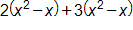
    Which of the following is equivalent to ?

    Correct answer: A

    Choice A is correct. Since is a common term in the original expression, like terms can be added: . Distributing the constant term 5 yields .Choice B is incorrect and may result from not distributing the -signs in the expressions within the parentheses. Choice C is incorrect and may result from not distributing the -signs in the expressions within the parentheses and from incorrectly eliminating the -term. Choice D is incorrect and may result from incorrectly eliminating the x-term.
  50. Question 50

    Which expression is equivalent to \(6 x Superscript 8 Baseline y ^2 + 12 x ^2 y ^2\)?

    Correct answer: C

    Choice C is correct. Since each term of the given expression has a common factor of \(6 x ^2 y ^2\), it may be rewritten as \(6 x ^2 y ^2(x Superscript 6 Baseline)+ 6 x ^2 y ^2(2)\), or \(6 x ^2 y ^2(x Superscript 6 Baseline + 2)\). Choice A is incorrect. This expression is equivalent to \(12 x Superscript 8 Baseline y ^2\), not \(6 x Superscript 8 Baseline y ^2 + 12 x ^2 y ^2\). Choice B is incorrect. This expression is equivalent to \(6 x Superscript 6 Baseline y ^2\), not \(6 x Superscript 8 Baseline y ^2 + 12 x ^2 y ^2\). Choice D is incorrect. This expression is equivalent to \(6 x Superscript 6 Baseline y ^2 + 12 x ^2 y ^2\), not \(6 x Superscript 8 Baseline y ^2 + 12 x ^2 y ^2\).
  51. Question 51

    If \(4 Superscript 8 c Baseline = RootIndex 3 √4 Superscript 7 Baseline\), what is the value of \(c\)?

    Correct answer: D

    The correct answer is \(7 20 fourths\). An expression of the form \(RootIndex n √a Superscript m Baseline\), where \(m\) and \(n\) are integers greater than \(1\) and \(a > or = 0\), is equivalent to \(a Superscript m/n\). Therefore, the expression on the right-hand side of the given equation, \(RootIndex 3 √4 Superscript 7 Baseline\), is equivalent to \(4 Superscript 7 thirds\). Thus, \(4 Superscript 8 c Baseline = 4 Superscript 7 thirds\). It follows that \(8 c = 7 thirds\). Dividing both sides of this equation by \(8\) yields \(c = 7 20 fourths\). Note that 7/24, .2916, .2917, 0.219, and 0.292 are examples of ways to enter a correct answer.
  52. Question 52

    Which expression is equivalent to \((7 x cubed + 7 x)-(6 x cubed -3 x)\)?

    Correct answer: A

    Choice A is correct. Applying the distributive property, the given expression can be written as \(7 x cubed + 7 x -6 x cubed + 3 x\). Grouπng like terms in this expression yields \((7 x cubed -6 x cubed)+(7 x + 3 x)\). Combining like terms in this expression yields \(x cubed + 10 x\). Choice B is incorrect and may result from conceptual or calculation errors. Choice C is incorrect and may result from conceptual or calculation errors. Choice D is incorrect and may result from conceptual or calculation errors.
  53. Question 53

    The expression is equivalent to for some constant a. What is the value of a ?

    Correct answer: D

    Choice D is correct. It’s given that is equivalent to for some constant a. Distributing the x over each term in the parentheses gives, which is in the same form as the first given expression, . The coefficient of the second term in is 7. Therefore, the value of a is 7.Choice A is incorrect. If the value of a were 2, then would be equivalent to, which isn’t equivalent to . Choice B is incorrect. If the value of a were 3, then would be equivalent to, which isn’t equivalent to . Choice C is incorrect. If the value of a were 4, then would be equivalent to, which isn’t equivalent to .
  54. Question 54

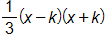
    The expression can be rewritten as, where k is a positive constant. What is the value of k ?

    Correct answer: D

    Choice D is correct. Factoring out the coefficient, the given expression can be rewritten as . The expression can be approached as a difference of squares and rewritten as . Therefore, k must be .Choice A is incorrect. If k were 2, then the expression given would be rewritten as, which is equivalent to, not .Choice B is incorrect. This may result from incorrectly factoring the expression and finding as the factored form of the expression. Choice C is incorrect. This may result from incorrectly distributing the and rewriting the expression as .
  55. Question 55

    Which of the following expressions is equivalent to, for ?

    Correct answer: D

    Choice D is correct. Since and, the fraction can be written as . It is given that, so the common factor is not equal to 0. Therefore, the fraction can be further simplified to .Choice A is incorrect. The expression is not equivalent to because at, as a value of 1 and has a value of 0.Choice B is incorrect and results from omitting the factor x in the factorization of . Choice C is incorrect and may result from incorrectly factoring as instead of .
  56. Question 56

    Which expression is a factor of \(2 x ^2 + 38 x + 10\)?

    Correct answer: A

    Choice A is correct. Since \(2\) is a common factor of each of the terms in the given expression, the expression can be rewritten as \(2(x ^2 + 19 x + 5)\). Therefore, the factors of the given expression are \(2\) and \(x ^2 + 19 x + 5\). Of these two factors, only \(2\) is listed as a choice. Choice B is incorrect and may result from conceptual or calculation errors. Choice C is incorrect. This is a term of the given expression, not a factor of the given expression. Choice D is incorrect. This is a term of the given expression, not a factor of the given expression.
  57. Question 57

    The expression \(4 x ^2 + b x -45\), where \(b\) is a constant, can be rewritten as \((h x + k)(x + j)\), where \(h\), \(k\), and \(j\) are integer constants. Which of the following must be an integer?

    Correct answer: D

    Choice D is correct. It's given that \(4 x ^2 + b x -45\) can be rewritten as \((h x + k)(x + j)\). The expression \((h x + k)(x + j)\) can be rewritten as \(h x ^2 + j h x + k x + k j\), or \(h x ^2 +(j h + k)x + k j\). Therefore, \(h x ^2 +(j h + k)x + k j\) is equivalent to \(4 x ^2 + b x -45\). It follows that \(k j = -45\). Dividing each side of this equation by \(k\) yields \(j = \ -45/k\). Since \(j\) is an integer, \(-45/k\) must be an integer. Therefore, \(45/k\) must also be an integer. Choice A is incorrect and may result from conceptual or calculation errors. Choice B is incorrect and may result from conceptual or calculation errors. Choice C is incorrect and may result from conceptual or calculation errors.
  58. Question 58

    The expression, where and, is equivalent to which of the following?

    Correct answer: D

    Choice D is correct. For and, and are equivalent to and, respectively. Also, and are equivalent to and, respectively. Therefore, the given expression can be rewritten as .Choices A, B, and C are incorrect because these choices are not equivalent to the given expression for and .For example, for and, the value of the given expression is ; the values of the choices, however, are,, and 1, respectively.
  59. Question 59

    Which expression is equivalent to \(42 a/k + 42 a k\), where \(k > 0\)?

    Correct answer: D

    Choice D is correct. Two fractions can be added together when they have a common denominator. Since \(k > 0\), multiplying the second term in the given expression by \(k/k\) yields \((42 a k)k/k\), which is equivalent to \(42 a k ^2/k\). Therefore, the expression \(42 a/k + 42 a k\) can be written as \(42 a/k + 42 a k ^2/k\) which is equivalent to \(42 a + 42 a k ^2/k\). Since each term in the numerator of this expression has a factor of \(42 a\), the expression \(42 a + 42 a k ^2/k\) can be rewritten as \(42 a(1)+ 42 a(k ^2)/k\), or \(42 a(1 + k ^2)/k\), which is equivalent to \(42 a(k ^2 + 1)/k\). Choice A is incorrect. This expression is equivalent to \(42 a/k + 42 a/k\). Choice B is incorrect and may result from conceptual or calculation errors. Choice C is incorrect. This expression is equivalent to \(42 a/k + 42 a\).
  60. Question 60

    Which expression is equivalent to ?

    Correct answer: A

    Choice A is correct. The given expression can be rewritten as . Combining like terms yields .Choices B, C, and D are incorrect and may be the result of errors when applying the distributive property.
  61. Question 61

    Which of the following expressions has a factor of \(x + 2 b\), where \(b\) is a positive integer constant?

    Correct answer: D

    Choice D is correct. Since each choice has a term of \(3 x ^2\), which can be written as \((3 x)(x)\), and each choice has a term of \(14 b\), which can be written as \((7)(2 b)\), the expression that has a factor of \(x + 2 b\), where \(b\) is a positive integer constant, can be represented as \((3 x + 7)(x + 2 b)\). Using the distributive property of multiplication, this expression is equivalent to \(3 x(x + 2 b)+ 7(x + 2 b)\), or \(3 x ^2 + 6 x b + 7 x + 14 b\). Combining the x-terms in this expression yields \(3 x ^2 +(7 + 6 b)x + 14 b\). It follows that the coefficient of the x-term is equal to \(7 + 6 b\). Thus, from the given choices, \(7 + 6 b\) must be equal to \(7\), \(28\), \(42\), or \(49\). Therefore, \(6 b\) must be equal to \(0\), \(21\), \(35\), or \(42\), respectively, and \(b\) must be equal to \(0/6\), \(21/6\), \(35/6\), or \(42/6\), respectively. Of these four values of \(b\), only \(42/6\), or \(7\), is a positive integer. It follows that \(7 + 6 b\) must be equal to \(49\) because this is the only choice for which the value of \(b\) is a positive integer constant. Therefore, the expression that has a factor of \(x + 2 b\) is \(3 x ^2 + 49 x + 14 b\). Choice A is incorrect. If this expression has a factor of \(x + 2 b\), then the value of \(b\) is \(0\), which isn't positive. Choice B is incorrect. If this expression has a factor of \(x + 2 b\), then the value of \(b\) is \(21/6\), which isn't an integer. Choice C is incorrect. If this expression has a factor of \(x + 2 b\), then the value of \(b\) is \(35/6\), which isn't an integer.
  62. Question 62

    The expression \(24/6 x + 42\) is equivalent to \(4/x + b\), where b is a constant and \(x > 0\). What is the value of b?

    Correct answer: A

    Choice A is correct. Since the given expressions are equivalent and the numerator of the second expression is \(1 sixth\) of the numerator of the first expression, the denominator of the second expression must also be \(1 sixth\) of the denominator of the first expression. By the distributive property, \(1 sixth(6 x + 42)\) is equivalent to \(1 sixth(6 x)+ 1 sixth(42)\), or \(x + 7\). Therefore, the value of \(b\) is \(7\). Choice B is incorrect and may result from conceptual or calculation errors. Choice C is incorrect and may result from conceptual or calculation errors. Choice D is incorrect and may result from conceptual or calculation errors.
  63. Question 63

    In the expression, p is a constant. This expression is equivalent to the expression . What is the value of p ?

    Correct answer: B

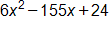
    Choice B is correct. Using the distributive property, the first given expression can be rewritten as 6x2 + 3px + 24 – 16px – 64x + 24, and then rewritten as 6x2 + (3p – 16p – 64)x + 24. Since the expression 6x2 + (3p – 16p – 64)x + 24 is equivalent to 6x2 – 155x + 24, the coefficients of the x terms from each expression are equivalent to each other; thus 3p – 16p – 64 = –155. Combining like terms gives –13p – 64 = –155. Adding 64 to both sides of the equation gives –13p = –71. Dividing both sides of the equation by –13 yields p = 7.Choice A is incorrect. If p = –3, then the first expression would be equivalent to 6x2 – 25x + 24. Choice C is incorrect. If p = 13, then the first expression would be equivalent to 6x2 – 233x + 24. Choice D is incorrect. If p = 155, then the first expression would be equivalent to 6x2 – 2,079x + 24.
  64. Question 64

    Which of the following is equivalent to the expression above?

    Correct answer: B

    Choice B is correct. The given quadratic expression is in standard form, and each answer choice is in vertex form. Completing the square converts the expression from standard form to vertex form. The first step is to rewrite the expression as follows: . The first three terms of the revised expression can be rewritten as a perfect square as follows: . Combining the constant terms gives .Choice A is incorrect. Squaring the binomial and simplifying the expression in choice A gives . Combining like terms gives, not . Choice C is incorrect. Squaring the binomial and simplifying the expression in choice C gives . Combining like terms gives, not . Choice D is incorrect. Squaring the binomial and simplifying the expression in choice D gives . Combining like terms gives, not .
  65. Question 65

    \(0.36 x ^2 + 0.63 x + 1.17\) The given expression can be rewritten as \(a(4 x ^2 + 7 x + 13)\), where \(a\) is a constant. What is the value of \(a\)?

    Correct answer: C

    The correct answer is \(.09\). It's given that the expression \(0.36 x ^2 + 0.63 x + 1.17\) can be rewritten as \(a(4 x ^2 + 7 x + 13)\). Applying the distributive property to the expression \(a(4 x ^2 + 7 x + 13)\) yields \(4 a x ^2 + 7 a x + 13 a\). Therefore, \(0.36 x ^2 + 0.63 x + 1.17\) can be rewritten as \(4 a x ^2 + 7 a x + 13 a\). It follows that in the expressions \(0.36 x ^2 + 0.63 x + 1.17\) and \(4 a x ^2 + 7 a x + 13 a\), the coefficients of \(x ^2\) are equivalent, the coefficients of \(x\) are equivalent, and the constant terms are equivalent. Therefore, \(0.36 = 4 a\), \(0.63 = 7 a\), and \(1.17 = 13 a\). Solving any of these equations for \(a\) yields the value of \(a\). Dividing both sides of the equation \(0.36 = 4 a\) by \(4\) yields \(0.09 = a\). Therefore, the value of \(a\) is \(0.09\). Note that .09 and 9/100 are examples of ways to enter a correct answer.
  66. Question 66

    Which expression is equivalent to \(19(x ^2 -7)\)?

    Correct answer: A

    Choice A is correct. The expression \(19(x ^2 -7)\) can be rewritten as \(19(x ^2)-19(7)\), which is equivalent to \(19 x ^2 -133\). Choice B is incorrect and may result from conceptual or calculation errors. Choice C is incorrect and may result from conceptual or calculation errors. Choice D is incorrect and may result from conceptual or calculation errors.
  67. Question 67

    Which expression is equivalent to \(23 x cubed + 2 x ^2 + 9 x\)?

    Correct answer: C

    Choice C is correct. Since \(x\) is a common factor of each term in the given expression, the given expression can be rewritten as \(x(23 x ^2 + 2 x + 9)\). Choice A is incorrect. This expression is equivalent to \(23 x cubed + 46 x ^2 + 207 x\). Choice B is incorrect. This expression is equivalent to \(207 x Superscript 4 + 18 x cubed + 9 x\). Choice D is incorrect. This expression is equivalent to \(34 x cubed + 34 x ^2 + 34 x\).
  68. Question 68

    If, which of the following expressions is equivalent to ?

    Correct answer: D

    Choice D is correct. Taking the square root of an exponential expression halves the exponent, so, which further reduces to . This can be rewritten as .Choice A is incorrect and may result from neglecting the denominator of the given expression and from incorrectly calculating the square root of 16. Choice B is incorrect and may result from rewriting as rather than . Choice C is incorrect and may result from taking the square root of the variables in the numerator twice instead of once.
  69. Question 69

    If and, which of the following is equal to ?

    Correct answer: B

    Choice B is correct. It’s given that and . Using the distributive property, the expression can be rewritten as . Substituting and for and, respectively, in this expression yields . Expanding this expression yields . Combining like terms, this expression can be rewritten as .Choices A, C, and D are incorrect and may result from an error in using the distributive property, substituting, or combining like terms.
  70. Question 70

    Which expression is equivalent to \((d -6)(8 d ^2 -3)\)?

    Correct answer: C

    Choice C is correct. Applying the distributive property to the given expression yields \(d(8 d ^2 -3)-6(8 d ^2 -3)\). Applying the distributive property once again to this expression yields \((d)(8 d ^2)+(d)(-3)+(-6)(8 d ^2)+(-6)(-3)\), or \(8 d cubed +(-3 d)+(-48 d ^2)+ 18\). This expression can be rewritten as \(8 d cubed -48 d ^2 -3 d + 18\). Thus, \((d -6)(8 d ^2 -3)\) is equivalent to \(8 d cubed -48 d ^2 -3 d + 18\). Choice A is incorrect and may result from conceptual or calculation errors. Choice B is incorrect and may result from conceptual or calculation errors. Choice D is incorrect and may result from conceptual or calculation errors.
  71. Question 71

    Which of the following expressions is equivalent to the expression above?

    Correct answer: B

    Choice B is correct. One of the properties of radicals is . Thus, the given expression can be rewritten as . Simplifying by taking the cube root of each part gives x1 ⋅ y2, or xy2.Choices A, C, and D are incorrect and may be the result of incorrect application of the properties of exponents and radicals.
  72. Question 72

    \(g(x)= 3 fifths x + 7 sixths\) \(h(x)= 6 x -5\) The functions \(g\) and \(h\) are defined by the equations shown. Which expression is equivalent to \(g(x)dot h(x)\)?

    Correct answer: D

    Choice D is correct. It’s given that \(g(x)= 3 fifths x + 7 sixths\) and \(h(x)= 6 x -5\). Substituting \(3 fifths x + 7 sixths\) for \(g(x)\) and \(6 x -5\) for \(h(x)\) in the expression \(g(x)dot h(x)\) yields \((3 fifths x + 7 sixths)(6 x -5)\). This expression can be rewritten as \(3 fifths x(6 x -5)+ 7 sixths(6 x -5)\), or \(18 x ^2/5 -3 x + 7 x -35/6\), which is equivalent to \(18 x ^2/5 + 4 x -35/6\). Choice A is incorrect. This expression is equivalent to \(3 fifths x(6 x)+ 7 sixths(-5)\), not \((3 fifths x + 7 sixths)(6 x -5)\). Choice B is incorrect and may result from conceptual or calculation errors. Choice C is incorrect. This expression is equivalent to \((3 fifths x -7 sixths)(6 x + 5)\), not \((3 fifths x + 7 sixths)(6 x -5)\).
  73. Question 73

    In the expression above, b and c are positive integers. If the expression is equivalent to and, which of the following could be the value of c ?

    Correct answer: A

    Choice A is correct. If the given expression is equivalent to, then, where x isn’t equal to b. Multiplying both sides of this equation by yields . Since the right-hand side of this equation is in factored form for the difference of squares, the value of c must be a perfect square. Only choice A gives a perfect square for the value of c.Choices B, C, and D are incorrect. None of these values of c produces a difference of squares. For example, when 6 is substituted for c in the given expression, the result is . The expression can’t be factored with integer values, and therefore isn’t equivalent to .
  74. Question 74

    Which of the following is equivalent to ?

    Correct answer: C

    Choice C is correct. Using the distributive property to multiply 3 and gives, which can be rewritten as .Choice A is incorrect and may result from rewriting the given expression as . Choice B is incorrect and may result from incorrectly rewriting the expression as . Choice D is incorrect and may result from incorrectly rewriting the expression as .
  75. Question 75

    Which expression is equivalent to \(4/4 x -5 -1/x + 1\)?

    Correct answer: D

    Choice D is correct. The expression \(4/4 x -5 -1/x + 1\) can be rewritten as \(4/4 x -5 + (-1)/x + 1\). To add the two terms of this expression, the terms can be rewritten with a common denominator. Since \(x + 1/x + 1 = 1\), the expression \(4/4 x -5\) can be rewritten as \((x + 1)(4)/(x + 1)(4 x -5)\). Since \(4 x -5/4 x -5 = 1\), the expression \(\ -1/x + 1\) can be rewritten as \((4 x -5)(-1)/(4 x -5)(x + 1)\). Therefore, the expression \(4/4 x -5 + (-1)/x + 1\) can be rewritten as \((x + 1)(4)/(x + 1)(4 x -5) + (4 x -5)(-1)/(4 x -5)(x + 1)\), which is equivalent to \((x + 1)(4)+(4 x -5)(-1)/(x + 1)(4 x -5)\). Applying the distributive property to each term of the numerator yields \((4 x + 4)+(-4 x + 5)/(x + 1)(4 x -5)\), or \((4 x +(-4 x))+(4 + 5)/(x + 1)(4 x -5)\). Adding like terms in the numerator yields \(9/(x + 1)(4 x -5)\). Choice A is incorrect and may result from conceptual or calculation errors. Choice B is incorrect and may result from conceptual or calculation errors. Choice C is incorrect and may result from conceptual or calculation errors.
  76. Question 76

    Which expression is equivalent to \(20 w -(4 w + 3 w)\)?

    Correct answer: B

    Choice B is correct. Combining like terms inside the parentheses of the given expression, \(20 w -(4 w + 3 w)\), yields \(20 w -(7 w)\). Combining like terms in this resulting expression yields \(13 w\). Choice A is incorrect and may result from conceptual or calculation errors. Choice C is incorrect and may result from conceptual or calculation errors. Choice D is incorrect and may result from conceptual or calculation errors.
  77. Question 77

    The expression \((3 x -23)(19 x + 6)\) is equivalent to the expression \(a x ^2 + b x + c\), where \(a\), \(b\), and \(c\) are constants. What is the value of \(b\)?

    Correct answer: C

    The correct answer is \(-419\). It's given that the expression \((3 x -23)(19 x + 6)\) is equivalent to the expression \(a x ^2 + b x + c\), where \(a\), \(b\), and \(c\) are constants. Applying the distributive property to the given expression, \((3 x -23)(19 x + 6)\), yields \((3 x)(19 x)+(3 x)(6)-(23)(19 x)-(23)(6)\), which can be rewritten as \(57 x ^2 + 18 x -437 x -138\). Combining like terms yields \(57 x ^2 -419 x -138\). Since this expression is equivalent to \(a x ^2 + b x + c\), it follows that the value of \(b\) is \(-419\).
  78. Question 78

    Which expression is equivalent to \(50 x ^2 + 5 x ^2\)?

    Correct answer: D

    Choice D is correct. The given expression shows addition of two like terms. Therefore, the given expression is equivalent to \((50 + 5)x ^2\), or \(55 x ^2\). Choice A is incorrect. This expression is equivalent to \((50)(5)x ^2\), not \((50 + 5)x ^2\). Choice B is incorrect. This expression is equivalent to \((50/5)x ^2\), not \((50 + 5)x ^2\). Choice C is incorrect. This expression is equivalent to \((50 -5)x ^2\), not \((50 + 5)x ^2\).
  79. Question 79

    Which expression is equivalent to \(11 x cubed -5 x cubed\)?

    Correct answer: B

    Choice B is correct. The given expression can be rewritten as \(11 x cubed +(-5)x cubed\). Since the two terms of this expression are both constant multiples of \(x cubed\), they are like terms and can, therefore, be combined through addition. Adding like terms in the expression \(11 x cubed +(-5)x cubed\) yields \(6 x cubed\). Choice A is incorrect. This is equivalent to \(11 x cubed + 5 x cubed\), not \(11 x cubed -5 x cubed\). Choice C is incorrect. This is equivalent to \(11 x Superscript 6 -5 x Superscript 6\), not \(11 x cubed -5 x cubed\). Choice D is incorrect. This is equivalent to \(11 x Superscript 6 + 5 x Superscript 6\), not \(11 x cubed -5 x cubed\).
  80. Question 80

    \(RootIndex 5 √70 n (RootIndex 6 √70 n )^2\) For what value of \(x\) is the given expression equivalent to \((70 n)Superscript 30 x\), where \(n > 1\)?

    Correct answer: D

    The correct answer is \(4/225\). An expression of the form \(RootIndex k √a\), where \(k\) is an integer greater than \(1\) and \(a > or = 0\), is equivalent to \(a Superscript 1/k\). Therefore, the given expression, where \(n > 1\), is equivalent to \((70 n)Superscript 1 fifth Baseline((70 n)Superscript 1 sixth Baseline)^2\). Applying properties of exponents, this expression can be rewritten as \((70 n)Superscript 1 fifth Baseline(70 n)Superscript 1 sixth dot 2\), or \((70 n)Superscript 1 fifth Baseline(70 n)Superscript 1 third\), which can be rewritten as \((70 n)Superscript 1 fifth + 1 third\), or \((70 n)Superscript 8 fifteenths\). It's given that the expression \(RootIndex 5 √70 n (RootIndex 6 √70 n )^2\) is equivalent to \((70 n)Superscript 30 x\), where \(n > 1\). It follows that \((70 n)Superscript 8 fifteenths\) is equivalent to \((70 n)Superscript 30 x\). Therefore, \(8 fifteenths = 30 x\). Dividing both sides of this equation by \(30\) yields \(8/450 = x\), or \(4/225 = x\). Thus, the value of \(x\) for which the given expression is equivalent to \((70 n)Superscript 30 x\), where \(n > 1\), is \(4/225\). Note that 4/225, .0177, .0178, 0.017, and 0.018 are examples of ways to enter a correct answer.
  81. Question 81

    Which expression is equivalent to \((8 y z)(y)(7 z)\)?

    Correct answer: A

    Choice A is correct. The given expression can be rewritten as \((8 dot 7)(y dot y)(z dot z)\), which is equivalent to \((56)(y ^2)(z ^2)\), or \(56 y ^2 z ^2\). Choice B is incorrect. This expression is equivalent to \((8 y z)(y)(7)\). Choice C is incorrect. This expression is equivalent to \((8 z)(y)(7)\). Choice D is incorrect and may result from conceptual or calculation errors.
  82. Question 82

    Which of the following is an equivalent form of ?

    Correct answer: C

    Choice C is correct. The first expression can be rewritten as . Applying the distributive property to this product yields . This difference can be rewritten as . Distributing the factor of through the second expression yields . Regrouπng like terms, the expression becomes . Combining like terms yields .Choices A, B, and D are incorrect and likely result from errors made when applying the distributive property or combining the resulting like terms.
  83. Question 83

    The equation above is true for all, where r and t are positive constants. What is the value of rt ?

    Correct answer: C

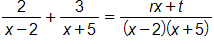
    Choice C is correct. To express the sum of the two rational expressions on the left-hand side of the equation as the single rational expression on the right-hand side of the equation, the expressions on the left-hand side must have the same denominator. Multiplying the first expression by results in, and multiplying the second expression by results in, so the given equation can be rewritten as, or . Since the two rational expressions on the left-hand side of the equation have the same denominator as the rational expression on the right-hand side of the equation, it follows that . Combining like terms on the left-hand side yields, so it follows that and . Therefore, the value of is .Choice A is incorrect and may result from an error when determining the sign of either r or t. Choice B is incorrect and may result from not distributing the 2 and 3 to their respective terms in . Choice D is incorrect and may result from a calculation error.
  84. Question 84

    The expression \(90 y Superscript 5 -54 y Superscript 4\) is equivalent to \(r y Superscript 4 Baseline(15 y -9)\), where \(r\) is a constant. What is the value of \(r\)?

    Correct answer: C

    The correct answer is \(6\). Applying the distributive property to the expression \(r y Superscript 4 Baseline(15 y -9)\) yields \(15 r y Superscript 5 -9 r y Superscript 4\). Since \(90 y Superscript 5 -54 y Superscript 4\) is equivalent to \(r y Superscript 4 Baseline(15 y -9)\), it follows that \(90 y Superscript 5 -54 y Superscript 4\) is also equivalent to \(15 r y Superscript 5 -9 r y Superscript 4\). Since these expressions are equivalent, it follows that corresponding coefficients are equivalent. Therefore, \(90 = 15 r\) and \(-54 = -9 r\). Solving either of these equations for \(r\) will yield the value of \(r\). Dividing both sides of \(90 = 15 r\) by \(15\) yields \(6 = r\). Therefore, the value of \(r\) is \(6\).
  85. Question 85

    Which of the following expressions is equivalent to \(8 x Superscript 10 -8 x Superscript 9 + 88 x\)?

    Correct answer: D

    Choice D is correct. Since \(8 x\) is a common factor of each term in the given expression, the expression can be rewritten as \(8 x(x Superscript 9 Baseline -x Superscript 8 Baseline + 11)\). Choice A is incorrect. This expression is equivalent to \(7 x Superscript 11 -7 x Superscript 10 + 87 x ^2\). Choice B is incorrect. This expression is equivalent to \(8 Superscript 10 Baseline x -8 Superscript 9 Baseline x + 88 x\). Choice C is incorrect. This expression is equivalent to \(8 x Superscript 11 -8 x Superscript 10 + 88 x ^2\).
  86. Question 86

    If for all positive values of x, what is the value of ?

    Correct answer: D

    The correct answer is . The value of can be found by first rewriting the left-hand side of the given equation as . Using the properties of exponents, this expression can be rewritten as . This expression can be rewritten by subtracting the fractions in the exponent, which yields . Thus, is . Note that 7/6, 1.166, and 1.167 are examples of ways to enter a correct answer.
  87. Question 87

    Which of the following expressions is(are) a factor of \(3 x ^2 + 20 x -63\)? \(x -9\) \(3 x -7\)

    Correct answer: B

    Choice B is correct. The given expression can be factored by first finding two values whose sum is \(20\) and whose product is \(3(-63)\), or \(-189\). Those two values are \(27\) and \(-7\). It follows that the given expression can be rewritten as \(3 x ^2 + 27 x -7 x -63\). Since the first two terms of this expression have a common factor of \(3 x\) and the last two terms of this expression have a common factor of \(-7\), this expression can be rewritten as \(3 x(x + 9)-7(x + 9)\). Since the two terms of this expression have a common factor of \((x + 9)\), it can be rewritten as \((3 x -7)(x + 9)\). Therefore, expression II, \(3 x -7\), is a factor of \(3 x ^2 + 20 x -63\), but expression I, \(x -9\), is not a factor of \(3 x ^2 + 20 x -63\). Choice A is incorrect and may result from conceptual or calculation errors. Choice C is incorrect and may result from conceptual or calculation errors. Choice D is incorrect and may result from conceptual or calculation errors.
  88. Question 88

    Which of the following expressions is equivalent to ?

    Correct answer: C

    Choice C is correct. The expression can be written as a difference of squares x2 – y2, which can be factored as (x + y)(x – y). Here, y2 = 5, so, and the expression therefore factors as .Choices A and B are incorrect and may result from misunderstanding how to factor a difference of squares. Choice D is incorrect; (x + 5)(x – 1) can be rewritten as x2 + 4x – 5, which is not equivalent to the original expression.
  89. Question 89

    The equation above is true for all x, where a and b are constants. What is the value of ab ?

    Correct answer: C

    Choice C is correct. If the equation is true for all x, then the expressions on both sides of the equation will be equivalent. Multiplying the polynomials on the left-hand side of the equation gives . On the right-hand side of the equation, the only -term is . Since the expressions on both sides of the equation are equivalent, it follows that, which can be rewritten as . Therefore,, which gives .Choice A is incorrect. If, then the coefficient of on the left-hand side of the equation would be, which doesn’t equal the coefficient of,, on the right-hand side. Choice B is incorrect. If, then the coefficient of on the left-hand side of the equation would be, which doesn’t equal the coefficient of,, on the right-hand side. Choice D is incorrect. If, then the coefficient of on the left-hand side of the equation would be, which doesn’t equal the coefficient of,, on the right-hand side.
  90. Question 90

    Which of the following is equivalent to the expression above?

    Correct answer: A

    Choice A is correct. The given expression can be rewritten as . Applying the distributive property, the expression can be rewritten as, or . Adding like terms yields . Substituting for in the given expression yields . By the rules of exponents, the expression is equivalent to . Applying the distributive property, this expression can be rewritten as, or . Adding like terms gives . Substituting for in the rewritten expression yields, and adding like terms yields .Choices B, C, and D are incorrect. Choices C and D may result from rewriting the expression as, instead of as . Choices B and C may result from rewriting the expression as, instead of .
  91. Question 91

    Which of the following is equivalent to the expression ?

    Correct answer: B

    Choice B is correct. The term x4 can be factored as . Factoring –6 as yields values that add to –1, the coefficient of x2 in the expression.Choices A, C, and D are incorrect and may result from finding factors of –6 that don’t add to the coefficient of x2 in the original expression.
  92. Question 92

    Which expression is equivalent to \((9 x cubed + 5 x + 7)+(6 x cubed + 5 x ^2 -5)\)?

    Correct answer: D

    Choice D is correct. The given expression can be rewritten as \((9 x cubed + 6 x cubed)+ 5 x ^2 + 5 x +(7 -5)\). Combining like terms in this expression yields \(15 x cubed + 5 x ^2 + 5 x + 2\). Choice A is incorrect and may result from conceptual or calculation errors. Choice B is incorrect and may result from conceptual or calculation errors. Choice C is incorrect and may result from conceptual or calculation errors.
  93. Question 93

    Which expression is equivalent to \(8 x(x -7)-3(x -7)/2 x -14\), where \(x > 7\)?

    Correct answer: B

    Choice B is correct. The given expression has a common factor of \(2\) in the denominator, so the expression can be rewritten as \(8 x(x -7)-3(x -7)/2(x -7)\). The three terms in this expression have a common factor of \((x -7)\). Since it's given that \(x > 7\), \(x\) can't be equal to \(7\), which means \((x -7)\) can't be equal to \(0\). Therefore, each term in the expression, \(8 x(x -7)-3(x -7)/2(x -7)\), can be divided by \((x -7)\), which gives \(8 x -3/2\). Choice A is incorrect and may result from conceptual or calculation errors. Choice C is incorrect and may result from conceptual or calculation errors. Choice D is incorrect and may result from conceptual or calculation errors.
  94. Question 94

    Which of the following is equivalent to the given expression?

    Correct answer: B

    Choice B is correct. Using the associative and commutative properties of addition, the given expression can be rewritten as . Adding these like terms results in .Choice A is incorrect and may result from adding . Choice C is incorrect and may result from adding . Choice D is incorrect and may result from adding .
  95. Question 95

    If and, which of the following is equivalent to ?

    Correct answer: B

    Choice B is correct. It’s given that and . Substituting the values for p and v into the expression yields . Multiplying the terms yields . Using the distributive property to rewrite yields . Therefore, the entire expression can be represented as . Combining like terms yields .Choice A is incorrect and may result from subtracting, instead of adding, the term . Choice C is incorrect. This is the result of multiplying the terms . Choice D is incorrect and may result from distributing 2, instead of, to the term .
  96. Question 96

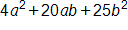
    Which of the following is a factor of the polynomial above?

    Correct answer: B

    Choice B is correct. The first and last terms of the polynomial are both squares such that and . The second term is twice the product of the square root of the first and last terms: . Therefore, the polynomial is the square of a binomial such that, and is a factor.Choice A is incorrect and may be the result of incorrectly factoring the polynomial. Choice C is incorrect and may be the result of dividing the second and third terms of the polynomial by their greatest common factor. Choice D is incorrect and may be the result of not factoring the coefficients.
  97. Question 97

    Which expression is equivalent to \(16 x cubed y ^2 + 14 x y\)?

    Correct answer: B

    Choice B is correct. Since \(2 x y\) is a common factor of each term in the given expression, the expression can be rewritten as \(2 x y(8 x ^2 y + 7)\). Choice A is incorrect. This expression is equivalent to \(16 x ^2 y ^2 + 14 x y\). Choice C is incorrect. This expression is equivalent to \(28 x cubed y ^2 + 14 x y\). Choice D is incorrect. This expression is equivalent to \(112 x cubed y ^2 + 14 x y\).
  98. Question 98

    Which expression is equivalent to \((m Superscript 4 Baseline q Superscript 4 Baseline z Superscript -1 Baseline)(m q Superscript 5 Baseline z cubed)\), where \(m\), \(q\), and \(z\) are positive?

    Correct answer: B

    Choice B is correct. Applying the commutative property of multiplication, the expression \((m Superscript 4 Baseline q Superscript 4 Baseline z Superscript -1 Baseline)(m q Superscript 5 Baseline z cubed)\) can be rewritten as \((m Superscript 4 Baseline m)(q Superscript 4 Baseline q Superscript 5 Baseline)(z Superscript -1 Baseline z cubed)\). For positive values of \(x\), \((x Superscript a Baseline)(x Superscript b Baseline)= x Superscript a + b\). Therefore, the expression \((m Superscript 4 Baseline m)(q Superscript 4 Baseline q Superscript 5 Baseline)(z Superscript -1 Baseline z cubed)\) can be rewritten as \((m Superscript 4 + 1 Baseline)(q Superscript 4 + 5 Baseline)(z Superscript -1 + 3 Baseline)\), or \(m Superscript 5 Baseline q Superscript 9 Baseline z ^2\). Choice A is incorrect and may result from multiplying, not adding, the exponents. Choice C is incorrect and may result from conceptual or calculation errors. Choice D is incorrect and may result from conceptual or calculation errors.

About this practice test

This quiz contains question of 3 different levels - Easy, Medium, Hard.

Want a higher score?

One-on-one tutoring for SAT, online or in person, with a plan built around the questions you missed.

Get Started

Book Your Free Session

5.0
from 38 Google reviews

Call or Text 1 (888) 356-0607