Skip to content

SAT practice test

SAT Full Math Practice Test 30 Questions

  • 44 questions
  • Untimed
  • Answers and explanations
Embed on your site
  • 44 questions
  • No time limit
  • Every answer explained at the end
  1. Question 1

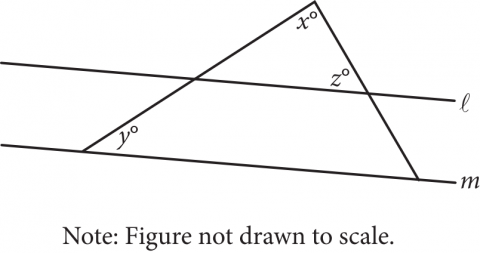
    In the figure above, lines and m are parallel,, and . What is the value of x ?

    Correct answer: B

    Choice B is correct. Let the measure of the third angle in the smaller triangle be . Since lines and m are parallel and cut by transversals, it follows that the corresponding angles formed are congruent. So . The sum of the measures of the interior angles of a triangle is, which for the interior angles in the smaller triangle yields . Given that and, it follows that . Solving for x gives, or .Choice A is incorrect and may result from incorrectly assuming that angles . Choice C is incorrect and may result from incorrectly assuming that the smaller triangle is a right triangle, with x as the right angle. Choice D is incorrect and may result from a misunderstanding of the exterior angle theorem and incorrectly assuming that .
  2. Question 2

    If \(2 x + 3 = 9\), what is the value of \(6 x -1\)?

    Correct answer: A

    The correct answer is \(17\). It’s given that \(2 x + 3 = 9\). Multiplying each side of this equation by \(3\) yields \(3(2 x + 3)= 3(9)\), or \(6 x + 9 = 27\). Subtracting \(10\) from each side of this equation yields \(6 x + 9 -10 = 27 -10\), or \(6 x -1 = 17\). Therefore, the value of \(6 x -1\) is \(17\).
  3. Question 3

    Hector used a tool called an auger to remove corn from a storage bin at a constant rate. The bin contained 24,000 bushels of corn when Hector began to use the auger. After 5 hours of using the auger, 19,350 bushels of corn remained in the bin. If the auger continues to remove corn at this rate, what is the total number of hours Hector will have been using the auger when 12,840 bushels of corn remain in the bin?

    Correct answer: D

    Choice D is correct. After using the auger for 5 hours, Hector had removed 24,000 – 19,350 = 4,650 bushels of corn from the storage bin. During the 5-hour period, the auger removed corn from the bin at a constant rate of bushels per hour. Assuming the auger continues to remove corn at this rate, after x hours it will have removed 930x bushels of corn. Because the bin contained 24,000 bushels of corn when Hector started using the auger, the equation 24,000 – 930x = 12,840 can be used to find the number of hours, x, Hector will have been using the auger when 12,840 bushels of corn remain in the bin. Subtracting 12,840 from both sides of this equation and adding 930x to both sides of the equation yields 11,160 = 930x. Dividing both sides of this equation by 930 yields x = 12. Therefore, Hector will have been using the auger for 12 hours when 12,840 bushels of corn remain in the storage bin. Choice A is incorrect. Three hours after Hector began using the auger, 24,000 – 3(930) = 21,210 bushels of corn remained, not 12,840. Choice B is incorrect. Seven hours after Hector began using the auger, 24,000 – 7(930) = 17,490 bushels of corn will remain, not 12,840. Choice C is incorrect. Eight hours after Hector began using the auger, 24,000 – 8(930) = 16,560 bushels of corn will remain, not 12,840.
  4. Question 4

    \(3(k x + 13)= 48/17 x + 36\) In the given equation, \(k\) is a constant. The equation has no solution. What is the value of \(k\)?

    Correct answer: D

    The correct answer is \(16/17\). It's given that the equation \(3(k x + 13)= 48/17 x + 36\) has no solution. A linear equation in the form \(a x + b = c x + d\), where \(a\), \(b\), \(c\), and \(d\) are constants, has no solution only when the coefficients of \(x\) on each side of the equation are equal and the constant terms aren't equal. Dividing both sides of the given equation by \(3\) yields \(k x + 13 = 48/51 x + 36/3\), or \(k x + 13 = 16/17 x + 12\). Since the coefficients of \(x\) on each side of the equation must be equal, it follows that the value of \(k\) is \(16/17\). Note that 16/17, .9411, .9412, and 0.941 are examples of ways to enter a correct answer.
  5. Question 5

    In the equation above, what is the value of x ?

    Correct answer: A

    Choice A is correct. Multiplying both sides of the equation by 5 results in . Dividing both sides of the resulting equation by 4 results in .Choice B is incorrect and may result from adding 20 and 4. Choice C is incorrect and may result from dividing 20 by 5 and then multiplying the result by 4. Choice D is incorrect and may result from subtracting 5 from 20.
  6. Question 6

    How many solutions does the equation \(10(15 x -9)= -15(6 -10 x)\) have?

    Correct answer: C

    Choice C is correct. Applying the distributive property to each side of the given equation yields \(150 x -90 = -90 + 150 x\). Applying the commutative property of addition to the right-hand side of this equation yields \(150 x -90 = 150 x -90\). Since the two sides of the equation are equivalent, this equation is true for any value of \(x\). Therefore, the given equation has infinitely many solutions. Choice A is incorrect and may result from conceptual or calculation errors. Choice B is incorrect and may result from conceptual or calculation errors. Choice D is incorrect and may result from conceptual or calculation errors.
  7. Question 7

    In the given equation, b is a constant. If the equation has no solution, what is the value of b ?

    Correct answer: A

    Choice A is correct. This equation has no solution when there is no value of x that produces a true statement. Solving the given equation for x by dividing both sides by gives . When, the right-hand side of this equation will be undefined, and the equation will have no solution. Therefore, when, there is no value of x that satisfies the given equation.Choices B, C, and D are incorrect. Substituting 4, 6, and 10 for b in the given equation yields exactly one solution, rather than no solution, for x. For example, substituting 4 for b in the given equation yields, or . Dividing both sides of by 2 yields . Similarly, if or, and, respectively.
  8. Question 8

    If \(3 x = 30\), what is the value of \(3 x -12\)?

    Correct answer: B

    Choice B is correct. Subtracting \(12\) from each side of the given equation yields \(3 x -12 = 30 -12\), or \(3 x -12 = 18\). Therefore, the value of \(3 x -12\) is \(18\). Choice A is incorrect. This is the value of \(x -12\), not \(3 x -12\). Choice C is incorrect. This is the value of \(x + 12\), not \(3 x -12\). Choice D is incorrect. This is the value of \(3 x + 12\), not \(3 x -12\).
  9. Question 9

    The perimeter of an isosceles triangle is \(83\) inches. Each of the two congruent sides of the triangle has a length of \(24\) inches. What is the length, in inches, of the third side?

    Correct answer: C

    The correct answer is \(35\). It’s given that the perimeter of an isosceles triangle is \(83\) inches and that each of the two congruent sides has a length of \(24\) inches. The perimeter of a triangle is the sum of the lengths of its three sides. The equation \(24 + 24 + x = 83\) can be used to represent this situation, where \(x\) is the length, in inches, of the third side. Combining like terms on the left-hand side of this equation yields \(48 + x = 83\). Subtracting \(48\) from both sides of this equation yields \(x = 35\). Therefore, the length, in inches, of the third side is \(35\).
  10. Question 10

    If \(x/8 = 5\), what is the value of \(8/x\)?

    Correct answer: A

    The correct answer is \(1 fifth\). Since the number \(5\) can also be written as \(5 oneths\), the given equation can also be written as \(x/8 = 5 oneths\). This equation is equivalent to \(8/x = 1 fifth\). Therefore, the value of \(8/x\) is \(1 fifth\). Note that 1/5 and .2 are examples of ways to enter a correct answer. Alternate approach: Multiplying both sides of the equation \(x/8 = 5\) by \(8\) yields \(x = 40\). Substituting \(40\) for \(x\) into the expression \(8/x\) yields \(8 fortieths\), or \(1 fifth\).
  11. Question 11

    \(2 x + 16 = a(x + 8)\) In the given equation, \(a\) is a constant. If the equation has infinitely many solutions, what is the value of \(a\)?

    Correct answer: B

    The correct answer is \(2\). An equation with one variable, \(x\), has infinitely many solutions only when both sides of the equation are equal for any defined value of \(x\). It's given that \(2 x + 16 = a(x + 8)\), where \(a\) is a constant. This equation can be rewritten as \(2(x + 8)= a(x + 8)\). If this equation has infinitely many solutions, then both sides of this equation are equal for any defined value of \(x\). Both sides of this equation are equal for any defined value of \(x\) when \(2 = a\). Therefore, if the equation has infinitely many solutions, the value of \(a\) is \(2\). Alternate approach: If the given equation, \(2 x + 16 = a(x + 8)\), has infinitely many solutions, then both sides of this equation are equal for any value of \(x\). If \(x = 0\), then substituting \(0\) for \(x\) in \(2 x + 16 = a(x + 8)\) yields \(2(0)+ 16 = a(0 + 8)\), or \(16 = 8 a\). Dividing both sides of this equation by \(8\) yields \(2 = a\).
  12. Question 12

    The length of each edge of a box is \(2\) inches. Each side of the box is in the shape of a square. The box does not have a lid. What is the exterior surface area, in square inches, of this box without a lid?

    Correct answer: B

    The correct answer is \(4,205\). The exterior surface area of a figure is the sum of the areas of all its faces. It's given that the box does not have a lid and that each side of the box is in the shape of a square. Therefore, the box consists of \(5\) congruent square faces. It's also given that the length of each edge is \(29\) inches. Let \(s\) represent the length of an edge of a square. It follows that the area of a square is equal to \(s ^2\). Therefore, the area of each of the \(5\) square faces is equal to \(29 ^2\), or \(841\), square inches. Since the box consists of \(5\) congruent square faces, it follows that the sum of the areas of all its faces, or the exterior surface area of this box without a lid, is \(5(841)\), or \(4,205\), square inches.
  13. Question 13

    A right circular cylinder has a volume of \(45π\). If the height of the cylinder is 5, what is the radius of the cylinder?

    Correct answer: A

    Choice A is correct. The volume of a right circular cylinder with a radius of r is the product of the area of the base,, and the height, h. The volume of the right circular cylinder described is and its height is 5. If the radius is r, it follows that . Dividing both sides of this equation by yields . Taking the square root of both sides yields or . Since r represents the radius, the value must be positive. Therefore, the radius is 3.Choice B is incorrect and may result from finding that the square of the radius is 9, but then from dividing 9 by 2, rather than taking the square root of 9. Choice C is incorrect. This represents the square of the radius. Choice D is incorrect and may result from solving the equation for, not r, by dividing by on both sides and then by subtracting, not dividing, 5 from both sides.
  14. Question 14

    Square A has side lengths that are \(166\) times the side lengths of square B. The area of square A is \(k\) times the area of square B. What is the value of \(k\)?

    Correct answer: A

    The correct answer is \(27,556\). The area of a square is \(s ^2\), where \(s\) is the side length of the square. Let \(x\) represent the length of each side of square B. Substituting \(x\) for \(s\) in \(s ^2\) yields \(x ^2\). It follows that the area of square B is \(x ^2\). It’s given that square A has side lengths that are \(166\) times the side lengths of square B. Since \(x\) represents the length of each side of square B, the length of each side of square A can be represented by the expression \(166 x\). It follows that the area of square A is \((166 x)^2\), or \(27,556 x ^2\). It’s given that the area of square A is \(k\) times the area of square B. Since the area of square A is equal to \(27,556 x ^2\), and the area of square B is equal to \(x ^2\), an equation representing the given statement is \(27,556 x ^2 = k x ^2\). Since \(x\) represents the length of each side of square B, the value of \(x\) must be positive. Therefore, the value of \(x ^2\) is also positive, so it does not equal \(0\). Dividing by \(x ^2\) on both sides of the equation \(27,556 x ^2 = k x ^2\) yields \(27,556 = k\). Therefore, the value of \(k\) is \(27,556\).
  15. Question 15

    What is the area, in square inches, of a rectangle with a length of \(7\) inches and a width of \(6\) inches?

    Correct answer: C

    Choice C is correct. The area, \(A\), of a rectangle is given by the formula \(A = ell w\), where \(ell\) represents the length of the rectangle and \(w\) represents its width. It’s given that the rectangle has a length of \(7\) inches and a width of \(6\) inches. Substituting \(7\) for \(ell\) and \(6\) for \(w\) in the formula \(A = ell w\) yields \(A =(7)(6)\), or \(A = 42\). Thus, the area, in square inches, of the rectangle is \(42\). Choice A is incorrect. This is the sum, not the product, of the length and width of the rectangle. Choice B is incorrect and may result from conceptual or calculation errors. Choice D is incorrect. This is twice the area, in square inches, of the rectangle.
  16. Question 16

    The side length of a square is \(55 centimeters(cm)\). What is the area, \(in cm^2\), of the square?

    Correct answer: C

    Choice C is correct. The area \(A\), \(in square centimeters(cm ^2)\), of a square with side length \(s\), \(in cm\), is given by the formula \(A = s ^2\). It’s given that the square has a side length of \(55 cm\). Substituting \(55\) for \(s\) in the formula \(A = s ^2\) yields \(A = 55 ^2\), or \(A = 3,025\). Therefore, the area, \(in cm ^2\), of the square is \(3,025\). Choice A is incorrect and may result from conceptual or calculation errors. Choice B is incorrect. This is the perimeter, \(in cm\), of the square, not its area, \(in cm ^2\). Choice D is incorrect and may result from conceptual or calculation errors.
  17. Question 17

    What is the length of one side of a square that has the same area as a circle with radius 2 ?

    Correct answer: C

    Choice C is correct. The area A of a circle with radius r is given by the formula . Thus, a circle with radius 2 has area, which can be rewritten as . The area of a square with side length s is given by the formula . Thus, if a square has the same area as a circle with radius 2, then . Since the side length of a square must be a positive number, taking the square root of both sides of gives . Using the properties of square roots, can be rewritten as, which is equivalent to . Therefore, .Choice A is incorrect. The side length of the square isn’t equal to the radius of the circle. Choices B and D are incorrect and may result from incorrectly simplifying the expression .
  18. Question 18

    A right square prism has a height of \(14\) units. The volume of the prism is \(2,016\) cubic units. What is the length, in units, of an edge of the base?

    Correct answer: B

    The correct answer is \(12\). The volume, \(V\), of a right square prism can be calculated using the formula \(V = s ^2 h\), where \(s\) represents the length of an edge of the base and \(h\) represents the height of the prism. It’s given that the volume of the prism is \(2,016\) cubic units and the height is \(14\) units. Substituting \(2,016\) for \(V\) and \(14\) for \(h\) in the formula \(V = s ^2 h\) yields \(2,016 =(s ^2)(14)\). Dividing both sides of this equation by \(14\) yields \(144 = s ^2\). Taking the square root of both sides of this equation yields two solutions: \(-12 = s\) and \(12 = s\). The length can't be negative, so \(12 = s\). Therefore, the length, in units, of an edge of the base is \(12\).
  19. Question 19

    Square X has a side length of \(12\) centimeters. The perimeter of square Y is \(2\) times the perimeter of square X. What is the length, in centimeters, of one side of square Y?

    Correct answer: D

    Choice D is correct. The perimeter, \(P\), of a square can be found using the formula \(P = 4 s\), where \(s\) is the length of each side of the square. It's given that square X has a side length of \(12\) centimeters. Substituting \(12\) for \(s\) in the formula for the perimeter of a square yields \(P = 4(12)\), or \(P = 48\). Therefore, the perimeter of square X is \(48\) centimeters. It’s also given that the perimeter of square Y is \(2\) times the perimeter of square X. Therefore, the perimeter of square Y is \(2(48)\), or \(96\), centimeters. Substituting \(96\) for \(P\) in the formula \(P = 4 s\) gives \(96 = 4 s\). Dividing both sides of this equation by \(4\) gives \(24 = s\). Therefore, the length of one side of square Y is \(24\) centimeters. Choice A is incorrect and may result from conceptual or calculation errors. Choice B is incorrect and may result from conceptual or calculation errors. Choice C is incorrect and may result from conceptual or calculation errors.
  20. Question 20

    The area of a square is \(64\) square inches. What is the side length, in inches, of this square?

    Correct answer: A

    Choice A is correct. It's given that the area of a square is \(64\) square inches. The area \(A\), in square inches, of a square is given by the formula \(A = s ^2\), where \(s\) is the side length, in inches, of the square. Substituting \(64\) for \(A\) in this formula yields \(64 = s ^2\). Taking the positive square root of both sides of this equation yields \(8 = s\). Thus, the side length, in inches, of this square is \(8\). Choice B is incorrect and may result from conceptual or calculation errors. Choice C is incorrect. This is the area, in square inches, of the square, not the side length, in inches, of the square. Choice D is incorrect and may result from conceptual or calculation errors.
  21. Question 21

    A circle has a radius of \(43\) meters. What is the area, in square meters, of the circle?

    Correct answer: D

    Choice D is correct. The area, \(A\), of a circle is given by the formula \(A =π r ^2\), where \(r\) is the radius of the circle. It’s given that the circle has a radius of \(43\) meters. Substituting \(43\) for \(r\) in the formula \(A =π r ^2\) yields \(A =π(43)^2\), or \(A = 1,849π\). Therefore, the area, in square meters, of the circle is \(1,849π\). Choice A is incorrect. This is the area, in square meters, of a circle with a radius of \(√43/2\) meters. Choice B is incorrect. This is the area, in square meters, of a circle with a radius of \(√43\) meters. Choice C is incorrect. This is the circumference, in meters, of the circle.
  22. Question 22

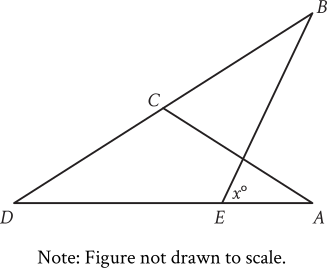
    Triangle A C D partially overlaps triangle E B D. Point C is on line segment B D. Point E is on line segment A D. The measure of angle A E B is x°. A note indicates the figure is not drawn to scale. In the figure, \(A C = C D\). The measure of angle \(E B C\) is \(45 °\), and the measure of angle \(A C D\) is \(104 °\). What is the value of \(x\)?

    Correct answer: B

    The correct answer is \(83\). It's given that in the figure, \(A C = C D\). Thus, triangle \(A C D\) is an isosceles triangle and the measure of angle \(C D A\) is equal to the measure of angle \(C A D\). The sum of the measures of the interior angles of a triangle is \(180 °\). Thus, the sum of the measures of the interior angles of triangle \(A C D\) is \(180 °\). It's given that the measure of angle \(A C D\) is \(104 °\). It follows that the sum of the measures of angles \(C D A\) and \(C A D\) is \((180 -104)°\), or \(76 °\). Since the measure of angle \(C D A\) is equal to the measure of angle \(C A D\), the measure of angle \(C D A\) is half of \(76 °\), or \(38 °\). The sum of the measures of the interior angles of triangle \(B D E\) is \(180 °\). It's given that the measure of angle \(E B C\) is \(45 °\). Since the measure of angle \(B D E\), which is the same angle as angle \(C D A\), is \(38 °\), it follows that the measure of angle \(D E B\) is \((180 -45 -38)°\), or \(97 °\). Since angle \(D E B\) and angle \(A E B\) form a straight line, the sum of the measures of these angles is \(180 °\). It's given in the figure that the measure of angle \(A E B\) is \(x °\). It follows that \(97 + x = 180\). Subtracting \(97\) from both sides of this equation yields \(x = 83\).
  23. Question 23

    Triangles \(E F G\) and \(J K L\) are congruent, where \(E\), \(F\), and \(G\) correspond to \(J\), \(K\), and \(L\), respectively. The measure of angle \(E\) is \(45 °\) and the measure of angle \(F\) is \(20 °\). What is the measure of angle \(J\)?

    Correct answer: B

    Choice B is correct. It's given that triangles \(E F G\) and \(J K L\) are congruent such that angle \(E\) corresponds to angle \(J\). Corresponding angles of congruent triangles are congruent, so angle \(E\) and angle \(J\) must be congruent. Therefore, if the measure of angle \(E\) is \(45 °\), then the measure of angle \(J\) is also \(45 °\). Choice A is incorrect. This is the measure of angle \(K\), not angle \(J\). Choice C is incorrect and may result from conceptual or calculation errors. Choice D is incorrect and may result from conceptual or calculation errors.
  24. Question 24

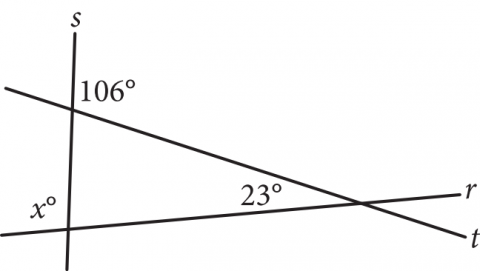
    What is the value of x ?

    Correct answer: D

    The correct answer is 97. The intersecting lines form a triangle, and the angle with measure of is an exterior angle of this triangle. The measure of an exterior angle of a triangle is equal to the sum of the measures of the two nonadjacent interior angles of the triangle. One of these angles has measure of and the other, which is supplementary to the angle with measure, has measure of . Therefore, the value of x is .
  25. Question 25

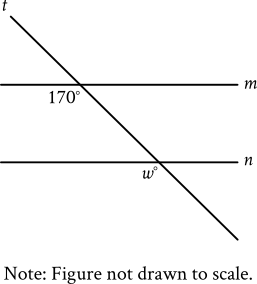
    Clockwise from top left, the 3 lines are labeled t, m, and n. Line t intersects both line m and line n. At the intersection of line t and line m, 1 angle is labeled clockwise from top left as follows: Bottom left: 170° At the intersection of line t and line n, 1 angle is labeled clockwise from top left as follows: Bottom left: w° A note indicates the figure is not drawn to scale. In the figure, line \(m\) is parallel to line \(n\). What is the value of \(w\)?

    Correct answer: D

    Choice D is correct. It's given that lines \(m\) and \(n\) are parallel. Since line \(t\) intersects both lines \(m\) and \(n\), it's a transversal. The angles in the figure marked as \(170 °\) and \(w °\) are on the same side of the transversal, where one is an interior angle with line \(m\) as a side, and the other is an exterior angle with line \(n\) as a side. Thus, the marked angles are corresponding angles. When two parallel lines are intersected by a transversal, corresponding angles are congruent and, therefore, have equal measure. It follows that \(w ° = 170 °\). Therefore, the value of \(w\) is \(170\). Choice A is incorrect and may result from conceptual or calculation errors. Choice B is incorrect and may result from conceptual or calculation errors. Choice C is incorrect and may result from conceptual or calculation errors.
  26. Question 26

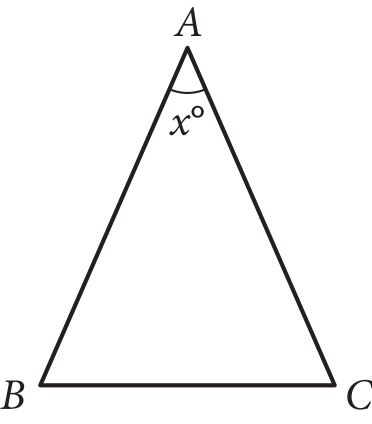
    In the given triangle, and has a measure of . What is the value of x ?

    Correct answer: B

    Choice B is correct. Since, the measures of their corresponding angles, and, are equal. Since has a measure of, the measure of is also . Since the sum of the measures of the interior angles in a triangle is, it follows that, or . Subtracting by 134 on both sides of this equation yields .Choices A, C, and D are incorrect and may result from calculation errors.
  27. Question 27

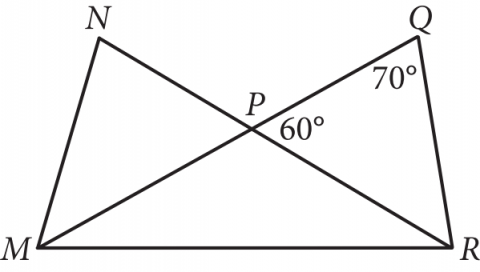
    In the figure above, and intersect at point P,, and . What is the measure, in °s, of ? (Disregard the ° symbol when gridding your answer.)

    Correct answer: C

    The correct answer is 30. It is given that the measure of is . Angle MPR and are collinear and therefore are supplementary angles. This means that the sum of the two angle measures is, and so the measure of is . The sum of the angles in a triangle is . Subtracting the measure of from yields the sum of the other angles in the triangle MPR. Since, the sum of the measures of and is . It is given that, so it follows that triangle MPR is isosceles. Therefore and must be congruent. Since the sum of the measure of these two angles is, it follows that the measure of each angle is .An alternate approach would be to use the exterior angle theorem, noting that the measure of is equal to the sum of the measures of and . Since both angles are equal, each of them has a measure of .
  28. Question 28

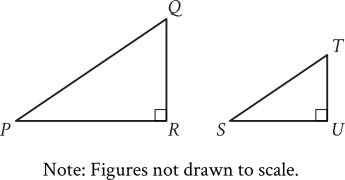
    Right triangle P Q R is labeled as follows: Angle R is a right angle. Right triangle S T U is labeled as follows: Angle U is a right angle. A note indicates the figures are not drawn to scale. Right triangles \(P Q R\) and \(S T U\) are similar, where \(P\) corresponds to \(S\). If the measure of angle \(Q\) is \(18 °\), what is the measure of angle \(S\)?

    Correct answer: B

    Choice B is correct. In similar triangles, corresponding angles are congruent. It’s given that right triangles \(P Q R\) and \(S T U\) are similar, where angle \(P\) corresponds to angle \(S\). It follows that angle \(P\) is congruent to angle \(S\). In the triangles shown, angle \(R\) and angle \(U\) are both marked as right angles, so angle \(R\) and angle \(U\) are corresponding angles. It follows that angle \(Q\) and angle \(T\) are corresponding angles, and thus, angle \(Q\) is congruent to angle \(T\). It’s given that the measure of angle \(Q\) is \(18 °\), so the measure of angle \(T\) is also \(18 °\). Angle \(U\) is a right angle, so the measure of angle \(U\) is \(90 °\). The sum of the measures of the interior angles of a triangle is \(180 °\). Thus, the sum of the measures of the interior angles of triangle \(S T U\) is \(180\) °s. Let \(s\) represent the measure, in °s, of angle \(S\). It follows that \(s + 18 + 90 = 180\), or \(s + 108 = 180\). Subtracting \(108\) from both sides of this equation yields \(s = 72\). Therefore, if the measure of angle \(Q\) is \(18\) °s, then the measure of angle \(S\) is \(72\) °s. Choice A is incorrect. This is the measure of angle \(T\). Choice C is incorrect and may result from conceptual or calculation errors. Choice D is incorrect. This is the sum of the measures of angle \(S\) and angle \(U\).
  29. Question 29

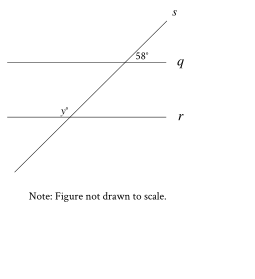
    Clockwise from top left, the 3 lines are labeled s, q, and r. Line s intersects both line q and line r. At the intersection of line s and line q, 1 angle is labeled clockwise from top left as follows: Top right: 58° At the intersection of line s and line r, 1 angle is labeled clockwise from top left as follows: Top left: y° A note indicates the figure is not drawn to scale. In the figure, line \(q\) is parallel to line \(r\), and both lines are intersected by line \(s\). If \(y = 2 x + 8\), what is the value of \(x\)?

    Correct answer: A

    The correct answer is \(57\). Based on the figure, the angle with measure \(y °\) and the angle vertical to the angle with measure \(58 °\) are same side interior angles. Since vertical angles are congruent, the angle vertical to the angle with measure \(58 °\) also has measure \(58 °\). It’s given that lines \(q\) and \(r\) are parallel. Therefore, same side interior angles between lines \(q\) and \(r\) are supplementary. It follows that \(y + 58 = 180\). If \(y = 2 x + 8\), then the value of \(x\) can be found by substituting \(2 x + 8\) for \(y\) in the equation \(y + 58 = 180\), which yields \((2 x + 8)+ 58 = 180\), or \(2 x + 66 = 180\). Subtracting \(66\) from both sides of this equation yields \(2 x = 114\). Dividing both sides of this equation by \(2\) yields \(x = 57\). Thus, if \(y = 2 x + 8\), the value of \(x\) is \(57\).
  30. Question 30

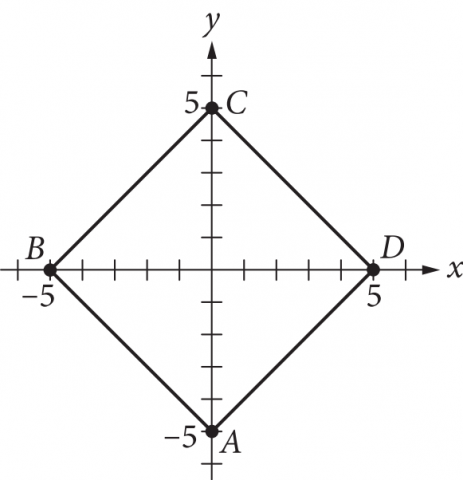
    In the xy-plane shown, square ABCD has its diagonals on the x-and y-axes. What is the area, in square units, of the square?

    Correct answer: C

    Choice C is correct. The two diagonals of square ABCD divide the square into 4 congruent right triangles, where each triangle has a vertex at the origin of the graph shown. The formula for the area of a triangle is, where b is the base length of the triangle and h is the height of the triangle. Each of the 4 congruent right triangles has a height of 5 units and a base length of 5 units. Therefore, the area of each triangle is, or 12.5 square units. Since the 4 right triangles are congruent, the area of each is of the area of square ABCD. It follows that the area of the square ABCD is equal to, or 50 square units.Choices A and D are incorrect and may result from using 5 or 25, respectively, as the area of one of the 4 congruent right triangles formed by diagonals of square ABCD. However, the area of these triangles is 12.5. Choice B is incorrect and may result from using 5 as the length of one side of square ABCD. However, the length of a side of square ABCD is .
  31. Question 31

    A cube has a surface area of 54 square meters. What is the volume, in cubic meters, of the cube?

    Correct answer: B

    Choice B is correct. The surface area of a cube with side length s is equal to . Since the surface area is given as 54 square meters, the equation can be used to solve for s. Dividing both sides of the equation by 6 yields . Taking the square root of both sides of this equation yields and . Since the side length of a cube must be a positive value, can be discarded as a possible solution, leaving . The volume of a cube with side length s is equal to . Therefore, the volume of this cube, in cubic meters, is, or 27.Choices A, C, and D are incorrect and may result from calculation errors.
  32. Question 32

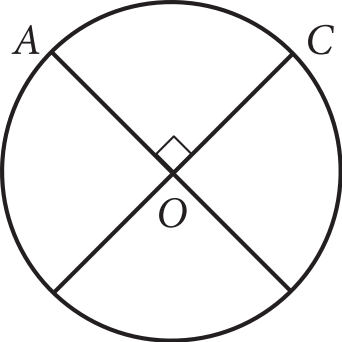
    The circle above with center O has a circumference of 36. What is the length of minor arc ?

    Correct answer: A

    Choice A is correct. A circle has 360 °s of arc. In the circle shown, O is the center of the circle and is a central angle of the circle. From the figure, the two diameters that meet to form are perpendicular, so the measure of is . Therefore, the length of minor arc is of the circumference of the circle. Since the circumference of the circle is 36, the length of minor arc is .Choices B, C, and D are incorrect. The perpendicular diameters divide the circumference of the circle into four equal arcs; therefore, minor arc is of the circumference. However, the lengths in choices B and C are, respectively, and the circumference of the circle, and the length in choice D is the length of the entire circumference. None of these lengths is the circumference.
  33. Question 33

    In triangle \(A B C\), the measure of angle \(B\) is \(52 °\) and the measure of angle \(C\) is \(17 °\). What is the measure of angle \(A\)?

    Correct answer: D

    Choice D is correct. The sum of the angle measures of a triangle is \(180 °\). Adding the measures of angles \(B\) and \(C\) gives \(52 + 17 = 69 °\). Therefore, the measure of angle \(A\) is \(180 -69 = 111 °\). Choice A is incorrect and may result from subtracting the sum of the measures of angles \(B\) and \(C\) from \(90 °\), instead of from \(180 °\). Choice B is incorrect and may result from subtracting the measure of angle \(C\) from the measure of angle \(B\). Choice C is incorrect and may result from adding the measures of angles \(B\) and \(C\) but not subtracting the result from \(180 °\).
  34. Question 34

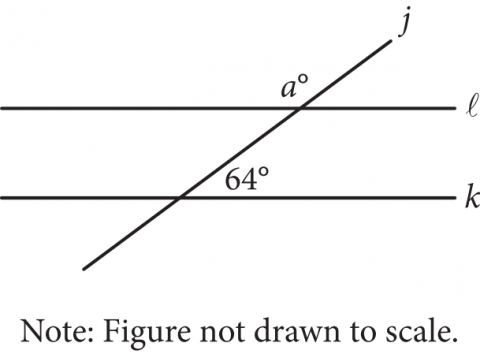
    In the figure above, lines and k are parallel. What is the value of a ?

    Correct answer: C

    Choice C is correct. Since lines and k are parallel, corresponding angles formed by the intersection of line j with lines and k are congruent. Therefore, the angle with measure a° must be the supplement of the angle with measure 64°. The sum of two supplementary angles is 180°, so a = 180 – 64 = 116.Choice A is incorrect and likely results from thinking the angle with measure a° is the complement of the angle with measure 64°. Choice B is incorrect and likely results from thinking the angle with measure a° is congruent to the angle with measure 64°. Choice D is incorrect and likely results from a conceptual or computational error.
  35. Question 35

    A right triangle has legs with lengths of \(28\) centimeters and \(20\) centimeters. What is the length of this triangle's hypotenuse, in centimeters?

    Correct answer: B

    Choice B is correct. The Pythagorean theorem states that in a right triangle, the sum of the squares of the lengths of the two legs is equal to the square of the length of the hypotenuse. It's given that the right triangle has legs with lengths of \(28\) centimeters and \(20\) centimeters. Let \(c\) represent the length of this triangle's hypotenuse, in centimeters. Therefore, by the Pythagorean theorem, \(28 ^2 + 20 ^2 = c ^2\), or \(1,184 = c ^2\). Taking the positive square root of both sides of this equation yields \(√1,184 = c\), or \(4 √74 = c\). Therefore, the length of this triangle's hypotenuse, in centimeters, is \(4 √74\). Choice A is incorrect and may result from conceptual or calculation errors. Choice C is incorrect and may result from conceptual or calculation errors. Choice D is incorrect. This is the square of the length of the triangle’s hypotenuse.
  36. Question 36

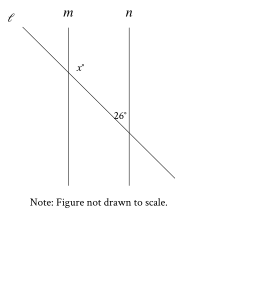
    Clockwise from top left, the 3 lines are labeled l, m, and n. Line l intersects both line m and line n. At the intersection of line l and line m, 1 angle is labeled clockwise from top left as follows: Top right: x° At the intersection of line l and line n, 1 angle is labeled clockwise from top left as follows: Top left: 26° A note indicates the figure is not drawn to scale. In the figure shown, line \(m\) is parallel to line \(n\). What is the value of \(x\)?

    Correct answer: D

    Choice D is correct. The sum of consecutive interior angles between two parallel lines and on the same side of the transversal is \(180\) °s. Since it's given that line \(m\) is parallel to line \(n\), it follows that \(x + 26 = 180\). Subtracting \(26\) from both sides of this equation yields \(154\). Therefore, the value of \(x\) is \(154\). Choice A is incorrect. This is half of the given angle measure. Choice B is incorrect. This is the value of the given angle measure. Choice C is incorrect. This is twice the value of the given angle measure.
  37. Question 37

    In triangle RST above, point W (not shown) lies on . What is the value of ?

    Correct answer: B

    The correct answer is 0. Note that no matter where point W is on, the sum of the measures of and is equal to the measure of, which is . Thus, and are complementary angles. Since the cosine of an angle is equal to the sine of its complementary angle, . Therefore, .
  38. Question 38

    A rectangle has a length of \(13\) and a width of \(6\). What is the perimeter of the rectangle?

    Correct answer: C

    Choice C is correct. The perimeter of a quadrilateral is the sum of the lengths of its four sides. It's given that the rectangle has a length of \(13\) and a width of \(6\). It follows that the rectangle has two sides with length \(13\) and two sides with length \(6\). Therefore, the perimeter of the rectangle is \(13 + 13 + 6 + 6\), or \(38\). Choice A is incorrect. This is the sum of the lengths of the two sides with length \(6\), not the sum of the lengths of all four sides of the rectangle. Choice B is incorrect. This is the sum of the lengths of the two sides with length \(13\), not the sum of the lengths of all four sides of the rectangle. Choice D is incorrect. This is the perimeter of a rectangle that has four sides with length \(13\), not two sides with length \(13\) and two sides with length \(6\).
  39. Question 39

    A circle has a radius of \(2.1\) inches. The area of the circle is \(bπ\) square inches, where \(b\) is a constant. What is the value of \(b\)?

    Correct answer: C

    The correct answer is \(4.41\). The area, \(A\), of a circle is given by the formula \(A =π r ^2\), where \(r\) is the radius of the circle. It's given that the area of the circle is \(bπ\) square inches, where \(b\) is a constant, and the radius of the circle is \(2.1\) inches. Substituting \(bπ\) for \(A\) and \(2.1\) for \(r\) in the formula \(A =π r ^2\) yields \(bπ =π(2.1 ^2)\). Dividing both sides of this equation by \(π\) yields \(b = 4.41\). Therefore, the value of \(b\) is \(4.41\).
  40. Question 40

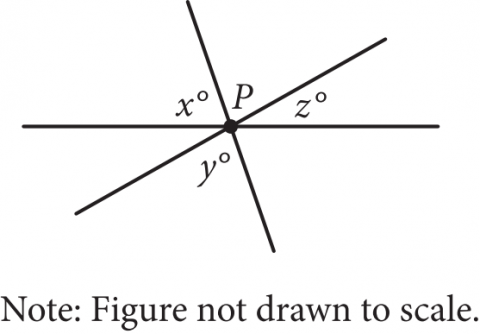
    In the figure, three lines intersect at point P. If and, what is the value of z ?

    Correct answer: C

    Choice C is correct. The angle that is shown as lying between the y° angle and the z° angle is a vertical angle with the x° angle. Since vertical angles are congruent and, the angle between the y° angle and the z° angle measures 65°. Since the 65° angle, the y° angle, and the z° angle are adjacent and form a straight angle, it follows that the sum of the measures of these three angles is 180°, which is represented by the equation . It’s given that y = 75. Substituting 75 for y yields, which can be rewritten as . Subtracting 140° from both sides of this equation yields . Therefore, .Choice A is incorrect and may result from finding the value of rather than z. Choices B and D are incorrect and may result from conceptual or computational errors.
  41. Question 41

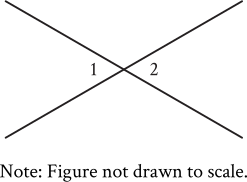
    At the intersection of the 2 lines, the angles are labeled clockwise from left as follows: Left: 1 Top: unlabeled Right: 2 Bottom: unlabeled A note indicates the figure is not drawn to scale. In the figure, two lines intersect at a point. Angle \(1\) and angle \(2\) are vertical angles. The measure of angle \(1\) is \(72 °\). What is the measure of angle \(2\)?

    Correct answer: A

    Choice A is correct. It’s given that angle \(1\) and angle \(2\) are vertical angles, and the measure of angle \(1\) is \(72 °\). Vertical angles have equal measures. Therefore, the measure of angle \(2\) is \(72 °\). Choice B is incorrect. This is the measure of an angle that is supplementary, not congruent, to angle \(1\). Choice C is incorrect. This is the sum of the measures of angle \(1\) and angle \(2\). Choice D is incorrect and may result from conceptual or calculation errors.
  42. Question 42

    \(R S = 20\) \(S T = 48\) \(T R = 52\) The side lengths of right triangle \(R S T\) are given. Triangle \(R S T\) is similar to triangle \(U V W\), where \(S\) corresponds to \(V\) and \(T\) corresponds to \(W\). What is the value of \(tangent W\)?

    Correct answer: B

    Choice B is correct. It's given that right triangle \(R S T\) is similar to triangle \(U V W\), where \(S\) corresponds to \(V\) and \(T\) corresponds to \(W\). It's given that the side lengths of the right triangle \(R S T\) are \(R S = 20\), \(S T = 48\), and \(T R = 52\). Corresponding angles in similar triangles are equal. It follows that the measure of angle \(T\) is equal to the measure of angle \(W\). The hypotenuse of a right triangle is the longest side. It follows that the hypotenuse of triangle \(R S T\) is side \(T R\). The hypotenuse of a right triangle is the side opposite the right angle. Therefore, angle \(S\) is a right angle. The adjacent side of an acute angle in a right triangle is the side closest to the angle that is not the hypotenuse. It follows that the adjacent side of angle \(T\) is side \(S T\). The opposite side of an acute angle in a right triangle is the side across from the acute angle. It follows that the opposite side of angle \(T\) is side \(R S\). The tangent of an acute angle in a right triangle is the ratio of the length of the opposite side to the length of the adjacent side. Therefore, \(tangent T = R S/ S T\). Substituting \(20\) for \(R S\) and \(48\) for \(S T\) in this equation yields \(tangent T = 20/48\), or \(tangent T = 5 twelfths\). The tangents of two acute angles with equal measures are equal. Since the measure of angle \(T\) is equal to the measure of angle \(W\), it follows that \(tangent T = tangent W\). Substituting \(5 twelfths\) for \(tangent T\) in this equation yields \(5 twelfths = tangent W\). Therefore, the value of \(tangent W\) is \(5 twelfths\). Choice A is incorrect. This is the value of \(sine W\). Choice C is incorrect. This is the value of \(cosine W\). Choice D is incorrect. This is the value of \(1/tangent W\).
  43. Question 43

    A right triangle has legs with lengths of \(24\) centimeters and \(21\) centimeters. If the length of this triangle's hypotenuse, in centimeters, can be written in the form \(3 √d\), where \(d\) is an integer, what is the value of \(d\)?

    Correct answer: A

    The correct answer is \(113\). It's given that the legs of a right triangle have lengths \(24\) centimeters and \(21\) centimeters. In a right triangle, the square of the length of the hypotenuse is equal to the sum of the squares of the lengths of the two legs. It follows that if \(h\) represents the length, in centimeters, of the hypotenuse of the right triangle, \(h ^2 = 24 ^2 + 21 ^2\). This equation is equivalent to \(h ^2 = 1,017\). Taking the square root of each side of this equation yields \(h = √1,017\). This equation can be rewritten as \(h = √9 dot 113\), or \(h = √9 dot √113\). This equation is equivalent to \(h = 3 √113\). It's given that the length of the triangle's hypotenuse, in centimeters, can be written in the form \(3 √d\). It follows that the value of \(d\) is \(113\).
  44. Question 44

    An angle has a measure of \(16π/15\) radians. What is the measure of the angle, in °s?

    Correct answer: C

    The correct answer is \(192\). The measure of an angle, in °s, can be found by multiplying its measure, in radians, by \(180 °s/π radians\). Multiplying the given angle measure, \(16π/15 radians\), by \(180 °s/π radians\) yields \((16π/15 radians)(180 °s/π r a d i a n s)\), which simplifies to \(192\) °s.

Want a higher score?

One-on-one tutoring for SAT, online or in person, with a plan built around the questions you missed.

Get Started

Book Your Free Session

5.0
from 38 Google reviews

Call or Text 1 (888) 356-0607