Skip to content

SAT practice test

SAT Area and Volume Questions - Real Collegeboard

  • 67 questions
  • Untimed
  • Answers and explanations
Embed on your site
  • 67 questions
  • No time limit
  • Every answer explained at the end
  1. Question 1

    What is the perimeter, in inches, of a rectangle with a length of \(4\) inches and a width of \(9\) inches?

    Correct answer: D

    Choice D is correct. The perimeter of a figure is equal to the sum of the measurements of the sides of the figure. It’s given that the rectangle has a length of \(4\) inches and a width of \(9\) inches. Since a rectangle has \(4\) sides, of which opposite sides are parallel and equal, it follows that the rectangle has two sides with a length of \(4\) inches and two sides with a width of \(9\) inches. Therefore, the perimeter of this rectangle is \(4 + 4 + 9 + 9\), or \(26\) inches. Choice A is incorrect. This is the sum, in inches, of the length and the width of the rectangle. Choice B is incorrect. This is the sum, in inches, of the two lengths and the width of the rectangle. Choice C is incorrect. This is the sum, in inches, of the length and the two widths of the rectangle.
  2. Question 2

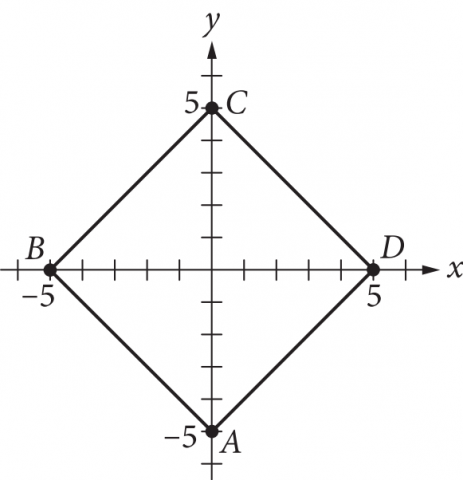
    In the xy-plane shown, square ABCD has its diagonals on the x-and y-axes. What is the area, in square units, of the square?

    Correct answer: C

    Choice C is correct. The two diagonals of square ABCD divide the square into 4 congruent right triangles, where each triangle has a vertex at the origin of the graph shown. The formula for the area of a triangle is, where b is the base length of the triangle and h is the height of the triangle. Each of the 4 congruent right triangles has a height of 5 units and a base length of 5 units. Therefore, the area of each triangle is, or 12.5 square units. Since the 4 right triangles are congruent, the area of each is of the area of square ABCD. It follows that the area of the square ABCD is equal to, or 50 square units.Choices A and D are incorrect and may result from using 5 or 25, respectively, as the area of one of the 4 congruent right triangles formed by diagonals of square ABCD. However, the area of these triangles is 12.5. Choice B is incorrect and may result from using 5 as the length of one side of square ABCD. However, the length of a side of square ABCD is .
  3. Question 3

    A cube has a surface area of 54 square meters. What is the volume, in cubic meters, of the cube?

    Correct answer: B

    Choice B is correct. The surface area of a cube with side length s is equal to . Since the surface area is given as 54 square meters, the equation can be used to solve for s. Dividing both sides of the equation by 6 yields . Taking the square root of both sides of this equation yields and . Since the side length of a cube must be a positive value, can be discarded as a possible solution, leaving . The volume of a cube with side length s is equal to . Therefore, the volume of this cube, in cubic meters, is, or 27.Choices A, C, and D are incorrect and may result from calculation errors.
  4. Question 4

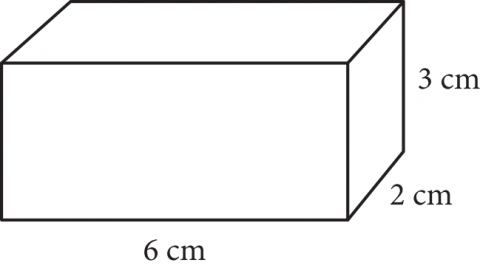
    The figure shows the lengths, in centimeters (cm), of the edges of a right rectangular prism. The volume V of a right rectangular prism is, where is the length of the prism, w is the width of the prism, and h is the height of the prism. What is the volume, in cubic centimeters, of the prism?

    Correct answer: A

    Choice A is correct. It’s given that the volume of a right rectangular prism is . The prism shown has a length of 6 cm, a width of 2 cm, and a height of 3 cm. Thus,, or 36 cubic centimeters.Choice B is incorrect. This is the volume of a rectangular prism with edge lengths of 6, 2, and 2. Choice C is incorrect and may result from only finding the product of the length and width of the base of the prism. Choice D is incorrect and may result from finding the sum, not the product, of the edge lengths of the prism.
  5. Question 5

    Triangles \(ABC\) and \(DEF\) are similar. Each side length of triangle \(ABC\) is \(4\) times the corresponding side length of triangle \(DEF\). The area of triangle \(ABC\) is \(270\) square inches. What is the area, in square inches, of triangle \(DEF\)?

    Correct answer: A

    The correct answer is \(135/8\). It's given that triangles \(A B C\) and \(D E F\) are similar and each side length of triangle \(A B C\) is \(4\) times the corresponding side length of triangle \(D E F\). For two similar triangles, if each side length of the first triangle is \(k\) times the corresponding side length of the second triangle, then the area of the first triangle is \(k ^2\) times the area of the second triangle. Therefore, the area of triangle \(A B C\) is \(4 ^2\), or \(16\), times the area of triangle \(D E F\). It's given that the area of triangle \(A B C\) is \(270\) square inches. Let \(a\) represent the area, in square inches, of triangle \(D E F\). It follows that \(270\) is \(16\) times \(a\), or \(270 = 16 a\). Dividing both sides of this equation by \(16\) yields \(270/16 = a\), which is equivalent to \(135/8 = a\). Thus, the area, in square inches, of triangle \(D E F\) is \(135/8\). Note that 135/8, 16.87, and 16.88 are examples of ways to enter a correct answer.
  6. Question 6

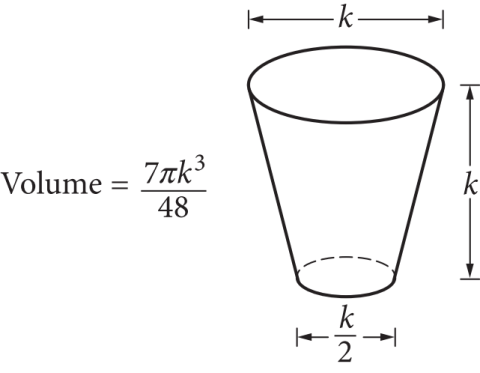
    The glassπctured above can hold a maximum volume of 473 cubic centimeters, which is approximately 16 fluid ounces. What is the value of k, in centimeters?

    Correct answer: D

    Choice D is correct. Using the volume formula and the given information that the volume of the glass is 473 cubic centimeters, the value of k can be found as follows:Therefore, the value of k is approximately 10.11 centimeters.Choices A, B, and C are incorrect. Substituting the values of k from these choices in the formula results in volumes of approximately 7 cubic centimeters, 207 cubic centimeters, and 217 cubic centimeters, respectively, all of which contradict the given information that the volume of the glass is 473 cubic centimeters.
  7. Question 7

    A right triangle has sides of length \(2 √2\), \(6 √2\), and \(√80\) units. What is the area of the triangle, in square units?

    Correct answer: B

    Choice B is correct. The area, \(A\), of a triangle can be found using the formula \(A = 1 half b h\), where \(b\) is the length of the base of the triangle and \(h\) is the height of the triangle. It's given that the triangle is a right triangle. Therefore, its base and height can be represented by the two legs. It’s also given that the triangle has sides of length \(2 √2\), \(6 √2\), and \(√80\) units. Since \(√80\) units is the greatest of these lengths, it's the length of the hypotenuse. Therefore, the two legs have lengths \(2 √2\) and \(6 √2\) units. Substituting these values for \(b\) and \(h\) in the formula \(A = 1 half b h\) gives \(A = 1 half(2 √2 )(6 √2 )\), which is equivalent to \(A = 6 √4\) square units, or \(A = 12\) square units. Choice A is incorrect. This expression represents the perimeter, rather than the area, of the triangle. Choice C is incorrect and may result from conceptual or calculation errors. Choice D is incorrect and may result from conceptual or calculation errors.
  8. Question 8

    A rectangle has a length of \(64\) inches and a width of \(32\) inches. What is the area, in square inches, of the rectangle?

    Correct answer: D

    The correct answer is \(2,048\). The area \(A\), in square inches, of a rectangle is equal to the product of its length \(ell\), in inches, and its width \(w\), in inches, or \(A = ell w\). It's given that the rectangle has a length of \(64\) inches and a width of \(32\) inches. Substituting \(64\) for \(ell\) and \(32\) for \(w\) in the equation \(A = ell w\) yields \(A =(64)(32)\), or \(A = 2,048\). Therefore, the area, in square inches, of the rectangle is \(2,048\).
  9. Question 9

    A cylindrical can containingπeces of fruit is filled to the top with syrup before being sealed. The base of the can has an area of, and the height of the can is 10 cm. If of syrup is needed to fill the can to the top, which of the following is closest to the total volume of theπeces of fruit in the can?

    Correct answer: C

    Choice C is correct. The total volume of the cylindrical can is found by multiplying the area of the base of the can,, by the height of the can, 10 cm, which yields . If the syrup needed to fill the can has a volume of, then the remaining volume for theπeces offruit is .Choice A is incorrect because if the fruit had a volume of, there would be of syrup needed to fill the can to the top. Choice B is incorrect because if the fruit had a volume of, there would be of syrup needed to fill the can to the top. Choice D is incorrect because it is the total volume of the can, not just of theπeces of fruit.
  10. Question 10

    A right circular cylinder has a volume of \(432\) cubic centimeters. The area of the base of the cylinder is \(24\) square centimeters. What is the height, in centimeters, of the cylinder?

    Correct answer: A

    Choice A is correct. The volume, \(V\), of a right circular cylinder is given by the formula \(V =π r ^2 h\), where \(π r ^2\) is the area of the base of the cylinder and \(h\) is the height. It’s given that a right circular cylinder has a volume of \(432\) cubic centimeters and the area of the base is \(24\) square centimeters. Substituting \(432\) for \(V\) and \(24\) for \(π r ^2\) in the formula \(V =π r ^2 h\) yields \(432 = 24 h\). Dividing both sides of this equation by \(24\) yields \(18 = h\). Therefore, the height of the cylinder, in centimeters, is \(18\). Choice B is incorrect. This is the area of the base, in square centimeters, not the height, in centimeters, of the cylinder. Choice C is incorrect. This is the height, in centimeters, of a cylinder if its volume is \(432\) cubic centimeters and the area of its base is \(2\), not \(24\), cubic centimeters. Choice D is incorrect. This is the height, in centimeters, of a cylinder if its volume is \(432\) cubic centimeters and the area of its base is \(1 20 fourth\), not \(24\), cubic centimeters.
  11. Question 11

    The dimensions of a right rectangular prism are 4 inches by 5 inches by 6 inches. What is the surface area, in square inches, of the prism?

    Correct answer: D

    Choice D is correct. The surface area is found by summing the area of each face. A right rectangular prism consists of three pairs of congruent rectangles, so the surface area is found by multiplying the areas of three adjacent rectangles by 2 and adding these products. For this prism, the surface area is equal to \(2(4 \times 5) + 2(4 \times 6) + 2(5 \times 6)\), or \(2(20) + 2(24) + 2(30)\), which is equal to 148.Choice A is incorrect. This is the area of one of the faces of the prism. Choice B is incorrect and may result from adding the areas of three adjacent rectangles without multiplying by 2. Choice C is incorrect. This is the volume, in cubic inches, of the prism.
  12. Question 12

    Each side of a square has a length of \(45\). What is the perimeter of this square?

    Correct answer: D

    The correct answer is \(180\). The perimeter of a polygon is equal to the sum of the lengths of the sides of the polygon. It’s given that each side of the square has a length of \(45\). Since a square is a polygon with \(4\) sides, the perimeter of this square is \(45 + 45 + 45 + 45\), or \(180\).
  13. Question 13

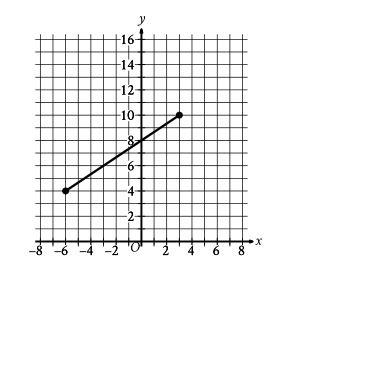
    The line segment slants gradually up from left to right. The line segment begins at the point (-6, 4). The line segment ends at the point (3, 10). The line segment shown in the xy-plane represents one of the legs of a right triangle. The area of this triangle is \(36 √13\) square units. What is the length, in units, of the other leg of this triangle?

    Correct answer: B

    Choice B is correct. The length of a segment in the xy-plane can be found using the distance formula, \(√(x_2 -x_1)^2 +(y_2 -y_1)^2\), where \((x_1, y_1)\) and \((x_2, y_2)\) are the endpoints of the segment. The segment shown has endpoints at \((-6, 4)\) and \((3, 10)\). Substituting \((-6, 4)\) and \((3, 10)\) for \((x_1, y_1)\) and \((x_2, y_2)\), respectively, in the distance formula yields \(√(3 -(-6))^2 +(10 -4)^2\), or \(√9 ^2 + 6 ^2\), which is equivalent to \(√81 + 36\), or \(√117\). Let \(x\) represent the length, in units, of the other leg of this triangle. The area, \(A\), of a right triangle can be calculated using the formula \(A = 1 half b h\), where \(b\) and \(h\) are the lengths of the legs of the triangle. It's given that the area of the triangle is \(36 √13\) square units. Substituting \(36 √13\) for \(A\), \(√117\) for \(b\), and \(x\) for \(h\) in the formula \(A = 1 half b h\) yields \(36 √13 = 1 half(√117 )(x)\). Multiplying both sides of this equation by \(2\) yields \(72 √13 = x √117\). Dividing both sides of this equation by \(√117\) yields \(72 √13 /√117 = x\). Multiplying the numerator and denominator on the left-hand side of this equation by \(√117\) yields \(72 √1,521 /117 = x\), or \(72(39)/117 = x\), which is equivalent to \(2,808/117 = x\), or \(24 = x\). Therefore, the length, in units, of the other leg of this triangle is \(24\). Choice A is incorrect and may result from conceptual or calculation errors. Choice C is incorrect. \(3 √13\) is equivalent to \(√117\), which is the length, in units, of the line segment shown in the xy-plane, not the length, in units, of the other leg of the triangle. Choice D is incorrect and may result from conceptual or calculation errors.
  14. Question 14

    What is the area of a rectangle with a length of \(4 centimeters(cm)\) and a width of \(2 cm\)?

    Correct answer: B

    Choice B is correct. The area of a rectangle with length \(ell\) and width \(w\) can be found using the formula \(A = ell w\). It’s given that the rectangle has a length of \(4 cm\) and a width of \(2 cm\). Therefore, the area of this rectangle is \((4 cm)(2 cm)\), or \(8 cm ^2\). Choice A is incorrect. This is the sum, \(in cm\), of the length and width of the rectangle, not the area, \(in cm ^2\). Choice C is incorrect. This is the perimeter, \(in cm\), of the rectangle, not the area, \(in cm ^2\). Choice D is incorrect. This is the sum of the length and width of the rectangle ^2, not the area.
  15. Question 15

    A right circular cylinder has a base diameter of \(22\) centimeters and a height of \(6\) centimeters. What is the volume, in cubic centimeters, of the cylinder?

    Correct answer: C

    Choice C is correct. The volume, \(V\), of a right circular cylinder is given by the formula \(V =π r ^2 h\), where \(r\) is the radius of the base of the cylinder and \(h\) is the height of the cylinder. It's given that a right circular cylinder has a height of \(6\) centimeters. Therefore, \(h = 6\). It's also given that the cylinder has a base diameter of \(22\) centimeters. The radius of a circle is half the diameter of the circle. Since the base of a right circular cylinder is a circle, it follows that the radius of the base of the right circular cylinder is \(22/2\), or \(11\), centimeters. Therefore, \(r = 11\). Substituting \(11\) for \(r\) and \(6\) for \(h\) in the formula \(V =π r ^2 h\) yields \(V =π(11)^2(6)\), which is equivalent to \(V =π(121)(6)\), or \(V = 726π\). Therefore, the volume, in cubic centimeters, of the cylinder is \(726π\). Choice A is incorrect. This is the volume of a right circular cylinder that has a base diameter of \(2 √22\), not \(22\), centimeters and a height of \(6\) centimeters. Choice B is incorrect. This is the volume of a right circular cylinder that has a base diameter of \(4 √11\), not \(22\), centimeters and a height of \(6\) centimeters. Choice D is incorrect. This is the volume of a right circular cylinder that has a base diameter of \(44\), not \(22\), centimeters and a height of \(6\) centimeters.
  16. Question 16

    A triangle has a base length of \(40\) centimeters and a height of \(90\) centimeters. What is the area, in square centimeters, of the triangle?

    Correct answer: B

    The correct answer is \(1,800\). The area, \(A\), of a triangle can be found using the formula \(A = 1 half b h\), where \(b\) is the base length of the triangle and \(h\) is the height of the triangle. It’s given that the triangle has a base length of \(40\) centimeters and a height of \(90\) centimeters. Substituting \(40\) for \(b\) and \(90\) for \(h\) in the formula \(A = 1 half b h\) yields \(A = 1 half(40)(90)\), or \(A = 1,800\). Therefore, the area, in square centimeters, of the triangle is \(1,800\).
  17. Question 17

    Circle \(A\) has a radius of \(3 n\) and circle \(B\) has a radius of \(129 n\), where \(n\) is a positive constant. The area of circle \(B\) is how many times the area of circle \(A\)?

    Correct answer: D

    Choice D is correct. The area of a circle can be found by using the formula \(A =π r ^2\), where \(A\) is the area and \(r\) is the radius of the circle. It’s given that the radius of circle A is \(3 n\). Substituting this value for \(r\) into the formula \(A =π r ^2\) gives \(A =π(3 n)^2\), or \(9π n ^2\). It’s also given that the radius of circle B is \(129 n\). Substituting this value for \(r\) into the formula \(A =π r ^2\) gives \(A =π(129 n)^2\), or \(16,641π n ^2\). Dividing the area of circle B by the area of circle A gives \(16,641π n ^2/9π n ^2\), which simplifies to \(1,849\). Therefore, the area of circle B is \(1,849\) times the area of circle A. Choice A is incorrect. This is how many times greater the radius of circle B is than the radius of circle A. Choice B is incorrect and may result from conceptual or calculation errors. Choice C is incorrect. This is the coefficient on the term that describes the radius of circle B.
  18. Question 18

    Moving from left to right, the points have the following coordinates: (-3, 4) (4, -3) (5, 3) What is the area, in square units, of the triangle formed by connecting the three points shown?

    Correct answer: A

    The correct answer is \(24.5\). It's given that a triangle is formed by connecting the three points shown, which are \((-3, 4)\), \((5, 3)\), and \((4, -3)\). Let this triangle be triangle A. The area of triangle A can be found by calculating the area of the rectangle that circumscribes it and subtracting the areas of the three triangles that are inside the rectangle but outside triangle A. The rectangle formed by the points \((-3, 4)\), \((5, 4)\), \((5, -3)\), and \((-3, -3)\) circumscribes triangle A. The width, in units, of this rectangle can be found by calculating the distance between the points \((5, 4)\) and \((5, -3)\). This distance is \(4 -(-3)\), or \(7\). The length, in units, of this rectangle can be found by calculating the distance between the points \((5, 4)\) and \((-3, 4)\). This distance is \(5 -(-3)\), or \(8\). It follows that the area, in square units, of the rectangle is \((7)(8)\), or \(56\). One of the triangles that lies inside the rectangle but outside triangle A is formed by the points \((-3, 4)\), \((5, 4)\), and \((5, 3)\). The length, in units, of a base of this triangle can be found by calculating the distance between the points \((5, 4)\) and \((5, 3)\). This distance is \(4 -3\), or \(1\). The corresponding height, in units, of this triangle can be found by calculating the distance between the points \((5, 4)\) and \((-3, 4)\). This distance is \(5 -(-3)\), or \(8\). It follows that the area, in square units, of this triangle is \(1 half(8)(1)\), or \(4\). A second triangle that lies inside the rectangle but outside triangle A is formed by the points \((4, -3)\), \((5, 3)\), and \((5, -3)\). The length, in units, of a base of this triangle can be found by calculating the distance between the points \((5, 3)\) and \((5, -3)\). This distance is \(3 -(-3)\), or \(6\). The corresponding height, in units, of this triangle can be found by calculating the distance between the points \((5, -3)\) and \((4, -3)\). This distance is \(5 -4\), or \(1\). It follows that the area, in square units, of this triangle is \(1 half(1)(6)\), or \(3\). The third triangle that lies inside the rectangle but outside triangle A is formed by the points \((-3, 4)\), \((-3, -3)\), and \((4, -3)\). The length, in units, of a base of this triangle can be found by calculating the distance between the points \((4, -3)\) and \((-3, -3)\). This distance is \(4 -(-3)\), or \(7\). The corresponding height, in units, of this triangle can be found by calculating the distance between the points \((-3, 4)\) and \((-3, -3)\). This distance is \(4 -(-3)\), or \(7\). It follows that the area, in square units, of this triangle is \(1 half(7)(7)\), or \(24.5\). Thus, the area, in square units, of the triangle formed by connecting the three points shown is \(56 -4 -3 -24.5\), or \(24.5\). Note that 24.5 and 49/2 are examples of ways to enter a correct answer.
  19. Question 19

    The area of a rectangle is \(57\) square inches. The length of the longest side of the rectangle is \(19\) inches. What is the length, in inches, of the shortest side of this rectangle?

    Correct answer: A

    The correct answer is \(3\). The area of a rectangle can be calculated by multiplying the length of its longest side by the length of its shortest side. It’s given that the area of the rectangle is \(57\) square inches and the length of the longest side of the rectangle is \(19\) inches. Let \(x\) represent the length, in inches, of the shortest side of this rectangle. It follows that \(57 = 19 x\). Dividing both sides of this equation by \(19\) yields \(3 = x\). Therefore, the length, in inches, of the shortest side of the rectangle is \(3\).
  20. Question 20

    What is the area of a rectangle with a length of \(17 centimeters(cm)\) and a width of \(7 cm\)?

    Correct answer: C

    Choice C is correct. The area of a rectangle with length \(l\) and width \(w\) can be found using the formula \(A = l w\). It’s given that the rectangle has a length of \(17 cm\) and a width of \(7 cm\). Therefore, the area of this rectangle is \(A = 17(7)\), or \(119 cm ^2\). Choice A is incorrect. This is the sum of the length and width of the rectangle, not the area. Choice B is incorrect. This is the perimeter of the rectangle, not the area. Choice D is incorrect. This is the sum of the length and width of the rectangle ^2, not the area.
  21. Question 21

    The area of a rectangle is \(630\) square inches. The length of the rectangle is \(70\) inches. What is the width, in inches, of this rectangle?

    Correct answer: A

    Choice A is correct. The area \(A\), in square inches, of a rectangle is the product of its length \(ell\), in inches, and its width \(w\), in inches; thus, \(A = ell w\). It's given that the area of a rectangle is \(630\) square inches and the length of the rectangle is \(70\) inches. Substituting \(630\) for \(A\) and \(70\) for \(ell\) in the equation \(A = ell w\) yields \(630 = 70 w\). Dividing both sides of this equation by \(70\) yields \(9 = w\). Therefore, the width, in inches, of this rectangle is \(9\). Choice B is incorrect. This is the length, not the width, in inches, of the rectangle. Choice C is incorrect. This is half the area, in square inches, not the width, in inches, of the rectangle. Choice D is incorrect. This is the difference between the area, in square inches, and the length, in inches, of the rectangle, not the width, in inches, of the rectangle.
  22. Question 22

    The volume of right circular cylinder A is 22 cubic centimeters. What is the volume, in cubic centimeters, of a right circular cylinder with twice the radius and half the height of cylinder A?

    Correct answer: C

    Choice C is correct. The volume of right circular cylinder A is given by the expression, where r is the radius of its circular base and h is its height. The volume of a cylinder with twice the radius and half the height of cylinder A is given by, which is equivalent to . Therefore, the volume is twice the volume of cylinder A, or .Choice A is incorrect and likely results from not multiplying the radius of cylinder A by 2. Choice B is incorrect and likely results from not squaring the 2 in 2r when applying the volume formula. Choice D is incorrect and likely results from a conceptual error.
  23. Question 23

    Two identical rectangular prisms each have a height of \(90 centimeters(cm)\). The base of each prism is a square, and the surface area of each prism is \(K cm ^2\). If the prisms are glued together along a square base, the resulting prism has a surface area of \(92/47 K cm ^2\). What is the side length, in \(cm\), of each square base?

    Correct answer: B

    Choice B is correct. Let \(x\) represent the side length, in \(cm\), of each square base. If the two prisms are glued together along a square base, the resulting prism has a surface area equal to twice the surface area of one of the prisms, minus the area of the two square bases that are being glued together, which yields \(2 K -2 x ^2 cm ^2\) . It’s given that this resulting surface area is equal to \(92/47 K cm ^2\), so \(2 K -2 x ^2 = 92/47 K\). Subtracting \(92/47 K\) from both sides of this equation yields \(2 K -92/47 K -2 x ^2 = 0\). This equation can be rewritten by multiplying \(2 K\) on the left-hand side by \(47/47\), which yields \(94/47 K -92/47 K -2 x ^2 = 0\), or \(2 40 sevenths K -2 x ^2 = 0\). Adding \(2 x ^2\) to both sides of this equation yields \(2 40 sevenths K = 2 x ^2\). Multiplying both sides of this equation by \(47/2\) yields \(K = 47 x ^2\). The surface area \(K\), in \(cm Superscript 2\), of each rectangular prism is equivalent to the sum of the areas of the two square bases and the areas of the four lateral faces. Since the height of each rectangular prism is \(90 cm\) and the side length of each square base is \(x cm\), it follows that the area of each square base is \(x ^2 cm ^2\) and the area of each lateral face is \(90 x cm ^2\). Therefore, the surface area of each rectangular prism can be represented by the expression \(2 x ^2 + 4(90 x)\), or \(2 x ^2 + 360 x\). Substituting this expression for \(K\) in the equation \(K = 47 x ^2\) yields \(2 x ^2 + 360 x = 47 x ^2\). Subtracting \(2 x ^2\) and \(360 x\) from both sides of this equation yields \(0 = 45 x ^2 -360 x\). Factoring \(x\) from the right-hand side of this equation yields \(0 = x(45 x -360)\). Applying the zero product property, it follows that \(x = 0\) and \(45 x -360 = 0\). Adding \(360\) to both sides of the equation \(45 x -360 = 0\) yields \(45 x = 360\). Dividing both sides of this equation by \(45\) yields \(x = 8\). Since a side length of a rectangular prism can’t be \(0\), the length of each square base is \(8\) \(cm\). Choice A is incorrect and may result from conceptual or calculation errors. Choice C is incorrect and may result from conceptual or calculation errors. Choice D is incorrect and may result from conceptual or calculation errors.
  24. Question 24

    What is the area, in square centimeters, of a rectangle with a length of \(36\) centimeters and a width of \(34\) centimeters?

    Correct answer: D

    Choice D is correct. The area \(A\), in square centimeters, of a rectangle can be found using the formula \(A = ell w\), where \(ell\) is the length, in centimeters, of the rectangle and \(w\) is its width, in centimeters. It's given that the rectangle has a length of \(36\) centimeters and a width of \(34\) centimeters. Substituting \(36\) for \(ell\) and \(34\) for \(w\) in the formula \(A = ell w\) yields \(A = 36(34)\), or \(A = 1,224\). Therefore, the area, in square centimeters, of this rectangle is \(1,224\). Choice A is incorrect and may result from conceptual or calculation errors. Choice B is incorrect. This is the perimeter, in centimeters, not the area, in square centimeters, of the rectangle. Choice C is incorrect and may result from conceptual or calculation errors.
  25. Question 25

    A right circular cone has a volume of \(71,148π\) cubic centimeters and the area of its base is \(5,929π\) square centimeters. What is the slant height, in centimeters, of this cone?

    Correct answer: D

    Choice D is correct. The volume, \(V\), of a right circular cone is given by the formula \(V = 1 thirdπ r ^2 h\), where \(π r ^2\) is the area of the circular base of the cone and \(h\) is the height. It’s given that this right circular cone has a volume of \(71,148π\) cubic centimeters and the area of its base is \(5,929π\) square centimeters. Substituting \(71,148π\) for \(V\) and \(5,929π\) for \(π r ^2\) in the formula \(V = 1 thirdπ r ^2 h\) yields \(71,148π =(1 third)(5,929π)(h)\). Dividing each side of this equation by \(5,929π\) yields \(12 = h/3\). Multiplying each side of this equation by \(3\) yields \(36 = h\). Let \(s\) represent the slant height, in centimeters, of this cone. A right triangle is formed by the radius, \(r\), height, \(h\), and slant height, \(s\), of this cone, where \(r\) and \(h\) are the legs of the triangle and \(s\) is the hypotenuse. Using the Pythagorean theorem, the equation \(r ^2 + h ^2 = s ^2\) represents this relationship. Because \(5,929π\) is the area of the base and the area of the base is \(π r ^2\), it follows that \(5,929π =π r ^2\). Dividing both sides of this equation by \(π\) yields \(5,929 = r ^2\). Substituting \(5,929\) for \(r ^2\) and \(36\) for \(h\) in the equation \(r ^2 + h ^2 = s ^2\) yields \(5,929 + 36 ^2 = s ^2\), which is equivalent to \(5,929 + 1,296 = s ^2\), or \(7,225 = s ^2\). Taking the positive square root of both sides of this equation yields \(85 = s\). Therefore, the slant height of the cone is \(85\) centimeters. Choice A is incorrect. This is one-third of the height, in centimeters, not the slant height, in centimeters, of this cone. Choice B is incorrect. This is the height, in centimeters, not the slant height, in centimeters, of this cone. Choice C is incorrect. This is the radius, in centimeters, of the base, not the slant height, in centimeters, of this cone.
  26. Question 26

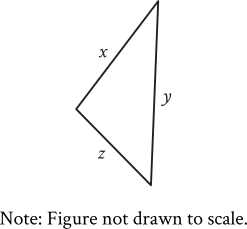
    The lengths of the sides are x, y, and z. A note indicates the figure is not drawn to scale. The triangle shown has a perimeter of \(22\) units. If \(x = 9\) units and \(y = 7\) units, what is the value of \(z\), in units?

    Correct answer: A

    Choice A is correct. The perimeter of a triangle is the sum of the lengths of its three sides. The triangle shown has side lengths \(x\), \(y\), and \(z\). It's given that the triangle has a perimeter of \(22\) units. Therefore, \(x + y + z = 22\). If \(x = 9\) units and \(y = 7\) units, the value of \(z\), in units, can be found by substituting \(9\) for \(x\) and \(7\) for \(y\) in the equation \(x + y + z = 22\), which yields \(9 + 7 + z = 22\), or \(16 + z = 22\). Subtracting \(16\) from both sides of this equation yields \(z = 6\). Therefore, if \(x = 9\) units and \(y = 7\) units, the value of \(z\), in units, is \(6\). Choice B is incorrect. This is the value of \(y\), in units, not the value of \(z\), in units. Choice C is incorrect. This is the value of \(x\), in units, not the value of \(z\), in units. Choice D is incorrect. This is the value of \(x + y\), in units, not the value of \(z\), in units.
  27. Question 27

    A triangular prism has a height of \(8 centimeters(cm)\) and a volume of \(216 cm cubed\). What is the area, \(in cm ^2\), of the base of the prism? (The volume of a triangular prism is equal to \(B h\), where \(B\) is the area of the base and \(h\) is the height of the prism.)

    Correct answer: D

    The correct answer is \(27\). It's given that a triangular prism has a volume of \(216 cubic centimeters(cm cubed)\) and the volume of a triangular prism is equal to \(B h\), where \(B\) is the area of the base and \(h\) is the height of the prism. Therefore, \(216 = B h\). It's also given that the triangular prism has a height of \(8 cm\). Therefore, \(h = 8\). Substituting \(8\) for \(h\) in the equation \(216 = B h\) yields \(216 = B(8)\). Dividing both sides of this equation by \(8\) yields \(27 = B\). Therefore, the area, \(in cm ^2\), of the base of the prism is \(27\).
  28. Question 28

    A rectangle has a length of \(13\) and a width of \(6\). What is the perimeter of the rectangle?

    Correct answer: C

    Choice C is correct. The perimeter of a quadrilateral is the sum of the lengths of its four sides. It's given that the rectangle has a length of \(13\) and a width of \(6\). It follows that the rectangle has two sides with length \(13\) and two sides with length \(6\). Therefore, the perimeter of the rectangle is \(13 + 13 + 6 + 6\), or \(38\). Choice A is incorrect. This is the sum of the lengths of the two sides with length \(6\), not the sum of the lengths of all four sides of the rectangle. Choice B is incorrect. This is the sum of the lengths of the two sides with length \(13\), not the sum of the lengths of all four sides of the rectangle. Choice D is incorrect. This is the perimeter of a rectangle that has four sides with length \(13\), not two sides with length \(13\) and two sides with length \(6\).
  29. Question 29

    A circle has a radius of \(2.1\) inches. The area of the circle is \(bπ\) square inches, where \(b\) is a constant. What is the value of \(b\)?

    Correct answer: C

    The correct answer is \(4.41\). The area, \(A\), of a circle is given by the formula \(A =π r ^2\), where \(r\) is the radius of the circle. It's given that the area of the circle is \(bπ\) square inches, where \(b\) is a constant, and the radius of the circle is \(2.1\) inches. Substituting \(bπ\) for \(A\) and \(2.1\) for \(r\) in the formula \(A =π r ^2\) yields \(bπ =π(2.1 ^2)\). Dividing both sides of this equation by \(π\) yields \(b = 4.41\). Therefore, the value of \(b\) is \(4.41\).
  30. Question 30

    A right circular cone has a volume of cubic feet and a height of 9 feet. What is the radius, in feet, of the base of the cone?

    Correct answer: A

    Choice A is correct. The equation for the volume of a right circular cone is . It’s given that the volume of the right circular cone is cubic feet and the height is 9 feet. Substituting these values for V and h, respectively, gives . Dividing both sides of the equation by gives . Dividing both sides of the equation by 9 gives . Taking the square root of both sides results in two possible values for the radius, or . Since the radius can’t have a negative value, that leaves as the only possibility. Applying the quotient property of square roots,, results in, or .Choices B and C are incorrect and may result from incorrectly evaluating . Choice D is incorrect and may result from solving instead of .
  31. Question 31

    The lengths of two sides of a triangle are \(4\) centimeters and \(6\) centimeters. If the perimeter of the triangle is \(18\) centimeters, what is the length, in centimeters, of the third side of this triangle?

    Correct answer: B

    Choice B is correct. The perimeter of a triangle is the sum of the lengths of all three of its sides. It's given that the lengths of two sides of a triangle are \(4\) centimeters and \(6\) centimeters. Let \(x\) represent the length, in centimeters, of the third side of this triangle. The sum of the lengths, in centimeters, of all three sides of the triangle can be represented by the expression \(4 + 6 + x\). Since it’s given that the perimeter of the triangle is \(18\) centimeters, it follows that \(4 + 6 + x = 18\), or \(10 + x = 18\). Subtracting \(10\) from both sides of this equation yields \(x = 8\). Therefore, the length, in centimeters, of the third side of this triangle is \(8\). Choice A is incorrect. If the length of the third side of this triangle were \(2\) centimeters, the perimeter, in centimeters, of the triangle would be \(4 + 6 + 2\), or \(12\), not \(18\). Choice C is incorrect. If the length of the third side of this triangle were \(10\) centimeters, the perimeter, in centimeters, of the triangle would be \(4 + 6 + 10\), or \(20\), not \(18\). Choice D is incorrect. If the length of the third side of this triangle were \(24\) centimeters, the perimeter, in centimeters, of the triangle would be \(4 + 6 + 24\), or \(34\), not \(18\).
  32. Question 32

    What is the area, in square centimeters, of a rectangle with a length of \(34 centimeters(cm)\) and a width of \(29 cm\)?

    Correct answer: A

    The correct answer is \(986\). The area, \(A\), of a rectangle is given by \(A = ell w\), where \(ell\) is the length of the rectangle and \(w\) is its width. It’s given that the length of the rectangle is \(34\) centimeters (cm) and the width is \(29\) cm. Substituting \(34\) for \(ell\) and \(29\) for \(w\) in the equation \(A = ell w\) yields \(A =(34)(29)\), or \(A = 986\). Therefore, the area, in square centimeters, of this rectangle is \(986\).
  33. Question 33

    A right rectangular prism has a length of \(28 centimeters(cm)\), a width of \(15 cm\), and a height of \(16 cm\). What is the surface area, \(in cm ^2\), of the right rectangular prism?

    Correct answer: B

    The correct answer is \(2,216\). The surface area of a prism is the sum of the areas of all its faces. A right rectangular prism consists of six rectangular faces, where opposite faces are congruent. It's given that this prism has a length of \(28 cm\), a width of \(15 cm\), and a height of \(16 cm\). Thus, for this prism, there are two faces with area \((28)(15)cm ^2\), two faces with area \((28)(16)cm ^2\), and two faces with area \((15)(16)cm ^2\). Therefore, the surface area, \(in cm ^2\), of the right rectangular prism is \(2(28)(15)+ 2(28)(16)+ 2(15)(16)\), or \(2,216\).
  34. Question 34

    A rectangular poster has an area of \(360\) square inches. A copy of the poster is made in which the length and width of the original poster are each increased by \(20 percent sign\). What is the area of the copy, in square inches?

    Correct answer: C

    The correct answer is \(518.4\). It's given that the area of the original poster is \(360\) square inches. Let \(ell\) represent the length, in inches, of the original poster, and let \(w\) represent the width, in inches, of the original poster. Since the area of a rectangle is equal to its length times its width, it follows that \(360 = ell w\). It's also given that a copy of the poster is made in which the length and width of the original poster are each increased by \(20 percent sign\). It follows that the length of the copy is the length of the original poster plus \(20 percent sign\) of the length of the original poster, which is equivalent to \(ell + 20/100 ell\) inches. This length can be rewritten as \(ell + 0.2 ell\) inches, or \(1.2 ell\) inches. Similarly, the width of the copy is the width of the original poster plus \(20 percent sign\) of the width of the original poster, which is equivalent to \(w + 20/100 w\) inches. This width can be rewritten as \(w + 0.2 w\) inches, or \(1.2 w\) inches. Since the area of a rectangle is equal to its length times its width, it follows that the area, in square inches, of the copy is equal to \((1.2 ell)(1.2 w)\), which can be rewritten as \((1.2)(1.2)(ell w)\). Since \(360 = ell w\), the area, in square inches, of the copy can be found by substituting \(360\) for \(ell w\) in the expression \((1.2)(1.2)(ell w)\), which yields \((1.2)(1.2)(360)\), or \(518.4\). Therefore, the area of the copy, in square inches, is \(518.4\).
  35. Question 35

    Triangle ABC and triangle DEF are similar triangles, where and are corresponding sides. If and the perimeter of triangle ABC is 20, what is the perimeter of triangle DEF ?

    Correct answer: B

    Choice B is correct. Since triangles ABC and DEF are similar and, the length of each side of triangle DEF is two times the length of its corresponding side in triangle ABC. Therefore, the perimeter of triangle DEF is two times the perimeter of triangle ABC. Since the perimeter of triangle ABC is 20, the perimeter of triangle DEF is 40.Choice A is incorrect. This is half, not two times, the perimeter of triangle ABC. Choice C is incorrect. This is two times the perimeter of triangle DEF rather than two times the perimeter of triangle ABC. Choice D is incorrect. This is six times, not two times, the perimeter of triangle ABC.
  36. Question 36

    Rectangles \(ABCD\) and \(EFGH\) are similar. The length of each side of \(EFGH\) is \(6\) times the length of the corresponding side of \(ABCD\). The area of \(ABCD\) is \(54\) square units. What is the area, in square units, of \(EFGH\)?

    Correct answer: D

    Choice D is correct. The area of a rectangle is given by \(b h\), where \(b\) is the length of the base of the rectangle and \(h\) is its height. Let \(x\) represent the length, in units, of the base of rectangle \(ABCD\), and let \(y\) represent its height, in units. Substituting \(x\) for \(b\) and \(y\) for \(h\) in the formula \(b h\) yields \(x y\). Therefore, the area, in square units, of \(ABCD\) can be represented by the expression \(x y\). It’s given that the length of each side of \(EFGH\) is \(6\) times the length of the corresponding side of \(ABCD\). Therefore, the length, in units, of the base of \(EFGH\) can be represented by the expression \(6 x\), and its height, in units, can be represented by the expression \(6 y\). Substituting \(6 x\) for \(b\) and \(6 y\) for \(h\) in the formula \(b h\) yields \((6 x)(6 y)\), which is equivalent to \(36 x y\). Therefore, the area, in square units, of \(EFGH\) can be represented by the expression \(36 x y\). It’s given that the area of \(ABCD\) is \(54\) square units. Since \(x y\) represents the area, in square units, of \(ABCD\), substituting \(54\) for \(x y\) in the expression \(36 x y\) yields \(36(54)\), or \(1,944\). Therefore, the area, in square units, of \(EFGH\) is \(1,944\). Choice A is incorrect. This is the area of a rectangle where the length of each side of the rectangle is \(√1 sixth\), not \(6\), times the length of the corresponding side of \(ABCD\). Choice B is incorrect. This is the area of a rectangle where the length of each side of the rectangle is \(√2 thirds\), not \(6\), times the length of the corresponding side of \(ABCD\). Choice C is incorrect. This is the area of a rectangle where the length of each side of the rectangle is \(√6\), not \(6\), times the length of the corresponding side of \(ABCD\).
  37. Question 37

    Rectangle P has an area of \(72\) square inches. If a rectangle with an area of \(20\) square inches is removed from rectangle P, what is the area, in square inches, of the resulting figure?

    Correct answer: D

    Choice D is correct. It's given that rectangle P has an area of \(72\) square inches. If a rectangle with an area of \(20\) square inches is removed from rectangle P, the area, in square inches, of the resulting figure is \(72 -20\), or \(52\). Choice A is incorrect and may result from conceptual or calculation errors. Choice B is incorrect and may result from conceptual or calculation errors. Choice C is incorrect and may result from conceptual or calculation errors.
  38. Question 38

    A manufacturer determined that right cylindrical containers with a height that is 4 inches longer than the radius offer the optimal number of containers to be displayed on a shelf. Which of the following expresses the volume, V, in cubic inches, of such containers, where r is the radius, in inches?

    Correct answer: D

    Choice D is correct. The volume, V, of a right cylinder is given by the formula, where r represents the radius of the base of the cylinder and h represents the height. Since the height is 4 inches longer than the radius, the expression represents the height of each cylindrical container. It follows that the volume of each container is represented by the equation . Distributing the expression into each term in the parentheses yields .Choice A is incorrect and may result from representing the height as instead of . Choice B is incorrect and may result from representing the height as instead of . Choice C is incorrect and may result from representing the volume of a right cylinder as instead of .
  39. Question 39

    Circle \(K\) has a radius of \(4 millimeters(mm)\). Circle \(L\) has an area of \(100π mm ^2\). What is the total area, \(in mm ^2\), of circles \(K\) and \(L\)?

    Correct answer: D

    Choice D is correct. The area, \(A\), of a circle is given by the formula \(A =π r ^2\), where \(r\) represents the radius of the circle. It’s given that circle \(K\) has a radius of \(4 millimeters(mm)\). Substituting \(4\) for \(r\) in the formula \(A =π r ^2\) yields \(A =π(4)^2\), or \(A = 16π\). Therefore, the area of circle \(K\) is \(16π mm Superscript 2\). It’s given that circle \(L\) has an area of \(100π mm Superscript 2\). Therefore, the total area, \(in mm Superscript 2\), of circles \(K\) and \(L\) is \(16π + 100π\), or \(116π\). Choice A is incorrect. This is the sum of the radii, \(in mm\), of circles \(K\) and \(L\) multiplied by \(π\), not the total area, \(in mm Superscript 2\), of the circles. Choice B is incorrect. This is the sum of the diameters, \(in mm\), of circles \(K\) and \(L\) multiplied by \(π\), not the total area, \(in mm Superscript 2\), of the circles. Choice C is incorrect and may result from conceptual or calculation errors.
  40. Question 40

    A circle has a circumference of \(31π\) centimeters. What is the diameter, in centimeters, of the circle?

    Correct answer: A

    The correct answer is \(31\). The circumference of a circle is equal to \(2π r\) centimeters, where \(r\) represents the radius, in centimeters, of the circle, and the diameter of the circle is equal to \(2 r\) centimeters. It's given that a circle has a circumference of \(31π\) centimeters. Therefore, \(31π = 2π r\). Dividing both sides of this equation by \(π\) yields \(31 = 2 r\). Since the diameter of the circle is equal to \(2 r\) centimeters, it follows that the diameter, in centimeters, of the circle is \(31\).
  41. Question 41

    A right circular cone has a height of \(22 centimeters(cm)\) and a base with a diameter of \(6 cm\). The volume of this cone is \(nπ cm cubed\). What is the value of \(n\)?

    Correct answer: D

    The correct answer is \(66\). It’s given that the right circular cone has a height of \(22\) centimeters \((cm)\) and a base with a diameter of \(6 cm\). Since the diameter of the base of the cone is \(6 cm\), the radius of the base is \(3 cm\). The volume \(V\), \(in cm cubed\), of a right circular cone can be found using the formula \(V = 1 thirdπ r ^2 h\), where \(h\) is the height, \(in cm\), and \(r\) is the radius, \(in cm\), of the base of the cone. Substituting \(22\) for \(h\) and \(3\) for \(r\) in this formula yields \(V = 1 thirdπ(3)^2(22)\), or \(V = 66π\). Therefore, the volume of the cone is \(66π cm cubed\). It’s given that the volume of the cone is \(nπ cm cubed\). Therefore, the value of \(n\) is \(66\).
  42. Question 42

    The table gives the perimeters of similar triangles \(T U V\) and \(X Y Z\), where \(line segment T U\) corresponds to \(line segment X Y\). The length of \(line segment T U\) is \(18\). Perimeter Triangle \(T U V\) \(37\) Triangle \(X Y Z\) \(333\) What is the length of \(line segment X Y\)?

    Correct answer: D

    Choice D is correct. It's given that triangle\(X Y Z\) is similar to triangle \(T U V\). Therefore, each side of triangle \(X Y Z\) is \(k\) times its corresponding side of triangle \(T U V\), where \(k\) is a constant. It follows that the perimeter of triangle \(X Y Z\) is \(k\) times the perimeter of triangle \(T U V\). It's also given that \(line segment T U\) corresponds to \(line segment X Y\) and the length of \(line segment T U\) is \(18\). Let \(x\) represent the length of \(line segment X Y\). It follows that \(x = 18 k\). The table shows that the perimeters of triangles \(T U V\) and \(X Y Z\) are \(37\) and \(333\), respectively. It follows that \(333 = 37 k\), or \(9 = k\). Substituting \(9\) for \(k\) in the equation \(x = 18 k\) yields \(x =(18)(9)\), or \(x = 162\). Therefore, the length of \(line segment X Y\) is \(162\). Choice A is incorrect and may result from conceptual or calculation errors. Choice B is incorrect. This is the length of \(line segment T U\), not the length of \(line segment X Y\). Choice C is incorrect and may result from conceptual or calculation errors.
  43. Question 43

    The perimeter of triangle \(A B C\) is \(17\) inches, the length of side \(A B\) is \(4\) inches, and the length of side \(A C\) is \(7\) inches. What is the length, in inches, of side \(B C\)?

    Correct answer: B

    Choice B is correct. The perimeter of a triangle is the sum of the lengths of all three sides of the triangle. It’s given that the lengths of side \(A B\) and side \(A C\) are \(4\) inches and \(7\) inches, respectively. Let \(x\) represent the length, in inches, of side \(B C\). The sum of the lengths, in inches, of all three sides of triangle \(A B C\) can be represented by the expression \(4 + 7 + x\). Since it’s given that the perimeter of triangle \(A B C\) is \(17\) inches, it follows that \(17 = 4 + 7 + x\), or \(17 = 11 + x\). Subtracting \(11\) from both sides of this equation yields \(6 = x\). Therefore, the length, in inches, of side \(B C\) is \(6\). Choice A is incorrect. This is the length, in inches, of side \(A B\). Choice C is incorrect. This is the length, in inches, of side \(A C\). Choice D is incorrect. This is the sum of the lengths, in inches, of sides \(A B\) and \(A C\).
  44. Question 44

    A cube has a volume of \(474,552\) cubic units. What is the surface area, in square units, of the cube?

    Correct answer: D

    The correct answer is \(36,504\). The volume of a cube can be found using the formula \(V = s cubed\), where \(s\) represents the edge length of a cube. It’s given that this cube has a volume of \(474,552\) cubic units. Substituting \(474,552\) for \(V\) in \(V = s cubed\) yields \(474,552 = s cubed\). Taking the cube root of both sides of this equation yields \(78 = s\). Thus, the edge length of the cube is \(78\) units. Since each face of a cube is a square, it follows that each face has an edge length of \(78\) units. The area of a square can be found using the formula \(A = s ^2\). Substituting \(78\) for \(s\) in this formula yields \(A = 78 ^2\), or \(A = 6,084\). Therefore, the area of one face of this cube is \(6,084\) square units. Since a cube has \(6\) faces, the surface area, in square units, of this cube is \(6(6,084)\), or \(36,504\).
  45. Question 45

    The floor of a ballroom has an area of \(600\) square meters. An architect creates a scale model of the floor of the ballroom, where the length of each side of the model is \(1 tenth\) times the length of the corresponding side of the actual floor of the ballroom. What is the area, in square meters, of the scale model?

    Correct answer: A

    Choice A is correct. It’s given that the length of each side of a scale model is \(1 tenth\) times the length of the corresponding side of the actual floor of a ballroom. Therefore, the area of the scale model is \((1 tenth)^2\), or \(1/100\), times the area of the actual floor of the ballroom. It’s given that the area of the floor of the ballroom is \(600\) square meters. Therefore, the area, in square meters, of the scale model is \((1/100)(600)\), or \(6\). Choice B is incorrect and may result from conceptual or calculation errors. Choice C is incorrect and may result from conceptual or calculation errors. Choice D is incorrect and may result from conceptual or calculation errors.
  46. Question 46

    A sphere has a radius of \(17/5\) feet. What is the volume, in cubic feet, of the sphere?

    Correct answer: D

    Choice D is correct. The volume, \(V\), of a sphere can be found using the formula \(V = 4 thirdsπ r cubed\), where \(r\) is the radius of the sphere. It’s given that the sphere has a radius of \(17/5\) feet. Substituting \(17/5\) for \(r\) in the formula \(V = 4 thirdsπ r cubed\) yields \(V = 4 thirdsπ(17/5)cubed\), which is equivalent to \(V = 4 thirdsπ(4,913/125)\), or \(V = 19,652π/375\). Therefore, the volume, in cubic feet, of the sphere is \(19,652π/375\). Choice A is incorrect and may result from conceptual or calculation errors. Choice B is incorrect. This is the volume, in cubic feet, of a sphere with a radius of \(RootIndex 3 √17/5\) feet. Choice C is incorrect and may result from conceptual or calculation errors.
  47. Question 47

    A rectangle has an area of \(63\) square meters and a length of \(9\) meters. What is the width, in meters, of the rectangle?

    Correct answer: A

    Choice A is correct. The area \(A\), in square meters, of a rectangle is the product of its length \(ell\), in meters, and its width \(w\), in meters; thus, \(A = ell w\). It's given that a rectangle has an area of \(63\) square meters and a length of \(9\) meters. Substituting \(63\) for \(A\) and \(9\) for \(ell\) in the equation \(A = ell w\) yields \(63 = 9 w\). Dividing both sides of this equation by \(9\) yields \(7 = w\). Therefore, the width, in meters, of the rectangle is \(7\). Choice B is incorrect. This is the difference between the area, in square meters, and the length, in meters, of the rectangle, not the width, in meters, of the rectangle. Choice C is incorrect. This is the square of the length, in meters, not the width, in meters, of the rectangle. Choice D is incorrect. This is the product of the area, in square meters, and the length, in meters, of the rectangle, not the width, in meters, of the rectangle.
  48. Question 48

    Right rectangular prism X is similar to right rectangular prism Y. The surface area of right rectangular prism X is \(58 square centimeters(cm ^2)\), and the surface area of right rectangular prism Y is \(1,450 cm ^2\). The volume of right rectangular prism Y is \(1,250 cubic centimeters(cm cubed)\). What is the sum of the volumes, \(in cm cubed\), of right rectangular prism X and right rectangular prism Y?

    Correct answer: A

    The correct answer is \(1,260\). Since it's given that prisms X and Y are similar, all the linear measurements of prism Y are \(k\) times the respective linear measurements of prism X, where \(k\) is a positive constant. Therefore, the surface area of prism Y is \(k ^2\) times the surface area of prism X and the volume of prism Y is \(k cubed\) times the volume of prism X. It's given that the surface area of prism Y is \(1,450 c m ^2\), and the surface area of prism X is \(58 c m ^2\), which implies that \(1,450 = 58 k ^2\). Dividing both sides of this equation by \(58\) yields \(1,450/58 = k ^2\), or \(k ^2 = 25\). Since \(k\) is a positive constant, \(k = 5\). It's given that the volume of prism Y is \(1,250 c m cubed\). Therefore, the volume of prism X is equal to \(1,250/k cubed c m cubed\), which is equivalent to \(1,250/5 cubed c m cubed\), or \(10 c m cubed\). Thus, the sum of the volumes, in \(c m cubed\), of the two prisms is \(1,250 + 10\), or \(1,260\).
  49. Question 49

    A manufacturing company produces two sizes of cylindrical containers that each have a height of 50 centimeters. The radius of container A is 16 centimeters, and the radius of container B is 25% longer than the radius of container A. What is the volume, in cubic centimeters, of container B?

    Correct answer: B

    Choice B is correct. If the radius of container A is 16 centimeters and the radius of container B is 25% longer than the radius of container A, then the radius of container B is centimeters. The volume of a cylinder is, where r is the radius of the cylinder and h is its height. Substituting and into yields that the volume of cylinder B is cubic centimeters.Choice A is incorrect and may result from multiplying the radius of cylinder B by the radius of cylinder A rather than squaring the radius of cylinder B. Choice C is incorrect and may result from multiplying the radius of cylinder B by 25 rather than squaring it. Choice D is incorrect and may result from taking the radius of cylinder B to be 25 centimeters rather than 20 centimeters.
  50. Question 50

    A cylinder has a diameter of \(8\) inches and a height of \(12\) inches. What is the volume, in cubic inches, of the cylinder?

    Correct answer: C

    Choice C is correct. The base of a cylinder is a circle with a diameter equal to the diameter of the cylinder. The volume, \(V\), of a cylinder can be found by multiplying the area of the circular base, \(A\), by the height of the cylinder, \(h\), or \(V = A h\). The area of a circle can be found using the formula \(A =π r ^2\), where \(r\) is the radius of the circle. It’s given that the diameter of the cylinder is \(8\) inches. Thus, the radius of this circle is \(4\) inches. Therefore, the area of the circular base of the cylinder is \(A =π(4)^2\), or \(16π\) square inches. It’s given that the height \(h\) of the cylinder is \(12\) inches. Substituting \(16π\) for \(A\) and \(12\) for \(h\) in the formula \(V = A h\) gives \(V = 16π(12)\), or \(192π\) cubic inches. Choice A is incorrect. This is the area of the circular base of the cylinder. Choice B is incorrect and may result from using \(8\), instead of \(16\), as the value of \(r ^2\) in the formula for the area of a circle. Choice D is incorrect and may result from using \(8\), instead of \(4\), for the radius of the circular base.
  51. Question 51

    The length of the edge of the base of a right square prism is \(6\) units. The volume of the prism is \(2,880\) cubic units. What is the height, in units, of the prism?

    Correct answer: D

    Choice D is correct. The volume, \(V\), of a right square prism is given by the formula \(V = s ^2 h\), where \(s\) represents the length of the edge of the base and \(h\) represents the height of the prism. It’s given that the volume of a right square prism is \(2,880\) cubic units and the length of the edge of the base is \(6\) units. Substituting \(2,880\) for \(V\) and \(6\) for \(s\) in the formula \(V = s ^2 h\) yields \(2,880 =(6 ^2)h\), or \(2,880 = 36 h\). Dividing both sides of this equation by \(36\) yields \(80 = h\). Therefore, the height, in units, of the prism is \(80\). Choice A is incorrect. This is the height, in units, of a right square prism where the length of the edge of the base is \(6\) units and the volume of the prism is \(144 √30\), not \(2,880\), units. Choice B is incorrect. This is the area, in square units, of the base, not the height, in units, of the prism. Choice C is incorrect. This is the height, in units, of a right square prism where the length of the edge of the base is \(6\) units and the volume of the prism is \(864 √5\), not \(2,880\), units.
  52. Question 52

    A cube has an edge length of \(41\) inches. What is the volume, in cubic inches, of the cube?

    Correct answer: D

    Choice D is correct. The volume, \(V\), of a cube can be found using the formula \(V = s cubed\), where \(s\) is the edge length of the cube. It's given that a cube has an edge length of \(41\) inches. Substituting \(41\) inches for \(s\) in this equation yields \(V = 41 cubed\) cubic inches, or \(V = 68,921\) cubic inches. Therefore, the volume of the cube is \(68,921\) cubic inches. Choice A is incorrect. This is the perimeter, in inches, of the cube. Choice B is incorrect. This is the area, in square inches, of a face of the cube. Choice C is incorrect. This is the surface area, in square inches, of the cube.
  53. Question 53

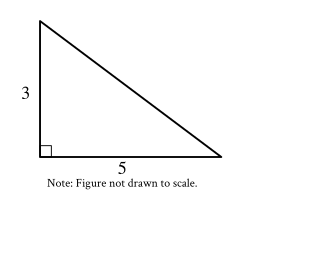
    One angle is a right angle. The lengths of the 2 sides adjacent to the right angle are as follows: 3 5 A note indicates the figure is not drawn to scale. The figure shows the lengths, in inches, of two sides of a right triangle. What is the area of the triangle, in square inches?

    Correct answer: C

    The correct answer is \(15/2\). The area, \(A\), of a triangle is given by the formula \(A = 1 half b h\), where \(b\) is the length of the base of the triangle and \(h\) is the height of the triangle. In the right triangle shown, the length of the base of the triangle is \(5\) inches, and the height is \(3\) inches. It follows that \(b = 5\) and \(h = 3\). Substituting \(5\) for \(b\) and \(3\) for \(h\) in the formula \(A = 1 half b h\) yields \(A = 1 half(5)(3)\), which is equivalent to \(A = 1 half(15)\), or \(A = 15/2\). Therefore, the area of the triangle, in square inches, is \(15/2\). Note that 15/2 and 7.5 are examples of ways to enter a correct answer.
  54. Question 54

    A right circular cylinder has a volume of \(377\) cubic centimeters. The area of the base of the cylinder is \(13\) square centimeters. What is the height, in centimeters, of the cylinder?

    Correct answer: B

    The correct answer is \(29\). The volume, \(V\), of a right circular cylinder is given by the formula \(V =π r ^2 h\), where \(r\) is the radius of the base of the cylinder and \(h\) is the height of the cylinder. Since the base of the cylinder is a circle with radius \(r\), the area of the base of the cylinder is \(π r ^2\). It's given that a right circular cylinder has a volume of \(377\) cubic centimeters; therefore, \(V = 377\). It's also given that the area of the base of the cylinder is \(13\) square centimeters; therefore, \(π r ^2 = 13\). Substituting \(377\) for \(V\) and \(13\) for \(π r ^2\) in the formula \(V =π r ^2 h\) yields \(377 = 13 h\). Dividing both sides of this equation by \(13\) yields \(29 = h\). Therefore, the height of the cylinder, in centimeters, is \(29\).
  55. Question 55

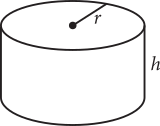
    The figure shown is a right circular cylinder with a radius of \(r\) and height of \(h\). A second right circular cylinder (not shown) has a volume that is \(392\) times as large as the volume of the cylinder shown. Which of the following could represent the radius \(R\), in terms of \(r\), and the height \(H\), in terms of \(h\), of the second cylinder?

    Correct answer: C

    Choice C is correct. The volume of a right circular cylinder is equal to \(π a ^2 b\), where \(a\) is the radius of a base of the cylinder and \(b\) is the height of the cylinder. It’s given that the cylinder shown has a radius of \(r\) and a height of \(h\). It follows that the volume of the cylinder shown is equal to \(π r ^2 h\). It’s given that the second right circular cylinder has a radius of \(R\) and a height of \(H\). It follows that the volume of the second cylinder is equal to \(π R ^2 H\). Choice C gives \(R = 7 r\) and \(H = 8 h\). Substituting \(7 r\) for \(R\) and \(8 h\) for \(H\) in the expression that represents the volume of the second cylinder yields \(π(7 r)^2(8 h)\), or \(π(49 r ^2)(8 h)\), which is equivalent to \(π(392 r ^2 h)\), or \(392(π r ^2 h)\). This expression is equal to \(392\) times the volume of the cylinder shown, \(π r ^2 h\). Therefore, \(R = 7 r\) and \(H = 8 h\) could represent the radius \(R\), in terms of \(r\), and the height \(H\), in terms of \(h\), of the second cylinder. Choice A is incorrect. Substituting \(8 r\) for \(R\) and \(7 h\) for \(H\) in the expression that represents the volume of the second cylinder yields \(π(8 r)^2(7 h)\), or \(π(64 r ^2)(7 h)\), which is equivalent to \(π(448 r ^2 h)\), or \(448(π r ^2 h)\). This expression is equal to \(448\), not \(392\), times the volume of the cylinder shown. Choice B is incorrect. Substituting \(8 r\) for \(R\) and \(49 h\) for \(H\) in the expression that represents the volume of the second cylinder yields \(π(8 r)^2(49 h)\), or \(π(64 r ^2)(49 h)\), which is equivalent to \(π(3,136 r ^2 h)\), or \(3,136(π r ^2 h)\). This expression is equal to \(3,136\), not \(392\), times the volume of the cylinder shown. Choice D is incorrect. Substituting \(49 r\) for \(R\) and \(8 h\) for \(H\) in the expression that represents the volume of the second cylinder yields \(π(49 r)^2(8 h)\), or \(π(2,401 r ^2)(8 h)\), which is equivalent to \(π(19,208 r ^2 h)\), or \(19,208(π r ^2 h)\). This expression is equal to \(19,208\), not \(392\), times the volume of the cylinder shown.
  56. Question 56

    A cube has an edge length of \(68\) inches. A solid sphere with a radius of \(34\) inches is inside the cube, such that the sphere touches the center of each face of the cube. To the nearest cubic inch, what is the volume of the space in the cube not taken up by the sphere?

    Correct answer: A

    Choice A is correct. The volume of a cube can be found by using the formula \(V = s cubed\), where \(V\) is the volume and \(s\) is the edge length of the cube. Therefore, the volume of the given cube is \(V = 68 cubed\), or \(314,432\) cubic inches. The volume of a sphere can be found by using the formula \(V = 4 thirdsπ r cubed\), where \(V\) is the volume and \(r\) is the radius of the sphere. Therefore, the volume of the given sphere is \(V = 4 thirdsπ(34)cubed\), or approximately \(164,636\) cubic inches. The volume of the space in the cube not taken up by the sphere is the difference between the volume of the cube and volume of the sphere. Subtracting the approximate volume of the sphere from the volume of the cube gives \(314,432 -164,636 = 149,796\) cubic inches. Choice B is incorrect and may result from conceptual or calculation errors. Choice C is incorrect and may result from conceptual or calculation errors. Choice D is incorrect and may result from conceptual or calculation errors.
  57. Question 57

    What is the volume, in cubic centimeters, of a right rectangular prism that has a length of 4 centimeters, a width of 9 centimeters, and a height of 10 centimeters?

    Correct answer: C

    The correct answer is 360. The volume of a right rectangular prism is calculated by multiplying its dimensions: length, width, and height. Multiplying the values given for these dimensions yields a volume of cubic centimeters.
  58. Question 58

    A circle has a radius of \(43\) meters. What is the area, in square meters, of the circle?

    Correct answer: D

    Choice D is correct. The area, \(A\), of a circle is given by the formula \(A =π r ^2\), where \(r\) is the radius of the circle. It’s given that the circle has a radius of \(43\) meters. Substituting \(43\) for \(r\) in the formula \(A =π r ^2\) yields \(A =π(43)^2\), or \(A = 1,849π\). Therefore, the area, in square meters, of the circle is \(1,849π\). Choice A is incorrect. This is the area, in square meters, of a circle with a radius of \(√43/2\) meters. Choice B is incorrect. This is the area, in square meters, of a circle with a radius of \(√43\) meters. Choice C is incorrect. This is the circumference, in meters, of the circle.
  59. Question 59

    The area of a square is \(64\) square inches. What is the side length, in inches, of this square?

    Correct answer: A

    Choice A is correct. It's given that the area of a square is \(64\) square inches. The area \(A\), in square inches, of a square is given by the formula \(A = s ^2\), where \(s\) is the side length, in inches, of the square. Substituting \(64\) for \(A\) in this formula yields \(64 = s ^2\). Taking the positive square root of both sides of this equation yields \(8 = s\). Thus, the side length, in inches, of this square is \(8\). Choice B is incorrect and may result from conceptual or calculation errors. Choice C is incorrect. This is the area, in square inches, of the square, not the side length, in inches, of the square. Choice D is incorrect and may result from conceptual or calculation errors.
  60. Question 60

    Square X has a side length of \(12\) centimeters. The perimeter of square Y is \(2\) times the perimeter of square X. What is the length, in centimeters, of one side of square Y?

    Correct answer: D

    Choice D is correct. The perimeter, \(P\), of a square can be found using the formula \(P = 4 s\), where \(s\) is the length of each side of the square. It's given that square X has a side length of \(12\) centimeters. Substituting \(12\) for \(s\) in the formula for the perimeter of a square yields \(P = 4(12)\), or \(P = 48\). Therefore, the perimeter of square X is \(48\) centimeters. It’s also given that the perimeter of square Y is \(2\) times the perimeter of square X. Therefore, the perimeter of square Y is \(2(48)\), or \(96\), centimeters. Substituting \(96\) for \(P\) in the formula \(P = 4 s\) gives \(96 = 4 s\). Dividing both sides of this equation by \(4\) gives \(24 = s\). Therefore, the length of one side of square Y is \(24\) centimeters. Choice A is incorrect and may result from conceptual or calculation errors. Choice B is incorrect and may result from conceptual or calculation errors. Choice C is incorrect and may result from conceptual or calculation errors.
  61. Question 61

    A right square prism has a height of \(14\) units. The volume of the prism is \(2,016\) cubic units. What is the length, in units, of an edge of the base?

    Correct answer: B

    The correct answer is \(12\). The volume, \(V\), of a right square prism can be calculated using the formula \(V = s ^2 h\), where \(s\) represents the length of an edge of the base and \(h\) represents the height of the prism. It’s given that the volume of the prism is \(2,016\) cubic units and the height is \(14\) units. Substituting \(2,016\) for \(V\) and \(14\) for \(h\) in the formula \(V = s ^2 h\) yields \(2,016 =(s ^2)(14)\). Dividing both sides of this equation by \(14\) yields \(144 = s ^2\). Taking the square root of both sides of this equation yields two solutions: \(-12 = s\) and \(12 = s\). The length can't be negative, so \(12 = s\). Therefore, the length, in units, of an edge of the base is \(12\).
  62. Question 62

    What is the length of one side of a square that has the same area as a circle with radius 2 ?

    Correct answer: C

    Choice C is correct. The area A of a circle with radius r is given by the formula . Thus, a circle with radius 2 has area, which can be rewritten as . The area of a square with side length s is given by the formula . Thus, if a square has the same area as a circle with radius 2, then . Since the side length of a square must be a positive number, taking the square root of both sides of gives . Using the properties of square roots, can be rewritten as, which is equivalent to . Therefore, .Choice A is incorrect. The side length of the square isn’t equal to the radius of the circle. Choices B and D are incorrect and may result from incorrectly simplifying the expression .
  63. Question 63

    The side length of a square is \(55 centimeters(cm)\). What is the area, \(in cm^2\), of the square?

    Correct answer: C

    Choice C is correct. The area \(A\), \(in square centimeters(cm ^2)\), of a square with side length \(s\), \(in cm\), is given by the formula \(A = s ^2\). It’s given that the square has a side length of \(55 cm\). Substituting \(55\) for \(s\) in the formula \(A = s ^2\) yields \(A = 55 ^2\), or \(A = 3,025\). Therefore, the area, \(in cm ^2\), of the square is \(3,025\). Choice A is incorrect and may result from conceptual or calculation errors. Choice B is incorrect. This is the perimeter, \(in cm\), of the square, not its area, \(in cm ^2\). Choice D is incorrect and may result from conceptual or calculation errors.
  64. Question 64

    What is the area, in square inches, of a rectangle with a length of \(7\) inches and a width of \(6\) inches?

    Correct answer: C

    Choice C is correct. The area, \(A\), of a rectangle is given by the formula \(A = ell w\), where \(ell\) represents the length of the rectangle and \(w\) represents its width. It’s given that the rectangle has a length of \(7\) inches and a width of \(6\) inches. Substituting \(7\) for \(ell\) and \(6\) for \(w\) in the formula \(A = ell w\) yields \(A =(7)(6)\), or \(A = 42\). Thus, the area, in square inches, of the rectangle is \(42\). Choice A is incorrect. This is the sum, not the product, of the length and width of the rectangle. Choice B is incorrect and may result from conceptual or calculation errors. Choice D is incorrect. This is twice the area, in square inches, of the rectangle.
  65. Question 65

    Square A has side lengths that are \(166\) times the side lengths of square B. The area of square A is \(k\) times the area of square B. What is the value of \(k\)?

    Correct answer: A

    The correct answer is \(27,556\). The area of a square is \(s ^2\), where \(s\) is the side length of the square. Let \(x\) represent the length of each side of square B. Substituting \(x\) for \(s\) in \(s ^2\) yields \(x ^2\). It follows that the area of square B is \(x ^2\). It’s given that square A has side lengths that are \(166\) times the side lengths of square B. Since \(x\) represents the length of each side of square B, the length of each side of square A can be represented by the expression \(166 x\). It follows that the area of square A is \((166 x)^2\), or \(27,556 x ^2\). It’s given that the area of square A is \(k\) times the area of square B. Since the area of square A is equal to \(27,556 x ^2\), and the area of square B is equal to \(x ^2\), an equation representing the given statement is \(27,556 x ^2 = k x ^2\). Since \(x\) represents the length of each side of square B, the value of \(x\) must be positive. Therefore, the value of \(x ^2\) is also positive, so it does not equal \(0\). Dividing by \(x ^2\) on both sides of the equation \(27,556 x ^2 = k x ^2\) yields \(27,556 = k\). Therefore, the value of \(k\) is \(27,556\).
  66. Question 66

    A right circular cylinder has a volume of \(45π\). If the height of the cylinder is 5, what is the radius of the cylinder?

    Correct answer: A

    Choice A is correct. The volume of a right circular cylinder with a radius of r is the product of the area of the base,, and the height, h. The volume of the right circular cylinder described is and its height is 5. If the radius is r, it follows that . Dividing both sides of this equation by yields . Taking the square root of both sides yields or . Since r represents the radius, the value must be positive. Therefore, the radius is 3.Choice B is incorrect and may result from finding that the square of the radius is 9, but then from dividing 9 by 2, rather than taking the square root of 9. Choice C is incorrect. This represents the square of the radius. Choice D is incorrect and may result from solving the equation for, not r, by dividing by on both sides and then by subtracting, not dividing, 5 from both sides.
  67. Question 67

    The length of each edge of a box is \(2\) inches. Each side of the box is in the shape of a square. The box does not have a lid. What is the exterior surface area, in square inches, of this box without a lid?

    Correct answer: B

    The correct answer is \(4,205\). The exterior surface area of a figure is the sum of the areas of all its faces. It's given that the box does not have a lid and that each side of the box is in the shape of a square. Therefore, the box consists of \(5\) congruent square faces. It's also given that the length of each edge is \(29\) inches. Let \(s\) represent the length of an edge of a square. It follows that the area of a square is equal to \(s ^2\). Therefore, the area of each of the \(5\) square faces is equal to \(29 ^2\), or \(841\), square inches. Since the box consists of \(5\) congruent square faces, it follows that the sum of the areas of all its faces, or the exterior surface area of this box without a lid, is \(5(841)\), or \(4,205\), square inches.

About this practice test

SAT Full Math - Area and Volume Questions by CollegeBoard.

Want a higher score?

One-on-one tutoring for SAT, online or in person, with a plan built around the questions you missed.

Get Started

Book Your Free Session

5.0
from 38 Google reviews

Call or Text 1 (888) 356-0607