Skip to content

SAT practice test

Right triangles and trigonometry

  • 44 questions
  • Untimed
  • Answers and explanations
Embed on your site
  • 44 questions
  • No time limit
  • Every answer explained at the end
  1. Question 1

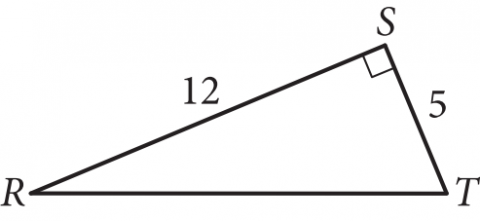
    A triangle with angle measures 30°, 60°, and 90° has a perimeter of . What is the length of the longest side of the triangle?

    Correct answer: B

    The correct answer is 12. It is given that the triangle has angle measures of 30°, 60°, and 90°, and so the triangle is a special right triangle. The side measures of this type of special triangle are in the ratio . If x is the measure of the shortest leg, then the measure of the other leg is and the measure of the hypotenuse is 2x. The perimeter of the triangle is given to be, and so the equation for the perimeter can be written as . Combining like terms and factoring out a common factor of x on the left-hand side of the equation gives . Rewriting the right-hand side of the equation by factoring out 6 gives . Dividing both sides of the equation by the common factor gives x = 6. The longest side of the right triangle, the hypotenuse, has a length of 2x, or 2(6), which is 12.
  2. Question 2

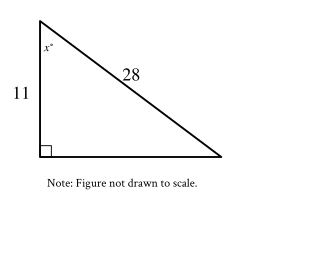
    One angle is a right angle. The measure of a second angle is x°. The length of the hypotenuse is 28. The length of the leg adjacent to the angle with measure x° is 11. A note indicates the figure is not drawn to scale. In the triangle shown, what is the value of \(cosine(x)°\)?

    Correct answer: B

    The correct answer is \(11/28\). The cosine of an acute angle in a right triangle is defined as the ratio of the length of the leg adjacent to the angle to the length of the hypotenuse. In the triangle shown, the length of the leg adjacent to the angle with measure \(x °\) is \(11\) units and the length of the hypotenuse is \(28\) units. Therefore, the value of \(cosine x °\) is \(11/28\). Note that 11/28, .3928, .3929, 0.392, and 0.393 are examples of ways to enter a correct answer.
  3. Question 3

    In triangle \(J K L\), \(cosine( K)= 24/51\) and angle \(J\) is a right angle. What is the value of \(cosine( L)\)?

    Correct answer: A

    The correct answer is \(15/17\). It's given that angle \(J\) is the right angle in triangle \(J K L\). Therefore, the acute angles of triangle \(J K L\) are angle \(K\) and angle \(L\). The hypotenuse of a right triangle is the side opposite its right angle. Therefore, the hypotenuse of triangle \(J K L\) is side \(K L\). The cosine of an acute angle in a right triangle is the ratio of the length of the side adjacent to the angle to the length of the hypotenuse. It's given that \(cosine( K)= 24/51\). This can be written as \(cosine( K)= 8 seventeenths\). Since the cosine of angle \(K\) is a ratio, it follows that the length of the side adjacent to angle \(K\) is \(8 n\) and the length of the hypotenuse is \(17 n\), where \(n\) is a constant. Therefore, \(J K = 8 n\) and \(K L = 17 n\). The Pythagorean theorem states that in a right triangle, the square of the length of the hypotenuse is equal to the sum of the squares of the lengths of the other two sides. For triangle \(J K L\), it follows that \(( J K)^2 +( J L)^2 =( K L)^2\). Substituting \(8 n\) for \(J K\) and \(17 n\) for \(K L\) yields \((8 n)^2 +( J L)^2 =(17 n)^2\). This is equivalent to \(64 n ^2 +( J L)^2 = 289 n ^2\). Subtracting \(64 n ^2\) from each side of this equation yields \(( J L)^2 = 225 n ^2\). Taking the square root of each side of this equation yields \(J L = 15 n\). Since \(cosine( L)= \ J L/ K L\), it follows that \(cosine( L)= 15 n/17 n\), which can be rewritten as \(cosine( L)= 15/17\). Note that 15/17, .8824, .8823, and 0.882 are examples of ways to enter a correct answer.
  4. Question 4

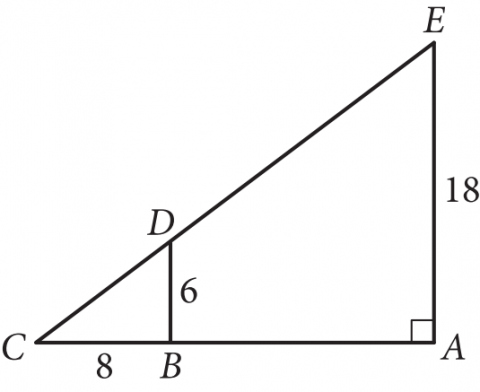
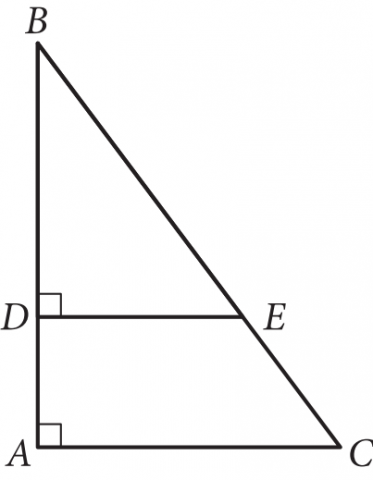
    In the figure above, BD is parallel to AE . What is the length of CE?

    Correct answer: A

    The correct answer is 30. In the figure given, since is parallel to and both segments are intersected by, then angle BDC and angle AEC are corresponding angles and therefore congruent. Angle BCD and angle ACE are also congruent because they are the same angle. Triangle BCD and triangle ACE are similar because if two angles of one triangle are congruent to two angles of another triangle, the triangles are similar. Since triangle BCD and triangle ACE are similar, their corresponding sides are proportional. So in triangle BCD and triangle ACE, corresponds to and corresponds to . Therefore, . Since triangle BCD is a right triangle, the Pythagorean theorem can be used to give the value of CD: . Taking the square root of each side gives . Substituting the values in the proportion yields . Multiplying each side by CE, and then multiplying by yields . Therefore, the length of is 30.
  5. Question 5

    Triangle \(A B C\) is similar to triangle \(D E F\), where angle \(A\) corresponds to angle \(D\) and angle \(C\) corresponds to angle \(F\). Angles \(C\) and \(F\) are right angles. If \(tangent(A)= 50/7\), what is the value of \(tangent(E)\)?

    Correct answer: C

    The correct answer is \(7 fiftieths\). It's given that triangle \(A B C\) is similar to triangle \(D E F\), where angle \(A\) corresponds to angle \(D\) and angle \(C\) corresponds to angle \(F\). In similar triangles, the tangents of corresponding angles are equal. Since angle \(A\) and angle \(D\) are corresponding angles, if \(tangent(A)= 50/7\), then \(tangent(D)= 50/7\). It's also given that angles \(C\) and \(F\) are right angles. It follows that triangle \(D E F\) is a right triangle with acute angles \(D\) and \(E\). The tangent of one acute angle in a right triangle is the inverse of the tangent of the other acute angle in the triangle. Therefore, \(tangent(E)= 1/tangent(D)\). Substituting \(50/7\) for \(tangent(D)\) in this equation yields \(tangent(E)= 1/50/7\), or \(tangent(E)= 7 fiftieths\). Thus, if \(tangent(A)= 50/7\), the value of \(tangent(E)\) is \(7 fiftieths\). Note that 7/50 and .14 are examples of ways to enter a correct answer.
  6. Question 6

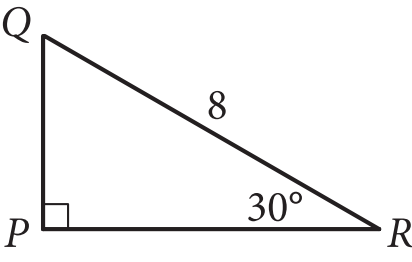
    In the right triangle shown above, what is the length of ?

    Correct answer: A

    The correct answer is 4. Triangle PQR has given angle measures of 30° and 90°, so the third angle must be 60° because the measures of the angles of a triangle sum to 180°. For any special right triangle with angles measuring 30°, 60°, and 90°, the length of the hypotenuse (the side opposite the right angle) is 2x, where x is the length of the side opposite the 30° angle. Segment PQ is opposite the 30° angle. Therefore, 2(PQ) = 8 and PQ = 4.
  7. Question 7

    In a right triangle, the tangent of one of the two acute angles is . What is the tangent of the other acute angle?

    Correct answer: D

    Choice D is correct. The tangent of a nonright angle in a right triangle is defined as the ratio of the length of the leg opposite the angle to the length of the leg adjacent to the angle. Using that definition for tangent, in a right triangle with legs that have lengths a and b, the tangent of one acute angle is and the tangent for the other acute angle is . It follows that the tangents of the acute angles in a right triangle are reciprocals of each other. Therefore, the tangent of the other acute angle in the given triangle is the reciprocal of or .Choice A is incorrect and may result from assuming that the tangent of the other acute angle is the -of the tangent of the angle described. Choice B is incorrect and may result from assuming that the tangent of the other acute angle is the -of the reciprocal of the tangent of the angle described. Choice C is incorrect and may result from interpreting the tangent of the other acute angle as equal to the tangent of the angle described.
  8. Question 8

    Triangle \(A B C\) is similar to triangle \(D E F\), where angle \(A\) corresponds to angle \(D\) and angles \(C\) and \(F\) are right angles. The length of \(line segment A B\) is \(2.9\) times the length of \(line segment D E\). If \(tangent A = 21/20\), what is the value of \(sine D\)?

    Correct answer: A

    The correct answer is \(21/29\). It's given that triangle \(A B C\) is similar to triangle \(D E F\), where angle \(A\) corresponds to angle \(D\) and angles \(C\) and \(F\) are right angles. In similar triangles, the tangents of corresponding angles are equal. Therefore, if \(tangent A = 21/20\), then \(tangent D = 21/20\). In a right triangle, the tangent of an acute angle is the ratio of the length of the leg opposite the angle to the length of the leg adjacent to the angle. Therefore, in triangle \(D E F\), if \(tangent D = 21/20\), the ratio of the length of \(line segment E F\) to the length of \(line segment D F\) is \(21/20\). If the lengths of \(line segment E F\) and \(line segment D F\) are \(21\) and \(20\), respectively, then the ratio of the length of \(line segment E F\) to the length of \(line segment D F\) is \(21/20\). In a right triangle, the sine of an acute angle is the ratio of the length of the leg opposite the angle to the length of the hypotenuse. Therefore, the value of \(sine D\) is the ratio of the length of \(line segment E F\) to the length of \(line segment D E\). The length of \(line segment D E\) can be calculated using the Pythagorean theorem, which states that if the lengths of the legs of a right triangle are \(a\) and \(b\) and the length of the hypotenuse is \(c\), then \(a ^2 + b ^2 = c ^2\). Therefore, if the lengths of \(line segment E F\) and \(line segment D F\) are \(21\) and \(20\), respectively, then \((21)^2 +(20)^2 =(D E)^2\), or \(841 =(D E)^2\). Taking the positive square root of both sides of this equation yields \(29 = D E\). Therefore, if the lengths of \(line segment E F\) and \(line segment D F\) are \(21\) and \(20\), respectively, then the length of \(line segment D E\) is \(29\) and the ratio of the length of \(line segment E F\) to the length of \(line segment D E\) is \(21/29\). Thus, if \(tangent A = 21/20\), the value of \(sine D\) is \(21/29\). Note that 21/29, .7241, and 0.724 are examples of ways to enter a correct answer.
  9. Question 9

    A square is inscribed in a circle. The radius of the circle is \(20 √2 /2\) inches. What is the side length, in inches, of the square?

    Correct answer: A

    Choice A is correct. When a square is inscribed in a circle, a diagonal of the square is a diameter of the circle. It's given that a square is inscribed in a circle and the length of a radius of the circle is \(20 √2 /2\) inches. Therefore, the length of a diameter of the circle is \(2(20 √2 /2)\) inches, or \(20 √2\) inches. It follows that the length of a diagonal of the square is \(20 √2\) inches. A diagonal of a square separates the square into two right triangles in which the legs are the sides of the square and the hypotenuse is a diagonal. Since a square has \(4\) congruent sides, each of these two right triangles has congruent legs and a hypotenuse of length \(20 √2\) inches. Since each of these two right triangles has congruent legs, they are both \(45\)-\(45\)-\(90\) triangles. In a \(45\)-\(45\)-\(90\) triangle, the length of the hypotenuse is \(√2\) times the length of a leg. Let \(s\) represent the length of a leg of one of these \(45\)-\(45\)-\(90\) triangles. It follows that \(20 √2 = √2 (s)\). Dividing both sides of this equation by \(√2\) yields \(20 = s\). Therefore, the length of a leg of one of these \(45\)-\(45\)-\(90\) triangles is \(20\) inches. Since the legs of these two \(45\)-\(45\)-\(90\) triangles are the sides of the square, it follows that the side length of the square is \(20\) inches. Choice B is incorrect. This is the length of a radius, in inches, of the circle. Choice C is incorrect. This is the length of a diameter, in inches, of the circle. Choice D is incorrect and may result from conceptual or calculation errors.
  10. Question 10

    The length of a rectangle’s diagonal is \(517\), and the length of the rectangle’s shorter side is \(5\). What is the length of the rectangle’s longer side?

    Correct answer: B

    Choice B is correct. A rectangle’s diagonal divides a rectangle into two congruent right triangles, where the diagonal is the hypotenuse of both triangles. It’s given that the length of the diagonal is \(5 √17\) and the length of the rectangle’s shorter side is \(5\). Therefore, each of the two right triangles formed by the rectangle’s diagonal has a hypotenuse with length \(5 √17\), and a shorter leg with length \(5\). To calculate the length of the longer leg of each right triangle, the Pythagorean theorem, \(a ^2 + b ^2 = c ^2\), can be used, where \(a\) and \(b\) are the lengths of the legs and \(c\) is the length of the hypotenuse of the triangle. Substituting \(5\) for \(a\) and \(5 √17\) for \(c\) in the equation \(a ^2 + b ^2 = c ^2\) yields \(5 ^2 + b ^2 =(5 √17 )^2\), which is equivalent to \(25 + b ^2 = 25(17)\), or \(25 + b ^2 = 425\). Subtracting \(25\) from each side of this equation yields \(b ^2 = 400\). Taking the positive square root of each side of this equation yields \(b = 20\). Therefore, the length of the longer leg of each right triangle formed by the diagonal of the rectangle is \(20\). It follows that the length of the rectangle’s longer side is \(20\). Choice A is incorrect and may result from dividing the length of the rectangle’s diagonal by the length of the rectangle’s shorter side, rather than substituting these values into the Pythagorean theorem. Choice C is incorrect and may result from using the length of the rectangle’s diagonal as the length of a leg of the right triangle, rather than the length of the hypotenuse. Choice D is incorrect. This is the square of the length of the rectangle’s longer side.
  11. Question 11

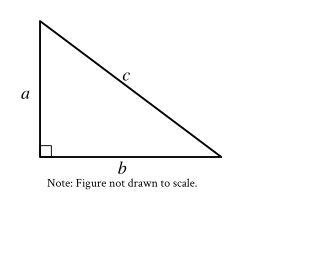
    The side lengths are labeled as follows: a b c The angle opposite the side labeled c is a right angle. A note indicates the figure is not drawn to scale. For the right triangle shown, \(a = 4\) and \(b = 5\). Which expression represents the value of \(c\)?

    Correct answer: D

    Choice D is correct. By the Pythagorean theorem, if a right triangle has a hypotenuse with length \(c\) and legs with lengths \(a\) and \(b\), then \(c ^2 = a ^2 + b ^2\). In the right triangle shown, the hypotenuse has length \(c\) and the legs have lengths \(a\) and \(b\). It's given that \(a = 4\) and \(b = 5\). Substituting \(4\) for \(a\) and \(5\) for \(b\) in the Pythagorean theorem yields \(c ^2 = 4 ^2 + 5 ^2\). Taking the square root of both sides of this equation yields \(c = + or -√4 ^2 + 5 ^2\). Since the length of a side of a triangle must be positive, the value of \(c\) is \(√4 ^2 + 5 ^2\). Choice A is incorrect and may result from conceptual or calculation errors. Choice B is incorrect and may result from conceptual or calculation errors. Choice C is incorrect and may result from conceptual or calculation errors.
  12. Question 12

    Which of the following expressions is equivalent to \((sine 24 °)(cosine 66 °)+(cosine 24 °)(sine 66 °)\)?

    Correct answer: C

    Choice C is correct. The sine of an angle is equal to the cosine of its complementary angle. Since angles with measures \(24 °\) and \(66 °\) are complementary to each other, \(sine 24 °\) is equal to \(cosine 66 °\) and \(sine 66 °\) is equal to \(cosine 24 °\). Substituting \(cosine 66 °\) for \(sine 24 °\) and \(cosine 24 °\) for \(sine 66 °\) in the given expression yields \((cosine 66 °)(cosine 66 °)+(cosine 24 °)(cosine 24 °)\), or \((cosine 66 °)^2 +(cosine 24 °)^2\). Choice A is incorrect and may result from conceptual or calculation errors. Choice B is incorrect and may result from conceptual or calculation errors. Choice D is incorrect and may result from conceptual or calculation errors.
  13. Question 13

    The length of a rectangle’s diagonal is \(3 √17\), and the length of the rectangle’s shorter side is \(3\). What is the length of the rectangle’s longer side?

    Correct answer: A

    The correct answer is \(12\). The diagonal of a rectangle forms a right triangle, where the shorter side and the longer side of the rectangle are the legs of the triangle and the diagonal of the rectangle is the hypotenuse of the triangle. It's given that the length of the rectangle's diagonal is \(3 √17\) and the length of the rectangle's shorter side is \(3\). Thus, the length of the hypotenuse of the right triangle formed by the diagonal is \(3 √17\) and the length of one of the legs is \(3\). By the Pythagorean theorem, if a right triangle has a hypotenuse with length \(c\) and legs with lengths \(a\) and \(b\), then \(a ^2 + b ^2 = c ^2\). Substituting \(3 √17\) for \(c\) and \(3\) for \(b\) in this equation yields \(a ^2 +(3)^2 =(3 √17 )^2\), or \(a ^2 + 9 = 153\). Subtracting \(9\) from both sides of this equation yields \(a ^2 = 144\). Taking the square root of both sides of this equation yields \(a = + or -√144\), or \(a = + or -12\). Since \(a\) represents a length, which must be positive, the value of \(a\) is \(12\). Thus, the length of the rectangle's longer side is \(12\).
  14. Question 14

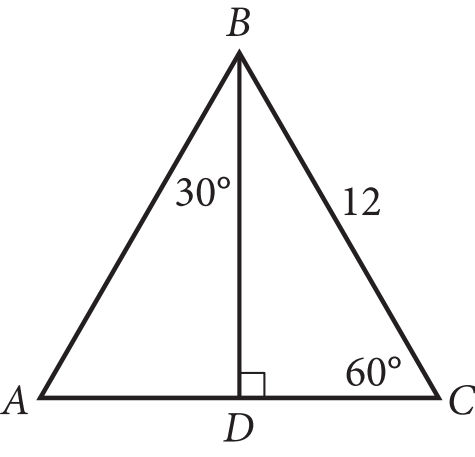
    In above, what is the length of ?

    Correct answer: B

    Choice B is correct. Triangles ADB and CDB are both triangles and share . Therefore, triangles ADB and CDB are congruent by the angle-side-angle postulate. Using the properties of triangles, the length of is half the length of hypotenuse . Since the triangles are congruent, . So the length of is .Alternate approach: Since angle CBD has a measure of, angle ABC must have a measure of . It follows that triangle ABC is equilateral, so side AC also has length 12. It also follows that the altitude BD is also a median, and therefore the length of AD is half of the length of AC, which is 6.Choice A is incorrect. If the length of were 4, then the length of would be 8. However, this is incorrect because is congruent to, which has a length of 12. Choices C and D are also incorrect. Following the same procedures as used to test choice A gives a length of for choice C and for choice D. However, these results cannot be true because is congruent to, which has a length of 12.
  15. Question 15

    A right triangle has legs with lengths of \(11\) centimeters and \(9\) centimeters. What is the length of this triangle's hypotenuse, in centimeters?

    Correct answer: B

    Choice B is correct. The Pythagorean theorem states that for a right triangle, \(c ^2 = a ^2 + b ^2\), where \(c\) represents the length of the hypotenuse and \(a\) and \(b\) represent the lengths of the legs. It’s given that a right triangle has legs with lengths of \(11\) centimeters and \(9\) centimeters. Substituting \(11\) for \(a\) and \(9\) for \(b\) in the formula \(c ^2 = a ^2 + b ^2\) yields \(c ^2 = 11 ^2 + 9 ^2\), which is equivalent to \(c ^2 = 121 + 81\), or \(c ^2 = 202\). Taking the square root of each side of this equation yields \(c = + or -√202\). Since \(c\) represents a length, \(c\) must be positive. Therefore, the length of the triangle’s hypotenuse, in centimeters, is \(√202\). Choice A is incorrect. This is the result of solving the equation \(c ^2 = 11(2)+ 9(2)\), not \(c ^2 = 11 ^2 + 9 ^2\). Choice C is incorrect. This is the result of solving the equation \(c(2)= 11(2)+ 9(2)\), not \(c ^2 = 11 ^2 + 9 ^2\). Choice D is incorrect. This is the result of solving the equation \(c = 11 ^2 + 9 ^2\), not \(c ^2 = 11 ^2 + 9 ^2\).
  16. Question 16

    Triangle \(A B C\) is similar to triangle \(D E F\), where \(A\) corresponds to \(D\) and \(C\) corresponds to \(F\). Angles \(C\) and \(F\) are right angles. If \(tangent(A)= √3\) and \(D F = 125\), what is the length of \(line segment D E\)?

    Correct answer: D

    Choice D is correct. Corresponding angles in similar triangles have equal measures. It's given that triangle \(A B C\) is similar to triangle \(D E F\), where \(A\) corresponds to \(D\), so the measure of angle \(A\) is equal to the measure of angle \(D\). Therefore, if \(tangent(A)= √3\), then \(tangent(D)= √3\). It's given that angles \(C\) and \(F\) are right angles, so triangles \(A B C\) and \(D E F\) are right triangles. The adjacent side of an acute angle in a right triangle is the side closest to the angle that is not the hypotenuse. It follows that the adjacent side of angle \(D\) is side \(D F\). The opposite side of an acute angle in a right triangle is the side across from the acute angle. It follows that the opposite side of angle \(D\) is side \(E F\). The tangent of an acute angle in a right triangle is the ratio of the length of the opposite side to the length of the adjacent side. Therefore, \(tangent(D)= E F/D F\). If \(D F = 125\), the length of side \(E F\) can be found by substituting \(√3\) for \(tangent(D)\) and \(125\) for \(D F\) in the equation \(tangent(D)= E F/D F\), which yields \(√3 = E F/125\). Multiplying both sides of this equation by \(125\) yields \(125 √3 = E F\). Since the length of side \(E F\) is \(√3\) times the length of side \(D F\), it follows that triangle \(D E F\) is a special right triangle with angle measures \(30 °\), \(60 °\), and \(90 °\). Therefore, the length of the hypotenuse, \(line segment D E\), is \(2\) times the length of side \(D F\), or \(D E = 2(D F)\). Substituting \(125\) for \(D F\) in this equation yields \(D E = 2(125)\), or \(D E = 250\). Thus, if \(tangent(A)= √3\) and \(D F = 125\), the length of \(line segment D E\) is \(250\). Choice A is incorrect and may result from conceptual or calculation errors. Choice B is incorrect and may result from conceptual or calculation errors. Choice C is incorrect. This is the length of \(line segment E F\), not \(line segment D E\).
  17. Question 17

    A right triangle has legs with lengths of \(28\) centimeters and \(20\) centimeters. What is the length of this triangle's hypotenuse, in centimeters?

    Correct answer: B

    Choice B is correct. The Pythagorean theorem states that in a right triangle, the sum of the squares of the lengths of the two legs is equal to the square of the length of the hypotenuse. It's given that the right triangle has legs with lengths of \(28\) centimeters and \(20\) centimeters. Let \(c\) represent the length of this triangle's hypotenuse, in centimeters. Therefore, by the Pythagorean theorem, \(28 ^2 + 20 ^2 = c ^2\), or \(1,184 = c ^2\). Taking the positive square root of both sides of this equation yields \(√1,184 = c\), or \(4 √74 = c\). Therefore, the length of this triangle's hypotenuse, in centimeters, is \(4 √74\). Choice A is incorrect and may result from conceptual or calculation errors. Choice C is incorrect and may result from conceptual or calculation errors. Choice D is incorrect. This is the square of the length of the triangle’s hypotenuse.
  18. Question 18

    In triangle RST above, point W (not shown) lies on . What is the value of ?

    Correct answer: B

    The correct answer is 0. Note that no matter where point W is on, the sum of the measures of and is equal to the measure of, which is . Thus, and are complementary angles. Since the cosine of an angle is equal to the sine of its complementary angle, . Therefore, .
  19. Question 19

    \(R S = 20\) \(S T = 48\) \(T R = 52\) The side lengths of right triangle \(R S T\) are given. Triangle \(R S T\) is similar to triangle \(U V W\), where \(S\) corresponds to \(V\) and \(T\) corresponds to \(W\). What is the value of \(tangent W\)?

    Correct answer: B

    Choice B is correct. It's given that right triangle \(R S T\) is similar to triangle \(U V W\), where \(S\) corresponds to \(V\) and \(T\) corresponds to \(W\). It's given that the side lengths of the right triangle \(R S T\) are \(R S = 20\), \(S T = 48\), and \(T R = 52\). Corresponding angles in similar triangles are equal. It follows that the measure of angle \(T\) is equal to the measure of angle \(W\). The hypotenuse of a right triangle is the longest side. It follows that the hypotenuse of triangle \(R S T\) is side \(T R\). The hypotenuse of a right triangle is the side opposite the right angle. Therefore, angle \(S\) is a right angle. The adjacent side of an acute angle in a right triangle is the side closest to the angle that is not the hypotenuse. It follows that the adjacent side of angle \(T\) is side \(S T\). The opposite side of an acute angle in a right triangle is the side across from the acute angle. It follows that the opposite side of angle \(T\) is side \(R S\). The tangent of an acute angle in a right triangle is the ratio of the length of the opposite side to the length of the adjacent side. Therefore, \(tangent T = R S/ S T\). Substituting \(20\) for \(R S\) and \(48\) for \(S T\) in this equation yields \(tangent T = 20/48\), or \(tangent T = 5 twelfths\). The tangents of two acute angles with equal measures are equal. Since the measure of angle \(T\) is equal to the measure of angle \(W\), it follows that \(tangent T = tangent W\). Substituting \(5 twelfths\) for \(tangent T\) in this equation yields \(5 twelfths = tangent W\). Therefore, the value of \(tangent W\) is \(5 twelfths\). Choice A is incorrect. This is the value of \(sine W\). Choice C is incorrect. This is the value of \(cosine W\). Choice D is incorrect. This is the value of \(1/tangent W\).
  20. Question 20

    A right triangle has legs with lengths of \(24\) centimeters and \(21\) centimeters. If the length of this triangle's hypotenuse, in centimeters, can be written in the form \(3 √d\), where \(d\) is an integer, what is the value of \(d\)?

    Correct answer: A

    The correct answer is \(113\). It's given that the legs of a right triangle have lengths \(24\) centimeters and \(21\) centimeters. In a right triangle, the square of the length of the hypotenuse is equal to the sum of the squares of the lengths of the two legs. It follows that if \(h\) represents the length, in centimeters, of the hypotenuse of the right triangle, \(h ^2 = 24 ^2 + 21 ^2\). This equation is equivalent to \(h ^2 = 1,017\). Taking the square root of each side of this equation yields \(h = √1,017\). This equation can be rewritten as \(h = √9 dot 113\), or \(h = √9 dot √113\). This equation is equivalent to \(h = 3 √113\). It's given that the length of the triangle's hypotenuse, in centimeters, can be written in the form \(3 √d\). It follows that the value of \(d\) is \(113\).
  21. Question 21

    \(R S = 440\) \(S T = 384\) \(T R = 584\) The side lengths of right triangle \(R S T\) are given. Triangle \(R S T\) is similar to triangle \(U V W\), where \(S\) corresponds to \(V\) and \(T\) corresponds to \(W\). What is the value of \(tangent W\)?

    Correct answer: D

    Choice D is correct. The hypotenuse of triangle \(R S T\) is the longest side and is across from the right angle. The longest side length given is \(584\), which is the length of side \(T R\). Therefore, the hypotenuse of triangle \(R S T\) is side \(T R\), so the right angle is angle \(S\). The tangent of an acute angle in a right triangle is the ratio of the length of the opposite side, which is the side across from the angle, to the length of the adjacent side, which is the side closest to the angle that is not the hypotenuse. It follows that the opposite side of angle \(T\) is side \(R S\) and the adjacent side of angle \(T\) is side \(S T\). Therefore, \(tangent T = \ R S/ S T\). Substituting \(440\) for \(R S\) and \(384\) for \(S T\) in this equation yields \(tangent T = 440/384\). This is equivalent to \(tangent T = 55/48\). It’s given that triangle \(R S T\) is similar to triangle \(U V W\), where \(S\) corresponds to \(V\) and \(T\) corresponds to \(W\). It follows that \(R\) corresponds to \(U\). Therefore, the hypotenuse of triangle \(U V W\) is side \(W U\), which means \(tangent W = \ U V/ V W\). Since the lengths of corresponding sides of similar triangles are proportional, \(\ R S/ S T = \ U V/ V W\). Therefore, \(tangent W = \ U V/ V W\) is equivalent to \(tangent W = \ R S/ S T\), or \(tangent W = tangent T\). Thus, \(tangent W = 55/48\). Choice A is incorrect. This is the value of \(cosine W\), not \(tangent W\). Choice B is incorrect. This is the value of \(sine W\), not \(tangent W\). Choice C is incorrect. This is the value of \(1/tangent W\), not \(tangent W\).
  22. Question 22

    An isosceles right triangle has a perimeter of \(94 + 94 √2\) inches. What is the length, in inches, of one leg of this triangle?

    Correct answer: B

    Choice B is correct. It's given that the right triangle is isosceles. In an isosceles right triangle, the two legs have equal lengths, and the length of the hypotenuse is \(√2\) times the length of one of the legs. Let \(ell\) represent the length, in inches, of each leg of the isosceles right triangle. It follows that the length of the hypotenuse is \(ell √2\) inches. The perimeter of a figure is the sum of the lengths of the sides of the figure. Therefore, the perimeter of the isosceles right triangle is \(ell + ell + ell √2\) inches. It's given that the perimeter of the triangle is \(94 + 94 √2\) inches. It follows that \(ell + ell + ell √2 = 94 + 94 √2\). Factoring the left-hand side of this equation yields \((1 + 1 + √2 )ell = 94 + 94 √2\), or \((2 + √2 )ell = 94 + 94 √2\). Dividing both sides of this equation by \(2 + √2\) yields \(ell = 94 + 94 √2 /2 + √2\). Rationalizing the denominator of the right-hand side of this equation by multiplying the right-hand side of the equation by \(2 -√2 /2 -√2\) yields \(ell = (94 + 94 √2 )(2 -√2 )/(2 + √2 )(2 -√2 )\). Applying the distributive property to the numerator and to the denominator of the right-hand side of this equation yields \(ell = 188 -94 √2 + 188 √2 -94 √4 /4 -2 √2 + 2 √2 -√4\). This is equivalent to \(ell = 94 √2 /2\), or \(ell = 47 √2\). Therefore, the length, in inches, of one leg of the isosceles right triangle is \(47 √2\). Choice A is incorrect and may result from conceptual or calculation errors. Choice C is incorrect. This is the length, in inches, of the hypotenuse. Choice D is incorrect and may result from conceptual or calculation errors.
  23. Question 23

    The perimeter of an equilateral triangle is \(852\) centimeters. The three vertices of the triangle lie on a circle. The radius of the circle is \(w √3\) centimeters. What is the value of \(w\)?

    Correct answer: C

    The correct answer is \(284/3\). Since the perimeter of a triangle is the sum of the lengths of its sides, and the given triangle is equilateral, the length of each side is \(852/3\), or \(284\), centimeters (cm). Right triangle \(A M O\) can be formed, where \(M\) is the midpoint of one of the triangle’s sides, \(A\) is one of this side’s endpoints, and \(O\) is the center of the circle. It follows that \(A M\) is \(284/2\), or \(142\), cm. Additionally, triangle \(A M O\) has angles measuring \(30 °\), \(60 °\), and \(90 °\), where the measure of angle \(O M A\) is \(90 °\) and the measure of angle \(O A M\) is \(30 °\). It follows that the length of side \(M O\) is half the length of hypotenuse \(A O\), and the length of side \(A M\) is \(√3\) times the length of side \(M O\). It’s given that \(A O = w √3\) cm. Therefore, \(M O = w √3 /2\) cm and \(A M = w √3 √3 /2\) cm, which is equivalent to \(A M = 3 w/2\) cm. Since \(A M = 142\) cm, it follows that \(3 w/2 = 142\). Multiplying both sides of this equation by \(2\) yields \(3 w = 284\). Dividing both sides of this equation by \(3\) yields \(w = 284/3\). Note that 284/3, 94.66, and 94.67 are examples of ways to enter a correct answer.
  24. Question 24

    One leg of a right triangle has a length of \(43.2\) millimeters. The hypotenuse of the triangle has a length of \(196.8\) millimeters. What is the length of the other leg of the triangle, in millimeters?

    Correct answer: C

    Choice C is correct. The Pythagorean theorem states that for a right triangle, the sum of the squares of the lengths of the two legs is equal to the square of the length of the hypotenuse. It's given that one leg of a right triangle has a length of \(43.2\) millimeters. It's also given that the hypotenuse of the triangle has a length of \(196.8\) millimeters. Let \(b\) represent the length of the other leg of the triangle, in millimeters. Therefore, by the Pythagorean theorem, \(43.2 ^2 + b ^2 = 196.8 ^2\), or \(1,866.24 + b ^2 = 38,730.24\). Subtracting \(1,866.24\) from both sides of this equation yields \(b ^2 = 36,864\). Taking the positive square root of both sides of this equation yields \(b = 192\). Therefore, the length of the other leg of the triangle, in millimeters, is \(192\). Choice A is incorrect and may result from conceptual or calculation errors. Choice B is incorrect and may result from conceptual or calculation errors. Choice D is incorrect and may result from conceptual or calculation errors.
  25. Question 25

    A rectangle is inscribed in a circle, such that each vertex of the rectangle lies on the circumference of the circle. The diagonal of the rectangle is twice the length of the shortest side of the rectangle. The area of the rectangle is \(1,089 √3\) square units. What is the length, in units, of the diameter of the circle?

    Correct answer: C

    The correct answer is \(66\). It's given that each vertex of the rectangle lies on the circumference of the circle. Therefore, the length of the diameter of the circle is equal to the length of the diagonal of the rectangle. The diagonal of a rectangle forms a right triangle with the shortest and longest sides of the rectangle, where the shortest side and the longest side of the rectangle are the legs of the triangle and the diagonal of the rectangle is the hypotenuse of the triangle. Let \(s\) represent the length, in units, of the shortest side of the rectangle. Since it's given that the diagonal is twice the length of the shortest side, \(2 s\) represents the length, in units, of the diagonal of the rectangle. By the Pythagorean theorem, if a right triangle has a hypotenuse with length \(c\) and legs with lengths \(a\) and \(b\), then \(a ^2 + b ^2 = c ^2\). Substituting \(s\) for \(a\) and \(2 s\) for \(c\) in this equation yields \(s ^2 + b ^2 =(2 s)^2\), or \(s ^2 + b ^2 = 4 s ^2\). Subtracting \(s ^2\) from both sides of this equation yields \(b ^2 = 3 s ^2\). Taking the positive square root of both sides of this equation yields\(b = s √3\). Therefore, the length, in units, of the rectangle’s longest side is \(s √3\). The area of a rectangle is the product of the length of the shortest side and the length of the longest side. The lengths, in units, of the shortest and longest sides of the rectangle are represented by \(s\) and \(s √3\), and it’s given that the area of the rectangle is \(1,089 √3\) square units. It follows that \(1,089 √3 = s(s √3 )\), or \(1,089 √3 = s ^2 √3\). Dividing both sides of this equation by \(√3\) yields \(1,089 = s ^2\). Taking the positive square root of both sides of this equation yields \(33 = s\). Since the length, in units, of the diagonal is represented by \(2 s\), it follows that the length, in units, of the diagonal is \(2(33)\), or \(66\). Since the length of the diameter of the circle is equal to the length of the diagonal of the rectangle, the length, in units, of the diameter of the circle is \(66\).
  26. Question 26

    An isosceles right triangle has a hypotenuse of length \(58\) inches. What is the perimeter, in inches, of this triangle?

    Correct answer: C

    Choice C is correct. Since the triangle is an isosceles right triangle, the two sides that form the right angle must be the same length. Let \(x\) be the length, in inches, of each of those sides. The Pythagorean theorem states that in a right triangle, \(a ^2 + b ^2 = c ^2\), where \(c\) is the length of the hypotenuse and \(a\) and \(b\) are the lengths of the other two sides. Substituting \(x\) for \(a\), \(x\) for \(b\), and \(58\) for \(c\) in this equation yields \(x ^2 + x ^2 = 58 ^2\), or \(2 x ^2 = 58 ^2\). Dividing each side of this equation by \(2\) yields \(x ^2 = 58 ^2/2\), or \(x ^2 = 2 dot 58 ^2/4\). Taking the square root of each side of this equation yields two solutions: \(x = 58 √2 /2\) and \(x = -58 √2 /2\). The value of \(x\) must be positive because it represents a side length. Therefore, \(x = 58 √2 /2\), or \(x = 29 √2\). The perimeter, in inches, of the triangle is \(58 + x + x\), or \(58 + 2 x\). Substituting \(29 √2\) for \(x\) in this expression gives a perimeter, in inches, of \(58 + 2(29 √2 )\), or \(58 + 58 √2\). Choice A is incorrect. This is the length, in inches, of each of the congruent sides of the triangle, not the perimeter, in inches, of the triangle. Choice B is incorrect. This is the sum of the lengths, in inches, of the congruent sides of the triangle, not the perimeter, in inches, of the triangle. Choice D is incorrect and may result from conceptual or calculation errors.
  27. Question 27

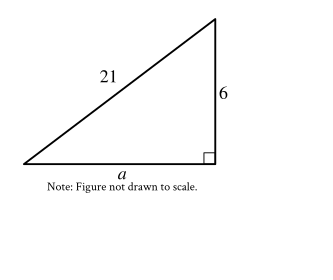
    One angle is a right angle. The length of the side opposite the right angle is 21. The length of one side adjacent to the right angle is 6. The length of the other side adjacent to the right angle is a. A note indicates the figure is not drawn to scale. For the triangle shown, which expression represents the value of \(a\)?

    Correct answer: A

    Choice A is correct. For the right triangle shown, the lengths of the legs are \(a\) units and \(6\) units, and the length of the hypotenuse is \(21\) units. The Pythagorean theorem states that in a right triangle, the sum of the squares of the lengths of the two legs is equal to the square of the length of the hypotenuse. Therefore, \(a ^2 + 6 ^2 = 21 ^2\). Subtracting \(6 ^2\) from both sides of this equation yields \(a ^2 = 21 ^2 -6 ^2\). Taking the square root of both sides of this equation yields \(a = + or -√21 ^2 -6 ^2\). Since \(a\) is a length, \(a\) must be positive. Therefore, \(a = √21 ^2 -6 ^2\). Thus, for the triangle shown, \(√21 ^2 -6 ^2\) represents the value of \(a\). Choice B is incorrect. For the triangle shown, this expression represents the value of \(a ^2\), not \(a\). Choice C is incorrect and may result from conceptual errors. Choice D is incorrect and may result from conceptual errors.
  28. Question 28

    In the figure above, . If and, what is the length of ?

    Correct answer: C

    The correct answer is 6. Since, and are both similar to 3-4-5 triangles. This means that they are both similar to the right triangle with sides of lengths 3, 4, and 5. Since, which is 3 times as long as the hypotenuse of the 3-4-5 triangle, the similarity ratio of to the 3-4-5 triangle is 3:1. Therefore, the length of (the side opposite to ) is, and the length of (the side adjacent to ) is . It is also given that . Since and, it follows that, which means that the similarity ratio of to the 3-4-5 triangle is 2:1 ( is the side adjacent to ). Therefore, the length of, which is the side opposite to, is .
  29. Question 29

    In triangle \(A B C\), angle \(B\) is a right angle. The length of side \(A B\) is \(10 √37\) and the length of side \(B C\) is \(24 √37\). What is the length of side \(A C\)?

    Correct answer: B

    Choice B is correct. The Pythagorean theorem states that for a right triangle, \(c ^2 = a ^2 + b ^2\), where \(c\) represents the length of the hypotenuse and \(a\) and \(b\) represent the lengths of the legs. It’s given that in triangle \(A B C\), angle \(B\) is a right angle. Therefore, triangle \(A B C\) is a right triangle, where the hypotenuse is side \(A C\) and the legs are sides \(A B\) and \(B C\). It’s given that the lengths of sides \(A B\) and \(B C\) are \(10 √37\) and \(24 √37\), respectively. Substituting these values for \(a\) and \(b\) in the formula \(c ^2 = a ^2 + b ^2\) yields \(c ^2 =(10 √37 )^2 +(24 √37 )^2\), which is equivalent to \(c ^2 = 100(37)+ 576(37)\), or \(c ^2 = 676(37)\). Taking the square root of both sides of this equation yields \(c = + or -26 √37\). Since \(c\) represents the length of the hypotenuse, side \(A C\), \(c\) must be positive. Therefore, the length of side \(A C\) is \(26 √37\). Choice A is incorrect. This is the result of solving the equation \(c = 24 √37 -10 √37\), not \(c ^2 =(10 √37 )^2 +(24 √37 )^2\). Choice C is incorrect. This is the result of solving the equation \(c = 10 √37 + 24 √37\), not \(c ^2 =(10 √37 )^2 +(24 √37 )^2\). Choice D is incorrect and may result from conceptual or calculation errors.
  30. Question 30

    The perimeter of an equilateral triangle is \(624\) centimeters. The height of this triangle is \(k √3\) centimeters, where \(k\) is a constant. What is the value of \(k\)?

    Correct answer: A

    The correct answer is \(104\). An equilateral triangle is a triangle in which all three sides have the same length and all three angles have a measure of \(60 °\). The height of the triangle, \(k √3\), is the length of the altitude from one vertex. The altitude divides the equilateral triangle into two congruent 30-60-90 right triangles, where the altitude is the side across from the \(60 °\) angle in each 30-60-90 right triangle. Since the altitude has a length of \(k √3\), it follows from the properties of 30-60-90 right triangles that the side across from each \(30 °\) angle has a length of \(k\) and each hypotenuse has a length of \(2 k\). In this case, the hypotenuse of each 30-60-90 right triangle is a side of the equilateral triangle; therefore, each side length of the equilateral triangle is \(2 k\). The perimeter of a triangle is the sum of the lengths of each side. It's given that the perimeter of the equilateral triangle is \(624\); therefore, \(2 k + 2 k + 2 k = 624\), or \(6 k = 624\). Dividing both sides of this equation by \(6\) yields \(k = 104\).
  31. Question 31

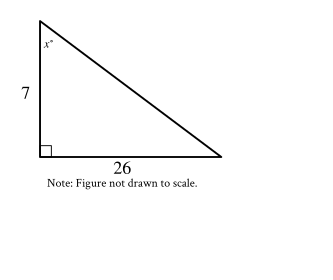
    One angle is a right angle. The measure of a second angle is x°. The length of the leg opposite the angle with measure x° is 26. The length of the leg adjacent to the angle with measure x° is 7. A note indicates the figure is not drawn to scale. In the triangle shown, what is the value of \(tangent x °\)?

    Correct answer: C

    Choice C is correct. The tangent of an acute angle in a right triangle is defined as the ratio of the length of the side opposite the angle to the length of the shorter side adjacent to the angle. In the triangle shown, the length of the side opposite the angle with measure \(x °\) is \(26\) units and the length of the side adjacent to the angle with measure \(x °\) is \(7\) units. Therefore, the value of \(tangent x °\) is \(26/7\). Choice A is incorrect and may result from conceptual or calculation errors. Choice B is incorrect and may result from conceptual or calculation errors. Choice D is incorrect and may result from conceptual or calculation errors.
  32. Question 32

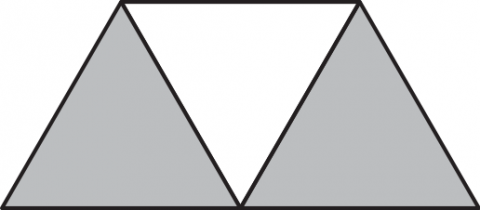
    A graphic designer is creating a logo for a company. The logo is shown in the figure above. The logo is in the shape of a trapezoid and consists of three congruent equilateral triangles. If the perimeter of the logo is 20 centimeters, what is the combined area of the shaded regions, in square centimeters, of the logo?

    Correct answer: C

    Choice C is correct. It’s given that the logo is in the shape of a trapezoid that consists of three congruent equilateral triangles, and that the perimeter of the trapezoid is 20 centimeters (cm). Since the perimeter of the trapezoid is the sum of the lengths of 5 of the sides of the triangles, the length of each side of an equilateral triangle is . Dividing up one equilateral triangle into two right triangles yields a pair of congruent 30°-60°-90° triangles. The shorter leg of each right triangle is half the length of the side of an equilateral triangle, or 2 cm. Using the Pythagorean Theorem,, the height of the equilateral triangle can be found. Substituting and and solving for b yields cm. The area of one equilateral triangle is, where and . Therefore, the area of one equilateral triangle is . The shaded area consists of two such triangles, so its area is .Alternate approach: The area of a trapezoid can be found by evaluating the expression, where is the length of one base, is the length of the other base, and h is the height of the trapezoid. Substituting,, and yields the expression, or, which gives an area of for the trapezoid. Since two-thirds of the trapezoid is shaded, the area of the shaded region is .Choice A is incorrect. This is the height of the trapezoid. Choice B is incorrect. This is the area of one of the equilateral triangles, not two. Choice D is incorrect and may result from using a height of 4 for each triangle rather than the height of .
  33. Question 33

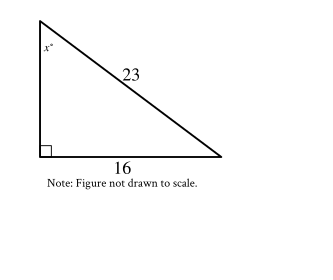
    One angle is a right angle. The measure of a second angle is x°. The length of the hypotenuse is 23. The length of the leg opposite the angle with measure x° is 16. A note indicates the figure is not drawn to scale. In the triangle shown, what is the value of \(sine x °\)?

    Correct answer: B

    The correct answer is \(16/23\). In a right triangle, the sine of an acute angle is defined as the ratio of the length of the side opposite the angle to the length of the hypotenuse. In the triangle shown, the length of the side opposite the angle with measure \(x °\) is \(16\) units and the length of the hypotenuse is \(23\) units. Therefore, the value of \(sine x °\) is \(16/23\). Note that 16/23, .6956, .6957, 0.695, and 0.696 are examples of ways to enter a correct answer.
  34. Question 34

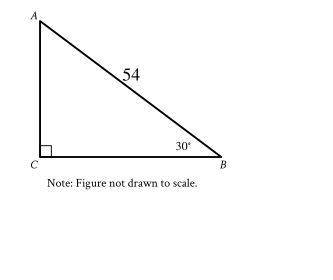
    The length of side A B is 54. The measure of angle B is 30°. Angle C is a right angle. A note indicates the figure is not drawn to scale. Right triangle \(A B C\) is shown. What is the value of \(tangent A\)?

    Correct answer: C

    Choice C is correct. In the triangle shown, the measure of angle \(B\) is \(30 °\) and angle \(C\) is a right angle, which means that it has a measure of \(90 °\). Since the sum of the angles in a triangle is equal to \(180 °\), the measure of angle \(A\) is equal to \(180 ° -(30 + 90)°\), or \(60 °\). In a right triangle whose acute angles have measures \(30 °\) and \(60 °\), the lengths of the legs can be represented by the expressions \(x\), \(x √3\), and \(2 x\), where \(x\) is the length of the leg opposite the angle with measure \(30 °\), \(x √3\) is the length of the leg opposite the angle with measure \(60 °\), and \(2 x\) is the length of the hypotenuse. In the triangle shown, the hypotenuse has a length of \(54\). It follows that \(2 x = 54\), or \(x = 27\). Therefore, the length of the leg opposite angle \(B\) is \(27\) and the length of the leg opposite angle \(A\) is \(27 √3\). The tangent of an acute angle in a right triangle is defined as the ratio of the length of the leg opposite the angle to the length of the leg adjacent to the angle. The length of the leg opposite angle \(A\) is \(27 √3\) and the length of the leg adjacent to angle \(A\) is \(27\). Therefore, the value of \(tangent A\) is \(27 √3 /27\), or \(√3\). Choice A is incorrect and may result from conceptual or calculation errors. Choice B is incorrect. This is the value of \(1/tangent A\), not the value of \(tangent A\). Choice D is incorrect. This is the length of the leg opposite angle \(A\), not the value of \(tangent A\).
  35. Question 35

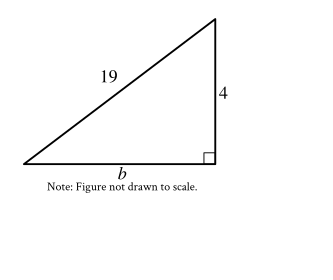
    One angle is a right angle. The length of the side opposite the right angle is 19. The lengths of the other 2 sides are as follows: b 4 A note indicates the figure is not drawn to scale. Which equation shows the relationship between the side lengths of the given triangle?

    Correct answer: C

    Choice C is correct. The Pythagorean theorem states that in a right triangle, the sum of the squares of the lengths of the two legs is equal to the square of the length of the hypotenuse. Therefore, \(a ^2 + b ^2 = c ^2\), where \(a\) and \(b\) are the lengths of the legs and \(c\) is the length of the hypotenuse. For the given right triangle, the lengths of the legs are \(4\) and \(b\), and the length of the hypotenuse is \(19\). Substituting \(4\) for \(a\) and \(19\) for \(c\) in the equation \(a ^2 + b ^2 = c ^2\) yields \(4 ^2 + b ^2 = 19 ^2\). Thus, the relationship between the side lengths of the given triangle is \(4 ^2 + b ^2 = 19 ^2\). Choice A is incorrect and may result from conceptual or calculation errors. Choice B is incorrect and may result from conceptual or calculation errors. Choice D is incorrect and may result from conceptual or calculation errors.
  36. Question 36

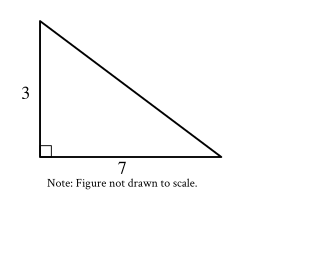
    One angle is a right angle. The lengths of the sides adjacent to the right angle are as follows: 3 7 A note indicates the figure is not drawn to scale. The lengths of the legs of a right triangle are shown. Which of the following is closest to the length of the triangle's hypotenuse?

    Correct answer: C

    Choice C is correct. The Pythagorean theorem states that for a right triangle, \(a ^2 + b ^2 = c ^2\), where \(a\) and \(b\) represent the lengths of the legs of the triangle and \(c\) represents the length of its hypotenuse. In the triangle shown, the legs have lengths of \(3\) and \(7\). Substituting \(3\) for \(a\) and \(7\) for \(b\) in the equation \(a ^2 + b ^2 = c ^2\) yields \(3 ^2 + 7 ^2 = c ^2\), which is equivalent to \(9 + 49 = c ^2\), or \(58 = c ^2\). Taking the positive square root of both sides of this equation yields \(√58 = c\). Thus, the value of \(c\) is approximately \(7.6\). Therefore, of the given choices, \(7.6\) is the closest to the length of the triangle's hypotenuse. Choice A is incorrect and may result from conceptual or calculation errors. Choice B is incorrect and may result from conceptual or calculation errors. Choice D is incorrect and may result from conceptual or calculation errors.
  37. Question 37

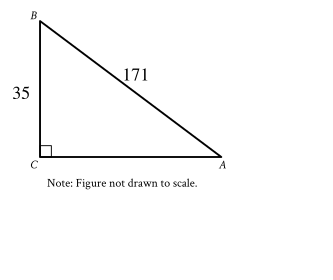
    Angle C is a right angle.The length of side A B is 171.The length of side B C is 35.A note indicates the figure is not drawn to scale. In the right triangle shown, what is the value of \(sine A\)?

    Correct answer: B

    Choice B is correct. The sine of an acute angle in a right triangle is the ratio of the length of the side opposite that angle to the length of the hypotenuse. The hypotenuse of a right triangle is the side opposite the right angle. In right triangle \(A B C\), side \(B C\) is the side opposite angle \(A\) and side \(A B\) is the hypotenuse. It's given that the length of side \(B C\) is \(35\) units and the length of side \(A B\) is \(171\) units. Therefore, the value of \(sine A\) is \(35/171\). Choice A is incorrect and may result from conceptual or calculation errors. Choice C is incorrect. This is the ratio of the length of the hypotenuse to the length of the side opposite angle \(A\) rather than the ratio of the length of the side opposite angle \(A\) to the length of the hypotenuse. Choice D is incorrect. This is the length of the hypotenuse rather than \(sine A\).
  38. Question 38

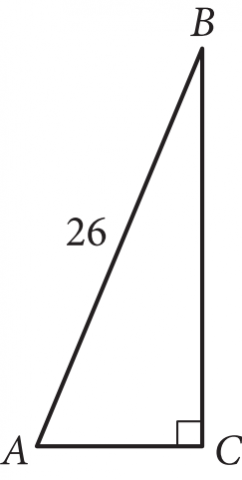
    Triangle above is a right triangle, and . What is the length of side ?

    Correct answer: C

    The correct answer is 24. The sine of an acute angle in a right triangle is equal to the ratio of the length of the side opposite the angle to the length of the hypotenuse. In the triangle shown, the sine of angle B, or, is equal to the ratio of the length of side to the length of side . It’s given that the length of side is 26 and that . Therefore, . Multiplying both sides of this equation by 26 yields .By the Pythagorean Theorem, the relationship between the lengths of the sides of triangle ABC is as follows:, or . Subtracting 100 from both sides of yields . Taking the square root of both sides of yields .
  39. Question 39

    In triangle \(X Y Z\), angle \(Y\) is a right angle, the measure of angle \(Z\) is \(33 °\), and the length of \(line segment Y Z\) is \(26\) units. If the area, in square units, of triangle \(X Y Z\) can be represented by the expression \(k tangent 33 °\), where \(k\) is a constant, what is the value of \(k\)?

    Correct answer: A

    The correct answer is \(338\). The tangent of an acute angle in a right triangle is the ratio of the length of the leg opposite the angle to the length of the leg adjacent to the angle. In triangle \(X Y Z\), it's given that angle \(Y\) is a right angle. Thus, \(line segment X Y\) is the leg opposite of angle \(Z\) and \(line segment Y Z\) is the leg adjacent to angle \(Z\). It follows that \(tangent Z = \ X Y/ Y Z\). It's also given that the measure of angle \(Z\) is \(33 °\) and the length of \(line segment Y Z\) is \(26\) units. Substituting \(33 °\) for \(Z\) and \(26\) for \(Y Z\) in the equation \(tangent Z = \ X Y/ Y Z\) yields \(tangent 33 ° = \ X Y/26\). Multiplying each side of this equation by \(26\) yields \(26 tangent 33 ° = X Y\). Therefore, the length of \(line segment X Y\) is \(26 tangent 33 °\). The area of a triangle is half the product of the lengths of its legs. Since the length of \(line segment Y Z\) is \(26\) and the length of \(line segment X Y\) is \(26 tangent 33 °\), it follows that the area of triangle \(X Y Z\) is \(1 half(26)(26 tangent 33 °)\) square units, or \(338 tangent 33 °\) square units. It's given that the area, in square units, of triangle \(X Y Z\) can be represented by the expression \(k tangent 33 °\), where \(k\) is a constant. Therefore, \(338\) is the value of \(k\).
  40. Question 40

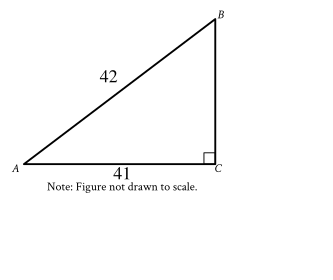
    Angle A C B is a right angle. The length of side A B is 42. The length of side A C is 41. A note indicates the figure is not drawn to scale. What is the value of \(cosine A\) in the triangle shown?

    Correct answer: B

    Choice B is correct. The cosine of an acute angle in a right triangle is defined as the ratio of the length of the leg adjacent to the angle to the length of the hypotenuse. In the triangle shown, the length of the leg adjacent to angle \(A\) is \(41\), and the length of the hypotenuse is \(42\). Therefore, \(cosine A = 41/42\). Choice A is incorrect. This is the value of \(1/cosine A\). Choice C is incorrect and may result from conceptual or calculation errors. Choice D is incorrect and may result from conceptual or calculation errors.
  41. Question 41

    In the figure above, what is the value of ?

    Correct answer: C

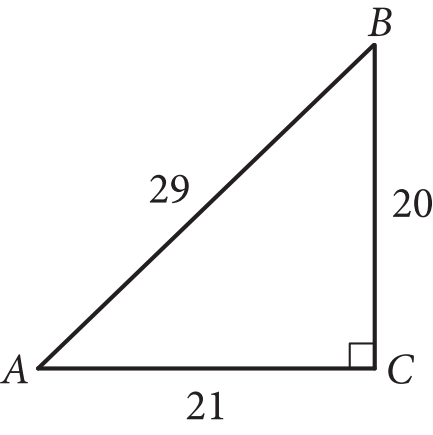
    Choice C is correct. Angle A is an acute angle in a right triangle, so the value of tan(A) is equivalent to the ratio of the length of the side opposite angle A, 20, to the length of the nonhypotenuse side adjacent to angle A, 21. Therefore, .Choice A is incorrect. This is the value of sin(A). Choice B is incorrect. This is the value of cos(A). Choice D is incorrect. This is the value of tan(B).
  42. Question 42

    In triangle \(X Y Z\), angle \(Z\) is a right angle and the length of \(line segment Y Z\) is \(24\) units. If \(tangent X = 12/35\), what is the perimeter, in units, of triangle \(X Y Z\)?

    Correct answer: B

    Choice B is correct. It's given that angle \(Z\) in triangle \(X Y Z\) is a right angle. Thus, side \(Y Z\) is the leg opposite angle \(X\) and side \(X Z\) is the leg adjacent to angle \(X\). The tangent of an acute angle in a right triangle is the ratio of the length of the leg opposite the angle to the length of the leg adjacent to the angle. It follows that \(tangent X = \ Y Z/ X Z\). It's given that \(tangent X = 12/35\) and the length of side \(Y Z\) is \(24\) units. Substituting \(12/35\) for \(tangent X\) and \(24\) for \(Y Z\) in the equation \(tangent X = \ Y Z/ X Z\) yields \(12/35 = 24/ X Z\). Multiplying both sides of this equation by \(35( X Z)\) yields \(12( X Z)= 24(35)\), or \(12( X Z)= 840\). Dividing both sides of this equation by \(12\) yields \(X Z = 70\). The length \(X Y\) can be calculated using the Pythagorean theorem, which states that if a right triangle has legs with lengths of \(a\) and \(b\) and a hypotenuse with length \(c\), then \(a ^2 + b ^2 = c ^2\). Substituting \(70\) for \(a\) and \(24\) for \(b\) in this equation yields \(70 ^2 + 24 ^2 = c ^2\), or \(5,476 = c ^2\). Taking the square root of both sides of this equation yields \(+ or -74 = c\). Since the length of the hypotenuse must be positive, \(74 = c\). Therefore, the length of \(X Y\) is \(74\) units. The perimeter of a triangle is the sum of the lengths of all sides. Thus, \((74 + 70 + 24)\) units, or \(168\) units, is the perimeter of triangle \(X Y Z\). Choice A is incorrect and may result from conceptual or calculation errors. Choice C is incorrect. This would be the perimeter, in units, for a right triangle where the length of side \(Y Z\) is \(12\) units, not \(24\) units. Choice D is incorrect and may result from conceptual or calculation errors.
  43. Question 43

    In right triangle \(R S T\), the sum of the measures of angle \(R\) and angle \(S\) is \(90\) °s. The value of \(sine( R)\) is \(√15 /4\). What is the value of \(cosine( S)\)?

    Correct answer: B

    Choice B is correct. The sine of any acute angle is equal to the cosine of its complement. It’s given that in right triangle \(R S T\), the sum of the measures of angle \(R\) and angle \(S\) is \(90\) °s. Therefore, angle \(R\) and angle \(S\) are complementary, and the value of \(sine R\) is equal to the value of \(cosine S\). It's given that the value of \(sine R\) is \(√15 /4\), so the value of \(cosine S\) is also \(√15 /4\). Choice A is incorrect. This is the value of \(tangent S\). Choice C is incorrect. This is the value of \(1/cosine S\). Choice D is incorrect. This is the value of \(1/tangent S\).
  44. Question 44

    Triangle \(F G H\) is similar to triangle \(J K L\), where angle \(F\) corresponds to angle \(J\) and angles \(G\) and \(K\) are right angles. If \(sine(F)= 308/317\), what is the value of \(sine( J)\)?

    Correct answer: B

    Choice B is correct. If two triangles are similar, then their corresponding angles are congruent. It's given that right triangle \(F G H\) is similar to right triangle \(J K L\) and angle \(F\) corresponds to angle \(J\). It follows that angle \(F\) is congruent to angle \(J\) and, therefore, the measure of angle \(F\) is equal to the measure of angle \(J\). The sine ratios of angles of equal measure are equal. Since the measure of angle \(F\) is equal to the measure of angle \(J\), \(sine(F)= sine( J)\). It's given that \(sine(F)= 308/317\). Therefore, \(sine( J)\) is \(308/317\). Choice A is incorrect. This is the value of \(cosine( J)\), not the value of \(sine( J)\). Choice C is incorrect. This is the reciprocal of the value of \(sine( J)\), not the value of \(sine( J)\). Choice D is incorrect. This is the reciprocal of the value of \(cosine( J)\), not the value of \(sine( J)\).

Want a higher score?

One-on-one tutoring for SAT, online or in person, with a plan built around the questions you missed.

Get Started

Book Your Free Session

5.0
from 38 Google reviews

Call or Text 1 (888) 356-0607