Skip to content

SAT practice test

Lines, Angles and Triangles

  • 71 questions
  • Untimed
  • Answers and explanations
Embed on your site
  • 71 questions
  • No time limit
  • Every answer explained at the end
  1. Question 1

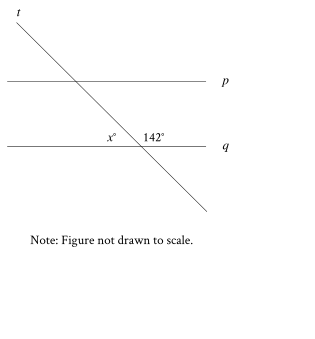
    Clockwise from top left, the 3 lines are labeled t, p, and q.Line t intersects both line p and line q.At the intersection of line t and line q, 2 angles are labeled clockwise from top left as follows:Top left: x°Top right: 142°A note indicates the figure is not drawn to scale. In the figure, line \(p\) is parallel to line \(q\), and line \(t\) intersects both lines. What is the value of \(x + 142\)?

    Correct answer: D

    Choice D is correct. In the figure shown, the angle marked \(x °\) and the angle marked \(142 °\) form a linear pair of angles. If two angles form a linear pair of angles, the sum of the measures of the angles is \(180 °\). Therefore, the value of \(x + 142\) is \(180\). Choice A is incorrect. This is \(90\) less than \(142\), not the sum of \(x\) and \(142\). Choice B is incorrect and may result from conceptual or calculation errors. Choice C is incorrect. This is the measure, in °s, of one of the angles shown.
  2. Question 2

    A line intersects two parallel lines, forming four acute angles and four obtuse angles. The measure of one of the acute angles is \((9 x -560)°\). The sum of the measures of one of the acute angles and three of the obtuse angles is \((-18 x + w)°\). What is the value of \(w\)?

    Correct answer: D

    The correct answer is \(1,660\). It’s given that a line intersects two parallel lines, forming four acute angles and four obtuse angles. When two parallel lines are intersected by a transversal line, the angles formed have the following properties: two adjacent angles are supplementary, and alternate interior angles are congruent. Therefore, each of the four acute angles have the same measure, and each of the four obtuse angles have the same measure. It’s also given that the measure of one of the acute angles is \((9 x -560)°\). If two angles are supplementary, then the sum of their measures is \(180 °\). Therefore, the measure of the obtuse angle adjacent to any of the acute angles is \((180 -(9 x -560))°\), or \((180 -9 x + 560)°\), which is equivalent to \((-9 x + 740)°\). It’s given that the sum of the measures of one of the acute angles and three of the obtuse angles is \((-18 x + w)°\). It follows that \((9 x -560)+ 3(-9 x + 740)=(-18 x + w)\), which is equivalent to \(9 x -560 -27 x + 2,220 = -18 x + w\), or \(-18 x + 1,660 = -18 x + w\). Adding \(18 x\) to both sides of this equation yields \(1,660 = w\).
  3. Question 3

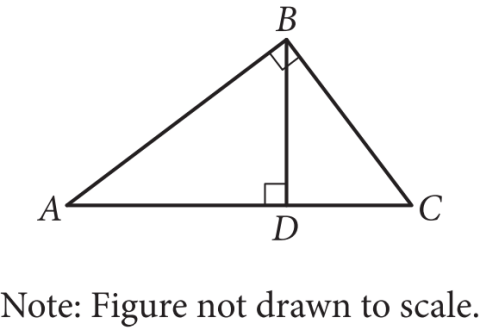
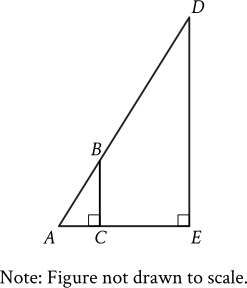
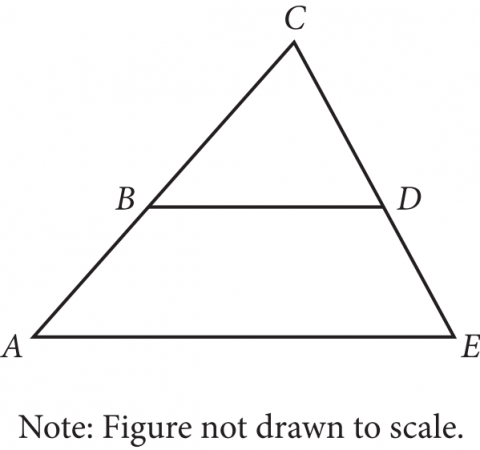
    In the figure above, and . What is the length of ?

    Correct answer: C

    The correct answer is 4.5. According to the properties of right triangles, BD divides triangle ABC into two similar triangles, ABD and BCD. The corresponding sides of ABD and BCD are proportional, so the ratio of BD to AD is the same as the ratio of DC to BD. Expressing this information as a proportion gives . Solving the proportion for DC results in . Note that 4.5 and 9/2 are examples of ways to enter a correct answer.
  4. Question 4

    In triangle \(A B C\), the measure of angle \(A\) is \(54 °\), the measure of angle \(B\) is \(90 °\), and the measure of angle \(C\) is \((k/2)°\). What is the value of \(k\)?

    Correct answer: C

    Choice C is correct. The sum of the interior angles of a triangle is \(180 °\). It's given that the interior angles of triangle \(A B C\) are \(54 °\), \(90 °\), and \((k/2)°\). It follows that \(54 + 90 + k/2 = 180\), or \(144 + k/2 = 180\). Subtracting \(144\) from each side of this equation yields \(k/2 = 36\). Multiplying each side of this equation by \(2\) yields \(k = 72\). Therefore, the value of \(k\) is \(72\). Choice A is incorrect. This is the value of \(k/2\), not \(k\). Choice B is incorrect and may result from conceptual or calculation errors. Choice D is incorrect and may result from conceptual or calculation errors.
  5. Question 5

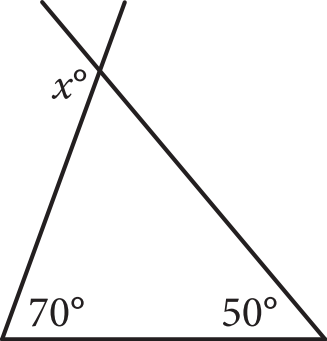
    In the figure above, two sides of a triangle are extended. What is the value of x ?

    Correct answer: B

    Choice B is correct. The sum of the interior angles of a triangle is 180°. The measures of the two interior angles of the given triangle are shown. Therefore, the measure of the third interior angle is 180° – 70° – 50° = 60°. The angles of measures x° and 60° are supplementary, so their sum is 180°. Therefore, x = 180 – 60 = 120.Choice A is incorrect and may be the result of misinterpreting x° as supplementary to 70°. Choice C is incorrect and may be the result of misinterpreting x° as supplementary to 50°. Choice D is incorrect and may be the result of a calculation error.
  6. Question 6

    In a right triangle, the measure of one of the acute angles is \(51 °\). What is the measure, in °s, of the other acute angle?

    Correct answer: B

    Choice B is correct. The sum of the measures of the interior angles of a triangle is \(180\) °s. Since the triangle is a right triangle, it has one angle that measures \(90\) °s. Therefore, the sum of the measures, in °s, of the remaining two angles is \(180 -90\), or \(90\). It’s given that the measure of one of the acute angles in the triangle is \(51\) °s. Therefore, the measure, in °s, of the other acute angle is \(90 -51\), or \(39\). Choice A is incorrect and may result from conceptual or calculation errors. Choice C is incorrect and may result from conceptual or calculation errors. Choice D is incorrect. This is the measure, in °s, of the acute angle whose measure is given.
  7. Question 7

    Right triangles \(L M N\) and \(P Q R\) are similar, where \(L\) and \(M\) correspond to \(P\) and \(Q\), respectively. Angle \(M\) has a measure of \(53 °\). What is the measure of angle \(Q\)?

    Correct answer: B

    Choice B is correct. It’s given that triangle \(L M N\) is similar to triangle \(P Q R\). Corresponding angles of similar triangles are congruent. Since angle \(M\) and angle \(Q\) correspond to each other, they must be congruent. Therefore, if the measure of angle \(M\) is \(53 °\), then the measure of angle \(Q\) is also \(53 °\). Choice A is incorrect and may result from concluding that angle \(M\) and angle \(Q\) are complementary rather than congruent. Choice C is incorrect and may result from concluding that angle \(M\) and angle \(Q\) are supplementary rather than congruent. Choice D is incorrect and may result from conceptual or calculation errors.
  8. Question 8

    In triangle \(A B C\), \(A B = 4,680 millimeters(mm)\) and \(B C = 4,680 mm\). Which statement is sufficient to prove that triangle \(A B C\) is equilateral?

    Correct answer: A

    Choice A is correct. In an equilateral triangle, all three sides have the same length. It’s given that in triangle \(A B C\), \(A B = 4,680 millimeters\) and \(B C = 4,680 millimeters\). Therefore, if \(A C = 4,680 millimeters\), then all three sides of triangle \(A B C\) have the same length, so triangle \(A B C\) is equilateral. Therefore, \(A C = 4,680 millimeters\) is sufficient to prove that triangle \(A B C\) is equilateral. Choice B is incorrect and may result from conceptual or calculation errors. Choice C is incorrect and may result from conceptual or calculation errors. Choice D is incorrect and may result from conceptual or calculation errors.
  9. Question 9

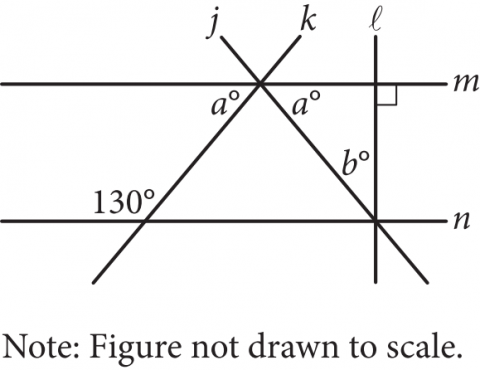
    In the figure above, lines m and n are parallel. What is the value of b ?

    Correct answer: A

    Choice A is correct. Given that lines m and n are parallel, the angle marked 130° must be supplementary to the leftmost angle marked a° because they are same-side interior angles. Therefore, 130° + a° = 180°, which yields a = 50°. Lines and m intersect at a right angle, so lines j,, and m form a right triangle where the two acute angles are a° and b°. The acute angles of a right triangle are complementary, so a° + b° = 90°, which yields 50° + b° = 90°, and b = 40.Choice B is incorrect. This is the value of a, not b. Choice C is incorrect and may be the result of dividing 130° by 2. Choice D is incorrect and may be the result of multiplying b by 2.
  10. Question 10

    Angle D E A is a right angle. Point B lies on side A D. Point C lies on side A E. Line segment B C is drawn from side A D to side A E to form right triangle A B C. Angle B C A is a right angle. A note indicates the figure is not drawn to scale. In the figure shown, \(A B = √34\) units, \(A C = 3\) units, and \(C E = 21\) units. What is the area, in square units, of triangle \(A D E\)?

    Correct answer: A

    The correct answer is \(480\). It's given in the figure that angle \(A C B\) and angle \(A E D\) are right angles. It follows that angle \(A C B\) is congruent to angle \(A E D\). It's also given that angle \(B A C\) and angle \(D A E\) are the same angle. It follows that angle \(B A C\) is congruent to angle \(D A E\). Since triangles \(A B C\) and \(A D E\) have two pairs of congruent angles, the triangles are similar. Sides \(A B\) and \(A C\) in triangle \(A B C\) correspond to sides \(A D\) and \(A E\), respectively, in triangle \(A D E\). Corresponding sides in similar triangles are proportional. Therefore, \(A D/A B = A E/A C\). It's given that \(A C = 3\) units and \(C E = 21\) units. Therefore, \(A E = 24\) units. It’s also given that \(A B = √34\) units. Substituting \(3\) for \(A C\), \(24\) for \(A E\), and \(√34\) for \(A B\) in the equation \(A D/A B = A E/A C\) yields \(A D/√34 = 24/3\), or \(A D/√34 = 8\). Multiplying each side of this equation by \(√34\) yields \(A D = 8 √34\). By the Pythagorean theorem, if a right triangle has a hypotenuse with length \(c\) and legs with lengths \(a\) and \(b\), then \(a ^2 + b ^2 = c ^2\). Since triangle \(A D E\) is a right triangle, it follows that \(A D\) represents the length of the hypotenuse, \(c\), and \(D E\) and \(A E\) represent the lengths of the legs, \(a\) and \(b\). Substituting \(24\) for \(b\) and \(8 √34\) for \(c\) in the equation \(a ^2 + b ^2 = c ^2\) yields \(a ^2 +(24)^2 =(8 √34 )^2\), which is equivalent to \(a ^2 + 576 = 64(34)\), or \(a ^2 + 576 = 2,176\). Subtracting \(576\) from both sides of this equation yields \(a ^2 = 1,600\). Taking the square root of both sides of this equation yields \(a = + or -40\). Since \(a\) represents a length, which must be positive, the value of \(a\) is \(40\). Therefore, \(D E = 40\). Since \(D E\) and \(A E\) represent the lengths of the legs of triangle \(A D E\), it follows that \(D E\) and \(A E\) can be used to calculate the area, in square units, of the triangle as \(1 half(40)(24)\), or \(480\). Therefore, the area, in square units, of triangle \(A D E\) is \(480\).
  11. Question 11

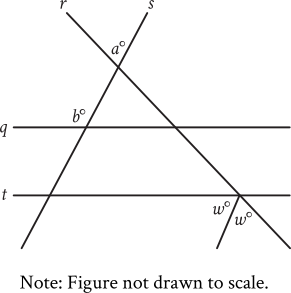
    Counterclockwise from top right, the lines are labeled s, r, q, and t. Line s intersects line r above line q. Line s and line r each intersect line q and line t. At the intersection of line s and line r, 1 angle is labeled counterclockwise from top as follows: Top: a° At the intersection of line s and line q, 1 angle is labeled counterclockwise from top-left as follows: Top left: b° At the intersection of line r and line t: The line segment divides the bottom-left angle into two equal angles, each labeled w°. A note indicates the figure is not drawn to scale. In the figure, parallel lines \(q\) and \(t\) are intersected by lines \(r\) and \(s\). If \(a = 43\) and \(b = 122\), what is the value of \(w\)?

    Correct answer: B

    The correct answer is \(101/2\). In the figure, lines \(q\), \(r\), and \(s\) form a triangle. One interior angle of this triangle is vertical to the angle marked \(a °\); therefore, the interior angle also has measure \(a °\). It's given that \(a = 43\). Therefore, the interior angle of the triangle has measure \(43 °\). A second interior angle of the triangle forms a straight line, \(q\), with the angle marked \(b °\). Therefore, the sum of the measures of these two angles is \(180 °\). It's given that \(b = 122\). Therefore, the angle marked \(b °\) has measure \(122 °\) and the second interior angle of the triangle has measure \((180 -122)°\), or \(58 °\). The sum of the interior angles of a triangle is \(180 °\). Therefore, the measure of the third interior angle of the triangle is \((180 -43 -58)°\), or \(79 °\). It's given that parallel lines \(q\) and \(t\) are intersected by line \(r\). It follows that the triangle's interior angle with measure \(79 °\) is congruent to the same side interior angle between lines \(q\) and \(t\) formed by lines \(t\) and \(r\). Since this angle is supplementary to the two angles marked \(w °\), the sum of \(79 °\), \(w °\), and \(w °\) is \(180 °\). It follows that \(79 + w + w = 180\), or \(79 + 2 w = 180\). Subtracting \(79\) from both sides of this equation yields \(2 w = 101\). Dividing both sides of this equation by \(2\) yields \(w = 101/2\). Note that 101/2 and 50.5 are examples of ways to enter a correct answer.
  12. Question 12

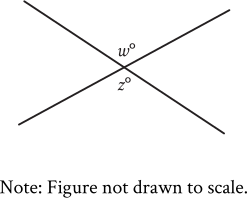
    At the intersection of the 2 lines, the angles are labeled clockwise from top as follows: Top: w° Right: unlabeled Bottom: z° Left: unlabeled A note indicates the figure is not drawn to scale. In the figure, two lines intersect at a point. If \(w = 136\), what is the value of \(z\)?

    Correct answer: D

    Choice D is correct. In the figure shown, the angles with measures \(w °\) and \(z °\) are vertical angles. Since vertical angles are congruent, \(w = z\). Therefore, if \(w = 136\), the value of \(z\) is \(136\). Choice A is incorrect and may result from conceptual or calculation errors. Choice B is incorrect. This is the measure, in °s, of an angle that's supplementary, not congruent, to the angle with measure \(w °\). Choice C is incorrect and may result from conceptual or calculation errors.
  13. Question 13

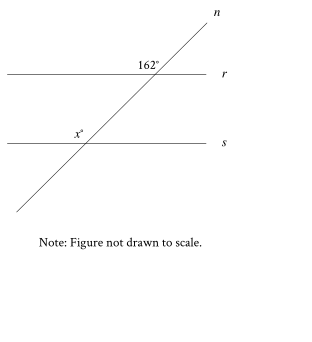
    Clockwise from top left, the 3 lines are labeled n, r, and s. Line n intersects both line r and line s. At the intersection of line n and line r, 1 angle is labeled clockwise from top left as follows: Top left: 162° At the intersection of line n and line s, 1 angle is labeled clockwise from top left as follows: Top left: x° A note indicates the figure is not drawn to scale. In the figure, line \(n\) intersects lines \(r\) and \(s\). Line \(r\) is parallel to line \(s\). What is the value of \(x\)?

    Correct answer: A

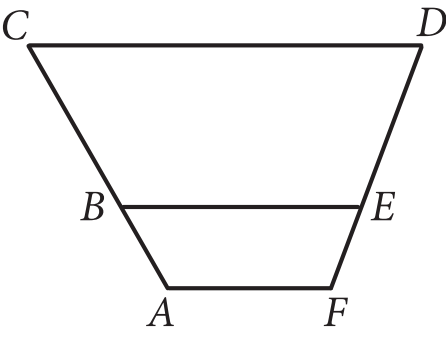
    The correct answer is \(162\). It's given that line \(r\) is parallel to line \(s\). Since line \(n\) intersects both lines \(r\) and \(s\), it's a transversal. The angles in the figure marked as \(162 °\) and \(x °\) are on the same side of the transversal, where one is an interior angle with line \(s\) as a side, and the other is an exterior angle with line \(r\) as a side. Thus, the marked angles are corresponding angles. When two parallel lines are intersected by a transversal, corresponding angles are congruent and, therefore, have equal measure. It follows that the value of \(x\) is \(162\).
  14. Question 14

    In convex pentagon \(A B C D E\), segment \(A B\) is parallel to segment \(D E\). The measure of angle \(B\) is \(139\) °s, and the measure of angle \(D\) is \(174\) °s. What is the measure, in °s, of angle \(C\)?

    Correct answer: C

    The correct answer is \(47\). It's given that the measure of angle \(B\) is \(139\) °s. Therefore, the exterior angle formed by extending segment \(A B\) at point \(B\) has measure \(180 -139\), or \(41\), °s. It's given that segment \(A B\) is parallel to segment \(D E\). Extending segment \(B C\) at point \(C\) and extending segment \(D E\) at point \(D\) until the two segments intersect results in a transversal that intersects two parallel line segments. One of these intersection points is point \(B\), and let the other intersection point be point \(X\). Since segment \(A B\) is parallel to segment \(D E\), alternate interior angles are congruent. Angle \(C X D\) and the exterior angle formed by extending segment \(A B\) at point \(B\) are alternate interior angles. Therefore, the measure of angle \(C X D\) is \(41\) °s. It's given that the measure of angle \(D\) in pentagon \(A B C D E\) is \(174\) °s. Therefore, angle \(C D X\) has measure \(180 -174\), or \(6\), °s. Since angle \(C\) in pentagon \(A B C D E\) is an exterior angle of triangle \(C D X\), it follows that the measure of angle \(C\) is the sum of the measures of angles \(C D X\) and \(C X D\). Therefore, the measure, in °s, of angle \(C\) is \(6 + 41\), or \(47\). Alternate approach: A line can be created that's perpendicular to segments \(A B\) and \(D E\) and passes through point \(C\). Extending segments \(A B\) and \(D E\) at points \(B\) and \(D\), respectively, until they intersect this line yields two right triangles. Let these intersection points be point \(X\) and point \(Y\), and the two right triangles be triangle \(B X C\) and triangle \(D Y C\). It's given that the measure of angle \(B\) is \(139\) °s. Therefore, angle \(C B X\) has measure \(180 -139\), or \(41\), °s. Since the measure of angle \(C B X\) is \(41\) °s and the measure of angle \(B X C\) is \(90\) °s, it follows that the measure of angle \(X C B\) is \(180 -90 -41\), or \(49\), °s. It's given that the measure of angle \(D\) is \(174\) °s. Therefore, angle \(Y D C\) has measure \(180 -174\), or \(6\), °s. Since the measure of angle \(Y D C\) is \(6\) °s and the measure of angle \(C Y D\) is \(90\) °s, it follows that the measure of angle \(D C Y\) is \(180 -90 -6\), or \(84\), °s. Since angles \(X C B\), \(D C Y\), and angle \(C\) in pentagon \(A B C D E\) form segment \(X Y\), it follows that the sum of the measures of those angles is \(180\) °s. Therefore, the measure, in °s, of angle \(C\) is \(180 -49 -84\), or \(47\).
  15. Question 15

    In the figure above, segments AE and BD are parallel. If angle BDC measures 58° and angle ACE measures 62°, what is the measure of angle CAE ?

    Correct answer: B

    Choice B is correct. It’s given that angle ACE measures . Since segments AE and BD are parallel, angles BDC and CEA are congruent. Therefore, angle CEA measures . The sum of the measures of angles ACE, CEA, and CAE is since the sum of the interior angles of triangle ACE is equal to . Let the measure of angle CAE be . Therefore,, which simplifies to . Thus, the measure of angle CAE is .Choice A is incorrect. This is the measure of angle AEC, not that of angle CAE. Choice C is incorrect. This is the measure of angle ACE, not that of CAE. Choice D is incorrect. This is the sum of the measures of angles ACE and CEA.
  16. Question 16

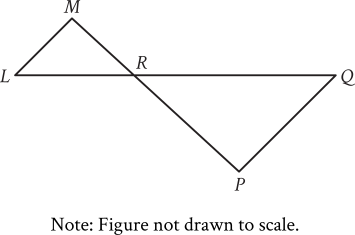
    Triangle L M R has a common vertex with triangle P Q R. The common vertex is R. A note indicates the figure is not drawn to scale. In the figure, \(line segment L Q\) intersects \(line segment M P\) at point \(R\), and \(line segment L M\) is parallel to \(line segment P Q\). The lengths of \(line segment M R\), \(line segment L R\), and \(line segment R P\) are \(6\), \(7\), and \(11\), respectively. What is the length of \(line segment L Q\)?

    Correct answer: D

    Choice D is correct. The figure shows that angle \(M R L\) and angle \(P R Q\) are vertical angles. Since vertical angles are congruent, angle \(M R L\) and angle \(P R Q\) are congruent. It’s given that \(line segment L M\) is parallel to \(line segment P Q\). The figure also shows that \(line segment L Q\) intersects \(line segment L M\) and \(line segment P Q\). If two parallel segments are intersected by a third segment, alternate interior angles are congruent. Thus, alternate interior angles \(M L R\) and \(P Q R\) are congruent. Since triangles \(L M R\) and \(P Q R\) have two pairs of congruent angles, the triangles are similar. Sides \(L R\) and \(M R\) in triangle \(L M R\) correspond to sides \(R Q\) and \(R P\), respectively, in triangle \(P Q R\). Since the lengths of corresponding sides in similar triangles are proportional, it follows that \(\ R Q/ L R = \ R P/ M R\). It's given that the lengths of \(line segment M R\), \(line segment L R\), and \(line segment R P\) are \(6\), \(7\), and \(11\), respectively. Substituting \(6\) for \(M R\), \(7\) for \(L R\), and \(11\) for \(R P\) in the equation \(\ R Q/ L R = \ R P/ M R\) yields \(\ R Q/7 = 11/6\). Multiplying each side of this equation by \(7\) yields \(R Q =(11/6)(7)\), or \(R Q = 77/6\). It's given that \(line segment L Q\) intersects \(line segment M P\) at point \(R\), so \(L Q = L R + R Q\). Substituting \(7\) for \(L R\) and \(77/6\) for \(R Q\) in this equation yields \(L Q = 7 + 77/6\), or \(L Q = 119/6\). Therefore, the length of \(line segment L Q\) is \(119/6\). Choice A is incorrect and may result from conceptual or calculation errors. Choice B is incorrect. This is the length of \(line segment R Q\), not \(line segment L Q\). Choice C is incorrect and may result from conceptual or calculation errors.
  17. Question 17

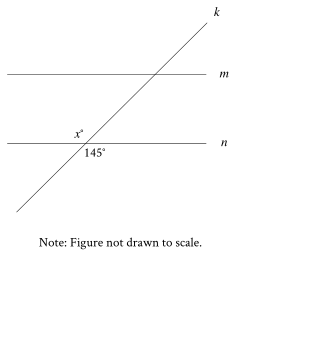
    Clockwise from top left, the 3 lines are labeled k, m, and n. Line k intersects both line m and line n. At the intersection of line k and line n, 2 angles are labeled clockwise from top left as follows: Top left: x° Bottom right: 145° A note indicates the figure is not drawn to scale. In the figure, line \(m\) is parallel to line \(n\), and line \(k\) intersects both lines. Which of the following statements is true?

    Correct answer: C

    Choice C is correct. Vertical angles, or angles that are opposite each other when two lines intersect, are congruent. It’s given that line \(k\) intersects line \(n\). Based on the figure, the angle with measure \(x °\) and the angle with measure \(145 °\) are vertical angles. Therefore, the value of \(x\) is equal to \(145\). Choice A is incorrect and may result from conceptual or calculation errors. Choice B is incorrect and may result from conceptual or calculation errors. Choice D is incorrect and may result from conceptual or calculation errors.
  18. Question 18

    Triangles \(A B C\) and \(D E F\) are congruent, where \(A\) corresponds to \(D\), and \(B\) and \(E\) are right angles. The measure of angle \(A\) is \(18 °\). What is the measure of angle \(F\)?

    Correct answer: B

    Choice B is correct. It’s given that triangle \(A B C\) is congruent to triangle \(D E F\). Corresponding angles of congruent triangles are congruent and, therefore, have equal measure. It’s given that angle \(A\) corresponds to angle \(D\), and that the measure of angle \(A\) is \(18 °\). It's also given that the measures of angles \(B\) and \(E\) are \(90 °\). Since these angles have equal measure, they are corresponding angles. It follows that angle \(C\) corresponds to angle \(F\). Let \(x °\) represent the measure of angle \(C\). Since the sum of the measures of the interior angles of a triangle is \(180 °\), it follows that \(18 ° + 90 ° + x ° = 180 °\), or \(108 ° + x ° = 180 °\). Subtracting \(108 °\) from both sides of this equation yields \(x ° = 72 °\). Therefore, the measure of angle \(C\) is \(72 °\). Since angle \(C\) corresponds to angle \(F\), it follows that the measure of angle \(F\) is also \(72 °\). Choice A is incorrect. This is the measure of angle \(D\), not the measure of angle \(F\). Choice C is incorrect. This is the measure of angle \(E\), not the measure of angle \(F\). Choice D is incorrect. This is the sum of the measures of angles \(E\) and \(F\), not the measure of angle \(F\).
  19. Question 19

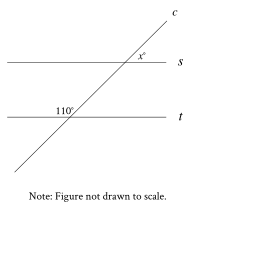
    Clockwise from top left, the 3 lines are labeled, c, s, and t. Line c intersects both line s and line t. At the intersection of line c and line s, 1 angle is labeled clockwise from top left as follows: Top right: x° At the intersection of line c and line t, 1 angle is labeled clockwise from top left as follows: Top left: 110° A note indicates the figure is not drawn to scale. In the figure shown, line \(c\) intersects parallel lines \(s\) and \(t\). What is the value of \(x\)?

    Correct answer: A

    The correct answer is \(70\). Based on the figure, the angle with measure \(110 °\) and the angle vertical to the angle with measure \(x °\) are same side interior angles. Since vertical angles are congruent, the angle vertical to the angle with measure \(x °\) also has measure \(x °\). It’s given that lines \(s\) and \(t\) are parallel. Therefore, same side interior angles between lines \(s\) and \(t\) are supplementary. It follows that \(x + 110 = 180\). Subtracting \(110\) from both sides of this equation yields \(x = 70\).
  20. Question 20

    In triangle \(R S T\), angle \(T\) is a right angle, point \(L\) lies on \(line segment R S\), point \(K\) lies on \(line segment S T\), and \(line segment L K\) is parallel to \(line segment R T\). If the length of \(line segment R T\) is \(72\) units, the length of \(line segment L K\) is \(24\) units, and the area of triangle \(R S T\) is \(792\) square units, what is the length of \(line segment K T\), in units?

    Correct answer: D

    The correct answer is \(44/3\). It's given that in triangle \(R S T\), angle \(T\) is a right angle. The area of a right triangle can be found using the formula \(A = 1 half ell 1 ell 2\), where \(A\) represents the area of the right triangle, \(ell 1\) represents the length of one leg of the triangle, and \(ell 2\) represents the length of the other leg of the triangle. In triangle \(R S T\), the two legs are \(line segment R T\) and \(line segment S T\). Therefore, if the length of \(line segment R T\) is \(72\) and the area of triangle \(R S T\) is \(792\), then \(792 = 1 half(72)( S T)\), or \(792 =(36)( S T)\). Dividing both sides of this equation by \(36\) yields \(22 = S T\). Therefore, the length of \(line segment S T\) is \(22\). It's also given that point \(L\) lies on \(line segment R S\), point \(K\) lies on \(line segment S T\), and \(line segment L K\) is parallel to \(line segment R T\). It follows that angle \(L K S\) is a right angle. Since triangles \(R S T\) and \(L S K\) share angle \(S\) and have right angles \(T\) and \(K\), respectively, triangles \(R S T\) and \(L S K\) are similar triangles. Therefore, the ratio of the length of \(line segment R T\) to the length of \(line segment L K\) is equal to the ratio of the length of \(line segment S T\) to the length of \(line segment S K\). If the length of \(line segment R T\) is \(72\) and the length of \(line segment L K\) is \(24\), it follows that the ratio of the length of \(line segment R T\) to the length of \(line segment L K\) is \(72/24\), or \(3\), so the ratio of the length of \(line segment S T\) to the length of \(line segment S K\) is \(3\). Therefore, \(22/ S K = 3\). Multiplying both sides of this equation by \(S K\) yields \(22 =(3)( S K)\). Dividing both sides of this equation by \(3\) yields \(22/3 = S K\). Since the length of \(line segment S T\), \(22\), is the sum of the length of \(line segment S K\), \(22/3\), and the length of \(line segment K T\), it follows that the length of \(line segment K T\) is \(22 -22/3\), or \(44/3\). Note that 44/3, 14.66, and 14.67 are examples of ways to enter a correct answer.
  21. Question 21

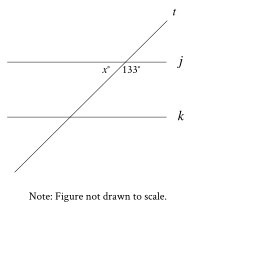
    Clockwise from top left, the 3 lines are labeled t, j, and k. Line t intersects both line j and line k. At the intersection of line t and line j, 2 angles are labeled clockwise from top left as follows: Bottom right: 133° Bottom left: x° A note indicates the figure is not drawn to scale. In the figure, line \(j\) is parallel to line \(k\). What is the value of \(x\)?

    Correct answer: D

    The correct answer is \(47\). Based on the figure, the angle with measure \(x °\) and the angle with measure \(133 °\) together form a straight line. Therefore, these two angles are supplementary, so the sum of their measures is \(180 °\). It follows that \(x + 133 = 180\). Subtracting \(133\) from both sides of this equation yields \(x = 47\).
  22. Question 22

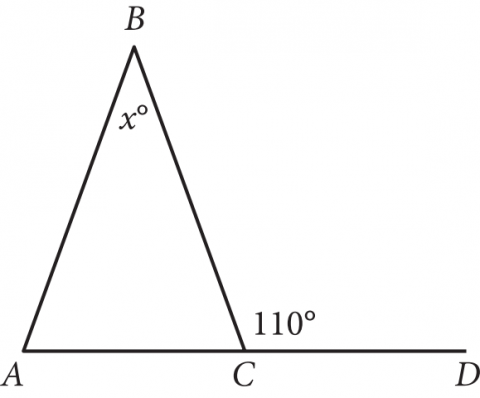
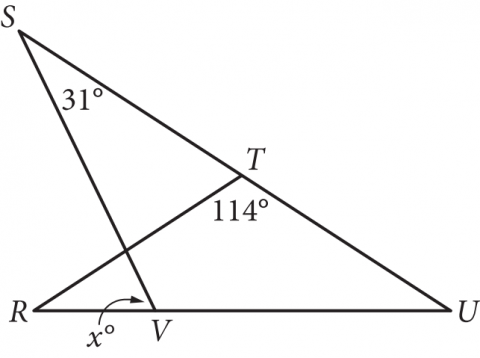
    In the given figure, extends to point D. If the measure of is equal to the measure of, what is the value of x ?

    Correct answer: D

    Choice D is correct. Since and form a linear pair of angles, their measures sum to 180°. It’s given that the measure of is 110°. Therefore, . Subtracting 110° from both sides of this equation gives the measure of as 70°. It’s also given that the measure of is equal to the measure of . Thus, the measure of is also 70°. The measures of the interior angles of a triangle sum to 180°. Thus, . Combining like terms on the left-hand side of this equation yields . Subtracting 140° from both sides of this equation yields, or .Choice A is incorrect. This is the value of the measure of . Choice B is incorrect. This is the value of the measure of each of the other two interior angles, and . Choice C is incorrect and may result from an error made when identifying the relationship between the exterior angle of a triangle and the interior angles of the triangle.
  23. Question 23

    Triangles \(P Q R\) and \(L M N\) are graphed in the xy-plane. Triangle \(P Q R\) has vertices \(P\), \(Q\), and \(R\) at \((4, 5)\), \((4, 7)\), and \((6, 5)\), respectively. Triangle \(L M N\) has vertices \(L\), \(M\), and \(N\) at \((4, 5)\), \((4, 7 + k)\), and \((6 + k, 5)\), respectively, where \(k\) is a positive constant. If the measure of \(angle Q\) is \(t °\), what is the measure of \(angle N\)?

    Correct answer: C

    Choice C is correct. Since \(P =(4, 5)\) and \(Q =(4, 7)\), side \(P Q\) is parallel to the y-axis and has a length of \(2\). Since \(P =(4, 5)\) and \(R =(6, 5)\), side \(P R\) is parallel to the x-axis and has a length of \(2\). Therefore, triangle \(P Q R\) is a right isosceles triangle, where \(angle P\) has measure \(90 °\) and \(angle Q\) and \(angle R\) each have measure \(45 °\). It follows that if the measure of \(angle Q\) is \(t °\), then \(t = 45\). Since \(L =(4, 5)\) and \(M =(4, 7 + k)\), side \(L M\) is parallel to the y-axis and has a length of \(k + 2\). Since \(L =(4, 5)\) and \(N =(6 + k, 5)\), side \(L N\) is parallel to the x-axis and has a length of \(k + 2\). Therefore, triangle \(L M N\) is a right isosceles triangle, where \(angle L\) has measure \(90 °\) and \(angle M\) and \(angle N\) each have measure \(45 °\). Of the given choices, only \((90 -t)°\) is equal to \(45 °\), so the measure of \(angle N\) is \((90 -t)°\). Choice A is incorrect and may result from conceptual or calculation errors. Choice B is incorrect and may result from conceptual or calculation errors. Choice D is incorrect and may result from conceptual or calculation errors.
  24. Question 24

    In triangle \(X Y Z\), angle \(Y\) is a right angle, point \(P\) lies on \(line segment X Z\), and point \(Q\) lies on \(line segment Y Z\) such that \(line segment P Q\) is parallel to \(line segment X Y\). If the measure of angle \(X Z Y\) is \(63 °\), what is the measure, in °s, of angle \(X P Q\)?

    Correct answer: D

    The correct answer is \(153\). Since it's given that \(line segment P Q\) is parallel to \(line segment X Y\) and angle \(Y\) is a right angle, angle \(Z Q P\) is also a right angle. Angle \(Z P Q\) is complementary to angle \(X Z Y\), which means its measure, in °s, is \(90 -63\), or \(27\). Since angle \(X P Q\) is supplementary to angle \(Z P Q\), its measure, in °s, is \(180 -27\), or \(153\).
  25. Question 25

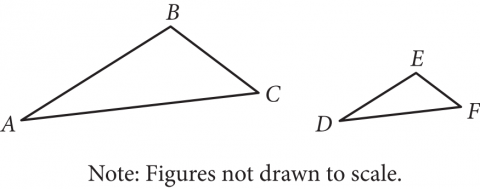
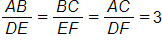
    Triangle ABC and triangle DEF are shown. The relationship between the side lengths of the two triangles is such that . If the measure of angle BAC is 20°, what is the measure, in °s, of angle EDF ? (Disregard the ° symbol when gridding your answer.)

    Correct answer: B

    The correct answer is 20. By the equality given, the three pairs of corresponding sides of the two triangles are in the same proportion. By the side-side-side (SSS) similarity theorem, triangle ABC is similar to triangle DEF. In similar triangles, the measures of corresponding angles are congruent. Since angle BAC corresponds to angle EDF, these two angles are congruent and their measures are equal. It’s given that the measure of angle BAC is 20°, so the measure of angle EDF is also 20°.
  26. Question 26

    In triangle \(A B C\), the measure of angle \(B\) is \(52 °\) and the measure of angle \(C\) is \(17 °\). What is the measure of angle \(A\)?
    Correct answer: D

    Choice D is correct. The sum of the angle measures of a triangle is \(180 °\). Adding the measures of angles \(B\) and \(C\) gives \(52 + 17 = 69 °\). Therefore, the measure of angle \(A\) is \(180 -69 = 111 °\). Choice A is incorrect and may result from subtracting the sum of the measures of angles \(B\) and \(C\) from \(90 °\), instead of from \(180 °\). Choice B is incorrect and may result from subtracting the measure of angle \(C\) from the measure of angle \(B\). Choice C is incorrect and may result from adding the measures of angles \(B\) and \(C\) but not subtracting the result from \(180 °\).
  27. Question 27

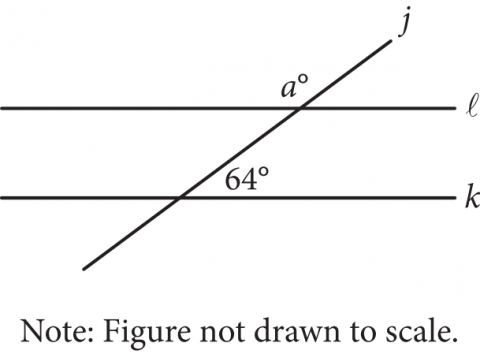
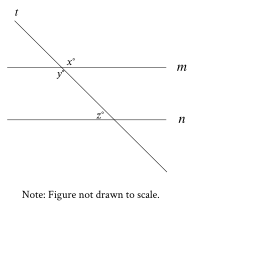
    In the figure above, lines and k are parallel. What is the value of a ?

    Correct answer: C

    Choice C is correct. Since lines and k are parallel, corresponding angles formed by the intersection of line j with lines and k are congruent. Therefore, the angle with measure a° must be the supplement of the angle with measure 64°. The sum of two supplementary angles is 180°, so a = 180 – 64 = 116.Choice A is incorrect and likely results from thinking the angle with measure a° is the complement of the angle with measure 64°. Choice B is incorrect and likely results from thinking the angle with measure a° is congruent to the angle with measure 64°. Choice D is incorrect and likely results from a conceptual or computational error.
  28. Question 28

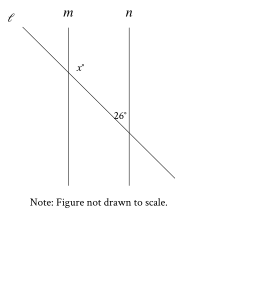
    Clockwise from top left, the 3 lines are labeled l, m, and n. Line l intersects both line m and line n. At the intersection of line l and line m, 1 angle is labeled clockwise from top left as follows: Top right: x° At the intersection of line l and line n, 1 angle is labeled clockwise from top left as follows: Top left: 26° A note indicates the figure is not drawn to scale. In the figure shown, line \(m\) is parallel to line \(n\). What is the value of \(x\)?

    Correct answer: D

    Choice D is correct. The sum of consecutive interior angles between two parallel lines and on the same side of the transversal is \(180\) °s. Since it's given that line \(m\) is parallel to line \(n\), it follows that \(x + 26 = 180\). Subtracting \(26\) from both sides of this equation yields \(154\). Therefore, the value of \(x\) is \(154\). Choice A is incorrect. This is half of the given angle measure. Choice B is incorrect. This is the value of the given angle measure. Choice C is incorrect. This is twice the value of the given angle measure.
  29. Question 29

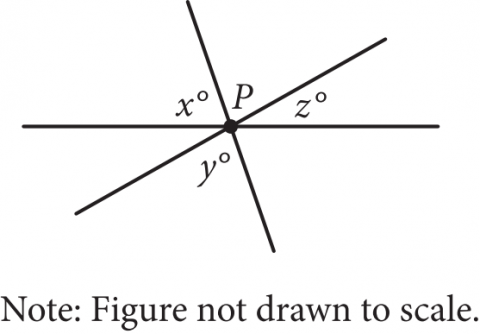
    In the figure, three lines intersect at point P. If and, what is the value of z ?

    Correct answer: C

    Choice C is correct. The angle that is shown as lying between the y° angle and the z° angle is a vertical angle with the x° angle. Since vertical angles are congruent and, the angle between the y° angle and the z° angle measures 65°. Since the 65° angle, the y° angle, and the z° angle are adjacent and form a straight angle, it follows that the sum of the measures of these three angles is 180°, which is represented by the equation . It’s given that y = 75. Substituting 75 for y yields, which can be rewritten as . Subtracting 140° from both sides of this equation yields . Therefore, .Choice A is incorrect and may result from finding the value of rather than z. Choices B and D are incorrect and may result from conceptual or computational errors.
  30. Question 30

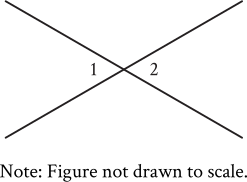
    At the intersection of the 2 lines, the angles are labeled clockwise from left as follows: Left: 1 Top: unlabeled Right: 2 Bottom: unlabeled A note indicates the figure is not drawn to scale. In the figure, two lines intersect at a point. Angle \(1\) and angle \(2\) are vertical angles. The measure of angle \(1\) is \(72 °\). What is the measure of angle \(2\)?

    Correct answer: A

    Choice A is correct. It’s given that angle \(1\) and angle \(2\) are vertical angles, and the measure of angle \(1\) is \(72 °\). Vertical angles have equal measures. Therefore, the measure of angle \(2\) is \(72 °\). Choice B is incorrect. This is the measure of an angle that is supplementary, not congruent, to angle \(1\). Choice C is incorrect. This is the sum of the measures of angle \(1\) and angle \(2\). Choice D is incorrect and may result from conceptual or calculation errors.
  31. Question 31

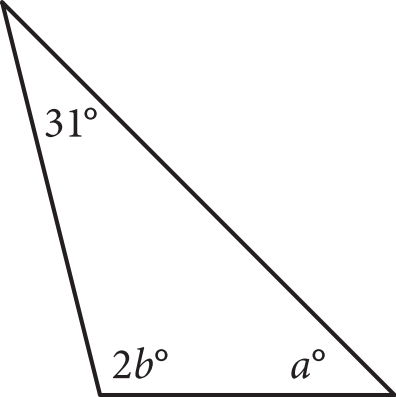
    In the triangle above, . What is the value of b ?

    Correct answer: A

    Choice A is correct. The sum of the measures of the three interior angles of a triangle is 180°. Therefore, . Since it’s given that, it follows that, or . Dividing both sides of this equation by 2 yields .Choice B is incorrect and may result from a calculation error. Choice C is incorrect. This is the value of . Choice D is incorrect. This is the value of .
  32. Question 32

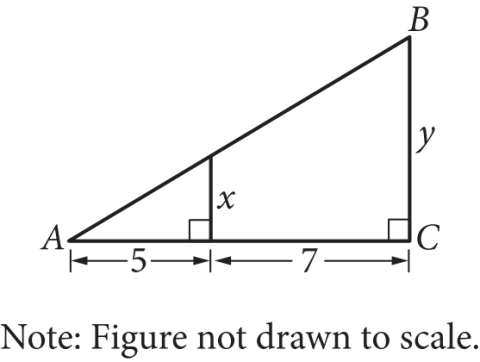
    The area of triangle ABC above is at least 48 but no more than 60. If y is an integer, what is one possible value of x ?

    Correct answer: D

    The correct answer is either,, or . The area of triangle ABC can be expressed as or . It’s given that the area of triangle ABC is at least 48 but no more than 60. It follows that . Dividing by 6 to isolate y in this compound inequality yields . Since y is an integer, . In the given figure, the two right triangles shown are similar because they have two pairs of congruent angles: their respective right angles and angle A. Therefore, the following proportion is true: . Substituting 8 for y in the proportion results in . Cross multiplying and solving for x yields . Substituting 9 for y in the proportion results in . Cross multiplying and solving for x yields . Substituting 10 for y in the proportion results in . Cross multiplying and solving for x yields . Note that 10/3, 15/4, 25/6, 3.333, 3.75, 4.166, and 4.167 are examples of ways to enter a correct answer.
  33. Question 33

    Clockwise from top left, the 3 lines are labeled t, m, and n. Line t intersects both line m and line n. At the intersection of line t and line m, 2 angles are labeled clockwise from top left as follows: Top right: x° Bottom left: y° At the intersection of line t and line n, 1 angle is labeled clockwise from top left as follows: Top left: z° A note indicates the figure is not drawn to scale. In the figure, lines \(m\) and \(n\) are parallel. If \(x = 6 k + 13\) and \(y = 8 k -29\), what is the value of \(z\)?

    Correct answer: C

    Choice C is correct. Vertical angles, which are angles that are opposite each other when two lines intersect, are congruent. The figure shows that lines \(t\) and \(m\) intersect. It follows that the angle with measure \(x °\) and the angle with measure \(y °\) are vertical angles, so \(x = y\). It's given that \(x = 6 k + 13\) and \(y = 8 k -29\). Substituting \(6 k + 13\) for \(x\) and \(8 k -29\) for \(y\) in the equation \(x = y\) yields \(6 k + 13 = 8 k -29\). Subtracting \(6 k\) from both sides of this equation yields \(13 = 2 k -29\). Adding \(29\) to both sides of this equation yields \(42 = 2 k\), or \(2 k = 42\). Dividing both sides of this equation by \(2\) yields \(k = 21\). It's given that lines \(m\) and \(n\) are parallel, and the figure shows that lines \(m\) and \(n\) are intersected by a transversal, line \(t\). If two parallel lines are intersected by a transversal, then the same-side interior angles are supplementary. It follows that the same-side interior angles with measures \(y °\) and \(z °\) are supplementary, so \(y + z = 180\). Substituting \(8 k -29\) for \(y\) in this equation yields \(8 k -29 + z = 180\). Substituting \(21\) for \(k\) in this equation yields \(8(21)-29 + z = 180\), or \(139 + z = 180\). Subtracting \(139\) from both sides of this equation yields \(z = 41\). Therefore, the value of \(z\) is \(41\). Choice A is incorrect and may result from conceptual or calculation errors. Choice B is incorrect. This is the value of \(k\), not \(z\). Choice D is incorrect. This is the value of \(x\) or \(y\), not \(z\).
  34. Question 34

    In the figure above, . What is the value of x ?

    Correct answer: C

    Choice C is correct. Since, it follows that is an isosceles triangle with base RU. Therefore, and are the base angles of an isosceles triangle and are congruent. Let the measures of both and be . According to the triangle sum theorem, the sum of the measures of the three angles of a triangle is . Therefore,, so .Note that is the same angle as . Thus, the measure of is . According to the triangle exterior angle theorem, an external angle of a triangle is equal to the sum of the opposite interior angles. Therefore, is equal to the sum of the measures of and ; that is, . Thus, the value of x is 64.Choice B is incorrect. This is the measure of, but is not congruent to . Choices A and D are incorrect and may result from a calculation error.
  35. Question 35

    In triangle ABC, the measure of angle A is . If triangle ABC is isosceles, which of the following is NOT a possible measure of angle B ?

    Correct answer: D

    Choice D is correct. The sum of the three interior angles in a triangle is . It’s given that angle A measures . If angle B measured, the measure of angle C would be . Thus, the measures of the angles in the triangle would be,, and . However, an isosceles triangle has two angles of equal measure. Therefore, angle B can’t measure .Choice A is incorrect. If angle B has measure, then angle C would measure, and,, and could be the angle measures of an isosceles triangle. Choice B is incorrect. If angle B has measure, then angle C would measure, and,, and could be the angle measures of an isosceles triangle. Choice C is incorrect. If angle B has measure, then angle C would measure, and,, and could be the angle measures of an isosceles triangle.
  36. Question 36

    In the figure above, intersects at C. If, what is the value of y ?

    Correct answer: C

    Choice C is correct. It’s given that ; therefore, substituting 100 for x in triangle ABC gives two known angle measures for this triangle. The sum of the measures of the interior angles of any triangle equals 180°. Subtracting the two known angle measures of triangle ABC from 180° gives the third angle measure: . This is the measure of angle BCA. Since vertical angles are congruent, the measure of angle DCE is also 60°. Subtracting the two known angle measures of triangle CDE from 180° gives the third angle measure: . Therefore, the value of y is 80.Choice A is incorrect and may result from a calculation error. Choice B is incorrect and may result from classifying angle CDE as a right angle. Choice D is incorrect and may result from finding the measure of angle BCA or DCE instead of the measure of angle CDE.
  37. Question 37

    At a certain time and day, the Washington Monument in Washington, DC, casts a shadow that is 300 feet long. At the same time, a nearby cherry tree casts a shadow that is 16 feet long. Given that the Washington Monument is approximately 555 feet tall, which of the following is closest to the height, in feet, of the cherry tree?

    Correct answer: C

    Choice C is correct. There is a proportional relationship between the height of an object and the length of its shadow. Let c represent the height, in feet, of the cherry tree. The given relationship can be expressed by the proportion \(\frac{c}{16} = \frac{555}{300}\). Multiplying both sides of this equation by 16 yields \(c = 29.6\). This height is closest to the value given in choice C, 30.Choices A, B, and D are incorrect and may result from calculation errors.
  38. Question 38

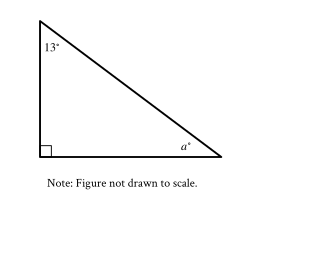
    One angle is a right angle. The measures of the other 2 angles are as follows: a° 13° A note indicates the figure is not drawn to scale. In the right triangle shown, what is the value of \(a\)?

    Correct answer: B

    Choice B is correct. The triangle shown is a right triangle, where the interior angle shown with a right angle symbol has a measure of \(90 °\). It's shown that the other two interior angles measure \(13 °\) and \(a °\). The sum of the measures of the interior angles of a triangle is \(180 °\); therefore, \(90 + 13 + a = 180\). Combining like terms on the left-hand side of this equation yields \(103 + a = 180\). Subtracting \(103\) from both sides of this equation yields \(a = 77\). Choice A is incorrect. This is the measure, in °s, of the other acute interior angle of the right triangle, not the value of \(a\). Choice C is incorrect. This is the measure, in °s, of the right angle of the right triangle, not the value of \(a\). Choice D is incorrect. This is the sum of the measures, in °s, of the other two interior angles of the right triangle, not the value of \(a\).
  39. Question 39

    Quadrilateral \(P prime Q prime R prime S prime\) is similar to quadrilateral \(P Q R S\), where \(P\), \(Q\), \(R\), and \(S\) correspond to \(P prime\), \(Q prime\), \(R prime\), and \(S prime\), respectively. The measure of angle \(P\) is \(30 °\), the measure of angle \(Q\) is \(50 °\), and the measure of angle \(R\) is \(70 °\). The length of each side of \(P prime Q prime R prime S prime\) is \(3\) times the length of each corresponding side of \(P Q R S\). What is the measure of angle \(P prime\)?

    Correct answer: B

    Choice B is correct. It's given that quadrilateral \(P prime Q prime R prime S prime\) is similar to quadrilateral \(P Q R S\), where \(P\), \(Q\), \(R\), and \(S\) correspond to \(P prime\), \(Q prime\), \(R prime\), and \(S prime\), respectively. Since corresponding angles of similar quadrilaterals are congruent, it follows that the measure of angle \(P\) is equal to the measure of angle \(P prime\). It's given that the measure of angle \(P\) is \(30 °\). Therefore, the measure of angle \(P prime\) is \(30 °\). Choice A is incorrect. This is \(1 third\) the measure of angle \(P prime\). Choice C is incorrect and may result from conceptual or calculation errors. Choice D is incorrect. This is \(3\) times the measure of angle \(P prime\).
  40. Question 40

    In \(triangle R S T\), the measure of \(angle R\) is \(63 °\). Which of the following could be the measure, in °s, of \(angle S\)?

    Correct answer: A

    Choice A is correct. The sum of the measures of the angles of a triangle is \(180 °\). Therefore, the sum of the measures of \(angle R\), \(angle S\), and \(angle T\) is \(180 °\). It's given that the measure of \(angle R\) is \(63 °\). It follows that the sum of the measures of \(angle S\) and \(angle T\) is \((180 -63)°\), or \(117 °\). Therefore, the measure of \(angle S\), in °s, must be less than \(117\). Of the given choices, only \(116\) is less than \(117\). Thus, the measure, in °s, of \(angle S\) could be \(116\). Choice B is incorrect. If the measure of \(angle S\) is \(118 °\), then the sum of the measures of the angles of the triangle is greater than, not equal to, \(180 °\). Choice C is incorrect. If the measure of \(angle S\) is \(126 °\), then the sum of the measures of the angles of the triangle is greater than, not equal to, \(180 °\). Choice D is incorrect. This is the sum of the measures of the angles of a triangle, in °s.
  41. Question 41

    In triangle \(J K L\), the measures of \(angle K\) and \(angle L\) are each \(48 °\). What is the measure of \(angle J\), in °s? (Disregard the ° symbol when entering your answer.)

    Correct answer: B

    The correct answer is \(84\). The sum of the measures of the interior angles of a triangle is \(180 °\). It's given that in triangle \(J K L\), the measures of \(angle K\)and \(angle L\) are each \(48 °\). Adding the measures, in °s, of \(angle K\) and \(angle L\) gives \(48 + 48\), or \(96\). Therefore, the measure of \(angle J\), in °s, is \(180 -96\), or \(84\).
  42. Question 42

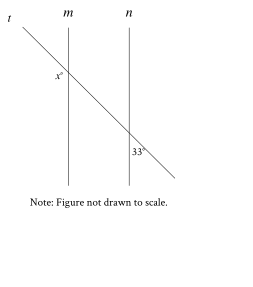
    Clockwise from top left, the lines are labeled t, m, and n. Line t intersects both line m and line n. At the intersection of line t and line m, 1 angle is labeled clockwise from top left as follows: Bottom left: x° At the intersection of line t and line n, 1 angle is labeled clockwise from top left as follows: Bottom right: 33° A note indicates the figure is not drawn to scale. In the figure, line \(m\) is parallel to line \(n\), and line \(t\) intersects both lines. What is the value of \(x\)?

    Correct answer: D

    Choice D is correct. It’s given that line \(m\) is parallel to line \(n\), and line \(t\) intersects both lines. It follows that line \(t\) is a transversal. When two lines are parallel and intersected by a transversal, exterior angles on the same side of the transversal are supplementary. Thus, \(x + 33 = 180\). Subtracting \(33\) from both sides of this equation yields \(x = 147\). Therefore, the value of \(x\) is \(147\). Choice A is incorrect and may result from conceptual or calculation errors. Choice B is incorrect and may result from conceptual or calculation errors. Choice C is incorrect and may result from conceptual or calculation errors.
  43. Question 43

    In \(triangle X Y Z\), the measure of \(angle X\) is \(23 °\) and the measure of \(angle Y\) is \(66 °\). What is the measure of \(angle Z\)?

    Correct answer: C

    Choice C is correct. The triangle angle sum theorem states that the sum of the measures of the interior angles of a triangle is \(180 °\). It's given that in \(triangle X Y Z\), the measure of \(angle X\) is \(23 °\) and the measure of \(angle Y\) is \(66 °\). It follows that the measure of \(angle Z\) is \((180 -23 -66)°\), or \(91 °\). Choice A is incorrect and may result from conceptual or calculation errors. Choice B is incorrect. This is the sum of the measures of \(angle X\) and \(angle Y\), not the measure of \(angle Z\). Choice D is incorrect and may result from conceptual or calculation errors.
  44. Question 44

    Triangle \(A B C\) is similar to triangle \(X Y Z\), such that \(A\), \(B\), and \(C\) correspond to \(X\), \(Y\), and \(Z\) respectively. The length of each side of triangle \(X Y Z\) is \(2\) times the length of its corresponding side in triangle \(A B C\). The measure of side \(A B\) is \(16\). What is the measure of side \(X Y\)?

    Correct answer: D

    Choice D is correct. It's given that triangle \(A B C\) is similar to triangle \(X Y Z\), such that \(A\), \(B\), and \(C\) correspond to \(X\), \(Y\), and \(Z\), respectively. Therefore, side \(A B\) corresponds to side \(X Y\). Since the length of each side of triangle \(X Y Z\) is \(2\) times the length of its corresponding side in triangle \(A B C\), it follows that the measure of side \(X Y\) is \(2\) times the measure of side \(A B\). Thus, since the measure of side \(A B\) is \(16\), then the measure of side \(X Y\) is \(2(16)\), or \(32\). Choice A is incorrect and may result from conceptual or calculation errors. Choice B is incorrect. This is the measure of side \(A B\), not side \(X Y\). Choice C is incorrect and may result from conceptual or calculation errors.
  45. Question 45

    Clockwise from top left, the 3 lines are labeled m, r, and s. Line m intersects both line r and line s. At the intersection of line m and line r, 1 angle is labeled clockwise from top left as follows: Top right: x° At the intersection of line m and line s, 1 angle is labeled clockwise from top left as follows: Bottom right: y° A note indicates the figure is not drawn to scale. In the figure shown, lines \(r\) and \(s\) are parallel, and line \(m\) intersects both lines. If \(y < 65\), which of the following must be true?

    Correct answer: B

    Choice B is correct. In the figure shown, the angle measuring \(y °\) is congruent to its vertical angle formed by lines \(s\) and \(m\), so the measure of the vertical angle is also \(y °\). The vertical angle forms a same-side interior angle pair with the angle measuring \(x °\). It's given that lines \(r\) and \(s\) are parallel. Therefore, same-side interior angles in the figure are supplementary, which means the sum of the measure of the vertical angle and the measure of the angle measuring \(x °\) is \(180 °\), or \(x + y = 180\). Subtracting \(x\) from both sides of this equation yields \(y = 180 -x\). Substituting \(180 -x\) for \(y\) in the inequality \(y < 65\) yields \(180 -x < 65\). Adding \(x\) to both sides of this inequality yields \(180 < 65 + x\). Subtracting \(65\) from both sides of this inequality yields \(115 < x\), or \(x > 115\). Thus, if \(y < 65\), it must be true that \(x > 115\). Choice A is incorrect and may result from conceptual or calculation errors. Choice C is incorrect. \(x + y\) must be equal to, not less than, \(180\). Choice D is incorrect. \(x + y\) must be equal to, not greater than, \(180\).
  46. Question 46

    Triangle \(X Y Z\) is similar to triangle \(R S T\) such that \(X\), \(Y\), and \(Z\) correspond to \(R\), \(S\), and \(T\), respectively. The measure of \(angle Z\) is \(20 °\) and \(2 X Y = R S\). What is the measure of \(angle T\)?

    Correct answer: C

    Choice C is correct. It’s given that triangle \(X Y Z\) is similar to triangle \(R S T\), such that \(X\), \(Y\), and \(Z\) correspond to \(R\), \(S\), and \(T\), respectively. Since corresponding angles of similar triangles are congruent, it follows that the measure of \(angle Z\) is congruent to the measure of \(angle T\). It’s given that the measure of \(angle Z\) is \(20 °\). Therefore, the measure of \(angle T\) is \(20 °\). Choice A is incorrect and may result from a conceptual error. Choice B is incorrect. This is half the measure of \(angle Z\). Choice D is incorrect. This is twice the measure of \(angle Z\).
  47. Question 47

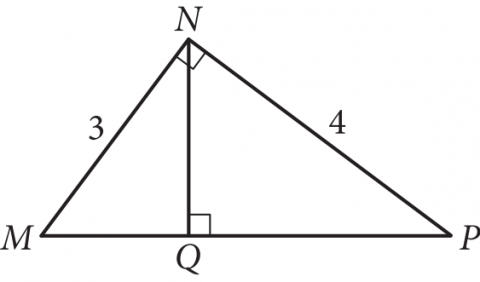
    In the figure above, what is the length of ?

    Correct answer: C

    Choice C is correct. First, is the hypotenuse of right, whose legs have lengths 3 and 4. Therefore,, so and . Second, because corresponds to and because corresponds to, is similar to . The ratio of corresponding sides of similar triangles is constant, so . Since and it’s given that and, . Solving for NQ results in, or 2.4.Choices A, B, and D are incorrect and may result from setting up incorrect ratios.
  48. Question 48

    In right triangle \(A B C\), angle \(C\) is the right angle and \(B C = 162\). Point \(D\) on side \(A B\) is connected by a line segment with point \(E\) on side \(A C\) such that line segment \(D E\) is parallel to side \(B C\) and \(C E = 2 A E\). What is the length of line segment \(D E\)?

    Correct answer: C

    The correct answer is \(54\). It’s given that in triangle \(A B C\), point \(D\) on side \(A B\) is connected by a line segment with point \(E\) on side \(A C\) such that line segment \(D E\) is parallel to side \(B C\). It follows that parallel segments \(D E\) and \(B C\) are intersected by sides \(A B\) and \(A C\). If two parallel segments are intersected by a third segment, corresponding angles are congruent. Thus, corresponding angles \(C\) and \(A E D\) are congruent and corresponding angles \(B\) and \(A D E\) are congruent. Since triangle \(A D E\) has two angles that are each congruent to an angle in triangle \(A B C\), triangle \(A D E\) is similar to triangle \(A B C\) by the angle-angle similarity postulate, where side \(D E\) corresponds to side \(B C\), and side \(A E\) corresponds to side \(A C\). Since the lengths of corresponding sides in similar triangles are proportional, it follows that \(D E/B C = A E/A C\). Since point \(E\) lies on side \(A C\), \(A E + C E = A C\). It's given that \(C E = 2 A E\). Substituting \(2 A E\) for \(C E\) in the equation \(A E + C E = A C\) yields \(A E + 2 A E = A C\), or \(3 A E = A C\). It’s given that \(B C = 162\). Substituting \(162\) for \(B C\) and \(3 A E\) for \(A C\) in the equation \(D E/B C = A E/A C\) yields \(D E/162 = A E/3 A E\), or \(D E/162 = 1 third\). Multiplying both sides of this equation by \(162\) yields \(D E = 54\). Thus, the length of line segment \(D E\) is \(54\).
  49. Question 49

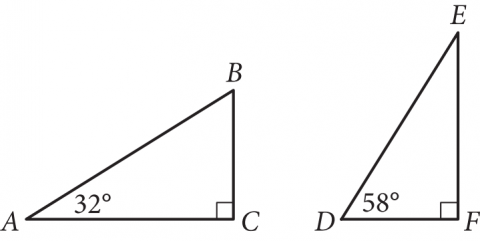
    Triangles ABC and DEF are shown above. Which of the following is equal to the ratio ?

    Correct answer: B

    Choice B is correct. In right triangle ABC, the measure of angle B must be 58° because the sum of the measure of angle A, which is 32°, and the measure of angle B is 90°. Angle D in the right triangle DEF has measure 58°. Hence, triangles ABC and DEF are similar (by angle-angle similarity). Since is the side opposite to the angle with measure 32° and AB is the hypotenuse in right triangle ABC, the ratio is equal to .Alternate approach: The trigonometric ratios can be used to answer this question. In right triangle ABC, the ratio . The angle E in triangle DEF has measure 32° because . In triangle DEF, the ratio . Therefore, .Choice A is incorrect because is the reciprocal of the ratio . Choice C is incorrect because, not . Choice D is incorrect because, not .
  50. Question 50

    Each side of equilateral triangle S is multiplied by a scale factor of \(k\) to create equilateral triangle T. The length of each side of triangle T is greater than the length of each side of triangle S. Which of the following could be the value of \(k\)?

    Correct answer: A

    Choice A is correct. It's given that each side of equilateral triangle S is multiplied by a scale factor of \(k\) to create equilateral triangle T. Since the length of each side of triangle T is greater than the length of each side of triangle S, the scale factor of \(k\) must be greater than \(1\). Of the given choices, only \(29/28\) is greater than \(1\). Choice B is incorrect. If each side of equilateral triangle S is multiplied by a scale factor of \(1\), the length of each side of triangle T would be equal to the length of each side of triangle S. Choice C is incorrect. If each side of equilateral triangle S is multiplied by a scale factor of \(28/29\), the length of each side of triangle T would be less than the length of each side of triangle S. Choice D is incorrect and may result from conceptual or calculation errors.
  51. Question 51

    In triangles \(L M N\) and \(R S T\), angles \(L\) and \(R\) each have measure \(60 °\), \(L N = 10\), and \(R T = 30\). Which additionalπece of information is sufficient to prove that triangle \(L M N\) is similar to triangle \(R S T\)?

    Correct answer: D

    Choice D is correct. Two triangles are similar if they have three pairs of congruent corresponding angles. It’s given that angles \(L\) and \(R\) each measure \(60 °\), and so these corresponding angles are congruent. If angle \(M\) is \(70 °\), then angle \(N\) must be \(50 °\) so that the sum of the angles in triangle \(L M N\) is \(180 °\). If angle \(T\) is \(50 °\), then angle \(S\) must be \(70 °\) so that the sum of the angles in triangle \(R S T\) is \(180 °\). Therefore, if the measures of angles \(M\) and \(T\) are \(70 °\) and \(50 °\), respectively, then corresponding angles \(M\) and \(S\) are both \(70 °\), and corresponding angles \(N\) and \(T\) are both \(50 °\). It follows that triangles \(L M N\) and \(R S T\) have three pairs of congruent corresponding angles, and so the triangles are similar. Therefore, the additionalπece of information that is sufficient to prove that triangle \(L M N\) is similar to triangle \(R S T\) is that the measures of angles \(M\) and \(T\) are \(70 °\) and \(50 °\), respectively. Choice A is incorrect. If the measures of two sides in one triangle are proportional to the corresponding sides in another triangle and the included angles are congruent, then the triangles are similar. However, the two sides given are not proportional and the angle given is not included by the given sides. Choice B is incorrect. If the measures of two sides in one triangle are proportional to the corresponding sides in another triangle and the included angles are congruent, then the triangles are similar. However, the angle given is not included between the proportional sides. Choice C is incorrect and may result from conceptual or calculation errors.
  52. Question 52

    In triangles \(A B C\) and \(D E F\), angles \(B\) and \(E\) each have measure \(27 °\) and angles \(C\) and \(F\) each have measure \(41 °\). Which additionalπece of information is sufficient to determine whether triangle \(A B C\) is congruent to triangle \(D E F\)?

    Correct answer: C

    Choice C is correct. Since angles \(B\) and \(E\) each have the same measure and angles \(C\) and \(F\) each have the same measure, triangles \(A B C\) and \(D E F\) are similar, where side \(B C\) corresponds to side \(E F\). To determine whether two similar triangles are congruent, it is sufficient to determine whether one pair of corresponding sides are congruent. Therefore, to determine whether triangles \(A B C\) and \(D E F\) are congruent, it is sufficient to determine whether sides \(B C\) and \(E F\) have equal length. Thus, the lengths of \(B C\) and \(E F\) are sufficient to determine whether triangle \(A B C\) is congruent to triangle \(D E F\). Choice A is incorrect and may result from conceptual errors. Choice B is incorrect and may result from conceptual errors. Choice D is incorrect. The given information is sufficient to determine that triangles \(A B C\) and \(D E F\) are similar, but not whether they are congruent.
  53. Question 53

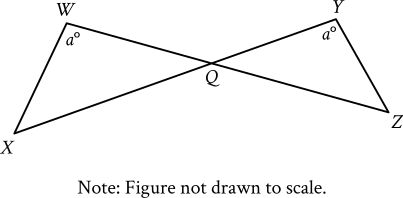
    The 2 triangles intersect at vertex Q. The measure of angle X W Q is a°. The measure of angle Z Y Q is a°. A note indicates the figure is not drawn to scale. In the figure shown, \(line segment W Z\) and \(line segment X Y\) intersect at point \(Q\). \(Y Q = 63\), \(W Q = 70\), \(W X = 60\), and \(X Q = 120\). What is the length of \(line segment Y Z\)?

    Correct answer: D

    The correct answer is \(54\). The figure shown includes two triangles, triangle \(W Q X\) and triangle \(Y Q Z\), such that angle \(W Q X\) and angle \(Y Q Z\) are vertical angles. It follows that angle \(W Q X\) is congruent to angle \(Y Q Z\). It’s also given in the figure that the measures of angle \(W\) and angle \(Y\) are \(a °\). Therefore angle \(W\) is congruent to angle \(Y\). Since triangle \(W Q X\) and triangle \(Y Q Z\) have two pairs of congruent angles, triangle \(W Q X\) is similar to triangle \(Y Q Z\) by the angle-angle similarity postulate, where \(line segment Y Z\) corresponds to \(line segment W X\), and \(line segment Y Q\) corresponds to \(line segment W Q\). Since the lengths of corresponding sides in similar triangles are proportional, it follows that \(\ Y Z/ W X = \ Y Q/ W Q\). It’s given that \(Y Q = 63\), \(W Q = 70\), and \(W X = 60\). Substituting \(63\) for \(Y Q\), \(70\) for \(W Q\), and \(60\) for \(W X\) in the equation \(\ Y Z/ W X = \ Y Q/ W Q\) yields \(\ Y Z/60 = 63/70\). Multiplying each side of this equation by \(60\) yields \(Y Z =(63/70)(60)\), or \(Y Z = 54\). Therefore, the length of \(line segment Y Z\) is \(54\).
  54. Question 54

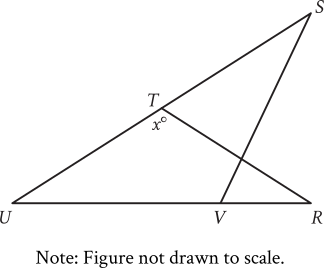
    Triangle R T U is labeled as follows: The measure of angle R T U is x°. The 2 triangles partially overlap: Side R T of triangle R T U intersects side S V of triangle S V U. Vertex V of triangle S V U lies on side R U of triangle R T U. Vertex T of triangle R T U lies on side S U of triangle S V U. A note indicates the figure is not drawn to scale. In the figure, \(R T = T U\), the measure of angle \(V S T\) is \(29 °\), and the measure of angle \(R V S\) is \(41 °\). What is the value of \(x\)?

    Correct answer: C

    The correct answer is \(156\). In the figure shown, the sum of the measures of angle \(U V S\) and angle \(R V S\) is \(180 °\). It’s given that the measure of angle \(R V S\) is \(41 °\). Therefore, the measure of angle \(U V S\) is \((180 -41)°\), or \(139 °\). The sum of the measures of the interior angles of a triangle is \(180 °\). In triangle \(U V S\), the measure of angle \(U V S\) is \(139 °\) and it's given that the measure of angle \(V S T\) is \(29 °\). Thus, the measure of angle \(V U S\) is \((180 -139 -29)°\), or \(12 °\). It’s given that \(R T = T U\). Therefore, triangle \(T U R\) is an isosceles triangle and the measure of \(V U S\) is equal to the measure of angle \(T R U\). In triangle \(T U R\), the measure of angle \(V U S\) is \(12 °\) and the measure of angle \(T R U\) is \(12 °\). Thus, the measure of angle \(U T R\) is \((180 -12 -12)°\), or \(156 °\). The figure shows that the measure of angle \(U T R\) is \(x °\), so the value of \(x\) is \(156\).
  55. Question 55

    Triangle \(A B C\) is similar to triangle \(X Y Z\), where \(A\), \(B\), and \(C\) correspond to \(X\), \(Y\), and \(Z\), respectively. In triangle \(A B C\), the length of \(line segment A B\) is \(170\) and the length of \(line segment B C\) is \(850\). In triangle \(X Y Z\), the length of \(line segment Y Z\) is \(60\). What is the length of \(line segment X Y\)?

    Correct answer: D

    Choice D is correct. It's given that triangle \(A B C\) is similar to triangle \(X Y Z\), where \(A\), \(B\), and \(C\) correspond to \(X\), \(Y\), and \(Z\), respectively. It follows that side \(A B\) corresponds to side \(X Y\) and side \(B C\) corresponds to side \(Y Z\). Since the lengths of corresponding sides in similar triangles are proportional, it follows that \(\ X Y/A B = \ Y Z/B C\). Substituting \(170\) for \(A B\), \(60\) for \(Y Z\), and \(850\) for \(B C\) in this equation yields \(\ X Y/170 = 60/850\). Multiplying each side of this equation by \(170\) yields \(X Y = 12\). Therefore, the length of \(line segment X Y\) is \(12\). Choice A is incorrect and may result from conceptual or calculation errors. Choice B is incorrect and may result from conceptual or calculation errors. Choice C is incorrect. This is the length of \(line segment Y Z\), not \(line segment X Y\).
  56. Question 56

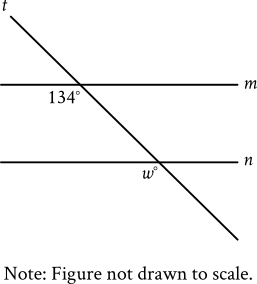
    Clockwise from top left, the 3 lines are labeled t, m, and n. Line t intersects both line m and line n. At the intersection of line t and line m, 1 angle is labeled clockwise from top left as follows: Bottom left: 134° At the intersection of line t and line n, 1 angle is labeled clockwise from top left as follows: Bottom left: w° A note indicates the figure is not drawn to scale. In the figure, line \(m\) is parallel to line \(n\). What is the value of \(w\)?

    Correct answer: D

    Choice D is correct. It's given that lines \(m\) and \(n\) are parallel. Since line \(t\) intersects both lines \(m\) and \(n\), it's a transversal. The angles in the figure marked as \(134 °\) and \(w °\) are on the same side of the transversal, where one is an interior angle with line \(m\) as a side, and the other is an exterior angle with line \(n\) as a side. Thus, the marked angles are corresponding angles. When two parallel lines are intersected by a transversal, corresponding angles are congruent and, therefore, have equal measure. It follows that \(w ° = 134 °\). Therefore, the value of \(w\) is \(134\). Choice A is incorrect and may result from conceptual or calculation errors. Choice B is incorrect and may result from conceptual or calculation errors. Choice C is incorrect and may result from conceptual or calculation errors.
  57. Question 57

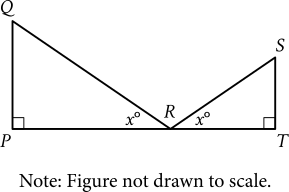
    The 2 triangles share common vertex R. Common vertex R lies on line segment P T. Triangle Q P R is labeled as follows: Angle Q P R is a right angle. The measure of angle Q R P is x°. Triangle S T R is labeled as follows: Angle S T R is a right angle. The measure of angle S R T is x°. A note indicates the figure is not drawn to scale. \(triangle Q P R\) is similar to \(triangle S T R\). The lengths represented by \(line segment S T\), \(line segment Q P\), \(line segment P R\), and \(line segment Q R\) in the figure are \(14\), \(15\), \(20\), and \(25\), respectively. What is the length of \(line segment S R\)?

    Correct answer: A

    Choice A is correct. The figure shows that angle \(P\) in \(triangle Q P R\) and angle \(T\) in \(triangle S T R\) are right angles. It follows that angle \(P\) is congruent to angle \(T\). The figure also shows that the measures of angle \(Q R P\) and angle \(S R T\) are both \(x °\). Therefore, angle \(Q R P\) is congruent to angle \(S R T\). It’s given that \(triangle Q P R\) is similar to \(triangle S T R\). Since angle \(P\) is congruent to angle \(T\), and angle \(Q R P\) is congruent to angle \(S R T\), it follows that \(line segment Q R\) corresponds to \(line segment S R\), and \(line segment Q P\) corresponds to \(line segment S T\). Since corresponding sides of similar triangles are proportional, it follows that \(\ S R/ Q R = \ S T/ Q P\). It’s also given that the lengths of \(line segment S T\), \(line segment Q P\), and \(line segment Q R\) are \(14\), \(15\), and \(25\), respectively. Substituting \(14\) for \(S T\), \(15\) for \(Q P\), and \(25\) for \(Q R\) in the equation \(\ S R/ Q R = \ S T/ Q P\) yields \(\ S R/25 = 14/15\). Multiplying each side of this equation by \(25\) yields \(S R =(14/15)(25)\), or \(S R = 350/15\). Thus, the length of \(line segment S R\) is \(350/15\). Choice B is incorrect. This is the result of solving the equation \(\ S R/25 = 14/20\), not \(\ S R/25 = 14/15\). Choice C is incorrect. This is the result of solving the equation \(\ S R/14 = 15/20\), not \(\ S R/25 = 14/15\). Choice D is incorrect. This is the result of solving the equation \(\ S R/14 = 15/25\), not \(\ S R/25 = 14/15\).
  58. Question 58

    Two nearby trees are perpendicular to the ground, which is flat. One of these trees is \(10\) feet tall and has a shadow that is \(5\) feet long. At the same time, the shadow of the other tree is \(2\) feet long. How tall, in feet, is the other tree?

    Correct answer: B

    Choice B is correct. Each tree and its shadow can be modeled using a right triangle, where the height of the tree and the length of its shadow are the legs of the triangle. At a given point in time, the right triangles formed by two nearby trees and their respective shadows will be similar. Therefore, if the height of the other tree is \(x\), in feet, the value of \(x\) can be calculated by solving the proportional relationship \(10 feet tall/5 feet long = x feet tall/2 feet long\). This equation is equivalent to\(10/5 = x/2\), or \(2 = x/2\). Multiplying each side of the equation \(2 = x/2\) by \(2\) yields \(4 = x\). Therefore, the other tree is \(4 feet\) tall. Choice A is incorrect and may result from calculating the difference between the lengths of the shadows, rather than the height of the other tree. Choice C is incorrect and may result from calculating the difference between the height of the \(10\)-foot-tall tree and the length of the shadow of the other tree, rather than calculating the height of the other tree. Choice D is incorrect and may result from a conceptual or calculation error.
  59. Question 59

    In \(triangle X Y Z\), the measure of \(angle X\) is \(24 °\) and the measure of \(angle Y\) is \(98 °\). What is the measure of \(angle Z\)?

    Correct answer: A

    Choice A is correct. The triangle angle sum theorem states that the sum of the measures of the interior angles of a triangle is \(180 °\). It's given that in \(triangle X Y Z\), the measure of \(angle X\) is \(24 °\) and the measure of \(angle Y\) is \(98 °\). It follows that the measure of \(angle Z\) is \((180 -24 -98)°\), or \(58 °\). Choice B is incorrect and may result from conceptual or calculation errors. Choice C is incorrect. This is the sum of the measures of \(angle X\) and \(angle Y\), not the measure of \(angle Z\). Choice D is incorrect and may result from conceptual or calculation errors.
  60. Question 60

    In triangle \(A B C\), the measure of angle \(B\) is \(90 °\) and \(line segment B D\) is an altitude of the triangle. The length of \(line segment A B\) is \(15\) and the length of \(line segment A C\) is \(23\) greater than the length of \(line segment A B\). What is the value of \(B C/B D\)?

    Correct answer: D

    Choice D is correct. It's given that in triangle \(A B C\), the measure of angle \(B\) is \(90 °\) and \(line segment B D\) is an altitude of the triangle. Therefore, the measure of angle \(B D C\) is \(90 °\). It follows that angle \(B\) is congruent to angle \(D\) and angle \(C\) is congruent to angle \(C\). By the angle-angle similarity postulate, triangle \(A B C\) is similar to triangle \(B D C\). Since triangles \(A B C\) and \(B D C\) are similar, it follows that \(A C/A B = B C/B D\). It's also given that the length of \(line segment A B\) is \(15\) and the length of \(line segment A C\) is \(23\) greater than the length of \(line segment A B\). Therefore, the length of \(line segment A C\) is \(15 + 23\), or \(38\). Substituting \(15\) for \(A B\) and \(38\) for \(A C\) in the equation \(A C/A B = B C/B D\) yields \(38/15 = B C/B D\). Therefore, the value of \(B C/B D\) is \(38/15\). Choice A is incorrect. This is the value of \(B D/B C\). Choice B is incorrect and may result from conceptual or calculation errors. Choice C is incorrect and may result from conceptual or calculation errors.
  61. Question 61

    In the figure above,,, and are parallel. Points B and E lie on and, respectively. If, and, what is the length of, to the nearest tenth?

    Correct answer: B

    Choice B is correct. Since,, and are parallel, quadrilaterals and are similar. Let x represent the length of . With similar figures, the ratios of the lengths of corresponding sides are equal. It follows that . Multiplying both sides of this equation by 18.5 and by x yields, or . Dividing both sides of this equation by 9 yields, which to the nearest tenth is 17.5.Choices A, C, and D are incorrect and may result from errors made when setting up the proportion.
  62. Question 62

    In the figure above, lines and m are parallel,, and . What is the value of x ?

    Correct answer: B

    Choice B is correct. Let the measure of the third angle in the smaller triangle be . Since lines and m are parallel and cut by transversals, it follows that the corresponding angles formed are congruent. So . The sum of the measures of the interior angles of a triangle is, which for the interior angles in the smaller triangle yields . Given that and, it follows that . Solving for x gives, or .Choice A is incorrect and may result from incorrectly assuming that angles . Choice C is incorrect and may result from incorrectly assuming that the smaller triangle is a right triangle, with x as the right angle. Choice D is incorrect and may result from a misunderstanding of the exterior angle theorem and incorrectly assuming that .
  63. Question 63

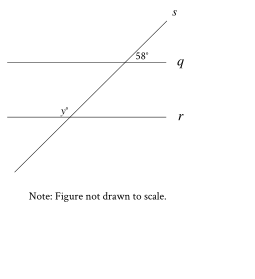
    Clockwise from top left, the 3 lines are labeled s, q, and r. Line s intersects both line q and line r. At the intersection of line s and line q, 1 angle is labeled clockwise from top left as follows: Top right: 58° At the intersection of line s and line r, 1 angle is labeled clockwise from top left as follows: Top left: y° A note indicates the figure is not drawn to scale. In the figure, line \(q\) is parallel to line \(r\), and both lines are intersected by line \(s\). If \(y = 2 x + 8\), what is the value of \(x\)?

    Correct answer: A

    The correct answer is \(57\). Based on the figure, the angle with measure \(y °\) and the angle vertical to the angle with measure \(58 °\) are same side interior angles. Since vertical angles are congruent, the angle vertical to the angle with measure \(58 °\) also has measure \(58 °\). It’s given that lines \(q\) and \(r\) are parallel. Therefore, same side interior angles between lines \(q\) and \(r\) are supplementary. It follows that \(y + 58 = 180\). If \(y = 2 x + 8\), then the value of \(x\) can be found by substituting \(2 x + 8\) for \(y\) in the equation \(y + 58 = 180\), which yields \((2 x + 8)+ 58 = 180\), or \(2 x + 66 = 180\). Subtracting \(66\) from both sides of this equation yields \(2 x = 114\). Dividing both sides of this equation by \(2\) yields \(x = 57\). Thus, if \(y = 2 x + 8\), the value of \(x\) is \(57\).
  64. Question 64

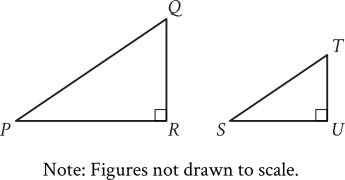
    Right triangle P Q R is labeled as follows: Angle R is a right angle. Right triangle S T U is labeled as follows: Angle U is a right angle. A note indicates the figures are not drawn to scale. Right triangles \(P Q R\) and \(S T U\) are similar, where \(P\) corresponds to \(S\). If the measure of angle \(Q\) is \(18 °\), what is the measure of angle \(S\)?

    Correct answer: B

    Choice B is correct. In similar triangles, corresponding angles are congruent. It’s given that right triangles \(P Q R\) and \(S T U\) are similar, where angle \(P\) corresponds to angle \(S\). It follows that angle \(P\) is congruent to angle \(S\). In the triangles shown, angle \(R\) and angle \(U\) are both marked as right angles, so angle \(R\) and angle \(U\) are corresponding angles. It follows that angle \(Q\) and angle \(T\) are corresponding angles, and thus, angle \(Q\) is congruent to angle \(T\). It’s given that the measure of angle \(Q\) is \(18 °\), so the measure of angle \(T\) is also \(18 °\). Angle \(U\) is a right angle, so the measure of angle \(U\) is \(90 °\). The sum of the measures of the interior angles of a triangle is \(180 °\). Thus, the sum of the measures of the interior angles of triangle \(S T U\) is \(180\) °s. Let \(s\) represent the measure, in °s, of angle \(S\). It follows that \(s + 18 + 90 = 180\), or \(s + 108 = 180\). Subtracting \(108\) from both sides of this equation yields \(s = 72\). Therefore, if the measure of angle \(Q\) is \(18\) °s, then the measure of angle \(S\) is \(72\) °s. Choice A is incorrect. This is the measure of angle \(T\). Choice C is incorrect and may result from conceptual or calculation errors. Choice D is incorrect. This is the sum of the measures of angle \(S\) and angle \(U\).
  65. Question 65

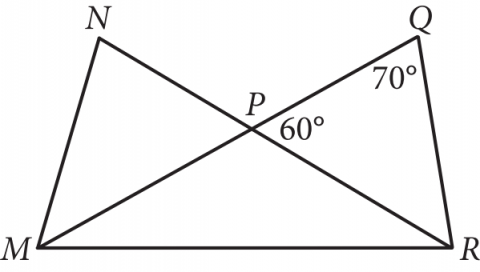
    In the figure above, and intersect at point P,, and . What is the measure, in °s, of ? (Disregard the ° symbol when gridding your answer.)

    Correct answer: C

    The correct answer is 30. It is given that the measure of is . Angle MPR and are collinear and therefore are supplementary angles. This means that the sum of the two angle measures is, and so the measure of is . The sum of the angles in a triangle is . Subtracting the measure of from yields the sum of the other angles in the triangle MPR. Since, the sum of the measures of and is . It is given that, so it follows that triangle MPR is isosceles. Therefore and must be congruent. Since the sum of the measure of these two angles is, it follows that the measure of each angle is .An alternate approach would be to use the exterior angle theorem, noting that the measure of is equal to the sum of the measures of and . Since both angles are equal, each of them has a measure of .
  66. Question 66

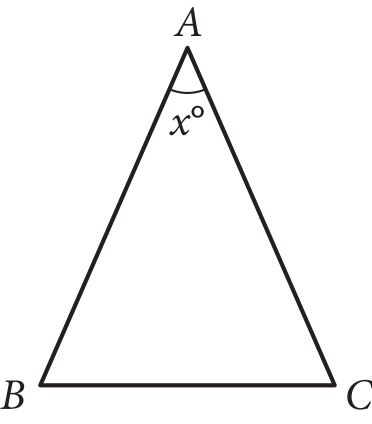
    In the given triangle, and has a measure of . What is the value of x ?

    Correct answer: B

    Choice B is correct. Since, the measures of their corresponding angles, and, are equal. Since has a measure of, the measure of is also . Since the sum of the measures of the interior angles in a triangle is, it follows that, or . Subtracting by 134 on both sides of this equation yields .Choices A, C, and D are incorrect and may result from calculation errors.
  67. Question 67

    Clockwise from top left, the 3 lines are labeled t, m, and n. Line t intersects both line m and line n. At the intersection of line t and line m, 1 angle is labeled clockwise from top left as follows: Bottom left: 170° At the intersection of line t and line n, 1 angle is labeled clockwise from top left as follows: Bottom left: w° A note indicates the figure is not drawn to scale. In the figure, line \(m\) is parallel to line \(n\). What is the value of \(w\)?

    Correct answer: D

    Choice D is correct. It's given that lines \(m\) and \(n\) are parallel. Since line \(t\) intersects both lines \(m\) and \(n\), it's a transversal. The angles in the figure marked as \(170 °\) and \(w °\) are on the same side of the transversal, where one is an interior angle with line \(m\) as a side, and the other is an exterior angle with line \(n\) as a side. Thus, the marked angles are corresponding angles. When two parallel lines are intersected by a transversal, corresponding angles are congruent and, therefore, have equal measure. It follows that \(w ° = 170 °\). Therefore, the value of \(w\) is \(170\). Choice A is incorrect and may result from conceptual or calculation errors. Choice B is incorrect and may result from conceptual or calculation errors. Choice C is incorrect and may result from conceptual or calculation errors.
  68. Question 68

    What is the value of x ?

    Correct answer: D

    The correct answer is 97. The intersecting lines form a triangle, and the angle with measure of is an exterior angle of this triangle. The measure of an exterior angle of a triangle is equal to the sum of the measures of the two nonadjacent interior angles of the triangle. One of these angles has measure of and the other, which is supplementary to the angle with measure, has measure of . Therefore, the value of x is .
  69. Question 69

    From left to right, horizontal line segment P V includes the following points: P Q R S T V Points X and U are each below line segment P V. From left to right, the following 2 overlapπng triangles are formed between points on line segment P V and points X and U: Triangle Q X S Triangle R U T Line segments R U and S X intersect at point W. A note indicates the figure is not drawn to scale. In the figure shown, points \(Q\), \(R\), \(S\), and \(T\) lie on line segment \(P V\), and line segment \(R U\) intersects line segment \(S X\) at point \(W\). The measure of \(angle S Q X\) is \(48 °\), the measure of \(angle S X Q\) is \(86 °\), the measure of \(angle S W U\) is \(85 °\), and the measure of \(angle V T U\) is \(162 °\). What is the measure, in °s, of \(angle T U R\)?

    Correct answer: D

    The correct answer is \(123\). The triangle angle sum theorem states that the sum of the measures of the interior angles of a triangle is \(180\) °s. It's given that the measure of \(angle S Q X\) is \(48 °\) and the measure of \(angle S X Q\) is \(86 °\). Since points \(S\), \(Q\), and \(X\) form a triangle, it follows from the triangle angle sum theorem that the measure, in °s, of \(angle Q S X\) is \(180 -48 -86\), or \(46\). It's also given that the measure of \(angle S W U\) is \(85 °\). Since \(angle S W U\) and \(angle S W R\) are supplementary angles, the sum of their measures is \(180\) °s. It follows that the measure, in °s, of \(angle S W R\) is \(180 -85\), or \(95\). Since points \(R\), \(S\), and \(W\) form a triangle, and \(angle R S W\) is the same angle as \(angle Q S X\), it follows from the triangle angle sum theorem that the measure, in °s, of \(angle W R S\) is \(180 -46 -95\), or \(39\). It's given that the measure of \(angle V T U\) is \(162 °\). Since \(angle V T U\) and \(angle S T U\) are supplementary angles, the sum of their measures is \(180\) °s. It follows that the measure, in °s, of \(angle S T U\) is \(180 -162\), or \(18\). Since points \(R\), \(T\), and \(U\) form a triangle, and \(angle U R T\) is the same angle as \(angle W R S\), it follows from the triangle angle sum theorem that the measure, in °s, of \(angle T U R\) is \(180 -39 -18\), or \(123\).
  70. Question 70

    Triangles \(E F G\) and \(J K L\) are congruent, where \(E\), \(F\), and \(G\) correspond to \(J\), \(K\), and \(L\), respectively. The measure of angle \(E\) is \(45 °\) and the measure of angle \(F\) is \(20 °\). What is the measure of angle \(J\)?

    Correct answer: B

    Choice B is correct. It's given that triangles \(E F G\) and \(J K L\) are congruent such that angle \(E\) corresponds to angle \(J\). Corresponding angles of congruent triangles are congruent, so angle \(E\) and angle \(J\) must be congruent. Therefore, if the measure of angle \(E\) is \(45 °\), then the measure of angle \(J\) is also \(45 °\). Choice A is incorrect. This is the measure of angle \(K\), not angle \(J\). Choice C is incorrect and may result from conceptual or calculation errors. Choice D is incorrect and may result from conceptual or calculation errors.
  71. Question 71

    Triangle A C D partially overlaps triangle E B D. Point C is on line segment B D. Point E is on line segment A D. The measure of angle A E B is x°. A note indicates the figure is not drawn to scale. In the figure, \(A C = C D\). The measure of angle \(E B C\) is \(45 °\), and the measure of angle \(A C D\) is \(104 °\). What is the value of \(x\)?

    Correct answer: B

    The correct answer is \(83\). It's given that in the figure, \(A C = C D\). Thus, triangle \(A C D\) is an isosceles triangle and the measure of angle \(C D A\) is equal to the measure of angle \(C A D\). The sum of the measures of the interior angles of a triangle is \(180 °\). Thus, the sum of the measures of the interior angles of triangle \(A C D\) is \(180 °\). It's given that the measure of angle \(A C D\) is \(104 °\). It follows that the sum of the measures of angles \(C D A\) and \(C A D\) is \((180 -104)°\), or \(76 °\). Since the measure of angle \(C D A\) is equal to the measure of angle \(C A D\), the measure of angle \(C D A\) is half of \(76 °\), or \(38 °\). The sum of the measures of the interior angles of triangle \(B D E\) is \(180 °\). It's given that the measure of angle \(E B C\) is \(45 °\). Since the measure of angle \(B D E\), which is the same angle as angle \(C D A\), is \(38 °\), it follows that the measure of angle \(D E B\) is \((180 -45 -38)°\), or \(97 °\). Since angle \(D E B\) and angle \(A E B\) form a straight line, the sum of the measures of these angles is \(180 °\). It's given in the figure that the measure of angle \(A E B\) is \(x °\). It follows that \(97 + x = 180\). Subtracting \(97\) from both sides of this equation yields \(x = 83\).

Want a higher score?

One-on-one tutoring for SAT, online or in person, with a plan built around the questions you missed.

Get Started

Book Your Free Session

5.0
from 38 Google reviews

Call or Text 1 (888) 356-0607