Skip to content

SAT practice test

Linear Functions

  • 140 questions
  • Untimed
  • Answers and explanations
Embed on your site
  • 140 questions
  • No time limit
  • Every answer explained at the end
  1. Question 1

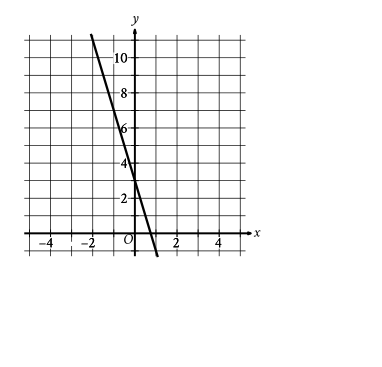
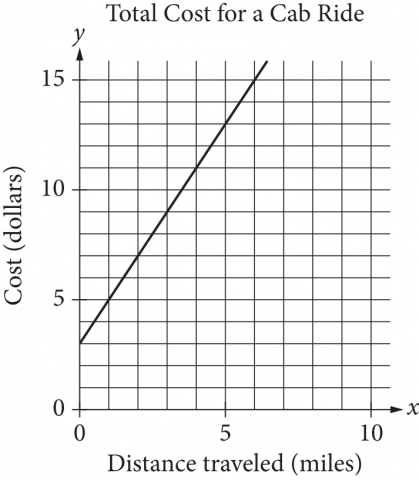
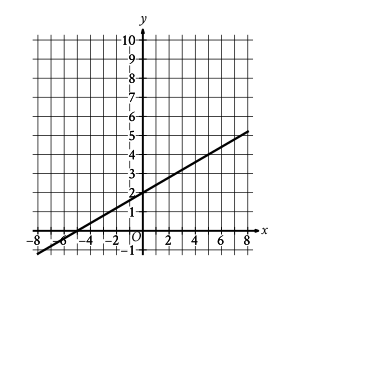
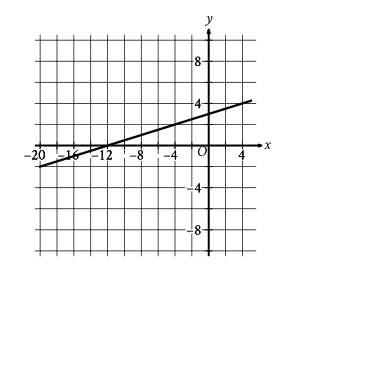
    Which of the following is the graph of the equation in the xy-plane?

    Correct answer: D

    Choice D is correct. In the xy-plane, the graph of the equation, where m and b are constants, is a line with slope m and y-intercept . Therefore, the graph of in the xy-plane is a line with slope 2 and a y-intercept . Having a slope of 2 means that for each increase in x by 1, the value of y increases by 2. Only the graph in choice D has a slope of 2 and crosses the y-axis at . Therefore, the graph shown in choice D must be the correct answer.Choices A, B, and C are incorrect. The graph of in the xy-plane is a line with slope 2 and a y-intercept at . The graph in choice A crosses the y-axis at the point, not, and it has a slope of, not 2. The graph in choice B crosses the y-axis at ; however, the slope of this line is, not 2. The graph in choice C has a slope of 2; however, the graph crosses the y-axis at, not .
  2. Question 2

    \(f(x)= 7 x + 1\) The function gives the total number of people on a company retreat with \(x\) managers. What is the total number of people on a company retreat with \(7\) managers?

    Correct answer: B

    The correct answer is \(50\). It's given that the function \(f\) gives the total number of people on a company retreat with \(x\) managers. It's also given that \(7\) managers are on the company retreat. Substituting \(7\) for \(x\) in the given function yields \(f(7)= 7(7)+ 1\), or \(f(7)= 50\). Therefore, there are a total of \(50\) people on a company retreat with \(7\) managers.
  3. Question 3

    The function \(g\) is defined by \(g(x)= 10 x + 8\). What is the value of \(g(x)\) when \(x = 8\)?

    Correct answer: D

    Choice D is correct. The value of \(g(x)\) when \(x = 8\) can be found by substituting \(8\) for \(x\) in the given equation \(g(x)= 10 x + 8\). This yields \(g(8)= 10(8)+ 8\), or \(g(8)= 88\). Therefore, when \(x = 8\), the value of \(g(x)\) is \(88\). Choice A is incorrect. This is the value of \(x\) when \(g(x)= 8\), rather than the value of \(g(x)\) when \(x = 8\). Choice B is incorrect and may result from conceptual or calculation errors. Choice C is incorrect and may result from conceptual or calculation errors.
  4. Question 4

    \(f(x)= x + b\) For the linear function \(f\), \(b\) is a constant. When \(x = 0\), \(f(x)= 30\). What is the value of \(b\)?

    Correct answer: D

    Choice D is correct. It’s given that when \(x = 0\), \(f(x)= 30\). Substituting \(0\) for \(x\) and \(30\) for \(f(x)\) in the given function yields \(30 = 0 + b\), or \(30 = b\). Therefore, the value of \(b\) is \(30\). Choice A is incorrect and may result from conceptual or calculation errors. Choice B is incorrect and may result from conceptual or calculation errors. Choice C is incorrect and may result from conceptual or calculation errors.
  5. Question 5

    A linear function \(f\) gives a company’s profit, in dollars, for selling \(x\) items. The company’s profit is \(\\) 220\( when it sells \)8\( items, and its profit is \)$ 320\( when it sells \)10\( items. Which equation defines \)f$?

    Correct answer: D

    Choice D is correct. It’s given that the relationship between \(x\) and \(f(x)\) is linear. A linear function can be written in the form \(f(x)= m x + b\), where \(m\) is the slope and \(b\) is the y-coordinate of the y-intercept of the graph of \(y = f(x)\) in the xy-plane. Given two points on a line, \((x_1, y_1)\) and \((x_2, y_2)\), the slope of the line can be found using the slope formula \(m = y_2 -y_1/x_2 -x_1\). It’s given that the company’s profit is \(\\) 220\( when it sells \)8\( items and the profit is \)$ 320\( when it sells \)10\( items. Since \)f(x)\( represents the company's profit, in dollars, for selling \)x\( items, the graph of \)y = f(x)\( in the xy-plane passes through the points \)(8, 220)\( and \)(10, 320)\(. Substituting \)(8, 220)\( and \)(10, 320)\( for \)(x_1, y_1)\( and \)(x_2, y_2)\(, respectively, in the slope formula yields \)m = 320 -220/10 -8\(, which gives \)m = 100/2\(, or \)m = 50\(. Substituting \)50\( for \)m\(, \)8\( for \)x\(, and \)220\( for \)f(x)\( in \)f(x)= m x + b\( yields \)220 =(50)(8)+ b\(, or \)220 = 400 + b\(. Subtracting \)400\( from each side of this equation yields \)-180 = b\(. Substituting \)50\( for \)m\( and \)-180\( for \)b\( in \)f(x)= m x + b\( yields \)f(x)= 50 x -180\(. Therefore, the equation that defines \)f\( is \)f(x)= 50 x -180$. Choice A is incorrect and may result from conceptual or calculation errors. Choice B is incorrect and may result from conceptual or calculation errors. Choice C is incorrect and may result from conceptual or calculation errors.
  6. Question 6

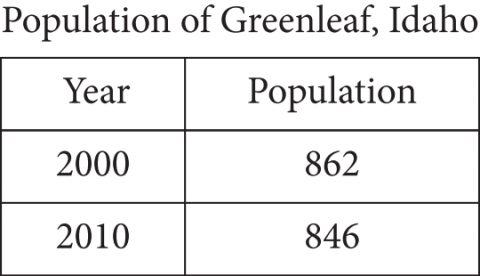
    The table above shows the population of Greenleaf, Idaho, for the years 2000 and 2010. If the relationship between population and year is linear, which of the following functions P models the population of Greenleaf t years after 2000?

    Correct answer: A

    Choice A is correct. It is given that the relationship between population and year is linear; therefore, the function that models the population t years after 2000 is of the form, where m is the slope and b is the population when . In the year 2000, . Therefore, . The slope is given by . Therefore,, which is equivalent to the equation in choice A.Choice B is incorrect and may be the result of incorrectly calculating the slope as just the change in the value of P. Choice C is incorrect and may be the result of the same error as in choice B, in addition to incorrectly using t to represent the year, instead of the number of years after 2000. Choice D is incorrect and may be the result of incorrectly using t to represent the year instead of the number of years after 2000.
  7. Question 7

    The cost of renting a carpet cleaner is \(\\) 52\( for the first day and \)$ 26\( for each additional day. Which of the following functions gives the cost \)C(d)\(, in dollars, of renting the carpet cleaner for \)d\( days, where \)d$ is a positive integer?

    Correct answer: A

    Choice A is correct. It's given that the cost of renting a carpet cleaner is \(\\) 52\( for the first day and \)$ 26\( for each additional day. Therefore, the cost \)C(d)\(, in dollars, of renting the carpet cleaner for \)d\( days is the sum of the cost for the first day, \)$ 52\(, and the cost for the additional \)d -1\( days, \)$ 26(d -1)\(. It follows that \)C(d)= 52 + 26(d -1)\(, which is equivalent to \)C(d)= 52 + 26 d -26\(, or \)C(d)= 26 d + 26\(. Choice B is incorrect. This function gives the cost of renting a carpet cleaner for \)d\( days if the cost is \)$ 78\(, not \)$ 52\(, for the first day and \)$ 26\( for each additional day. Choice C is incorrect. This function gives the cost of renting a carpet cleaner for \)d\( days if the cost is \)$ 26\(, not \)$ 52\(, for the first day and \)$ 52\(, not \)$ 26\(, for each additional day. Choice D is incorrect. This function gives the cost of renting a carpet cleaner for \)d\( days if the cost is \)$ 130\(, not \)$ 52\(, for the first day and \)$ 52\(, not \)$ 26$, for each additional day.
  8. Question 8

    If \(y = 5 x + 10\), what is the value of \(y\) when \(x = 8\)?

    Correct answer: B

    The correct answer is \(50\). Substituting \(8\) for \(x\) in the given equation yields \(y = 5(8)+ 10\), or \(y = 50\). Therefore, the value of \(y\) is \(50\) when \(x = 8\).
  9. Question 9

    For groups of \(25\) or more people, a museum charges \(\\) 21\( per person for the first \)25\( people and \)$ 14\( for each additional person. Which function \)f\( gives the total charge, in dollars, for a tour group with \)n\( people, where \)n > or = 25$?

    Correct answer: A

    Choice A is correct. A tour group with \(n\) people, where \(n > or = 25\), can be split into two subgroups: the first \(25\) people and the additional \(n -25\) people. Since the museum charges \(\\) 21\( per person for the first \)25\( people and \)$ 14\( for each additional person, the charge for the first \)25\( people is \)$ 21(25)\( and the charge for the additional \)n -25\( people is \)$ 14(n -25)\(. Therefore, the total charge, in dollars, is given by the function \)f(n)= 21(25)+ 14(n -25)\(, or \)f(n)= 14 n + 175$. Choice B is incorrect and may result from conceptual or calculation errors. Choice C is incorrect and may result from conceptual or calculation errors. Choice D is incorrect and may result from conceptual or calculation errors.
  10. Question 10

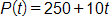
    The population of snow leopards in a certain area can be modeled by the function P defined above, where is the population t years after 1990. Of the following, which is the best interpretation of the equation ?

    Correct answer: C

    Choice C is correct. It’s given that represents the population of snow leopards t years after 1990. corresponds to and . It follows that corresponds to 30 years after 1990, or 2020. Thus, the best interpretation of is that the snow leopard population in this area is predicted to be 550 in the year 2020.Choices A and B are incorrect and may result from reversing the interpretations of t and . Choice D is incorrect and may result from determining that 30 years after 1990 is 2030, not 2020.
  11. Question 11

    The function f is defined by, where m and b are constants. If and, what is the value of m ?

    Correct answer: C

    The correct answer is 2. The slope-intercept form of an equation for a line is, where m is the slope and b is the y-coordinate of the y-intercept. Two ordered pairs, and, can be used to compute the slope using the formula . It’s given that and ; therefore, the two ordered pairs for this line are and . Substituting these values for and gives, or 2.
  12. Question 12

    \(f(x)= 2 x + 3\) For the given function \(f\), the graph of \(y = f(x)\) in the xy-plane is parallel to line \(j\). What is the slope of line \(j\)?

    Correct answer: D

    The correct answer is \(2\). It’s given that function \(f\) is defined by \(f(x)= 2 x + 3\). Therefore, the equation representing the graph of \(y = f(x)\) in the xy-plane is \(y = 2 x + 3\), and the graph is a line. For a linear equation in the form \(y = m x + b\), \(m\) represents the slope of the line. Since the value of \(m\) in the equation \(y = 2 x + 3\) is \(2\), the slope of the line defined by function \(f\) is \(2\). It's given that line \(j\) is parallel to the line defined by function \(f\). The slopes of parallel lines are equal. Therefore, the slope of line \(j\) is also \(2\).
  13. Question 13

    Robert rented a truck to transport materials he purchased from a hardware store. He was charged an initial fee of $20.00 plus an additional $0.70 per mile driven. If the truck was driven 38 miles, what was the total amount Robert was charged?

    Correct answer: A

    Choice A is correct. It’s given that Robert was charged an initial fee of $20.00 to rent the truck plus an additional $0.70 per mile driven. Let m represent the number of miles the truck was driven. Since the rental charge is $0.70 per mile driven, represents the amount Robert was charged for m miles driven. Let c equal the total amount, in dollars, Robert was charged to rent the truck. The total amount can be represented by the equation . It’s given that the truck was driven 38 miles, thus . Substituting 38 into the equation gives . Multiplying gives . Adding these values gives, so the total amount Robert was charged is $46.60.Choices B, C, and D are incorrect and may result from setting up the equation incorrectly or from making calculation errors.
  14. Question 14

    The relationship between two variables, \(x\) and \(y\), is linear. For every increase in the value of \(x\) by \(1\), the value of \(y\) increases by \(8\). When the value of \(x\) is \(2\), the value of \(y\) is \(18\). Which equation represents this relationship?

    Correct answer: C

    Choice C is correct. It’s given that the relationship between \(x\) and \(y\) is linear. An equation representing a linear relationship can be written in the form \(y = m x + b\), where \(m\) is the slope and \(b\) is the y-coordinate of the y-intercept of the graph of the relationship in the xy-plane. It’s given that for every increase in the value of \(x\) by \(1\), the value of \(y\) increases by \(8\). The slope of a line can be expressed as the change in \(y\) over the change in \(x\). Thus, the slope, \(m\), of the line representing this relationship can be expressed as \(8 oneths\), or \(8\). Substituting \(8\) for \(m\) in the equation \(y = m x + b\) yields \(y = 8 x + b\). It's also given that when the value of \(x\) is \(2\), the value of \(y\) is \(18\). Substituting \(2\) for \(x\) and \(18\) for \(y\) in the equation \(y = 8 x + b\) yields \(18 = 8(2)+ b\), or \(18 = 16 + b\). Subtracting \(16\) from each side of this equation yields \(2 = b\). Substituting \(2\) for \(b\) in the equation \(y = 8 x + b\) yields \(y = 8 x + 2\). Therefore, the equation \(y = 8 x + 2\) represents this relationship. Choice A is incorrect. This equation represents a relationship where for every increase in the value of \(x\) by \(1\), the value of \(y\) increases by \(2\), not \(8\), and when the value of \(x\) is \(2\), the value of \(y\) is \(22\), not \(18\). Choice B is incorrect. This equation represents a relationship where for every increase in the value of \(x\) by \(1\), the value of \(y\) increases by \(2\), not \(8\), and when the value of \(x\) is \(2\), the value of \(y\) is \(12\), not \(18\). Choice D is incorrect. This equation represents a relationship where for every increase in the value of \(x\) by \(1\), the value of \(y\) increases by \(3\), not \(8\), and when the value of \(x\) is \(2\), the value of \(y\) is \(32\), not \(18\).
  15. Question 15

    The function \(f\) is defined by \(f(x)= -3 x + 60\). What is the value of \(f(x)\) when \(x = -8\)?

    Correct answer: D

    Choice D is correct. The value of \(f(x)\) when \(x = -8\) can be found by substituting \(-8\) for \(x\) in the given function. This yields \(f(-8)= -3(-8)+ 60\), or \(f(-8)= 84\). Therefore, when \(x = -8\), the value of \(f(x)\) is \(84\). Choice A is incorrect. This is the value of \((-3 +(-8))+ 60\), not \(-3(-8)+ 60\). Choice B is incorrect. This is the value of \(-8 + 60\), not \(-3(-8)+ 60\). Choice C is incorrect. This is the value of \(-3 + 60\), not \(-3(-8)+ 60\).
  16. Question 16

    Oxygen gas is placed inside a tank with a constant volume. The graph shows the estimated temperature \(y\), in kelvins, of the oxygen gas when its pressure is \(x\) atmospheres. The line slants sharply up from left to right. The line begins at the approximate point (1.6, 190). The line passes through the following approximate points: (3, 350) (6, 700) (8, 933) What is the estimated temperature, in kelvins, of the oxygen gas when its pressure is \(6\) atmospheres?

    Correct answer: C

    Choice C is correct. For the graph shown, the x-axis represents pressure, in atmospheres, and the y-axis represents temperature, in kelvins. Therefore, the estimated temperature, in kelvins, of the oxygen gas when its pressure is \(6\) atmospheres is represented by the y-coordinate of the point on the graph that has an x-coordinate of \(6\). The point on the graph with an x-coordinate of \(6\) has a y-coordinate of approximately \(700\). Therefore, the estimated temperature, in kelvins, of the oxygen gas when its pressure is \(6\) atmospheres is \(700\). Choice A is incorrect. This is the pressure, in atmospheres, not the estimated temperature, in kelvins, of the oxygen gas when its pressure is \(6\) atmospheres. Choice B is incorrect and may result from conceptual or calculation errors. Choice D is incorrect and may result from conceptual or calculation errors.
  17. Question 17

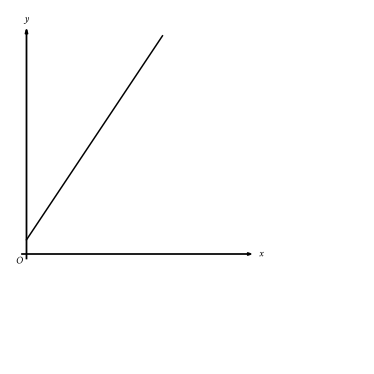
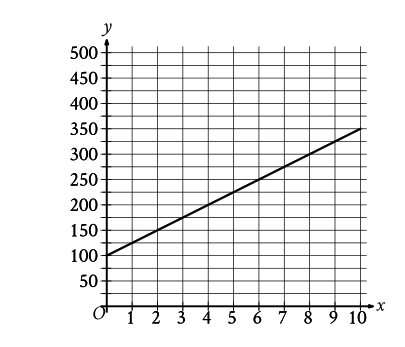
    The line begins on the y axis above the x axis. The line slants sharply up from left to right. The graph represents the total charge, in dollars, by an electrician for \(x\) hours of work. The electrician charges a onetime fee plus an hourly rate. What is the best interpretation of the slope of the graph?

    Correct answer: A

    Choice A is correct. It’s given that the electrician charges a onetime fee plus an hourly rate. It's also given that the graph represents the total charge, in dollars, for \(x\) hours of work. This graph shows a linear relationship in the xy-plane. Thus, the total charge \(y\), in dollars, for \(x\) hours of work can be represented as \(y = m x + b\), where \(m\) is the slope and \((0, b)\) is the y-intercept of the graph of the equation in the xy-plane. Since the given graph represents the total charge, in dollars, by an electrician for \(x\) hours of work, it follows that its slope is \(m\), or the electrician’s hourly rate. Choice B is incorrect. The electrician's onetime fee is represented by the y-coordinate of the y-intercept, not the slope, of the graph. Choice C is incorrect and may result from conceptual errors. Choice D is incorrect and may result from conceptual errors.
  18. Question 18

    The graph of the function f is a line in the xy-plane. If the line has slope and, which of the following defines f?

    Correct answer: B

    Choice B is correct. The equation for the function f in the xy-plane can be represented by, where m is the slope and b is the y-coordinate of the y-intercept. Since it’s given that the line has a slope of, it follows that in, which yields . It’s given that . This implies that the graph of the function f in the xy-plane passes through the point . Thus, the y-coordinate of the y-intercept of the graph is 3, so in, which yields . Therefore, the equation defines the function f. Choice A is incorrect and may result from a sign error for the y-intercept. Choice C is incorrect and may result from using the denominator of the given slope as m in, in addition to a sign error for the y-intercept. Choice D is incorrect and may result from using the denominator of the given slope as m in .
  19. Question 19

    Scientists collected fallen acorns that each housed a colony of the ant species P. ohioensis and analyzed each colony's structure. For any of these colonies, if the colony has \(x\) worker ants, the equation \(y = 0.67 x + 2.6\), where \(20 < or = x < or = 110\), gives the predicted number of larvae, \(y\), in the colony. If one of these colonies has \(58\) worker ants, which of the following is closest to the predicted number of larvae in the colony?

    Correct answer: A

    Choice A is correct. It's given that the equation \(y = 0.67 x + 2.6\), where \(20 < or = x < or = 110\), gives the predicted number of larvae, \(y\), in a colony of ants if the colony has \(x\) worker ants. If one of these colonies has \(58\) worker ants, the predicted number of larvae in that colony can be found by substituting \(58\) for \(x\) in the given equation. Substituting \(58\) for \(x\) in the given equation yields \(y = 0.67(58)+ 2.6\), or \(y = 41.46\). Of the given choices, \(41\) is closest to the predicted number of larvae in the colony. Choice B is incorrect. This is closest to the predicted number of larvae in a colony with \(87\) worker ants. Choice C is incorrect. This is closest to the number of worker ants for which the predicted number of larvae in a colony is \(58\). Choice D is incorrect. This is closest to the predicted number of larvae in a colony with \(280\) worker ants.
  20. Question 20

    The function \(f\) is defined by \(f(x)= 9 sevenths x + 8 sevenths\). For what value of \(x\) does \(f(x)= 5\)?

    Correct answer: C

    The correct answer is \(3\). Substituting \(5\) for \(f(x)\) in the given function yields \(5 = 9 sevenths x + 8 sevenths\). Multiplying each side of this equation by \(7\) yields \(7(5)= 7(9 sevenths x + 8 sevenths)\), or \(35 = 9 x + 8\). Subtracting \(8\) from each side of this equation yields \(27 = 9 x\). Dividing each side of this equation by \(9\) yields \(3 = x\). Therefore, \(f(x)= 5\) when the value of \(x\) is \(3\).
  21. Question 21

    The linear function \(g\) is defined by \(g(x)= b -15 x\), where \(b\) is a constant. If \(g(c + 7)= c/4\), where \(c\) is a constant, which of the following expressions represents the value of \(b\)?

    Correct answer: C

    Choice C is correct. It’s given that \(g(c + 7)= c/4\). Therefore, for the given linear function \(g\), when \(x = c + 7\), \(g(x)= c/4\). Substituting \(c + 7\) for \(x\) and \(c/4\) for \(g(x)\) in \(g(x)= b -15 x\) yields \(c/4 = b -15(c + 7)\). Applying the distributive property to the right-hand side of this equation yields \(c/4 = b -15 c -105\). Adding \(15 c\) to both sides of this equation yields \(c/4 + 15 c = b -105\). Adding \(105\) to both sides of this equation yields \(c/4 + 15 c + 105 = b\), or \(61 c/4 + 105 = b\). Therefore, the expression that represents the value of \(b\) is \(61 c/4 + 105\). Choice A is incorrect and may result from conceptual or calculation errors. Choice B is incorrect and may result from conceptual or calculation errors. Choice D is incorrect and may result from conceptual or calculation errors.
  22. Question 22

    For the function f, if for all values of x, what is the value of ?

    Correct answer: B

    Choice B is correct. It’s given that for all values of x. If, then will equal . Dividing both sides of by 3 gives . Therefore, substituting 2 for x in the given equation yields, which can be rewritten as .Choice A is incorrect. This is the value of the constant in the given equation for f. Choice C is incorrect and may result from substituting, rather than, into the given equation. Choice D is incorrect. This is the value of x that yields for the left-hand side of the given equation; it’s not the value of .
  23. Question 23

    An object hangs from a spring. The formula relates the length, in centimeters, of the spring to the weight w, in newtons, of the object. Which of the following describes the meaning of the 2 in this context?

    Correct answer: D

    Choice D is correct. The value 2 is multiplied by w, the weight of the object. When the weight is 0, the length is 30 + 2(0) = 30 centimeters. If the weight increases by w newtons, the length increases by 2w centimeters, or 2 centimeters for each one-newton increase in weight. Choice A is incorrect because this describes the value 30. Choice B is incorrect because 30 represents the length of the spring before it has been stretched. Choice C is incorrect because this describes the value w.
  24. Question 24

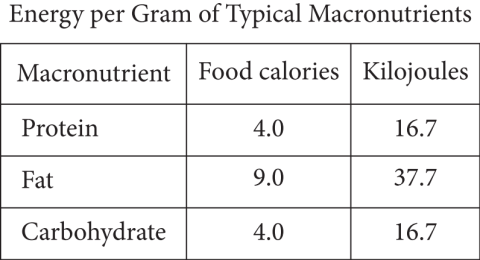
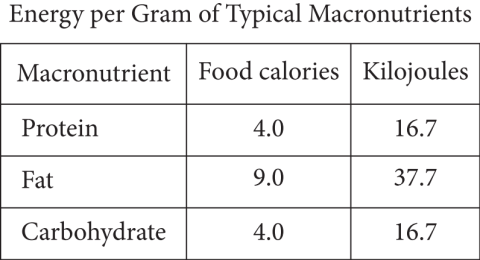
    The table above gives the tyπcal amounts of energy per gram, expressed in both food calories and kilojoules, of the three macronutrients in food. If the 180 food calories in a granola bar come entirely from p grams of protein, f grams of fat, and c grams of carbohydrate, which of the following expresses f in terms of p and c ?

    Correct answer: B

    Choice B is correct. It is given that there are 4.0 food calories per gram of protein, 9.0 food calories per gram of fat, and 4.0 food calories per gram of carbohydrate. If 180 food calories in a granola bar came from p grams of protein, f grams of fat, and c grams of carbohydrate, then the situation can be represented by the equation . The equation can then be rewritten in terms of f by subtracting 4p and 4c from both sides of the equation and then dividing both sides of the equation by 9. The result is the equation .Choices A, C, and D are incorrect and may be the result of not representing the situation with the correct equation or incorrectly rewriting the equation in terms of f.
  25. Question 25

    The function \(h\) is defined by \(h(x)= x + 200\). What is the value of \(h(50)\)?

    Correct answer: B

    Choice B is correct. Substituting \(50\) for \(x\) in the given function yields \(h(50)= 50 + 200\), or \(h(50)= 250\). Therefore, the value of \(h(50)\) is \(250\). Choice A is incorrect. This is the value of \(h(0)\). Choice C is incorrect. This is the value of \(h(9,800)\). Choice D is incorrect. This is the value of \(h(50,000)\).
  26. Question 26

    The function \(f(x)\) is defined as \(19\) more than \(4\) times a number \(x\). If \(y = f(x)\) is graphed in the \(x y\)-plane, what is the best interpretation of the \(x\)-intercept?

    Correct answer: A

    Choice A is correct. It’s given that the function \(f(x)\) is defined as \(19\) more than \(4\) times a number \(x\). This can be represented by the equation \(f(x)= 4 x + 19\). The x-intercept of the graph of \(y = f(x)\) in the xy-plane is the point where the graph intersects the x-axis, or the point on the graph where the value of \(f(x)\) is equal to \(0\). Substituting \(0\) for \(f(x)\) in the equation \(f(x)= 4 x + 19\) yields \(0 = 4 x + 19\). Subtracting \(19\) from each side of this equation yields \(-19 = 4 x\). Dividing each side of this equation by \(4\) yields \(x = -19/4\). Therefore, when \(f(x)= 0\), the number is \(-19/4\). Choice B is incorrect. This is the best interpretation of the y-intercept, not the x-intercept, of the graph of the function. Choice C is incorrect and may result from conceptual or calculation errors. Choice D is incorrect. This is the best interpretation of the slope, not the x-intercept, of the graph of the function.
  27. Question 27

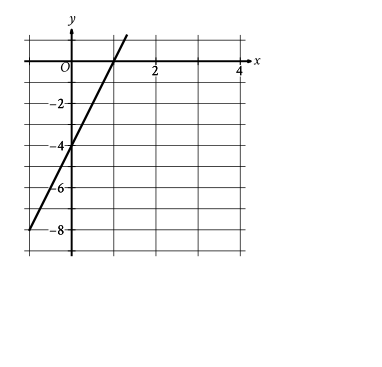
    The graph of \(y = f(x)-11\) is shown. The line slants sharply down from left to right. The line passes through the following points: (-1, -2) (0, -4) Which equation defines the linear function \(f\)?

    Correct answer: B

    Choice B is correct. The graph of a line in the xy-plane can be represented by the equation \(y = m x + b\), where \(m\) is the slope of the line and \((0, b)\) is the y-intercept. The slope of a line that passes through the points \((x_1, y_1)\) and \((x_2, y_2)\) can be calculated using the formula \(m = y_2 -y_1/x_2 -x_1\). The line shown passes through the points \((-1, -2)\) and \((0, -4)\). Substituting \((-1, -2)\) and \((0, 4)\) for \((x_1, y_1)\) and \((x_2, y_2)\), respectively, in the formula \(m = y_2 -y_1/x_2 -x_1\) yields \(m = \ -4 -(-2)/0 -(-1)\), which is equivalent to \(m = \ -2/1\), or \(m = -2\). Since the line shown passes through the point \((0, -4)\), it follows that \(b = -4\). Substituting \(-2\) for \(m\) and \(-4\) for \(b\) in the equation \(y = m x + b\) yields \(y = -2 x -4\). It’s given that the graph shown is the graph of \(y = f(x)-11\). Substituting \(-2 x -4\) for \(y\) in the equation \(y = f(x)-11\) yields \(-2 x -4 = f(x)-11\). Adding \(11\) to both sides of this equation yields \(-2 x + 7 = f(x)\). Therefore, the equation \(f(x)= -2 x + 7\) defines the linear function \(f\). Choice A is incorrect and may result from conceptual or calculation errors. Choice C is incorrect and may result from conceptual or calculation errors. Choice D is incorrect and may result from conceptual or calculation errors.
  28. Question 28

    The function \(f\) is defined by \(f(x)= 5 x + 8\). For what value of \(x\) does \(f(x)= 58\)?

    Correct answer: A

    Choice A is correct. It's given that the function \(f\) is defined by \(f(x)= 5 x + 8\). Substituting \(58\) for \(f(x)\) in this equation yields \(58 = 5 x + 8\). Subtracting \(8\) from both sides of this equation yields \(50 = 5 x\). Dividing both sides of this equation by \(5\) yields \(10 = x\). Therefore, the value of \(x\) when \(f(x)= 58\) is \(10\). Choice B is incorrect and may result from conceptual or calculation errors. Choice C is incorrect and may result from conceptual or calculation errors. Choice D is incorrect. This is the value of \(f(58)\), not the value of \(x\) when \(f(x)= 58\).
  29. Question 29

    Hana deposited a fixed amount into her bank account each month. The function \(f(t)= 100 + 25 t\) gives the amount, in dollars, in Hana's bank account after \(t\) monthly deposits. What is the best interpretation of \(25\) in this context?

    Correct answer: A

    Choice A is correct. It's given that \(t\) represents the number of monthly deposits. In the given function \(f(t)= 100 + 25 t\), the coefficient of \(t\) is \(25\). This means that for every increase in the value of \(t\) by \(1\), the value of \(f(t)\) increases by \(25\). It follows that with each monthly deposit, the amount in Hana's bank account increased by \(\\) 25\(. Choice B is incorrect. Before Hana made any monthly deposits, the amount in her bank account was \)$ 100\(. Choice C is incorrect. After \)1\( monthly deposit, the amount in Hana's bank account was \)$ 125$. Choice D is incorrect and may result from conceptual errors.
  30. Question 30

    In the linear function \(h\), \(h(0)= 41\) and \(h(1)= 40\). Which equation defines \(h\)?

    Correct answer: A

    Choice A is correct. An equation defining a linear function can be written in the form \(h(x)= a x + b\), where \(a\) and \(b\) are constants. It’s given that \(h(0)= 41\). Substituting \(0\) for \(x\) and \(41\) for \(h(x)\) in the equation \(h(x)= a x + b\) yields \(41 = a(0)+ b\), or \(b = 41\). Substituting \(41\) for \(b\) in the equation \(h(x)= a x + b\) yields \(h(x)= a x + 41\). It’s also given that \(h(1)= 40\). Substituting \(1\) for \(x\) and \(40\) for \(h(x)\) in the equation \(h(x)= a x + 41\) yields \(40 = a(1)+ 41\), or \(40 = a + 41\). Subtracting \(41\) from the left-and right-hand sides of this equation yields \(-1 = a\). Substituting \(-1\) for \(a\) in the equation \(h(x)= a x + 41\) yields \(h(x)= -1 x + 41\), or \(h(x)= -x + 41\). Choice B is incorrect. Substituting \(0\) for \(x\) and \(41\) for \(h(x)\) in this equation yields \(41 = -0\), which isn't a true statement. Choice C is incorrect. Substituting \(0\) for \(x\) and \(41\) for \(h(x)\) in this equation yields \(41 = -41(0)\), or \(41 = 0\), which isn't a true statement. Choice D is incorrect. Substituting \(41\) for \(h(x)\) in this equation yields \(41 = -41\), which isn't a true statement.
  31. Question 31

    To repair a refrigerator, a technician charges \(\\) 60\( per hour for labor plus \)$ 120\( for parts. Which function f represents the total amount, in dollars, the technician will charge for this job if it takes \)x$ hours?

    Correct answer: C

    Choice C is correct. It’s given that the technician charges \(\\) 60\( per hour for labor. Therefore, if the job takes \)x\( hours, the technician will charge \)($ 60/1 hour)(x hours)\(, or \)$ 60 x\(, for labor. It’s also given that the technician charges \)$ 120\( for parts. Therefore, \)f(x)= 60 x + 120\( represents the total amount, in dollars, the technician will charge for this job if it takes \)x$ hours. Choice A is incorrect and may result from conceptual or calculation errors. Choice B is incorrect. This function represents the total amount, in dollars, the technician charges for labor only, not the total amount charged for labor and parts. Choice D is incorrect. This function represents the total amount, in dollars, the technician would charge if the charge for parts were subtracted from, rather than added to, the charge for labor.
  32. Question 32

    The equation above represents the speed y, in feet per second, of Sheila’s bicycle x seconds after she applied the brakes at the end of a ride. If the equation is graphed in the xy-plane, which of the following is the best interpretation of the x-coordinate of the line’s x-intercept in the context of the problem?

    Correct answer: C

    Choice C is correct. It’s given that for each point on the graph of the given equation, the x-coordinate represents the number of seconds after Sheila applied the brakes, and the y-coordinate represents the speed of Sheila’s bicycle at that moment in time. For the graph of the equation, the y-coordinate of the x-intercept is 0. Therefore, the x-coordinate of the x-intercept of the graph of the given equation represents the number of seconds it took from the time Sheila began applying the brakes until the bicycle came to a complete stop.Choice A is incorrect. The speed of Sheila’s bicycle before she applied the brakes is represented by the y-coordinate of the y-intercept of the graph of the given equation, not the x-coordinate of the x-intercept. Choice B is incorrect. The number of feet per second the speed of Sheila’s bicycle decreased each second after Sheila applied the brakes is represented by the slope of the graph of the given equation, not the x-coordinate of the x-intercept. Choice D is incorrect and may result from misinterpreting x as the distance, in feet, traveled after applying the brakes, rather than the time, in seconds, after applying the brakes.
  33. Question 33

    Kaylani used fabric measuring \(5\) yards in length to make each suit for a men's choir. The relationship between the number of suits that Kaylani made, \(x\), and the total length of fabric that she purchased \(y\), in yards, is represented by the equation \(y -5 x = 6\). What is the best interpretation of \(6\) in this context?

    Correct answer: D

    Choice D is correct. It’s given that the equation \(y -5 x = 6\) represents the relationship between the number of suits that Kaylani made, \(x\), and the total length of fabric she purchased, \(y\), in yards. Adding \(5 x\) to both sides of the given equation yields \(y = 5 x + 6\). Since Kaylani made \(x\) suits and used \(5\) yards of fabric to make each suit, the expression \(5 x\) represents the total amount of fabric she used to make the suits. Since \(y\) represents the total length of fabric Kaylani purchased, in yards, it follows from the equation \(y = 5 x + 6\) that Kaylani purchased \(5 x\) yards of fabric to make the suits, plus an additional \(6\) yards of fabric. Therefore, the best interpretation of \(6\) in this context is that Kaylani purchased \(6\) yards more fabric than she used to make the suits. Choice A is incorrect. Kaylani made a total of \(x\) suits, not \(6\) suits. Choice B is incorrect. Kaylani purchased a total of \(y\) yards of fabric, not a total of \(6\) yards of fabric. Choice C is incorrect. Kaylani used a total of \(5 x\) yards of fabric to make the suits, not a total of \(6\) yards of fabric.
  34. Question 34

    \(g(m)= -0.05 m + 12.1\) The given function \(g\) models the number of gallons of gasoline that remains from a full gas tank in a car after driving \(m\) miles. According to the model, about how many gallons of gasoline are used to drive each mile?

    Correct answer: A

    Choice A is correct. It's given that the function \(g\) models the number of gallons that remain from a full gas tank in a car after driving \(m\) miles. In the given function \(g(m)= -0.05 m + 12.1\), the coefficient of \(m\) is \(-0.05\). This means that for every increase in the value of \(m\) by \(1\), the value of \(g(m)\) decreases by \(0.05\). It follows that for each mile driven, there is a decrease of \(0.05\) gallons of gasoline. Therefore, \(0.05\) gallons of gasoline are used to drive each mile. Choice B is incorrect and represents the number of gallons of gasoline in a full gas tank. Choice C is incorrect and may result from conceptual errors. Choice D is incorrect and may result from conceptual errors.
  35. Question 35

    The function \(f\) is defined by \(f(x)= 1 tenth x -2\). What is the y-intercept of the graph of \(y = f(x)\) in the xy-plane?

    Correct answer: B

    Choice B is correct. The y-intercept of the graph of a function in the xy-plane is the point on the graph where \(x = 0\). It′s given that \(f(x)= 1 tenth x -2\). Substituting \(0\) for \(x\) in this equation yields \(f(0)= 1 tenth(0)-2\), or \(f(0)= -2\). Since it′s given that \(y = f(x)\), it follows that \(y = -2\) when \(x = 0\). Therefore, the y-intercept of the graph of \(y = f(x)\) in the xy-plane is \((0, -2)\). Choice A is incorrect and may result from conceptual or calculation errors. Choice C is incorrect and may result from conceptual or calculation errors. Choice D is incorrect and may result from conceptual or calculation errors.
  36. Question 36

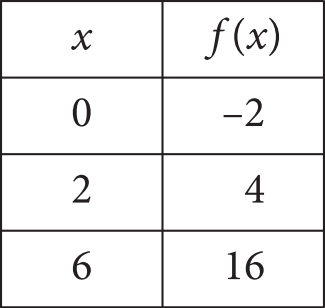
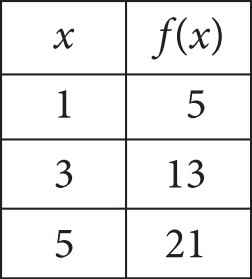
    The table above shows some values of x and their corresponding values for the linear function f. What is the x-intercept of the graph of in the xy-plane?

    Correct answer: B

    Choice B is correct. The equation of a linear function can be written in the form, where, m is the slope of the graph of, and b is the y-coordinate of the y-intercept of the graph. The value of m can be found using the slope formula, . According to the table, the points and lie on the graph of . Using these two points in the slope formula yields, or . Substituting for m in the slope-intercept form of the equation yields . The value of b can be found by substituting values from the table and solving; for example, substituting the coordinates of the point into the equation gives, which yields . This means the function given by the table can be represented by the equation . The value of the x-intercept of the graph of can be determined by finding the value of x when . Substituting into yields, or . This corresponds to the point .Choice A is incorrect and may result from substituting the value of the slope for the x-coordinate of the x-intercept. Choice C is incorrect and may result from a calculation error. Choice D is incorrect and may result from substituting the y-coordinate of the y-intercept for the x-coordinate of the x-intercept.
  37. Question 37

    The length, \(y\), of a white whale was \(162 centimeters(cm)\) when it was born and increased an average of \(4.8 cm\) per month for the first \(12\) months after it was born. Which equation best represents this situation, where \(x\) is the number of months after the whale was born and \(y\) is the length, in \(cm\), of the whale?

    Correct answer: D

    Choice D is correct. It's given that the length of the whale was \(162 cm\) when it was born and that its length increased an average of \(4.8 cm\) per month for the first \(12\) months after it was born. Since \(x\) represents the number of months after the whale was born, the total increase in the whale's length, in \(cm\), is \(4.8\) times \(x\), or \(4.8 x\). The length of the whale \(y\), in \(cm\), can be found by adding the whale's length at birth, \(162 cm\), to the total increase in length, \(4.8 x cm\). Therefore, the equation that best represents this situation is \(y = 4.8 x + 162\). Choice A is incorrect and may result from conceptual errors. Choice B is incorrect and may result from conceptual errors. Choice C is incorrect and may result from conceptual errors.
  38. Question 38

    Argon is placed inside a container with a constant volume. The graph shows the estimated pressure \(y\), in \(pounds per square inch(p s i)\), of the argon when its temperature is \(x\) kelvins. The line slants gradually up from left to right. The line begins at the approximate point (90, 1.8). The line passes through the following points: (300, 6) (450, 9) (600, 12) What is the estimated pressure of the argon, in \(p s i\), when the temperature is \(600\) kelvins?

    Correct answer: B

    Choice B is correct. For the graph shown, the x-axis represents temperature, in kelvins, and the y-axis represents the estimated pressure, in \(pounds per square inch(p s i)\). The estimated pressure of the argon when the temperature is \(600\) kelvins can be found by locating the point on the graph where the value of \(x\) is equal to \(600\). The graph passes through the point \((600, 12)\). This means that when the temperature is \(600\) kelvins, the estimated pressure is \(12 p s i\). Choice A is incorrect. This is the estimated pressure, in \(p s i\), of the argon when the temperature is \(300\) kelvins, not \(600\) kelvins. Choice C is incorrect and may result from conceptual or calculation errors. Choice D is incorrect. This is the temperature, in kelvins, of the argon.
  39. Question 39

    A student council group is selling school posters for a fundraiser. They use the function \(p(x)= 5 x -220\) to determine their profit \(p(x)\), in dollars, for selling \(x\) school posters. In order to earn a profit of \(\\) 900$, how many school posters must they sell?

    Correct answer: D

    The correct answer is \(224\). It’s given that a student council group uses the function \(p(x)= 5 x -220\) to determine their profit \(p(x)\), in dollars, for selling \(x\) school posters. Substituting \(900\) for \(p(x)\) in the given function yields \(900 = 5 x -220\). Adding \(220\) to each side of this equation yields \(1,120 = 5 x\). Dividing each side of this equation by \(5\) yields \(224 = x\). Therefore, in order to earn a profit of \(\\) 900\(, they must sell \)224$ school posters.
  40. Question 40

    On January 1, 2015, a city’s minimum hourly wage was $9.25. It will increase by $0.50 on the first day of the year for the next 5 years. Which of the following functions best models the minimum hourly wage, in dollars, x years after January 1, 2015, where ?

    Correct answer: C

    Choice C is correct. It’s given that the city’s minimum hourly wage will increase by $0.50 on the first day of the year for the 5 years after January 1, 2015. Therefore, the total increase, in dollars, in the minimum hourly wage x years after January 1, 2015, is represented by . Since the minimum hourly wage on January 1, 2015, was $9.25, it follows that the minimum hourly wage, in dollars, x years after January 1, 2015, is represented by . Therefore, the function best models this situation.Choices A, B, and D are incorrect. In choice A, the function models a situation where the minimum hourly wage is $9.25 on January 1, 2015, but decreases by $0.50 on the first day of the year for the next 5 years. The functions in choices B and D both model a situation where the minimum hourly wage is increasing by $9.25 on the first day of the year for the 5 years after January 1, 2015.
  41. Question 41

    If \(f(x)= x + 7\) and \(g(x)= 7x\), what is the value of \(4f(2)−g(2)\)?

    Correct answer: C

    Choice C is correct. The value of \(f(2)\) can be found by substituting \(2\) for \(x\) in the given equation \(f(x)= x + 7\), which yields \(f(2)= 2 + 7\), or \(f(2)= 9\). The value of \(g(2)\) can be found by substituting \(2\) for \(x\) in the given equation \(g(x)= 7 x\), which yields \(g(2)= 7(2)\), or \(g(2)= 14\). The value of the expression \(4 f(2)-g(2)\) can be found by substituting the corresponding values into the expression, which gives \(4(9)-14\). This expression is equivalent to \(36 -14\), or \(22\). Choice A is incorrect. This is the value of \(f(2)-g(2)\), not \(4 f(2)-g(2)\). Choice B is incorrect and may result from calculating \(4 f(2)\) as \(4(2)+ 7\), rather than\(4(2 + 7)\). Choice D is incorrect and may result from conceptual or calculation errors.
  42. Question 42

    The function \(f\) is defined by the equation \(f(x)= 100 x + 2\). What is the value of \(f(x)\) when \(x = 9\)?

    Correct answer: D

    Choice D is correct. Substituting \(9\) for \(x\) in the given equation yields \(f(9)= 100(9)+ 2\), or \(f(9)= 902\). Therefore, the value of \(f(x)\) when \(x = 9\) is \(902\). Choice A is incorrect. This is the value of \(f(x)\) when \(x = 1.09\). Choice B is incorrect. This is the value of \(f(x)\) when \(x = 1.16\). Choice C is incorrect. This is the value of \(f(x)\) when \(x = 8.98\).
  43. Question 43

    The function \(f\) is defined by \(f(x)= x + 15/5\), and \(f(a)= 10\), where \(a\) is a constant. What is the value of \(a\)?

    Correct answer: C

    Choice C is correct. It's given that \(f(x)= x + 15/5\) and \(f(a)= 10\), where \(a\) is a constant. Therefore, for the given function \(f\), when \(x = a\), \(f(x)= 10\). Substituting \(a\) for \(x\) and \(10\) for \(f(x)\) in the given function \(f\) yields \(10 = a + 15/5\). Multiplying both sides of this equation by \(5\) yields \(50 = a + 15\). Subtracting \(15\) from both sides of this equation yields \(35 = a\). Therefore, the value of \(a\) is \(35\). Choice A is incorrect. This is the value of \(a\) if \(f(a)= 4\). Choice B is incorrect. This is the value of \(a\) if \(f(a)= 5\). Choice D is incorrect. This is the value of \(a\) if \(f(a)= 16\).
  44. Question 44

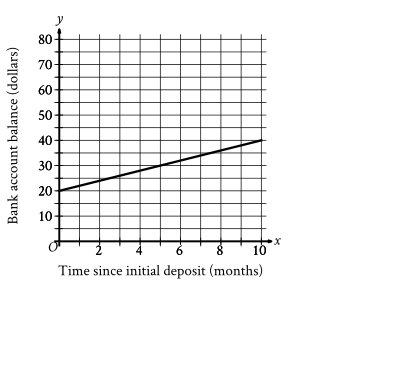
    The line slants gradually up from left to right. The line passes through the following points: (0, 20) (5, 30) (10, 40) A bank account was opened with an initial deposit. Over the next several months, regular deposits were made into this account, and there were no withdrawals made during this time. The graph of the function \(f\) shown, where \(y = f(x)\), estimates the account balance, in dollars, in this bank account \(x\) months since the initial deposit. To the nearest whole dollar, what is the amount of the initial deposit estimated by the graph?

    Correct answer: C

    The correct answer is \(20\). For the graph shown, the x-axis represents the time since the initial deposit, in months, and the y-axis represents the bank account balance, in dollars. The amount of the initial deposit is estimated by the y-coordinate of the point on the graph that represents \(0\) months since the initial deposit. Therefore, the amount of the initial deposit is estimated by the corresponding y-value for the point when \(x = 0\). When \(x = 0\), it is estimated that \(y = 20\). Thus, the amount of the initial deposit estimated by the graph, to the nearest whole dollar, is \(20\).
  45. Question 45

    For the linear function \(g\), the graph of \(y = g(x)\) in the xy-plane has a slope of \(2\) and passes through the point \((1, 14)\). Which equation defines \(g\)?

    Correct answer: C

    Choice C is correct. An equation defining a linear function can be written in the form \(g(x)= m x + b\), where \(m\) is the slope and \((0, b)\) is the y-intercept of the graph of \(y = g(x)\) in the xy-plane. It’s given that the graph of \(y = g(x)\) has a slope of \(2\). Therefore, \(m = 2\). It’s also given that the graph of \(y = g(x)\) passes through the point \((1, 14)\). It follows that when \(x = 1\), \(g(x)= 14\). Substituting \(1\) for \(x\), \(14\) for \(g(x)\), and \(2\) for \(m\) in the equation \(g(x)= m x + b\) yields \(14 = 2(1)+ b\), or \(14 = 2 + b\). Subtracting \(2\) from each side of this equation yields \(12 = b\). Therefore, \(b = 12\). Substituting \(2\) for \(m\) and \(12\) for \(b\) in the equation \(g(x)= m x + b\) yields \(g(x)= 2 x + 12\). Therefore, the equation that defines \(g\) is \(g(x)= 2 x + 12\). Choice A is incorrect. For this function, the graph of \(y = g(x)\) in the xy-plane passes through the point \((1, 2)\), not \((1, 14)\). Choice B is incorrect. For this function, the graph of \(y = g(x)\) in the xy-plane passes through the point \((1, 4)\), not \((1, 14)\). Choice D is incorrect. For this function, the graph of \(y = g(x)\) in the xy-plane passes through the point \((1, 16)\), not \((1, 14)\).
  46. Question 46

    The table gives the number of hours, \(h\), of labor and a plumber’s total charge \(f(h)\), in dollars, for two different jobs. \(h\) \(f(h)\) \(1\) \(155\) \(3\) \(285\) There is a linear relationship between \(h\) and \(f(h)\). Which equation represents this relationship?

    Correct answer: C

    Choice C is correct. It's given that there is a linear relationship between a plumber's hours of labor, \(h\), and the plumber's total charge \(f(h)\), in dollars. It follows that the relationship can be represented by an equation of the form \(f(h)= m h + b\), where \(m\) is the rate of change of the function \(f\) and \(b\) is a constant. The rate of change of \(f\) can be calculated by dividing the difference in two values of \(f(h)\) by the difference in the corresponding values of \(h\). Based on the values given in the table, the rate of change of \(f\) is \(285 -155/3 -1\), or \(65\). Substituting \(65\) for \(m\) in the equation \(f(h)= m h + b\) yields \(f(h)= 65 h + b\). The value of \(b\) can be found by substituting any value of \(h\) and its corresponding value of \(f(h)\) for \(h\) and \(f(h)\), respectively, in this equation. Substituting \(1\) for \(h\) and \(155\) for \(f(h)\) yields \(155 = 65(1)+ b\), or \(155 = 65 + b\). Subtracting \(65\) from both sides of this equation yields \(90 = b\). Substituting \(90\) for \(b\) in the equation \(f(h)= 65 h + b\) yields \(f(h)= 65 h + 90\). Choice A is incorrect and may result from conceptual or calculation errors. Choice B is incorrect and may result from conceptual or calculation errors. Choice D is incorrect and may result from conceptual or calculation errors.
  47. Question 47

    The table above gives the tyπcal amounts of energy per gram, expressed in both food calories and kilojoules, of the three macronutrients in food. If x food calories is equivalent to k kilojoules, of the following, which best represents the relationship between x and k ?

    Correct answer: B

    Choice B is correct. The relationship between x food calories and k kilojoules can be modeled as a proportional relationship. Let and represent the values in the first two rows in the table: and . The rate of change, or, is ; therefore, the equation that best represents the relationship between x and k is .Choice A is incorrect and may be the result of calculating the rate of change using . Choice C is incorrect because the number of kilojoules is greater than the number of food calories. Choice D is incorrect and may be the result of an error when setting up the equation.
  48. Question 48

    In the linear function \(h\), \(h(28)= 15\) and \(h(26)= 22\). Which equation defines \(h\)?

    Correct answer: D

    Choice D is correct. An equation defining \(h\) can be written in the form \(y = m x + b\), where \(y = h(x)\), \(m\) represents the slope of the graph of \(y = h(x)\) in the xy-plane, and \(b\) represents the y-coordinate of the y-intercept of the graph. It’s given that \(h(28)= 15\) and \(h(26)= 22\). It follows that the points \((28, 15)\) and \((26, 22)\) are on the graph of \(y = h(x)\) in the xy-plane. The slope can be found by using any two points, \((x_1, y_1)\) and \((x_2, y_2)\), and the formula \(m = y_2 -y_1/x_2 -x_1\). Substituting \((28, 15)\) and \((26, 22)\) for \((x_1, y_1)\) and \((x_2, y_2)\), respectively, in the slope formula yields \(m = 22 -15/26 -28\), or \(m = -7 halves\). Substituting \(-7 halves\) for \(m\) and \((28, 15)\) for \((x, y)\) in the equation \(y = m x + b\) yields \(15 =(-7 halves)(28)+ b\), or \(15 = -98 + b\). Adding \(98\) to both sides of this equation yields \(113 = b\). Substituting \(-7 halves\) for \(m\) and \(113\) for \(b\) in the equation \(y = m x + b\) yields \(y = -7 halves x + 113\). Since \(y = h(x)\), it follows that the equation that defines \(h\) is \(h(x)= -7 halves x + 113\). Choice A is incorrect. For this function, \(h(26)= 109/7\), not \(h(26)= 22\). Choice B is incorrect. For this function, \(h(28)= 105\), not \(h(28)= 15\), and \(h(26)= 739/7\), not \(h(26)= 22\). Choice C is incorrect. For this function, \(h(28)= -75\), not \(h(28)= 15\), and \(h(26)= -68\), not \(h(26)= 22\).
  49. Question 49

    \(j(x)= m x + 144\) For the linear function \(j\), \(m\) is a constant and \(j(12)= 18\). What is the value of \(j(10)\)?

    Correct answer: A

    The correct answer is \(39\). It’s given that for the linear function \(j\), \(m\) is a constant and \(j(12)= 18\). Substituting \(12\) for \(x\) and \(18\) for \(j(x)\) in the given equation yields \(18 = m(12)+ 144\). Subtracting \(144\) from both sides of this equation yields \(-126 = m(12)\). Dividing both sides of this equation by \(12\) yields \(-10.5 = m\). Substituting \(-10.5\) for \(m\) in the given equation, \(j(x)= m x + 144\), yields \(j(x)= -10.5 x + 144\). Substituting \(10\) for \(x\) in this equation yields \(j(10)=(-10.5)(10)+ 144\), or \(j(10)= 39\). Therefore, the value of \(j(10)\) is \(39\).
  50. Question 50

    The function is defined as, where a is a constant. If, what is the value of a ?

    Correct answer: C

    Choice C is correct. Substituting 4 for x in g(x) = 5x + a gives g(4) = 5(4) + a. Since g(4) = 31, the equation g(4) = 5(4) + a simplifies to 31 = 20 + a. It follows that a = 11.Choices A, B, and D are incorrect and may result from arithmetic errors.
  51. Question 51

    In the equation above, T represents Brittany’s total take-home pay, in dollars, for her first week of work, where h represents the number of hours she worked that week and 1,000 represents a sign-on bonus. If Brittany’s total take-home pay was $1,576, for how many hours was Brittany paid for her first week of work?

    Correct answer: B

    Choice B is correct. Since Brittany’s total take-home pay was $1,576, the value 1,576 can be substituted for T in the given equation to give . Subtracting 1,000 from both sides of this equation gives . Dividing both sides of this equation by 18 gives . Therefore, Brittany was paid for 32 hours for her first week of work.Choice A is incorrect. This is half the number of hours Brittany was paid for. Choice C is incorrect and may result from dividing 1,000 by 18. Choice D is incorrect and may result from dividing 1,576 by 18.
  52. Question 52

    \(s = 40 + 3 t\) The equation gives the speed \(s\), in miles per hour, of a certain car \(t\) seconds after it began to accelerate. What is the speed, in miles per hour, of the car \(5\) seconds after it began to accelerate?

    Correct answer: D

    Choice D is correct. In the given equation, \(s\) is the speed, in miles per hour, of a certain car \(t\) seconds after it began to accelerate. Therefore, the speed of the car, in miles per hour, \(5\) seconds after it began to accelerate can be found by substituting \(5\) for \(t\) in the given equation, which yields \(s = 40 + 3(5)\), or \(s = 55\). Thus, the speed of the car \(5\) seconds after it began to accelerate is \(55\) miles per hour. Choice A is incorrect and may result from conceptual or calculation errors. Choice B is incorrect and may result from conceptual or calculation errors. Choice C is incorrect and may result from conceptual or calculation errors.
  53. Question 53

    The function \(f\) defined by \(f(t)= 14 t + 9\) gives the estimated length, in inches, of a vine plant \(t\) months after Tavon purchased it. Which of the following is the best interpretation of \(9\) in this context?

    Correct answer: D

    Choice D is correct. It's given that the function \(f\) defined by \(f(t)= 14 t + 9\) gives the estimated length, in inches, of a vine plant \(t\) months after Tavon purchased it. For a function defined by an equation of the form \(f(t)= m t + b\), where \(m\) and \(b\) are constants, \(b\) represents the value of \(f(0)\), or the value of \(f(t)\) when the value of \(t\) is \(0\). Therefore, for the function defined by \(f(t)= 14 t + 9\), \(9\) represents the value of \(f(t)\) when the value of \(t\) is \(0\). This means that \(0\) months after the vine plant was purchased, the estimated length of the vine plant was \(9\) inches. Therefore, the best interpretation of \(9\) in this context is the estimated length of the vine plant was \(9\) inches when Tavon purchased it. Choice A is incorrect and may result from conceptual or calculation errors. Choice B is incorrect. The vine plant is expected to grow \(14\) inches, not \(9\) inches, each month. Choice C is incorrect and may result from conceptual or calculation errors.
  54. Question 54

    \(F(x)= 9 fifths(x -273.15)+ 32\) The function \(F\) gives the temperature, in °s Fahrenheit, that corresponds to a temperature of \(x\) kelvins. If a temperature increased by \(2.10\) kelvins, by how much did the temperature increase, in °s Fahrenheit?

    Correct answer: A

    Choice A is correct. It’s given that the function \(F(x)= 9 fifths(x -273.15)+ 32\) gives the temperature, in °s Fahrenheit, that corresponds to a temperature of \(x\) kelvins. A temperature that increased by \(2.10\) kelvins means that the value of \(x\) increased by \(2.10\) kelvins. It follows that an increase in \(x\) by \(2.10\) increases \(F(x)\) by \(9 fifths(2.10)\), or \(3.78\). Therefore, if a temperature increased by \(2.10\) kelvins, the temperature increased by \(3.78\) °s Fahrenheit. Choice B is incorrect and may result from conceptual or calculation errors. Choice C is incorrect and may result from conceptual or calculation errors. Choice D is incorrect and may result from conceptual or calculation errors.
  55. Question 55

    \(w(t)= 300 -4 t\) The function \(w\) models the volume of liquid, in milliliters, in a container \(t\) seconds after it begins draining from a hole at the bottom. According to the model, what is the predicted volume, in milliliters, draining from the container each second?

    Correct answer: D

    Choice D is correct. It’s given that the function \(w\) models the volume of liquid, in milliliters, in a container \(t\) seconds after it begins draining from a hole at the bottom. The given function \(w(t)= 300 -4 t\) can be rewritten as \(w(t)= -4 t + 300\). Thus, for each increase of \(t\) by \(1\), the value of \(w(t)\) decreases by \(4(1)\), or \(4\). Therefore, the predicted volume, in milliliters, draining from the container each second is \(4\) milliliters. Choice A is incorrect. This is the amount of liquid, in milliliters, in the container before the liquid begins draining. Choice B is incorrect and may result from conceptual errors. Choice C is incorrect and may result from conceptual errors.
  56. Question 56

    \(f(x)= 2 x + 244\) The given function \(f\) represents the perimeter, in \(centimeters(cm)\), of a rectangle with a length of \(x cm\) and a fixed width. What is the width, in \(cm\), of the rectangle?

    Correct answer: B

    Choice B is correct. It's given that \(f(x)= 2 x + 244\) represents the perimeter, in \(centimeters(cm)\), of a rectangle with a length of \(x\) \(c m\) and a fixed width. If \(w\) represents a fixed width, in \(cm\), then the perimeter, in \(cm\), of a rectangle with a length of \(x\) \(cm\) and a fixed width of \(w\) \(cm\) can be given by the function \(f(x)= 2 x + 2 w\). Therefore, \(2 x + 2 w = 2 x + 244\). Subtracting \(2 x\) from both sides of this equation yields \(2 w = 244\). Dividing both sides of this equation by \(2\) yields \(w = 122\). Therefore, the width, in \(cm\), of the rectangle is \(122\). Choice A is incorrect and may result from conceptual or calculation errors. Choice C is incorrect and may result from conceptual or calculation errors. Choice D is incorrect and may result from conceptual or calculation errors.
  57. Question 57

    In the linear function \(f\), \(f(0)= 8\) and \(f(1)= 12\). Which equation defines \(f\)?

    Correct answer: D

    Choice D is correct. Since \(f\) is a linear function, it can be defined by an equation of the form \(f(x)= a x + b\), where \(a\) and \(b\) are constants. It's given that \(f(0)= 8\). Substituting \(0\) for \(x\) and \(8\) for \(f(x)\) in the equation \(f(x)= a x + b\) yields \(8 = a(0)+ b\), or \(8 = b\). Substituting \(8\) for \(b\) in the equation \(f(x)= a x + b\) yields \(f(x)= a x + 8\). It's given that \(f(1)= 12\). Substituting \(1\) for \(x\) and \(12\) for \(f(x)\) in the equation \(f(x)= a x + 8\) yields \(12 = a(1)+ 8\), or \(12 = a + 8\). Subtracting \(8\) from both sides of this equation yields \(a = 4\). Substituting \(4\) for \(a\) in the equation \(f(x)= a x + 8\) yields \(f(x)= 4 x + 8\). Therefore, an equation that defines \(f\) is \(f(x)= 4 x + 8\). Choice A is incorrect and may result from conceptual or calculation errors. Choice B is incorrect and may result from conceptual or calculation errors. Choice C is incorrect and may result from conceptual or calculation errors.
  58. Question 58

    A linear model estimates the population of a city from \(1991\) to \(2015\). The model estimates the population was \(57\) thousand in \(1991\), \(224\) thousand in \(2011\), and \(x\) thousand in \(2015\). To the nearest whole number, what is the value of \(x\)?

    Correct answer: D

    The correct answer is \(257\). It’s given that a linear model estimates the population of a city from \(1991\) to \(2015\). Since the population can be estimated using a linear model, it follows that there is a constant rate of change for the model. It’s also given that the model estimates the population was \(57\) thousand in \(1991\), \(224\) thousand in \(2011\), and \(x\) thousand in \(2015\). The change in the population between \(2011\) and \(1991\) is \(224 -57\), or \(167\), thousand. The change in the number of years between \(2011\) and \(1991\) is \(2011 -1991\), or \(20\), years. Dividing \(167\) by \(20\) gives \(167 \div 20\), or \(8.35\), thousand per year. Thus, the change in population per year from \(1991\) to \(2015\) estimated by the model is \(8.35\) thousand. The change in the number of years between \(2015\) and \(2011\) is \(2015 -2011\), or \(4\), years. Multiplying the change in population per year by the change in number of years yields the increase in population from \(2011\) to \(2015\) estimated by the model: \((8.35)(4)\), or \(33.4\), thousand. Adding the change in population from \(2011\) to \(2015\) estimated by the model to the estimated population in \(2011\) yields the estimated population in \(2015\). Thus, the estimated population in \(2015\) is \(33.4 + 224\), or \(257.4\), thousand. Therefore to the nearest whole number, the value of \(x\) is \(257\).
  59. Question 59

    For the linear function \(f\), \(f(0)= 17\) and \(f(1)= 17\). Which equation defines \(f\)?

    Correct answer: C

    Choice C is correct. An equation defining the linear function \(f\) can be written in the form \(f(x)= m x + b\), where \(m\) is the slope and \((0, b)\) is the y-intercept of the graph of \(y = f(x)\) in the xy-plane. The slope of the graph of \(y = f(x)\) can be found using the formula \(m = y_2 -y_1/x_2 -x_1\), where \((x_1, y_1)\) and \((x_2, y_2)\) are any two points that the graph passes through. If \(f(0)= 17\), it follows that the graph of \(y = f(x)\) passes through the point \((0, 17)\). If \(f(1)= 17\), it follows that the graph of \(y = f(x)\) passes through the point \((1, 17)\). Substituting \((0, 17)\) and \((1, 17)\) for \((x_1, y_1)\) and \((x_2, y_2)\), respectively, in the formula \(m = y_2 -y_1/x_2 -x_1\) yields \(m = 17 -17/1 -0\), which is equivalent to \(m = 0/1\), or \(m = 0\). Since the graph of \(y = f(x)\) passes through \((0, 17)\), it follows that \(b = 17\). Substituting \(0\) for \(m\) and \(17\) for \(b\) in the equation \(f(x)= m x + b\) yields \(f(x)= 0 x + 17\), or \(f(x)= 17\). Thus, the equation that defines \(f\) is \(f(x)= 17\). Choice A is incorrect and may result from conceptual or calculation errors. Choice B is incorrect and may result from conceptual or calculation errors. Choice D is incorrect and may result from conceptual or calculation errors.
  60. Question 60

    Which of the following does 45 represent in the equation?

    Correct answer: C

    Choice C is correct. It’s given that d is the distance, in miles, Marisol traveled after driving for t hours. Therefore, 45 represents the distance in miles traveled per hour, which is the speed she drove in miles per hour.Choice A is incorrect and may result from misidentifying speed as the number of trips. Choice B is incorrect and may result from misidentifying speed as the total distance. Choice D is incorrect and may result from misidentifying the speed as the time, in hours.
  61. Question 61

    The function \(f(x)= 55.20 -0.16 x\) gives the estimated surface water temperature \(f(x)\), in °s Celsius, of a body of water on the \(xth\) day of the year, where \(220 < or = x < or = 360\). Based on the model, what is the estimated surface water temperature, in °s Celsius, of this body of water on the \(326th\) day of the year?

    Correct answer: B

    Choice B is correct. It’s given that the function \(f(x)= 55.20 -0.16 x\) gives the estimated surface water temperature, in °s Celsius, of a body of water on the \(xth\) day of the year. Substituting \(326\) for \(x\) in the given function yields \(f(326)= 55.20 -0.16(326)\), which is equivalent to \(f(326)= 55.20 -52.16\), or \(f(326)= 3.04\). Therefore, the estimated surface water temperature, in °s Celsius, of this body of water on the \(326th\) day of the year is \(3.04\). Choice A is incorrect and may result from conceptual or calculation errors. Choice C is incorrect. This is the rate of change, in °s Celsius per day, of the estimated surface water temperature. Choice D is incorrect. This is the change, in °s Celsius, in the estimated surface water temperature over \(326\) days.
  62. Question 62

    For the function \(f\), the graph of \(y = f(x)\) in the xy-plane has a slope of \(3\) and passes through the point \((0, -8)\). Which equation defines \(f\)?

    Correct answer: B

    Choice B is correct. An equation defining a linear function can be written in the form \(f(x)= m x + b\), where \(m\) and \(b\) are constants, \(m\) is the slope of the graph of \(y = f(x)\) in the xy-plane, and \((0, b)\) is the y-intercept of the graph. It's given that for the function \(f\), the graph of \(y = f(x)\) in the xy-plane has a slope of \(3\). Therefore, \(m = 3\). It's also given that this graph passes through the point \((0, -8)\). Therefore, the y-intercept of the graph is \((0, -8)\), and it follows that \(b = -8\). Substituting \(3\) for \(m\) and \(-8\) for \(b\) in the equation \(f(x)= m x + b\) yields \(f(x)= 3 x -8\). Thus, the equation that defines \(f\) is \(f(x)= 3 x -8\). Choice A is incorrect. For this function, the graph of \(y = f(x)\) in the xy-plane passes through the point \((0, 0)\), not \((0, -8)\). Choice C is incorrect. For this function, the graph of \(y = f(x)\) in the xy-plane passes through the point \((0, 5)\), not \((0, -8)\). Choice D is incorrect. For this function, the graph of \(y = f(x)\) in the xy-plane passes through the point \((0, 11)\), not \((0, -8)\).
  63. Question 63

    One gallon of paint will cover \(220\) square feet of a surface. A room has a total wall area of \(w\) square feet. Which equation represents the total amount of paint \(P\), in gallons, needed to paint the walls of the room twice?

    Correct answer: A

    Choice A is correct. It's given that \(w\) represents the total wall area, in square feet. Since the walls of the room will be painted twice, the amount of paint, in gallons, needs to cover \(2 w\) square feet. It’s also given that one gallon of paint will cover \(220\) square feet. Dividing the total area, in square feet, of the surface to be painted by the number of square feet covered by one gallon of paint gives the number of gallons of paint that will be needed. Dividing \(2 w\) by \(220\) yields \(2 w/220\), or \(w/110\). Therefore, the equation that represents the total amount of paint \(P\), in gallons, needed to paint the walls of the room twice is \(P = w/110\). Choice B is incorrect and may result from conceptual or calculation errors. Choice C is incorrect and may result from finding the amount of paint needed to paint the walls once rather than twice. Choice D is incorrect and may result from conceptual or calculation errors.
  64. Question 64

    For the linear function \(f\), the graph of \(y = f(x)\) in the xy-plane has a slope of \(39\) and passes through the point \((0, 0)\). Which equation defines \(f\)?

    Correct answer: D

    Choice D is correct. An equation defining a linear function can be written in the form \(f(x)= m x + b\), where \(m\) is the slope and \((0, b)\) is the y-intercept of the graph of \(y = f(x)\) in the xy-plane. It’s given that the graph of \(y = f(x)\) has a slope of \(39\), so \(m = 39\). It’s also given that the graph of \(y = f(x)\) passes through the point \((0, 0)\), so \(b = 0\). Substituting \(39\) for \(m\) and \(0\) for \(b\) in \(f(x)= m x + b\) yields \(f(x)= 39 x + 0\), or \(f(x)= 39 x\). Thus, the equation that defines \(f\) is \(f(x)= 39 x\). Choice A is incorrect. This equation defines a function whose graph has a slope of \(-39\), not \(39\). Choice B is incorrect. This equation defines a function whose graph has a slope of \(1 30 ninth\), not \(39\). Choice C is incorrect. This equation defines a function whose graph has a slope of \(1\), not \(39\), and passes through the point \((0, -39)\), not \((0, 0)\).
  65. Question 65

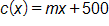
    A company’s total cost, in dollars, to produce x shirts is given by the function above, where m is a constant and . The total cost to produce 100 shirts is $800. What is the total cost, in dollars, to produce 1000 shirts? (Disregard the $ sign when gridding your answer.)

    Correct answer: C

    The correct answer is 3500. The given information includes a cost, $800, to produce 100 shirts. Substituting and into the given equation yields . Subtracting 500 from both sides of the equation yields . Dividing both sides of this equation by 100 yields . Substituting the value of m into the given equation yields . Substituting 1000 for x in this equation and solving for gives the cost of 1000 shirts:, or 3500.
  66. Question 66

    The function \(g\) is defined by \(g(x)= 4 x -6\). What is the value of \(g(-7)\)?

    Correct answer: A

    Choice A is correct. It’s given that the function \(g\) is defined by \(g(x)= 4 x -6\). Substituting \(-7\) for \(x\) into the given equation yields \(g(-7)= 4(-7)-6\), or \(g(-7)= -34\). Choice B is incorrect and may result from conceptual or calculation errors. Choice C is incorrect and may result from conceptual or calculation errors. Choice D is incorrect. This is the value of \(x\) for which \(g(x)= -7\), not the value of \(g(-7)\).
  67. Question 67

    The graph above shows the distance traveled d, in feet, by a product on a conveyor belt m minutes after the product is placed on the belt. Which of the following equations correctly relates d and m ?

    Correct answer: A

    Choice A is correct. The line passes through the origin. Therefore, this is a relationship of the form, where k is a constant representing the slope of the graph. To find the value of k, choose a point on the graph of the line other than the origin and substitute the values of m and d into the equation. For example, if the point is chosen, then, and . Therefore, the equation of the line is .Choice B is incorrect and may result from calculating the slope of the line as the change in time over the change in distance traveled instead of the change in distance traveled over the change in time. Choices C and D are incorrect because each of these equations represents a line with a d-intercept of 2. However, the graph shows a line with a d-intercept of 0.
  68. Question 68

    The function \(f\) is defined by \(f(x)= 1 half(x + 6)\). What is the value of \(f(4)\)?

    Correct answer: D

    Choice D is correct. It’s given that the function \(f\) is defined by \(f(x)= 1 half(x + 6)\). Substituting \(4\) for \(x\) in the given function yields \(f(4)= 1 half(4 + 6)\), or \(f(4)= 5\). Therefore, the value of \(f(4)\) is \(5\). Choice A is incorrect. This is the value of \(2(4 + 6)\), not \(1 half(4 + 6)\). Choice B is incorrect. This is the value of \(2 +(4 + 6)\), not \(1 half(4 + 6)\). Choice C is incorrect. This is the value of \(4 + 6\), not \(1 half(4 + 6)\).
  69. Question 69

    In the xy-plane, the points and lie on the graph of which of the following linear functions?

    Correct answer: C

    Choice C is correct. A linear function can be written in the form, where m is the slope and b is the y-coordinate of the y-intercept of the line. The slope of the graph can be found using the formula . Substituting the values of the given points into this formula yields or, which simplifies to . Only choice C shows an equation with this slope.Choices A, B, and D are incorrect and may result from computation errors or misinterpreting the given information.
  70. Question 70

    Some values of the linear function f are shown in the table above. What is the value of ?

    Correct answer: B

    Choice B is correct. A linear function has a constant rate of change, and any two rows of the table shown can be used to calculate this rate. From the first row to the second, the value of x is increased by 2 and the value of is increased by . So the values of increase by 3 for every increase by 1 in the value of x. Since, it follows that . Therefore, .Choice A is incorrect. This is the third x-value in the table, not . Choices C and D are incorrect and may result from errors when calculating the function’s rate of change.
  71. Question 71

    Oil and gas production in a certain area dropped from 4 million barrels in 2000 to 1.9 million barrels in 2013. Assuming that the oil and gas production decreased at a constant rate, which of the following linear functions f best models the production, in millions of barrels, t years after the year 2000?

    Correct answer: C

    Choice C is correct. It is assumed that the oil and gas production decreased at a constant rate. Therefore, the function f that best models the production t years after the year 2000 can be written as a linear function,, where m is the rate of change of the oil and gas production and b is the oil and gas production, in millions of barrels, in the year 2000. Since there were 4 million barrels of oil and gas produced in 2000, . The rate of change, m, can be calculated as, which is equivalent to, the rate of change in choice C.Choices A and B are incorrect because each of these functions has a positive rate of change. Since the oil and gas production decreased over time, the rate of change must be negative. Choice D is incorrect. This model may result from misinterpreting 1.9 million barrels as the amount by which the production decreased.
  72. Question 72

    \(x\) \(f(x)\) \(1\) \(-64\) \(2\) \(0\) \(3\) \(64\) For the linear function \(f\), the table shows three values of \(x\) and their corresponding values of \(f(x)\). Function \(f\) is defined by \(f(x)= a x + b\), where \(a\) and \(b\) are constants. What is the value of \(a -b\)?

    Correct answer: D

    Choice D is correct. The table gives that \(f(x)= 0\) when \(x = 2\). Substituting 0 for \(f(x)\) and \(2\) for \(x\) into the equation \(f(x)= a x + b\)yields \(0 = 2 a + b\). Subtracting \(2 a\) from both sides of this equation yields \(b = -2 a\). The table gives that \(f(x)= -64\) when \(x = 1\). Substituting \(-2 a\) for \(b\), \(-64\) for \(f(x)\), and \(1\) for \(x\) into the equation \(f(x)= a x + b\) yields \(-64 = a(1)+(-2 a)\). Combining like terms yields \(-64 = -a\), or \(a = 64\). Since \(b = -2 a\), substituting \(64\) for \(a\) into this equation gives \(b =(-2)(64)\), which yields \(b = -128\). Thus, the value of \(a -b\) can be written as \(64 -(-128)\), which is \(192\). Choice A is incorrect. This is the value of \(a + b\), not \(a -b\). Choice B is incorrect. This is the value of \(a -2\), not \(a -b\). Choice C is incorrect. This is the value of \(2 a\), not \(a -b\).
  73. Question 73

    For a training program, Juan rides his bike at an average rate of \(5.7\) minutes per mile. Which function \(m\) models the number of minutes it will take Juan to ride \(x\) miles at this rate?

    Correct answer: D

    Choice D is correct. It′s given that Juan rides his bike at an average rate of \(5.7\) minutes per mile. The number of minutes it will take Juan to ride \(x\) miles can be determined by multiplying his average rate by the number of miles, \(x\), which yields \(5.7 x\). Therefore, the function \(m(x)= 5.7 x\) models the number of minutes it will take Juan to ride \(x\) miles. Choice A is incorrect and may result from conceptual errors. Choice B is incorrect and may result from conceptual errors. Choice C is incorrect and may result from conceptual errors.
  74. Question 74

    \(x\) \(f(x)\) \(0\) \(29\) \(1\) \(32\) \(2\) \(35\) For the linear function \(f\), the table shows three values of \(x\) and their corresponding values of \(f(x)\). Which equation defines \(f(x)\)?

    Correct answer: A

    Choice A is correct. An equation that defines a linear function \(f\) can be written in the form \(f(x)= m x + b\), where \(m\) and \(b\) are constants. It's given in the table that when \(x = 0\), \(f(x)= 29\). Substituting \(0\) for \(x\) and \(29\) for \(f(x)\) in the equation \(f(x)= m x + b\) yields \(29 = m(0)+ b\), or \(29 = b\). Substituting \(29\) for \(b\) in the equation \(f(x)= m x + b\) yields \(f(x)= m x + 29\). It's also given in the table that when \(x = 1\), \(f(x)= 32\). Substituting \(1\) for \(x\) and \(32\) for \(f(x)\) in the equation \(f(x)= m x + 29\) yields \(32 = m(1)+ 29\), or \(32 = m + 29\). Subtracting \(29\) from both sides of this equation yields \(3 = m\). Substituting \(3\) for \(m\) in the equation \(f(x)= m x + 29\) yields \(f(x)= 3 x + 29\). Choice B is incorrect and may result from conceptual or calculation errors. Choice C is incorrect and may result from conceptual or calculation errors. Choice D is incorrect and may result from conceptual or calculation errors.
  75. Question 75

    The function \(h\) is defined by \(h(x)= 3 x -7\). What is the value of \(h(-2)\)?

    Correct answer: A

    Choice A is correct. The value of \(h(-2)\) can be found by substituting \(-2\) for \(x\) in the equation defining \(h\). Substituting \(-2\) for \(x\) in \(h(x)= 3 x -7\) yields \(h(-2)= 3(-2)-7\), or \(h(-2)= -13\). Therefore, the value of \(h(-2)\) is \(-13\). Choice B is incorrect. This is the value of \(h(-1)\), not \(h(-2)\). Choice C is incorrect and may result from conceptual or calculation errors. Choice D is incorrect and may result from conceptual or calculation errors.
  76. Question 76

    For the function f defined above, what is the value of ?

    Correct answer: B

    Choice B is correct. The value of can be calculated by finding the values of and . The value of can be found by substituting 9 for x in the given function: . This equation can be rewritten as, or 4. Then, the value of can be found by substituting 1 for x in the given function: . This equation can be rewritten as, or 2. Therefore,, which is equivalent to 2.Choices A, C, and D are incorrect and may result from incorrectly substituting values of x in the given function or making computational errors.
  77. Question 77

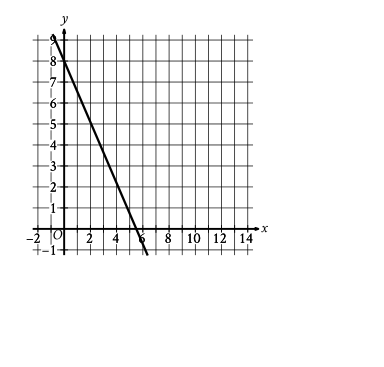
    The line slants sharply down from left to right. The line passes through the following points: (0, 8) (StartFraction 11 Over 2 EndFraction, 0) The graph of the linear function \(f\) is shown, where \(y = f(x)\). What is the y-intercept of the graph of \(f\)?

    Correct answer: D

    Choice D is correct. The y-intercept of a graph is the point where the graph intersects the y-axis. The graph of function \(f\) shown intersects the y-axis at the point \((0, 8)\). Therefore, the y-intercept of the graph of \(f\) is \((0, 8)\). Choice A is incorrect. This is the point where the x-axis, not the graph of \(f\), intersects the y-axis. Choice B is incorrect and may result from conceptual or calculation errors. Choice C is incorrect and may result from conceptual or calculation errors.
  78. Question 78

    The function \(f\) is defined by \(f(x)= 3 x -8\). What is the value of \(f(7)\)?

    Correct answer: B

    Choice B is correct. It’s given that the function \(f\) is defined by \(f(x)= 3 x -8\). The value of \(f(7)\) is the value of \(f(x)\) when \(x = 7\). Substituting \(7\) for \(x\) in the given equation yields \(f(7)= 3(7)-8\), which is equivalent to \(f(7)= 21 -8\), or \(f(7)= 13\). Choice A is incorrect. This is the value of \(f(7)\) when \(f(x)= 3 x + 8\), rather than \(f(x)= 3 x -8\). Choice C is incorrect. This is the value of \(f(1)\), rather than \(f(7)\). Choice D is incorrect. This is the value of \(f(-7)\), rather than \(f(7)\).
  79. Question 79

    The cost \(y\), in dollars, for a manufacturer to make \(x\) rings is represented by the line shown. The line slants gradually up from left to right. The line passes through the following points: (0, 100) (60, 175) (100, 225) What is the cost, in dollars, for the manufacturer to make \(60\) rings?

    Correct answer: C

    Choice C is correct. The line shown represents the cost \(y\), in dollars, for a manufacturer to make \(x\) rings. For the line shown, the x-axis represents the number of rings made by the manufacturer and the y-axis represents the cost, in dollars. Therefore, the cost, in dollars, for the manufacturer to make \(60\) rings is represented by the y-coordinate of the point on the line that has an x-coordinate of \(60\). The point on the line with an x-coordinate of \(60\) has a y-coordinate of \(175\). Therefore, the cost, in dollars, for the manufacturer to make \(60\) rings is \(175\). Choice A is incorrect and may result from conceptual or calculation errors. Choice B is incorrect. This is the cost, in dollars, for the manufacturer to make \(20\) rings. Choice D is incorrect. This is the cost, in dollars, for the manufacturer to make \(100\) rings.
  80. Question 80

    A bus is traveling at a constant speed along a straight portion of road. The equation \(d = 30 t\) gives the distance \(d\), in feet from a road marker, that the bus will be \(t\) seconds after passing the marker. How many feet from the marker will the bus be \(2\) seconds after passing the marker?

    Correct answer: C

    Choice C is correct. It’s given that \(t\) represents the number of seconds after the bus passes the marker. Substituting \(2\) for \(t\) in the given equation \(d = 30 t\) yields \(d = 30(2)\), or \(d = 60\). Therefore, the bus will be \(60\) feet from the marker \(2\) seconds after passing it. Choice A is incorrect. This is the distance, in feet, the bus will be from the marker \(1\) second, not \(2\) seconds, after passing it. Choice B is incorrect and may result from conceptual or calculation errors. Choice D is incorrect. This is the distance, in feet, the bus will be from the marker \(3\) seconds, not \(2\) seconds, after passing it.
  81. Question 81

    \(f(x)= 14 + 4 x\) The function \(f\) represents the total cost, in dollars, of attending an arcade when \(x\) games are played. How many games can be played for a total cost of \(\\) 58$?

    Correct answer: C

    The correct answer is \(11\). It’s given that the function \(f(x)= 14 + 4 x\) represents the total cost, in dollars, of attending an arcade when \(x\) games are played. Substituting \(58\) for \(f(x)\) in the given equation yields \(58 = 14 + 4 x\). Subtracting \(14\) from each side of this equation yields \(44 = 4 x\). Dividing each side of this equation by \(4\) yields \(11 = x\). Therefore, \(11\) games can be played for a total cost of \(\\) 58$.
  82. Question 82

    Some values of the linear function f are shown in the table above. Which of the following defines f ?

    Correct answer: C

    Choice C is correct. Because f is a linear function of x, the equation, where m and b are constants, can be used to define the relationship between x and f (x). In this equation, m represents the increase in the value of f (x) for every increase in the value of x by 1. From the table, it can be determined that the value of f (x) increases by 8 for every increase in the value of x by 2. In other words, for the function f the value of m is, or 4. The value of b can be found by substituting the values of x and f (x) from any row of the table and the value of m into the equation and solving for b. For example, using,, and yields . Solving for b yields . Therefore, the equation defining the function f can be written in the form .Choices A, B, and D are incorrect. Any equation defining the linear function f must give values of f (x) for corresponding values of x, as shown in each row of the table. According to the table, if, . However, substituting into the equation given in choice A gives, or, not 13. Similarly, substituting into the equation given in choice B gives, or, not 13.Lastly, substituting into the equation given in choice D gives, or, not 13. Therefore, the equations in choices A, B, and D cannot define f.
  83. Question 83

    The boiling point of water at sea level is 212 °s Fahrenheit . For every 550 feet above sea level, the boiling point of water is lowered by about . Which of the following equations can be used to find the boiling point B of water, in, x feet above sea level?

    Correct answer: D

    Choice D is correct. It’s given that the boiling point of water at sea level is 212°F and that for every 550 feet above sea level, the boiling point of water is lowered by about 1°F. Therefore, the change in the boiling point of water x feet above sea level is represented by the expression . Adding this expression to the boiling point of water at sea level gives the equation for the boiling point B of water, in °F, x feet above sea level:, or .Choices A and B are incorrect and may result from using the boiling point of water at sea level as the rate of change and the rate of change as the initial boiling point of water at sea level. Choice C is incorrect and may result from representing the change in the boiling point of water as an increase rather than a decrease.
  84. Question 84

    Sean rents a tent at a cost of \(\\) 11\( per day plus a onetime insurance fee of \)$ 10\(. Which equation represents the total cost \)c\(, in dollars, to rent the tent with insurance for \)d$ days?

    Correct answer: C

    Choice C is correct. It’s given that the cost of renting a tent is \(\\) 11\( per day for \)d\( days. Multiplying the rental cost by the number of days yields \)$ 11 d\(, which represents the cost of renting the tent for \)d\( days before the insurance is added. Adding the onetime insurance fee of \)$ 10\( to the rental cost of \)$ 11 d\( gives the total cost \)c\(, in dollars, which can be represented by the equation \)c = 11 d + 10\(. Choice A is incorrect. This equation represents the total cost to rent the tent if the insurance fee was charged every day. Choice B is incorrect. This equation represents the total cost to rent the tent if the daily fee was \)$(d + 11)\( for \)10\( days. Choice D is incorrect. This equation represents the total cost to rent the tent if the daily fee was \)$ 10\( and the onetime fee was \)$ 11$.
  85. Question 85

    \(f(x)= 8 x + 4\) The function \(f\) gives the estimated height, in feet, of a willow tree \(x\) years after its height was first measured. Which statement is the best interpretation of \(4\) in this context?

    Correct answer: D

    Choice D is correct. It's given that the function \(f(x)= 8 x + 4\) gives the estimated height, in feet, of a willow tree \(x\) years after its height was first measured. For a function defined by an equation of the form \(f(x)= m x + b\), where \(m\) and \(b\) are constants, \(b\) represents the value of \(f(x)\) when \(x = 0\). It follows that in the given function, \(4\) represents the value of \(f(x)\) when \(x = 0\). Therefore, the best interpretation of \(4\) in this context is that the estimated height of the tree was \(4\) feet when it was first measured. Choice A is incorrect and may result from conceptual errors. Choice B is incorrect and may result from conceptual errors. Choice C is incorrect and may result from conceptual errors.
  86. Question 86

    For the linear function \(h\), the graph of \(y = h(x)\) in the xy-plane passes through the points \((7, 21)\) and \((9, 25)\). Which equation defines \(h\)?

    Correct answer: B

    Choice B is correct. It’s given that the graph of the linear function \(h\), where \(y = h(x)\), passes through the points \((7, 21)\) and \((9, 25)\) in the xy-plane. An equation defining \(h\) can be written in the form \(y = m x + b\), where \(y = h(x)\), \(m\) represents the slope of the graph in the xy-plane, and \(b\) represents the y-coordinate of the y-intercept of the graph. The slope can be found using any two points, \((x_1, y_1)\) and \((x_2, y_2)\), and the formula \(m = (y_2 -y_1)/(x_2 -x_1)\). Substituting \((7, 21)\) and \((9, 25)\) for \((x_1, y_1)\) and \((x_2, y_2)\), respectively, in the slope formula yields \(m = 25 -21/9 -7\), which is equivalent to \(m = 4 halves\), or \(m = 2\). Substituting \(2\) for \(m\) and \((7, 21)\) for \((x, y)\) in the equation \(y = m x + b\) yields \(21 =(2)(7)+ b\), or \(21 = 14 + b\). Subtracting \(14\) from each side of this equation yields \(7 = b\). Substituting \(2\) for \(m\) and \(7\) for \(b\) in the equation \(y = m x + b\) yields \(y = 2 x + 7\). Since \(y = h(x)\), it follows that the equation that defines \(h\) is \(h(x)= 2 x + 7\). Choice A is incorrect. For this function, the graph of \(y = h(x)\) in the xy-plane would pass through \((7, 0)\), not \((7, 21)\), and \((9, 1)\), not \((9, 25)\). Choice C is incorrect. For this function, the graph of \(y = h(x)\) in the xy-plane would pass through \((7, 70)\), not \((7, 21)\), and \((9, 84)\), not \((9, 25)\). Choice D is incorrect. For this function, the graph of \(y = h(x)\) in the xy-plane would pass through \((7, 88)\), not \((7, 21)\), and \((9, 106)\), not \((9, 25)\).
  87. Question 87

    One gallon of stain will cover \(170\) square feet of a surface. A yard has a total fence area of \(w\) square feet. Which equation represents the total amount of stain \(S\), in gallons, needed to stain the fence in this yard twice?

    Correct answer: D

    Choice D is correct. It's given that \(w\) represents the total fence area, in square feet. Since the fence will be stained twice, the amount of stain, in gallons, will need to cover \(2 w\) square feet. It’s also given that one gallon of stain will cover \(170\) square feet. Dividing the total area, in square feet, of the surface to be stained by the number of square feet covered by one gallon of stain gives the number of gallons of stain that will be needed. Dividing \(2 w\) by \(170\) yields \(2 w/170\), or \(w/85\). Therefore, the equation that represents the total amount of stain \(S\), in gallons, needed to stain the fence of the yard twice is \(S = w/85\). Choice B is incorrect and may result from conceptual or calculation errors. Choice C is incorrect and may result from conceptual or calculation errors.
  88. Question 88

    Brian saves \(2 fifths\) of the \(\\) 215\( he earns each week from his job. If Brian continues to save at this rate, how much money, in dollars, will Brian save in \)9$ weeks?

    Correct answer: D

    The correct answer is \(774\). It's given that Brian saves \(2 fifths\) of the \(\\) 215\( he earns each week from his job. Therefore, Brian saves \)(2 fifths)($ 215)\(, or \)$ 86\(, per week. If Brian continues to save at this rate of \)$ 86\( per week for \)9\( weeks, then he will save a total of \)(9)(86)\(, or \)774$, dollars.
  89. Question 89

    \(f(x)= x + 8 elevenths\) The function \(f\) is defined by the given equation. What is the value of \(f(x)\) when \(x = 3 elevenths\)?

    Correct answer: A

    The correct answer is \(1\). It’s given that the function \(f\) is defined by \(f(x)= x + 8 elevenths\). Substituting \(3 elevenths\)for \(x\) in the given function yields \(f(3 elevenths)= 3 elevenths + 8 elevenths\), which gives \(f(3 elevenths)= 11/11\), or \(f(3 elevenths)= 1\). Therefore, when \(x = 3 elevenths\), the value of \(f(x)\) is \(1\).
  90. Question 90

    Number of cars Maximum number of passengers and crew \(3\) \(174\) \(5\) \(284\) \(10\) \(559\) The table shows the linear relationship between the number of cars, \(c\), on a commuter train and the maximum number of passengers and crew, \(p\), that the train can carry. Which equation represents the linear relationship between \(c\) and \(p\)?

    Correct answer: A

    Choice A is correct. It's given that there is a linear relationship between the number of cars, \(c\), on a commuter train and the maximum number of passengers and crew, \(p\), that the train can carry. It follows that this relationship can be represented by an equation of the form \(p = m c + b\), where \(m\) is the rate of change of \(p\) in this relationship and \(b\) is a constant. The rate of change of \(p\) in this relationship can be calculated by dividing the difference in any two values of \(p\) by the difference in the corresponding values of \(c\). Using two pairs of values given in the table, the rate of change of \(p\) in this relationship is \(284 -174/5 -3\), or \(55\). Substituting \(55\) for \(m\) in the equation \(p = m c + b\) yields \(p = 55 c + b\). The value of \(b\) can be found by substituting any value of \(c\) and its corresponding value of \(p\) for \(c\) and \(p\), respectively, in this equation. Substituting \(10\) for \(c\) and \(559\) for \(p\) yields \(559 = 55(10)+ b\), or \(559 = 550 + b\). Subtracting \(550\) from both sides of this equation yields \(9 = b\). Substituting \(9\) for \(b\) in the equation \(p = 55 c + b\) yields \(p = 55 c + 9\). Subtracting \(9\) from both sides of this equation yields \(p -9 = 55 c\). Subtracting \(p\) from both sides of this equation yields \(-9 = 55 c -p\), or \(55 c -p = -9\). Choice B is incorrect and may result from conceptual or calculation errors. Choice C is incorrect and may result from conceptual or calculation errors. Choice D is incorrect and may result from conceptual or calculation errors.
  91. Question 91

    In the xy-plane, the graph of the linear function \(f\) contains the points \((0, 2)\) and \((8, 34)\). Which equation defines \(f\), where \(y = f(x)\)?

    Correct answer: C

    Choice C is correct. In the xy-plane, the graph of a linear function can be written in the form \(f(x)= m x + b\), where \(m\) represents the slope and \((0, b)\) represents the y-intercept of the graph of \(y = f(x)\). It’s given that the graph of the linear function \(f\), where \(y = f(x)\), in the xy-plane contains the point \((0, 2)\). Thus, \(b = 2\). The slope of the graph of a line containing any two points \((x_1, y_1)\) and \((x_2, y_2)\) can be found using the slope formula, \(m = y_2 -y_1/x_2 -x_1\). Since it’s given that the graph of the linear function \(f\) contains the points \((0, 2)\) and \((8, 34)\), it follows that the slope of the graph of the line containing these points is \(m = 34 -2/8 -0\), or \(m = 4\). Substituting \(4\) for \(m\) and \(2\) for \(b\) in \(f(x)= m x + b\) yields \(f(x)= 4 x + 2\). Choice A is incorrect. This function represents a graph with a slope of \(2\) and a y-intercept of \((0, 42)\). Choice B is incorrect. This function represents a graph with a slope of \(32\) and a y-intercept of \((0, 36)\). Choice D is incorrect. This function represents a graph with a slope of \(8\) and a y-intercept of \((0, 2)\).
  92. Question 92

    The constant 2.74 in this function estimates which of the following?

    Correct answer: D

    Choice D is correct. Since 2.74 is a constant term, it represents an actual price of gas rather than a measure of change in gas price. To determine what gas price it represents, find x such that F(x) = 2.74, or 2.74 = 2.74 – 0.19(x – 3). Subtracting 2.74 from both sides gives 0 = –0.19(x – 3). Dividing both sides by –0.19 results in 0 = x – 3, or x = 3. Therefore, the average price of gas is $2.74 per gallon 3 months after September 1, 2014, which is December 1, 2014.Choice A is incorrect. Since 2.74 is a constant, not a multiple of x, it cannot represent a rate of change in price. Choice B is incorrect. The difference in the average price from September 1, 2014, to December 1, 2014, is F(3) – F(0) = 2.74 – 0.19(3 – 3) – (2.74 – 0.19(0 – 3)) = 2.74 – (2.74 + 0.57) = –0.57, which is not 2.74. Choice C is incorrect. The average price per gallon on September 1, 2014, is F(0) = 2.74 – 0.19(0 – 3) = 2.74 + 0.57 = 3.31, which is not 2.74.
  93. Question 93

    Caleb used juice to make popsicles. The function \(f(x)= -5 x + 30\) approximates the volume, in fluid ounces, of juice Caleb had remaining after making \(x\) popsicles. Which statement is the best interpretation of the y-intercept of the graph of \(y = f(x)\) in the xy-plane in this context?

    Correct answer: C

    Choice C is correct. An equation that defines a linear function \(f\) can be written in the form \(f(x)= m x + b\), where \(m\) represents the slope and \(b\) represents the y-intercept, \((0, b)\), of the line of \(y = f(x)\) in the xy-plane. The function \(f(x)= -5 x + 30\) is linear. Therefore, the graph of the given function \(y = f(x)\) in the xy-plane has a y-intercept of \((0, 30)\). It’s given that \(f(x)\) gives the approximate volume, in fluid ounces, of juice Caleb had remaining after making \(x\) popsicles. It follows that the y-intercept of \((0, 30)\) means that Caleb had approximately \(30\) fluid ounces of juice remaining after making \(0\) popsicles. In other words, Caleb had approximately \(30\) fluid ounces of juice when he began to make the popsicles. Choice A is incorrect. This is an interpretation of the slope, rather than the y-intercept, of the graph of \(y = f(x)\) in the xy-plane. Choice B is incorrect and may result from conceptual errors. Choice D is incorrect and may result from conceptual errors.
  94. Question 94

    The line slants sharply up from left to right. The line passes through the following points: (0, -4) (1, 0) The graph of the function \(f\) is shown, where \(y = f(x)\). What is the y-intercept of the graph?

    Correct answer: B

    Choice B is correct. The y-intercept of a graph is the point where the graph intersects the y-axis. The graph of function \(f\) shown intersects the y-axis at the point \((0, -4)\). Therefore, the y-intercept of the graph is \((0, -4)\). Choice A is incorrect and may result from conceptual or calculation errors. Choice C is incorrect and may result from conceptual or calculation errors. Choice D is incorrect and may result from conceptual or calculation errors.
  95. Question 95

    \(h(x)= x + b\) For the linear function \(h\), \(b\) is a constant and \(h(0)= 45\). What is the value of \(b\)?

    Correct answer: C

    The correct answer is \(45\). It’s given that \(h(0)= 45\). Therefore, for the given function \(h\), when \(x = 0\), \(h(x)= 45\). Substituting \(0\) for \(x\) and \(45\) for \(h(x)\) in the given function, \(h(x)= x + b\), yields \(45 = 0 + b\), or \(45 = b\). Therefore, the value of \(b\) is \(45\).
  96. Question 96

    The graph shown models the number of candy bars a certain machine wraps with a label in \(x\) seconds. The line slants sharply up from left to right. The line passes through the following points: (0, 0) (2, 80) (4, 160) (6, 240) According to the graph, what is the estimated number of candy bars the machine wraps with a label per second?

    Correct answer: B

    Choice B is correct. For the graph shown, the x-axis represents time, in seconds, and the y-axis represents the number of candy bars wrapped. The slope of a line in the xy-plane is the change in \(y\) for each \(1\)-unit increase in \(x\). It follows that the slope of the graph shown represents the estimated number of candy bars the machine wraps with a label per second. The slope, \(m\), of a line in the xy-plane can be found using any two points, \((x_1, y_1)\) and \((x_2, y_2)\), on the line and the slope formula \(m = y_2 -y_1/x_2 -x_1\). The graph shown passes through the points \((0, 0)\) and \((2, 80)\). Substituting these points for \((x_1, y_1)\) and \((x_2, y_2)\), respectively, in the slope formula yields \(m = 80 -0/2 -0\), which is equivalent to \(m = 80/2\), or \(m = 40\). Therefore, the estimated number of candy bars the machine wraps with a label per second is \(40\). Choice A is incorrect and may result from conceptual or calculation errors. Choice C is incorrect and may result from conceptual or calculation errors. Choice D is incorrect and may result from conceptual or calculation errors.
  97. Question 97

    The functions \(f\) and \(g\) are defined as \(f(x)= 1 fourth x -9\) and \(g(x)= 3 fourths x + 21\). If the function \(h\) is defined as \(h(x)= f(x)+ g(x)\), what is the x-coordinate of the x-intercept of the graph of \(y = h(x)\) in the xy-plane?

    Correct answer: C

    The correct answer is \(-12\). It's given that the functions \(f\) and \(g\) are defined as \(f(x)= 1 fourth x -9\) and \(g(x)= 3 fourths x + 21\). If the function \(h\) is defined as \(h(x)= f(x)+ g(x)\), then substituting \(1 fourth x -9\) for \(f(x)\) and \(3 fourths x + 21\) for \(g(x)\) in this function yields \(h(x)= 1 fourth x -9 + 3 fourths x + 21\). This can be rewritten as \(h(x)= 4 fourths x + 12\), or \(h(x)= x + 12\). The x-intercept of a graph in the xy-plane is the point on the graph where \(y = 0\). The equation representing the graph of \(y = h(x)\) is \(y = x + 12\). Substituting \(0\) for \(y\) in this equation yields \(0 = x + 12\). Subtracting \(12\) from both sides of this equation yields \(-12 = x\), or \(x = -12\). Therefore, the x-coordinate of the x-intercept of the graph of \(y = h(x)\) in the xy-plane is \(-12\).
  98. Question 98

    The function \(f\) is defined by \(f(x)= 80 -6 x\). What is the value of \(f(7)\)?

    Correct answer: B

    Choice B is correct. It’s given that function \(f\) is defined by \(f(x)= 80 -6 x\). The value of \(f(7)\) can be found by substituting \(7\) for \(x\) in the given function, which yields \(f(7)= 80 -6(7)\), or \(f(7)= 80 -42\), which is equivalent to \(f(7)= 38\). Therefore, the value of \(f(7)\) is \(38\). Choice A is incorrect. This is the value of \(80 -67\), not \(80 -6(7)\). Choice C is incorrect. This is the value of \(80 -6(1)\), not \(80 -6(7)\). Choice D is incorrect. This is the value of \(80 -6 + 7\), not \(80 -6(7)\).
  99. Question 99

    \(f(x)= 45 x + 600\) The function \(f\) gives the monthly fee \(f(x)\), in dollars, a facility charges to keep \(x\) crates in storage. What is the monthly fee, in dollars, the facility charges to keep \(50\) crates in storage?

    Correct answer: A

    The correct answer is \(2,850\). It’s given that the function \(f(x)= 45 x + 600\) gives the monthly fee, in dollars, a facility charges to keep \(x\) crates in storage. Substituting \(50\) for \(x\) in this function yields \(f(50)= 45(50)+ 600\), or \(f(50)= 2,850\). Therefore, the monthly fee, in dollars, the facility charges to keep \(50\) crates in storage is \(2,850\).
  100. Question 100

    For the linear function \(f\), the graph of \(y = f(x)\) in the xy-plane has a slope of \(2\) and has a y-intercept at \((0, -5)\). Which equation defines \(f\)?

    Correct answer: D

    Choice D is correct. An equation defining the linear function \(f\) can be written in the form \(f(x)= m x + b\), where \(m\) is the slope and \((0, b)\) is the y-intercept of the graph of \(y = f(x)\) in the xy-plane. It’s given that the graph of \(y = f(x)\) has a slope of \(2\). Therefore, \(m = 2\). It’s also given that the graph of \(y = f(x)\) has a y-intercept at \((0, -5)\). Therefore, \(b = -5\). Substituting \(2\) for \(m\) and \(-5\) for \(b\) in the equation \(f(x)= m x + b\) yields \(f(x)= 2 x -5\). Thus, the equation that defines \(f\) is \(f(x)= 2 x -5\). Choice A is incorrect. For this function, the graph of \(y = f(x)\) in the xy-plane has a slope of \(1 half\), not \(2\). Choice B is incorrect. For this function, the graph of \(y = f(x)\) in the xy-plane has a slope of \(-1 half\), not \(2\). Choice C is incorrect. For this function, the graph of \(y = f(x)\) in the xy-plane has a slope of \(-2\), not \(2\).
  101. Question 101

    The graph of the function \(f\), where \(y = f(x)\), gives the total cost \(y\), in dollars, for a certain video game system and \(x\) games. What is the best interpretation of the slope of the graph in this context?

    Correct answer: A

    Choice A is correct. The given graph is a line, and the slope of a line is defined as the change in the value of \(y\) for each increase in the value of \(x\) by \(1\). It’s given that \(y\) represents the total cost, in dollars, and that \(x\) represents the number of games. Therefore, the change in the value of \(y\) for each increase in the value of \(x\) by \(1\) represents the change in total cost, in dollars, for each increase in the number of games by \(1\). In other words, the slope represents the cost, in dollars, per game. The graph shows that when the value of \(x\) increases from \(0\) to \(1\), the value of \(y\) increases from \(100\) to \(125\). It follows that the slope is \(25\), or the cost per game is \(\\) 25\(. Thus, the best interpretation of the slope of the graph is that each game costs \)$ 25\(. Choice B is incorrect. This is an interpretation of the y-intercept of the graph rather than the slope of the graph. Choice C is incorrect. The slope of the graph is the cost per game, not the cost of the video game system. Choice D is incorrect. Each game costs \)$ 25\(, not \)$ 100$.
  102. Question 102

    \(x\) \(f(x)\) \(-4\) \(0\) \(-19/5\) \(1\) \(-18/5\) \(2\) For the linear function \(f\), the table shows three values of \(x\) and their corresponding values of \(f(x)\). If \(h(x)= f(x)-13\), which equation defines \(h\)?

    Correct answer: B

    Choice B is correct. An equation that defines a linear function \(f\) can be written in the form \(f(x)= m x + b\), where \(m\) and \(b\) are constants. It's given in the table that when \(x = -4\), \(f(x)= 0\). Substituting \(-4\) for \(x\) and \(0\) for \(f(x)\) in the equation \(f(x)= m x + b\) yields \(0 = m(-4)+ b\), or \(0 = -4 m + b\). Adding \(4 m\) to both sides of this equation yields \(4 m = b\). Substituting \(4 m\) for \(b\) in the equation \(f(x)= m x + b\) yields \(f(x)= m x + 4 m\). It's also given in the table that when \(x = -19/5\), \(f(x)= 1\). Substituting \(-19/5\) for \(x\) and \(1\) for \(f(x)\) in the equation \(f(x)= m x + 4 m\) yields \(1 = m(-19/5)+ 4 m\), or \(1 = 1 fifth m\). Multiplying both sides of this equation by \(5\) yields \(m = 5\). Substituting \(5\) for \(m\) in the equation \(f(x)= m x + 4 m\) yields \(f(x)= 5 x + 4(5)\), or \(f(x)= 5 x + 20\). If \(h(x)= f(x)-13\), substituting \(5 x + 20\) for \(f(x)\) in this equation yields \(h(x)=(5 x + 20)-13\), or \(h(x)= 5 x + 7\). Choice A is incorrect and may result from conceptual or calculation errors. Choice C is incorrect and may result from conceptual or calculation errors. Choice D is incorrect. This is an equation that defines the linear function \(f\), not \(h\).
  103. Question 103

    The line slants sharply down from left to right. The line passes through the following points: (-1, 7)(0, 3) The graph of the linear function \(y = f(x)+ 19\) is shown. If \(c\) and \(d\) are positive constants, which equation could define \(f\)?

    Correct answer: A

    Choice A is correct. It’s given that the graph of the linear function \(y = f(x)+ 19\) is shown. This means that the graph of \(y = f(x)+ 19\) can be translated down \(19\) units to create the graph of \(y = f(x)\) and the y-coordinate of every point on the graph of \(y = f(x)+ 19\) can be decreased by \(19\) to find the resulting point on the graph of \(y = f(x)\). The y-intercept of the graph of \(y = f(x)+ 19\) is \((0, 3)\). Translating the graph of \(y = f(x)+ 19\) down \(19\) units results in a y-intercept of the graph of \(y = f(x)\) at the point \((0, 3 -19)\), or \((0, -16)\). The graph of \(y = f(x)+ 19\) slants down from left to right, so the slope of the graph is negative. The translation of a linear graph changes its position, but does not change its slope. It follows that the slope of the graph of \(y = f(x)\) is also -. The equation of a linear function \(f\) can be written in the form \(f(x)= b + m x\), where \(b\) is the y-coordinate of the y-intercept and \(m\) is the slope of the graph of \(y = f(x)\). It's given that \(c\) and \(d\) are positive constants. Since the y-coordinate of the y-intercept and the slope of the graph of \(y = f(x)\) are both -, it follows that \(f(x)= -d -c x\) could define \(f\). Choice B is incorrect. This could define a linear function where its graph has a positive, not -, y-intercept. Choice C is incorrect. This could define a linear function where its graph has a positive, not -, slope. Choice D is incorrect. This could define a linear function where its graph has a positive, not -, y-intercept and a positive, not -, slope.
  104. Question 104

    \(x\) \(10\) \(15\) \(20\) \(25\) \(f(x)\) \(82\) \(137\) \(192\) \(247\) The table shows four values of \(x\) and their corresponding values of \(f(x)\). There is a linear relationship between \(x\) and \(f(x)\) that is defined by the equation \(f(x)= m x -28\), where \(m\) is a constant. What is the value of \(m\)?

    Correct answer: D

    The correct answer is \(11\). It's given that \(f(x)\) is defined by the equation \(f(x)= m x -28\), where \(m\) is a constant. It's also given in the table that when \(x = 10\), \(f(x)= 82\). Substituting \(10\) for \(x\) and \(82\) for \(f(x)\) in the equation \(f(x)= m x -28\) yields, \(82 = m(10)-28\). Adding \(28\) to both sides of this equation yields \(110 = 10 m\). Dividing both sides of this equation by \(10\) yields \(11 = m\). Therefore, the value of \(m\) is \(11\).
  105. Question 105

    The function \(f\) is defined by \(f(x)= 7 x -84\). What is the x-intercept of the graph of \(y = f(x)\) in the xy-plane?

    Correct answer: D

    Choice D is correct. The given function \(f\) is a linear function. Therefore, the graph of \(y = f(x)\) in the xy-plane has one x-intercept at the point \((k, 0)\), where \(k\) is a constant. Substituting \(0\) for \(f(x)\) and \(k\) for \(x\) in the given function yields \(0 = 7 k -84\). Adding \(84\) to both sides of this equation yields \(84 = 7 k\). Dividing both sides of this equation by \(7\) yields \(12 = k\). Therefore, the x-intercept of the graph of \(y = f(x)\) in the xy-plane is \((12, 0)\). Choice A is incorrect and may result from conceptual or calculation errors. Choice B is incorrect and may result from conceptual or calculation errors. Choice C is incorrect and may result from conceptual or calculation errors.
  106. Question 106

    The pressure exerted on a scuba diver at sea level is \(14.70 pounds per square inch(psi)\). For each foot the scuba diver descends below sea level, the pressure exerted on the scuba diver increases by \(0.44 psi\). What is the total pressure, in \(psi\), exerted on the scuba diver at \(105\) feet below sea level?

    Correct answer: A

    Choice A is correct. It's given that the pressure exerted on a scuba diver at sea level is \(14.70 pounds per square inch(psi)\). It's also given that for each foot the scuba diver descends below sea level, the pressure exerted on the scuba diver increases by \(0.44 psi\). The total pressure, in \(psi\), exerted on the scuba diver at \(x\) feet below sea level can be represented by the expression \(0.44 x + 14.70\). Substituting \(105\) for \(x\) in this expression yields \(0.44(105)+ 14.70\), or \(60.90\). Therefore, the total pressure exerted on the scuba diver at \(105\) feet below sea level is \(60.90 psi\). Choice B is incorrect and may result from conceptual or calculation errors. Choice C is incorrect. This is the pressure, in \(psi\), exerted on the scuba diver at sea level, not at \(105\) feet below sea level. Choice D is incorrect. This is the rate by which the pressure, in \(psi\), exerted on the scuba diver increases for each foot the scuba diver descends below sea level.
  107. Question 107

    \(F(x)= 9 fifths(x -273.15)+ 32\) The function \(F\) gives the temperature, in °s Fahrenheit, that corresponds to a temperature of \(x\) kelvins. If a temperature increased by \(9.10\) kelvins, by how much did the temperature increase, in °s Fahrenheit?

    Correct answer: A

    Choice A is correct. It’s given that the function \(F(x)= 9 fifths(x -273.15)+ 32\) gives the temperature, in °s Fahrenheit, that corresponds to a temperature of \(x\) kelvins. A temperature that increased by \(9.10\) kelvins means that the value of \(x\) increased by \(9.10\) kelvins. It follows that an increase in \(x\) by \(9.10\) increases \(F(x)\) by \(9 fifths(9.10)\), or \(16.38\). Therefore, if a temperature increased by \(9.10\) kelvins, the temperature increased by \(16.38\) °s Fahrenheit. Choice B is incorrect and may result from conceptual or calculation errors. Choice C is incorrect and may result from conceptual or calculation errors. Choice D is incorrect and may result from conceptual or calculation errors.
  108. Question 108

    A contract for a certain service requires a onetime activation cost of \(\\) 35\( and a monthly cost of \)$ 23\(. Which equation represents this situation, where \)c\( is the total cost, in dollars, of this service contract for \)t$ months?

    Correct answer: C

    Choice C is correct. It's given that this service contract requires a monthly cost of \(\\) 23\(. A monthly cost of \)$ 23\( for \)t\( months results in a cost of \)$ 23 t\(. It's also given that this service contract requires a onetime activation cost of \)$ 35\(. Adding the onetime activation cost to the monthly cost of the service contract for \)t\( months yields the total cost \)c\(, in dollars, of this service contract for \)t\( months. Therefore, this situation can be represented by the equation \)c = 23 t + 35$. Choice A is incorrect and may result from conceptual or calculation errors. Choice B is incorrect and may result from conceptual or calculation errors. Choice D is incorrect and may result from conceptual or calculation errors.
  109. Question 109

    The graph of this equation in the xy-plane is a line. What is the best interpretation of the x-intercept in this context?

    Correct answer: A

    Choice A is correct. The x-intercept of the line with equation y = 120 – 25x can be found by substituting 0 for y and finding the value of x. When y = 0, x = 4.8, so the x-intercept is at (4.8, 0). Since y represents the number of tons of cargo remaining to be moved x hours after the team started working, it follows that the x-intercept refers to the team having no cargo remaining to be moved after 4.8 hours. In other words, the team will have moved all of the cargo after about 4.8 hours.Choice B is incorrect and may result from incorrectly interpreting the value 4.8. Choices C and D are incorrect and may result from misunderstanding the x-intercept. These statements are accurate but not directly relevant to the x-intercept.
  110. Question 110

    According to the graph, what is the cost for each additional mile traveled, in dollars, of a cab ride?

    Correct answer: A

    Choice A is correct. The cost of each additional mile traveled is represented by the slope of the given line. The slope of the line can be calculated by identifying two points on the line and then calculating the ratio of the change in y to the change in x between the two points. Using the points and, the slope is equal to, or 2. Therefore, the cost for each additional mile traveled of the cab ride is $2.00.Choice B is incorrect and may result from calculating the slope of the line that passes through the points and . However, does not lie on the line shown. Choice C is incorrect. This is the y-coordinate of the y-intercept of the graph and represents the flat fee for a cab ride before the charge for any miles traveled is added. Choice D is incorrect. This value represents the total cost of a 1-mile cab ride.
  111. Question 111

    Hydrogen is placed inside a container and kept at a constant pressure. The graph shows the estimated volume \(y\), in liters, of the hydrogen when its temperature is \(x\) kelvins. The line slants gradually up from left to right. The line begins at the approximate point (90, 1.3). The line passes through the following approximate points: (90, 1.3) (500, 7) What is the estimated volume, in liters, of the hydrogen when its temperature is \(500\) kelvins?

    Correct answer: C

    Choice C is correct. For the graph shown, the x-axis represents temperature, in kelvins, and the y-axis represents volume, in liters. Therefore, the estimated volume, in liters, of the hydrogen when its temperature is \(500\) kelvins is represented by the y-coordinate of the point on the graph that has an x-coordinate of \(500\). The point on the graph with an x-coordinate of \(500\) has a y-coordinate of \(7\). Therefore, the estimated volume, in liters, of the hydrogen when its temperature is \(500\) kelvins is \(7\). Choice A is incorrect and may result from conceptual errors. Choice B is incorrect and may result from conceptual errors. Choice D is incorrect and may result from conceptual errors.
  112. Question 112

    The function \(f\) is defined by \(f(x)= 4 x\). For what value of \(x\) does \(f(x)= 8\)?

    Correct answer: D

    The correct answer is \(2\). Substituting \(8\) for \(f(x)\) in the given equation yields \(8 = 4 x\). Dividing the left-and right-hand sides of this equation by \(4\) yields \(x = 2\). Therefore, the value of \(x\) is \(2\) when \(f(x)= 8\).
  113. Question 113

    The function g is defined by . What is the value of ?

    Correct answer: D

    Choice D is correct. The value of is found by substituting 0 for x in the function g. This yields, which can be rewritten as .Choice A is incorrect and may result from misinterpreting the equation as instead of . Choice B is incorrect. This is the value of x, not . Choice C is incorrect and may result from calculation errors.
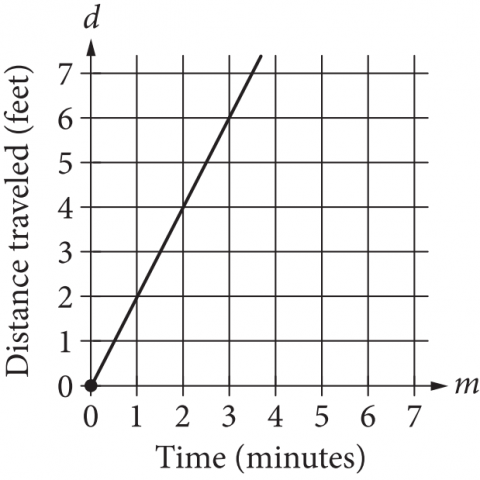
  114. Question 114

    \(g(x)= 11 x + 4\) For the given linear function \(g\), which table shows three values of \(x\) and their corresponding values of \(g(x)\)?

    Correct answer: C

    Choice C is correct. Each of the tables shows the same three values of \(x\): \(-1\), \(0\), and \(1\). Substituting \(-1\) for \(x\) in the given function yields \(g(-1)= 11(-1)+ 4\), or \(g(-1)= -7\). Therefore, when \(x = -1\), the corresponding value of \(g(x)\) is \(-7\). Substituting \(0\) for \(x\) in the given function yields \(g(0)= 11(0)+ 4\), or \(g(0)= 4\). Therefore, when \(x = 0\), the corresponding value of \(g(x)\) is \(4\). Substituting \(1\) for \(x\) in the given function yields \(g(1)= 11(1)+ 4\), or \(g(1)= 15\). Therefore, when \(x = 1\), the corresponding value of \(g(x)\) is \(15\). The table in choice C shows \(-7\), \(4\), and \(15\) as the corresponding value of \(g(x)\) for x-values of \(-1\), \(0\), and \(1\), respectively. Therefore, the table in choice C shows three values of \(x\) and their corresponding values of \(g(x)\). Choice A is incorrect. This table shows three values of \(x\) and their corresponding values of \(g(x)\) for the linear function \(g(x)= 4 x + 11\). Choice B is incorrect. This table shows three values of \(x\) and their corresponding values of \(g(x)\) for the linear function \(g(x)= 4 x\). Choice D is incorrect. This table shows three values of \(x\) and their corresponding values of \(g(x)\) for the linear function \(g(x)= 11 x\).
  115. Question 115

    A model predicts that a certain animal weighed \(241\) pounds when it was born and that the animal gained \(3\) pounds per day in its first year of life. This model is defined by an equation in the form \(f(x)= a + b x\), where \(f(x)\) is the predicted weight, in pounds, of the animal \(x\) days after it was born, and \(a\) and \(b\) are constants. What is the value of \(a\)?

    Correct answer: B

    The correct answer is \(241\). For a certain animal, it's given that a model predicts the animal weighed \(241\) pounds when it was born and gained \(3\) pounds per day in its first year of life. It's also given that this model is defined by an equation in the form \(f(x)= a + b x\), where \(f(x)\) is the predicted weight, in pounds, of the animal \(x\) days after it was born, and \(a\) and \(b\) are constants. It follows that \(a\) represents the predicted weight, in pounds, of the animal when it was born and \(b\) represents the predicted rate of weight gain, in pounds per day, in its first year of life. Thus, the value of \(a\) is \(241\).
  116. Question 116

    As part of a science project on evaporation, Amaya measured the height of a liquid in a container over a period of time. The function \(f(x)= 33 -0.18 x\) gives the estimated height, in centimeters (cm), of the liquid in the container \(x\) days after the start of the project. Which of the following is the best interpretation of \(33\) in this context?

    Correct answer: A

    Choice A is correct. It's given that the function \(f(x)= 33 -0.18 x\) gives the estimated height, in centimeters (cm), of the liquid in the container \(x\) days after the start of the project. For a linear function in the form \(f(x)= a + b x\), where \(a\) and \(b\) are constants, \(a\) represents the value of \(f(0)\) and \(b\) represents the rate of change of the function. It follows that in the given function, \(33\) represents the value of \(f(0)\). Therefore, the best interpretation of \(33\) in this context is the estimated height, in cm, of the liquid at the start of the project. Choice B is incorrect and may result from conceptual or calculation errors. Choice C is incorrect. The estimated change in the height, in cm, of the liquid each day is \(0.18\), not \(33\). Choice D is incorrect and may result from conceptual or calculation errors.
  117. Question 117

    The function \(f\) is defined by the equation \(f(x)= 7 x + 2\). What is the value of \(f(x)\) when \(x = 4\)?

    Correct answer: A

    The correct answer is \(30\). The value of \(f(x)\) when \(x = 4\) can be found by substituting \(4\) for \(x\) in the given equation \(f(x)= 7 x + 2\). This yields \(f(4)= 7(4)+ 2\), or \(f(4)= 30\). Therefore, when \(x = 4\), the value of \(f(x)\) is \(30\).
  118. Question 118

    The function \(f\) is defined by \(f(x)= 4 x -3\). What is the value of \(f(10)\)?

    Correct answer: B

    Choice B is correct. It’s given that the function \(f\) is defined by \(f(x)= 4 x -3\). Substituting \(10\) for \(x\) in the given function yields \(f(10)= 4(10)-3\), which is equivalent to \(f(10)= 40 -3\), or \(f(10)= 37\). Therefore, the value of \(f(10)\) is \(37\). Choice A is incorrect and may result from conceptual or calculation errors. Choice C is incorrect. This is the value of \(f(10)\) for the function \(f(x)= 4 x\), not \(f(x)= 4 x -3\). Choice D is incorrect. This is the value of \(f(10)\) for the function \(f(x)= 4 x + 3\), not \(f(x)= 4 x -3\).
  119. Question 119

    The number \(y\) is \(84\) less than the number \(x\). Which equation represents the relationship between \(x\) and \(y\)?

    Correct answer: D

    Choice D is correct. It’s given that the number \(y\) is \(84\) less than the number \(x\). A number that's \(84\) less than the number \(x\) is equivalent to \(84\) subtracted from the number \(x\), or \(x -84\). Therefore, the equation \(y = x -84\) represents the relationship between \(x\) and \(y\). Choice A is incorrect and may result from conceptual errors. Choice B is incorrect and may result from conceptual errors. Choice C is incorrect and may result from conceptual errors.
  120. Question 120

    The line slants gradually up from left to right. The line passes through the following points: (-5, 0) (0, 2) The graph of the linear function \(f\) is shown. What is the y-intercept of the graph of \(y = f(x)\)?

    Correct answer: C

    Choice C is correct. The y-intercept of a graph is the point where the graph intersects the y-axis. The graph of \(y = f(x)\) shown intersects the y-axis at the point \((0, 2)\). Therefore, the y-intercept of the graph of \(y = f(x)\) is \((0, 2)\). Choice A is incorrect. This is the x-intercept, not the y-intercept, of the graph of \(y = f(x)\). Choice B is incorrect and may result from conceptual or calculation errors. Choice D is incorrect and may result from conceptual or calculation errors.
  121. Question 121

    In the xy-plane, the graph of the linear function \(f\) contains the points \((0, 3)\) and \((7, 31)\). Which equation defines \(f\), where \(y = f(x)\)?

    Correct answer: C

    Choice C is correct. In the xy-plane, an equation of the graph of a linear function can be written in the form \(f(x)= m x + b\), where \(m\) represents the slope and \((0, b)\) represents the y-intercept of the graph of \(y = f(x)\). It’s given that the graph of the linear function \(f\), where \(y = f(x)\), in the xy-plane contains the point \((0, 3)\). Thus, \(b = 3\). The slope of the graph of a line containing any two points \((x_1, y_1)\) and \((x_2, y_2)\) can be found using the slope formula, \(m = y_2 -y_1/x_2 -x_1\). Since it’s given that the graph of the linear function \(f\) contains the points \((0, 3)\) and \((7, 31)\), it follows that the slope of the graph of the line containing these points is \(m = 31 -3/7 -0\), or \(m = 4\). Substituting \(4\) for \(m\) and \(3\) for \(b\) in \(f(x)= m x + b\) yields \(f(x)= 4 x + 3\). Choice A is incorrect. This function represents a graph with a slope of \(28\) and a y-intercept of \((0, 34)\). Choice B is incorrect. This function represents a graph with a slope of \(3\) and a y-intercept of \((0, 38)\). Choice D is incorrect. This function represents a graph with a slope of \(7\) and a y-intercept of \((0, 3)\).
  122. Question 122

    The line slants gradually up from left to right. The line passes through the following points:(-12, 0)(-4, 2) The graph of the linear function \(f\) is shown, where \(y = f(x)\). What is the x-intercept of the graph of \(f\)?

    Correct answer: A

    Choice A is correct. The x-intercept of a graph is the point where the graph intersects the x-axis. The graph of function \(f\), where \(y = f(x)\), intersects the x-axis at \((-12, 0)\). Therefore, the x-intercept of the graph of \(f\) is \((-12, 0)\). Choice B is incorrect and may result from conceptual or calculation errors. Choice C is incorrect and may result from conceptual or calculation errors. Choice D is incorrect and may result from conceptual or calculation errors.
  123. Question 123

    The function \(g\) is defined by \(g(x)= 6 x\). For what value of \(x\) is \(g(x)= 54\)?

    Correct answer: C

    The correct answer is \(9\). It’s given that \(g(x)= 6 x\). Substituting \(54\) for \(g(x)\) in the given function yields \(54 = 6 x\). Dividing both sides of this equation by \(6\) yields \(x = 9\). Therefore, the value of \(x\) when \(g(x)= 54\) is \(9\).
  124. Question 124

    \(f(x)= 39\) For the given linear function \(f\), which table gives three values of \(x\) and their corresponding values of \(f(x)\)?

    Correct answer: B

    Choice B is correct. For the given linear function \(f\), \(f(x)\) must equal \(39\) for all values of \(x\). Of the given choices, only choice B gives three values of \(x\) and their corresponding values of \(f(x)\) for the given linear function \(f\). Choice A is incorrect and may result from conceptual errors. Choice C is incorrect and may result from conceptual errors. Choice D is incorrect and may result from conceptual errors.
  125. Question 125

    \(d = 16 t\) The given equation represents the distance \(d\), in inches, where \(t\) represents the number of seconds since an object started moving. Which of the following is the best interpretation of \(16\) in this context?

    Correct answer: C

    Choice C is correct. It’s given that in the equation \(d = 16 t\), \(d\) represents the distance, in inches, and \(t\) represents the number of seconds since an object started moving. In this equation, \(t\) is being multiplied by \(16\). This means that the object’s distance increases by \(16\) inches each second. Therefore, the best interpretation of \(16\) in this context is that the object is moving at a rate of \(16\) inches per second. Choice A is incorrect and may result from conceptual errors. Choice B is incorrect. This is the best interpretation of \(16 t\), rather than \(16\), in this context. Choice D is incorrect and may result from conceptual errors.
  126. Question 126

    The function \(f\) is defined by \(f(x)= 4 x + k(x -1)\), where \(k\) is a constant, and \(f(5)= 32\). What is the value of \(f(10)\)?

    Correct answer: D

    The correct answer is \(67\). It’s given that \(f(5)= 32\). Therefore, for the given function \(f\), when \(x = 5\), \(f(x)= 32\). Substituting \(5\) for \(x\) and \(32\) for \(f(x)\) in the given function \(f(x)= 4 x + k(x -1)\) yields \(32 = 4(5)+ k(5 -1)\), or \(32 = 20 + 4 k\). Subtracting \(20\) from each side of this equation yields \(12 = 4 k\). Dividing each side of this equation by \(4\) yields \(k = 3\). Substituting \(3\) for \(k\) in the given function \(f(x)= 4 x + k(x -1)\) yields \(f(x)= 4 x + 3(x -1)\), which is equivalent to \(f(x)= 4 x + 3 x -3\), or \(f(x)= 7 x -3\). Substituting \(10\) for \(x\) into this equation yields \(f(10)= 7(10)-3\), or \(f(10)= 67\). Therefore, the value of \(f(10)\) is \(67\).
  127. Question 127

    If f is the function defined by, what is the value of ?

    Correct answer: C

    Choice C is correct. If, then .Choice A is incorrect and may result from not multiplying x by 2 in the numerator. Choice B is incorrect and may result from dividing 2x by 3 and then subtracting 1. Choice D is incorrect and may result from evaluating only the numerator 2x – 1.
  128. Question 128

    According to a model, the head width, in millimeters, of a worker bumblebee can be estimated by adding 0.6 to four times the body weight of the bee, in grams. According to the model, what would be the head width, in millimeters, of a worker bumblebee that has a body weight of 0.5 grams?

    Correct answer: A

    The correct answer is 2.6. According to the model, the head width, in millimeters, of a worker bumblebee can be estimated by adding 0.6 to 4 times the body weight, in grams, of the bee. Let x represent the body weight, in grams, of a worker bumblebee and let y represent the head width, in millimeters. Translating the verbal description of the model into an equation yields . Substituting 0.5 grams for x in this equation yields, or . Therefore, a worker bumblebee with a body weight of 0.5 grams has an estimated head width of 2.6 millimeters. Note that 2.6 and 13/5 are examples of ways to enter a correct answer.
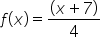
  129. Question 129

    The front of a roller-coaster car is at the bottom of a hill and is 15 feet above the ground. If the front of the roller-coaster car rises at a constant rate of 8 feet per second, which of the following equations gives the height h, in feet, of the front of the roller-coaster car s seconds after it starts up the hill?

    Correct answer: A

    Choice A is correct. It’s given that the front of the roller-coaster car starts rising when it’s 15 feet above the ground. This initial height of 15 feet can be represented by a constant term, 15, in an equation. Each second, the front of the roller-coaster car rises 8 feet, which can be represented by 8s. Thus, the equation gives the height, in feet, of the front of the roller-coaster car s seconds after it starts up the hill.Choices B and C are incorrect and may result from conceptual errors in creating a linear equation. Choice D is incorrect and may result from switching the rate at which the roller-coaster car rises with its initial height.
  130. Question 130

    The cost of renting a backhoe for up to \(10\) days is \(\\) 270\( for the first day and \)$ 135\( for each additional day. Which of the following equations gives the cost \)y\(, in dollars, of renting the backhoe for \)x\( days, where \)x\( is a positive integer and \)x < or = 10$?

    Correct answer: D

    Choice D is correct. It's given that the cost of renting a backhoe for up to \(10\) days is \(\\) 270\( for the first day and \)$ 135\( for each additional day. Therefore, the cost \)y\(, in dollars, for \)x\( days, where \)x < or = 10\(, is the sum of the cost for the first day, \)$ 270\(, and the cost for the additional \)x -1\( days, \)$ 135(x -1)\(. It follows that \)y = 270 + 135(x -1)\(, which is equivalent to \)y = 270 + 135 x -135\(, or \)y = 135 x + 135\(. Choice A is incorrect. This equation represents a situation where the cost of renting a backhoe is \)$ 135\( for the first day and \)$ 270$ for each additional day. Choice B is incorrect and may result from conceptual or calculation errors. Choice C is incorrect and may result from conceptual or calculation errors.
  131. Question 131

    \(d = 16 -x/30\) The equation shown gives the estimated amount of diesel \(d\), in gallons, that remains in the gas tank of a truck after being driven \(x\) miles, where \(0 < or = x < or = 480\). What is the estimated amount of diesel, in gallons, that remains in the gas tank of the truck when \(x = 300\)?

    Correct answer: B

    Choice B is correct. It’s given that the equation \(d = 16 -x/30\) gives the estimated amount of diesel \(d\), in gallons, that remains in the gas tank of the truck after being driven \(x\) miles. Substituting \(300\) for \(x\) in the given equation yields \(d = 16 -300/30\), which is equivalent to \(d = 16 -10\), or \(d = 6\). Therefore, the estimated amount of diesel that remains in the gas tank of the truck when \(x = 300\) is \(6\) gallons. Choice A is incorrect. This is the estimated amount of diesel, in gallons, that will remain in the gas tank of the truck when \(x = 480\), not when \(x = 300\). Choice C is incorrect. This is the estimated amount of diesel, in gallons, that will remain in the gas tank of the truck when \(x = 60\), not when \(x = 300\). Choice D is incorrect. This is the estimated amount of diesel, in gallons, that will remain in the gas tank of the truck when \(x = 0\), not when \(x = 300\).
  132. Question 132

    An economist modeled the demand Q for a certain product as a linear function of the selling price P. The demand was 20,000 units when the selling price was $40 per unit, and the demand was 15,000 units when the selling price was $60 per unit. Based on the model, what is the demand, in units, when the selling price is $55 per unit?

    Correct answer: A

    Choice A is correct. Let the economist’s model be the linear function, where Q is the demand, P is the selling price, m is the slope of the line, and b is the y-coordinate of the y-intercept of the line in the xy-plane, where . Two pairs of the selling price P and the demand Q are given. Using the coordinate pairs, two points that satisfy the function are and . The slope m of the function can be found using the formula . Substituting the given values into this formula yields, or . Therefore, . The value of b can be found by substituting one of the points into the function. Substituting the values of P and Q from the point yields, or . Adding 10,000 to both sides of this equation yields . Therefore, the linear function the economist used as the model is . Substituting 55 for P yields . It follows that when the selling price is $55 per unit, the demand is 16,250 units.Choices B, C, and D are incorrect and may result from calculation or conceptual errors.
  133. Question 133

    The function \(h\) is defined by \(h(x)= 4 x + 28\). The graph of \(y = h(x)\) in the xy-plane has an x-intercept at \((a, 0)\) and a y-intercept at \((0, b)\), where \(a\) and \(b\) are constants. What is the value of \(a + b\)?

    Correct answer: A

    Choice A is correct. The x-intercept of a graph in the xy-plane is the point on the graph where \(y = 0\). It's given that function \(h\) is defined by \(h(x)= 4 x + 28\). Therefore, the equation representing the graph of \(y = h(x)\) is \(y = 4 x + 28\). Substituting \(0\) for \(y\) in the equation \(y = 4 x + 28\) yields \(0 = 4 x + 28\). Subtracting \(28\) from both sides of this equation yields \(-28 = 4 x\). Dividing both sides of this equation by \(4\) yields \(-7 = x\). Therefore, the x-intercept of the graph of \(y = h(x)\) in the xy-plane is \((-7, 0)\). It's given that the x-intercept of the graph of \(y = h(x)\) is \((a, 0)\). Therefore, \(a = -7\). The y-intercept of a graph in the xy-plane is the point on the graph where \(x = 0\). Substituting \(0\) for \(x\) in the equation \(y = 4 x + 28\) yields \(y = 4(0)+ 28\), or \(y = 28\). Therefore, the y-intercept of the graph of \(y = h(x)\) in the xy-plane is \((0, 28)\). It's given that the y-intercept of the graph of \(y = h(x)\) is \((0, b)\). Therefore, \(b = 28\). If \(a = -7\) and \(b = 28\), then the value of \(a + b\) is \(-7 + 28\), or \(21\). Choice B is incorrect. This is the value of \(b\), not \(a + b\). Choice C is incorrect and may result from conceptual or calculation errors. Choice D is incorrect. This is the value of \(-a + b\), not \(a + b\).
  134. Question 134

    A window repair specialist charges \(\\) 220\( for the first two hours of repair plus an hourly fee for each additional hour. The total cost for \)5\( hours of repair is \)$ 400\(. Which function \)f\( gives the total cost, in dollars, for \)x\( hours of repair, where \)x > or = 2$?

    Correct answer: A

    Choice A is correct. It’s given that the window repair specialist charges \(\\) 220\( for the first two hours of repair plus an hourly fee for each additional hour. Let \)n\( represent the hourly fee for each additional hour after the first two hours. Since it’s given that \)x\( is the number of hours of repair, it follows that the charge generated by the hourly fee after the first two hours can be represented by the expression \)n(x -2)\(. Therefore, the total cost, in dollars, for \)x\( hours of repair is \)f(x)= 220 + n(x -2)\(. It’s given that the total cost for \)5\( hours of repair is \)$ 400\(. Substituting \)5\( for \)x\( and \)400\( for \)f(x)\( into the equation \)f(x)= 220 + n(x -2)\( yields \)400 = 220 + n(5 -2)\(, or \)400 = 220 + 3 n\(. Subtracting \)220\( from both sides of this equation yields \)180 = 3 n\(. Dividing both sides of this equation by \)3\( yields \)n = 60\(. Substituting \)60\( for \)n\( in the equation \)f(x)= 220 + n(x -2)\( yields \)f(x)= 220 + 60(x -2)\(, which is equivalent to \)f(x)= 220 + 60 x -120\(, or \)f(x)= 60 x + 100\(. Therefore, the total cost, in dollars, for \)x\( hours of repair is \)f(x)= 60 x + 100\(. Choice B is incorrect. This function represents the total cost, in dollars, for \)x\( hours of repair where the specialist charges \)$ 340\(, rather than \)$ 220\(, for the first two hours of repair. Choice C is incorrect. This function represents the total cost, in dollars, for \)x\( hours of repair where the specialist charges \)$ 160\(, rather than \)$ 220\(, for the first two hours of repair, and an hourly fee of \)$ 80\(, rather than \)$ 60\(, after the first two hours. Choice D is incorrect. This function represents the total cost, in dollars, for \)x\( hours of repair where the specialist charges \)$ 380\(, rather than \)$ 220\(, for the first two hours of repair, and an hourly fee of \)$ 80\(, rather than \)$ 60$, after the first two hours.
  135. Question 135

    The total cost \(f(x)\), in dollars, to lease a car for \(36\) months from a particular car dealership is given by \(f(x)= 36 x + 1,000\), where \(x\) is the monthly payment, in dollars. What is the total cost to lease a car when the monthly payment is \(\\) 400$?

    Correct answer: C

    Choice C is correct. It's given that \(f(x)\) is the total cost, in dollars, to lease a car from this dealership with a monthly payment of \(x\) dollars. Therefore, the total cost, in dollars, to lease the car when the monthly payment is \(\\) 400\( is represented by the value of \)f(x)\( when \)x = 400\(. Substituting \)400\( for \)x\( in the equation \)f(x)= 36 x + 1,000\( yields \)f(400)= 36(400)+ 1,000\(, or \)f(400)= 15,400\(. Thus, when the monthly payment is \)$ 400\(, the total cost to lease a car is \)$ 15,400$. Choice A is incorrect and may result from conceptual or calculation errors. Choice B is incorrect and may result from conceptual or calculation errors. Choice D is incorrect and may result from conceptual or calculation errors.
  136. Question 136

    A veterinarian recommends that each day a certain rabbit should eat \(25\) calories per pound of the rabbit’s weight, plus an additional \(11\) calories. Which equation represents this situation, where \(c\) is the total number of calories the veterinarian recommends the rabbit should eat each day if the rabbit’s weight is \(x\) pounds?

    Correct answer: D

    Choice D is correct. It’s given that a veterinarian recommends that each day the rabbit should eat \(25\) calories per pound of the rabbit’s weight, plus an additional \(11\) calories. If the rabbit’s weight is \(x\) pounds, then multiplying \(25\) calories per pound by the rabbit’s weight, \(x\) pounds, yields \(25 x\) calories. Adding the additional \(11\) calories that the rabbit should eat each day yields \(25 x + 11\) calories. It’s given that \(c\) is the total number of calories the veterinarian recommends the rabbit should eat each day if the rabbit’s weight is \(x\) pounds. Therefore, this situation can be represented by the equation \(c = 25 x + 11\). Choice A is incorrect. This equation represents a situation where a veterinarian recommends that each day the rabbit should eat \(25\) calories per pound of the rabbit’s weight. Choice B is incorrect. This equation represents a situation where a veterinarian recommends that each day the rabbit should eat \(25 + 11\), or \(36\), calories per pound of the rabbit’s weight. Choice C is incorrect. This equation represents a situation where a veterinarian recommends that each day the rabbit should eat \(11\) calories per pound of the rabbit’s weight, plus an additional \(25\) calories.
  137. Question 137

    Gabriella deposits \(\\) 35\( in a savings account at the end of each week. At the beginning of the \)1^{st}\( week of a year there was \)$ 600\( in that savings account. How much money, in dollars, will be in the account at the end of the \)4^{th}$ week of that year?

    Correct answer: D

    Choice D is correct. It’s given that at the beginning of the \(1^{st}\) week of the year there was \(\\) 600\( in a savings account and Gabriella deposits \)$ 35\( in that savings account at the end of each week. Therefore, the amount of money, in dollars, in the savings account at the end of the \)4^{th}\( week of that year is \)600 + 4(35)\(, or \)740\(. Choice A is incorrect. This is the amount of money, in dollars, that will be in the account at the end of the \)4^{th}\( week if Gabriella withdraws, rather than deposits, \)$ 35\( at the end of each week. Choice B is incorrect. This is the amount of money, in dollars, that will be in the account at the end of the \)1^{st}\( week, not the \)4^{th}$ week. Choice C is incorrect and may result from conceptual or calculation errors.
  138. Question 138

    \(f(x)= 4 x + b\) For the linear function \(f\), \(b\) is a constant and \(f(7)= 28\). What is the value of \(b\)?

    Correct answer: A

    Choice A is correct. For the linear function \(f\), it’s given that \(f(7)= 28\). Substituting \(7\) for \(x\) and \(28\) for \(f(x)\) in the given function yields \(28 = 4(7)+ b\), or \(28 = 28 + b\). Subtracting \(28\) from each side of this equation yields \(0 = b\). Therefore, the value of \(b\) is \(0\). Choice B is incorrect. Substituting \(1\) for \(b\) in the given function yields \(f(x)= 4 x + 1\). For this function, when the value of \(x\) is \(7\), the value of \(f(x)\) is \(29\), not \(28\). Choice C is incorrect. Substituting \(4\) for \(b\) in the given function yields \(f(x)= 4 x + 4\). For this function, when the value of \(x\) is \(7\), the value of \(f(x)\) is \(32\), not \(28\). Choice D is incorrect. Substituting \(7\) for \(b\) in the given function yields \(f(x)= 4 x + 7\). For this function, when the value of \(x\) is \(7\), the value of \(f(x)\) is \(35\), not \(28\).
  139. Question 139

    The function \(f\) is defined by \(f(x)= 8 x\). For what value of \(x\) does \(f(x)= 72\)?

    Correct answer: B

    Choice B is correct. Substituting \(72\) for \(f(x)\) in the given function yields \(72 = 8 x\). Dividing each side of this equation by \(8\) yields \(9 = x\). Therefore, \(f(x)= 72\) when the value of \(x\) is \(9\). Choice A is incorrect. This is the value of \(x\) for which \(f(x)= 64\), not \(f(x)= 72\). Choice C is incorrect. This is the value of \(x\) for which \(f(x)= 512\), not \(f(x)= 72\). Choice D is incorrect. This is the value of \(x\) for which \(f(x)= 640\), not \(f(x)= 72\).
  140. Question 140

    The function \(f\) is defined by \(f(x)= 25 x + 30\). What is the value of \(f(x)\) when \(x = 2\)?

    Correct answer: C

    Choice C is correct. It’s given that the function \(f\) is defined by \(f(x)= 25 x + 30\). Substituting \(2\) for \(x\) in this equation yields \(f(2)= 25(2)+ 30\), which is equivalent to \(f(2)= 50 + 30\), or \(f(2)= 80\). Therefore, the value of \(f(x)\) is \(80\) when \(x = 2\). Choice A is incorrect. This is the value of \(25(2)\), not \(25(2)+ 30\). Choice B is incorrect. This is the value of \(25 + 2 + 30\), not \(25(2)+ 30\). Choice D is incorrect. This is the value of \((25 + 30)(2)\), not \(25(2)+ 30\).

Want a higher score?

One-on-one tutoring for SAT, online or in person, with a plan built around the questions you missed.

Get Started

Book Your Free Session

5.0
from 38 Google reviews

Call or Text 1 (888) 356-0607