Skip to content

SAT practice test

Linear Equations in two variables

  • 113 questions
  • Untimed
  • Answers and explanations
Embed on your site
  • 113 questions
  • No time limit
  • Every answer explained at the end
  1. Question 1

    A store sells two different-sized containers of blueberries. The store’s sales of these blueberries totaled \(896.86\) dollars last month. The equation \(4.51 x + 6.07 y = 896.86\) represents this situation, where \(x\) is the number of smaller containers sold and \(y\) is the number of larger containers sold. According to the equation, what is the price, in dollars, of each smaller container?

    Correct answer: A

    The correct answer is \(4.51\). It’s given that the equation \(4.51 x + 6.07 y = 896.86\) represents this situation, where \(x\) is the number of smaller containers sold, \(y\) is the number of larger containers sold, and \(896.86\) is the store’s total sales, in dollars, of blueberries last month. Therefore, \(4.51 x\) represents the store's sales, in dollars, of smaller containers, and \(6.07 y\) represents the store's sales, in dollars, of larger containers. Since \(x\) is the number of smaller containers sold, the price, in dollars, of each smaller container is \(4.51\).
  2. Question 2

    \(x\) \(y\) \(-18\) \(-48\) \(7\) \(52\) The table shows two values of \(x\) and their corresponding values of \(y\). In the xy-plane, the graph of the linear equation representing this relationship passes through the point \((1 seventh, a)\). What is the value of \(a\)?

    Correct answer: D

    Choice D is correct. The linear relationship between \(x\) and \(y\) can be represented by the equation \(y = m x + b\), where \(m\) is the slope of the graph of this equation in the xy-plane and \(b\) is the y-coordinate of the y-intercept. The slope of a line between any two points \((x_1, y_1)\) and \((x_2, y_2)\) on the line can be calculated using the slope formula \(m = y_2 -y_1/x_2 -x_1\). Based on the table, the graph contains the points \((-18, -48)\) and \((7, 52)\). Substituting \((-18, -48)\) and \((7, 52)\) for \((x_1, y_1)\) and \((x_2, y_2)\), respectively, in the slope formula yields \(m = 52 -(-48)/7 -(-18)\), which is equivalent to \(m = 100/25\), or \(m = 4\). Substituting \(4\) for \(m\), \(-18\) for \(x\), and \(-48\) for \(y\) in the equation \(y = m x + b\) yields \(-48 = 4(-18)+ b\), or \(-48 = -72 + b\). Adding \(72\) to both sides of this equation yields \(24 = b\). Therefore, \(m = 4\) and \(b = 24\). Substituting \(4\) for \(m\) and \(24\) for \(b\) in the equation \(y = m x + b\) yields \(y = 4 x + 24\). Thus, the equation \(y = 4 x + 24\) represents the linear relationship between \(x\) and \(y\). It's also given that the graph of the linear equation representing this relationship in the xy-plane passes through the point \((1 seventh, a)\). Substituting \(1 seventh\) for \(x\) and \(a\) for \(y\) in the equation \(y = 4 x + 24\) yields \(a = 4(1 seventh)+ 24\), which is equivalent to \(a = 4 sevenths + 168/7\), or \(a = 172/7\). Choice A is incorrect and may result from conceptual or calculation errors. Choice B is incorrect and may result from conceptual or calculation errors. Choice C is incorrect and may result from conceptual or calculation errors.
  3. Question 3

    Davio bought some potatoes and celery. The potatoes cost \(\\) 0.69\( per pound, and the celery cost \)$ 0.99\( per pound. If Davio spent \)$ 5.34$ in total and bought twice as many pounds of celery as pounds of potatoes, how many pounds of celery did Davio buy?

    Correct answer: D

    Choice D is correct. Let \(p\) represent the number of pounds of potatoes and let \(c\) represent the number of pounds of celery that Davio bought. It’s given that potatoes cost \(\\) 0.69\( per pound and celery costs \)$ 0.99\( per pound. If Davio spent \)$ 5.34\( in total, then the equation \)0.69 p + 0.99 c = 5.34\( represents this situation. It’s also given that Davio bought twice as many pounds of celery as pounds of potatoes; therefore, \)c = 2 p\(. Substituting \)2 p\( for \)c\( in the equation \)0.69 p + 0.99 c = 5.34\( yields \)0.69 p + 0.99(2 p)= 5.34\(, which is equivalent to \)0.69 p + 1.98 p = 5.34\(, or \)2.67 p = 5.34\(. Dividing both sides of this equation by \)2.67\( yields \)p = 2\(. Substituting \)2\( for \)p\( in the equation \)c = 2 p\( yields \)c = 2(2)\(, or \)c = 4\(. Therefore, Davio bought \)4$ pounds of celery. Choice A is incorrect. This is the number of pounds of potatoes, not the number of pounds of celery, Davio bought. Choice B is incorrect and may result from conceptual or calculation errors. Choice C is incorrect and may result from conceptual or calculation errors.
  4. Question 4

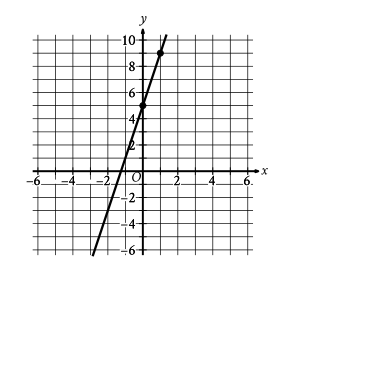
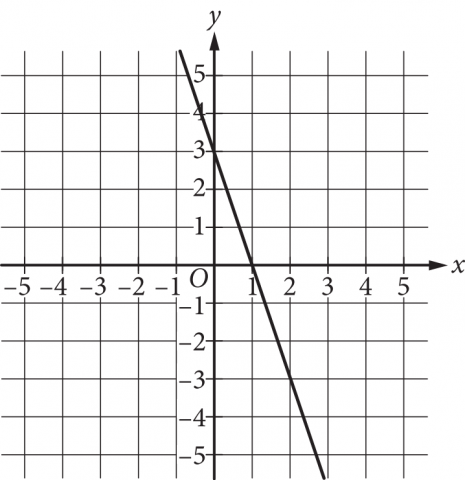
    What is the equation of the line shown in the xy-plane above?

    Correct answer: B

    Choice B is correct. Any line in the xy-plane can be defined by an equation in the form y = mx + b, where m is the slope of the line and b is the y-coordinate of the y-intercept of the line. From the graph, the y-intercept of the line is (0, 3). Therefore, b = 3. The slope of the line is the change in the value of y divided by the change in the value of x for any two points on the line. The line shown passes through (0, 3) and (1, 0), so, or m = –3. Therefore, the equation of the line is y = –3x + 3.Choices A and C are incorrect because the equations given in these choices represent a line with a positive slope. However, the line shown has a negative slope. Choice D is incorrect because the equation given in this choice represents a line with slope of . However, the line shown has a slope of –3.
  5. Question 5

    The y-intercept of the graph of \(y = -6 x -32\) in the xy-plane is \((0, y)\). What is the value of \(y\)?

    Correct answer: D

    The correct answer is \(-32\). It’s given that the y-intercept of the graph of \(y = -6 x -32\) is \((0, y)\). Substituting \(0\) for \(x\) in this equation yields \(y = -6(0)-32\), or \(y = -32\). Therefore, the value of \(y\) that corresponds to the y-intercept of the graph of \(y = -6 x -32\) in the xy-plane is \(-32\).
  6. Question 6

    Last week, an interior designer earned a total of \(\\) 1,258\( from consulting for \)x\( hours and drawing up plans for \)y\( hours. The equation \)68 x + 85 y = 1,258\( represents this situation. Which of the following is the best interpretation of \)68$ in this context?

    Correct answer: A

    Choice A is correct. It's given that \(68 x + 85 y = 1,258\) represents the situation where an interior designer earned a total of \(\\) 1,258\( last week from consulting for \)x\( hours and drawing up plans for \)y\( hours. Thus, \)68 x\( represents the amount earned, in dollars, from consulting for \)x\( hours, and \)85 y\( represents the amount earned, in dollars, from drawing up plans for \)y\( hours. Since \)68 x\( represents the amount earned, in dollars, from consulting for \)x\( hours, it follows that the interior designer earned \)$ 68\( per hour consulting last week. Choice B is incorrect. The interior designer worked \)y\( hours, not \)68\( hours, drawing up plans last week. Choice C is incorrect. The interior designer earned \)$ 85\( per hour, not \)$ 68\( per hour, drawing up plans last week. Choice D is incorrect. The interior designer worked \)x\( hours, not \)68$ hours, consulting last week.
  7. Question 7

    In the xy-plane, line \(s\) passes through the point \((0, 0)\) and is parallel to the line represented by the equation \(y = 18 x + 2\). If line \(s\) also passes through the point \((4, d)\), what is the value of \(d\)?

    Correct answer: C

    Choice C is correct. A line in the xy-plane can be represented by an equation of the form \(y = m x + b\), where \(m\) is the slope and \(b\) is the y-coordinate of the y-intercept of the line. It's given that line \(s\) passes through the point \((0, 0)\). Therefore, the y-coordinate of the y-intercept of line \(s\) is \(0\). It's also given that line \(s\) is parallel to the line represented by the equation \(y = 18 x + 2\). Since parallel lines have the same slope, it follows that the slope of line \(s\) is \(18\). Therefore, line \(s\) can be represented by the equation \(y = m x + b\), where \(m = 18\) and \(b = 0\). Substituting \(18\) for \(m\) and \(0\) for \(b\) in \(y = m x + b\) yields the equation \(y = 18 x + 0\), or \(y = 18 x\). If line \(s\) passes through the point \((4, d)\), then when \(x = 4\), \(y = d\) for the equation \(y = 18 x\). Substituting \(4\) for \(x\) and \(d\) for \(y\) in this equation yields \(d = 18(4)\), or \(d = 72\). Choice A is incorrect. This is the y-coordinate of the y-intercept of the line represented by the equation \(y = 18 x + 2\). Choice B is incorrect. This is the slope of the line represented by the equation \(y = 18 x + 2\). Choice D is incorrect. The line represented by the equation \(y = 18 x + 2\), not line \(s\), passes through the point \((4, 74)\).
  8. Question 8

    Naomi bought both rabbit snails and nerite snails for a total of \(\\) 52\(. Each rabbit snail costs \)$ 8\( and each nerite snail costs \)$ 6\(. If Naomi bought \)2$ nerite snails, how many rabbit snails did she buy?

    Correct answer: A

    Choice A is correct. Let \(x\) represent the number of rabbit snails that Naomi bought. It’s given that each rabbit snail costs \(\\) 8\(. Therefore, the total cost, in dollars, of the rabbit snails that Naomi bought can be represented by the expression \)8 x\(. It’s also given that each nerite snail costs \)$ 6\(, and that Naomi bought \)2\( nerite snails. Therefore, the total cost, in dollars, of the nerite snails that Naomi bought is \)6(2)\(, or \)12\(. Since Naomi bought both the rabbit snails and the nerite snails for a total of \)$ 52\(, the equation \)8 x + 12 = 52\( can be used to represent the situation. Subtracting \)12\( from both sides of this equation yields \)8 x = 40\(. Dividing both sides of this equation by \)8\( yields \)x = 5\(. Therefore, Naomi bought \)5$ rabbit snails. Choice B is incorrect. This is the total cost, in dollars, of the nerite snails that Naomi bought, not the number of rabbit snails. Choice C is incorrect. This is the cost, in dollars, of one rabbit snail and one nerite snail, not the number of rabbit snails that Naomi bought. Choice D is incorrect and may result from conceptual or calculation errors.
  9. Question 9

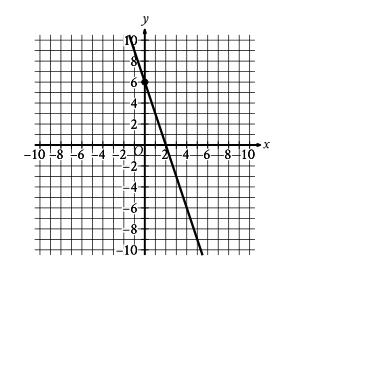
    The line slants sharply down from left to right. The line passes through the following points: (0, 6) (1, 3) The graph shows a linear relationship between \(x\) and \(y\). Which equation represents this relationship, where \(R\) is a positive constant?

    Correct answer: C

    Choice C is correct. The equation representing the linear relationship shown can be written in slope-intercept form \(y = m x + b\), where \(m\) is the slope and \((0, b)\) is the y-intercept of the line. The line shown passes through the points \((0, 6)\) and \((2, 0)\). Given two points on a line, \((x_1, y_1)\) and \((x_2, y_2)\), the slope of the line can be calculated using the equation \(m = y_2 -y_1/x_2 -x_1\). Substituting \((0, 6)\) and \((2, 0)\) for \((x_1, y_1)\) and \((x_2, y_2)\), respectively, in this equation yields \(m = 0 -6/2 -0\), which is equivalent to \(m = -6 halves\), or \(m = -3\). Since \((0, 6)\) is the y-intercept, it follows that \(b = 6\). Substituting \(-3\) for \(m\) and \(6\) for \(b\) in the equation \(y = m x + b\) yields \(y = -3 x + 6\). Adding \(3 x\) to both sides of this equation yields \(3 x + y = 6\). Multiplying this equation by \(6\) yields \(18 x + 6 y = 36\). It follows that the equation \(18 x + R y = 36\), where \(R\) is a positive constant, represents this relationship. Choice A is incorrect. The graph of this relationship passes through the point \((0, 2)\), not \((0, 6)\). Choice B is incorrect. The graph of this relationship passes through the point \((0, 2)\), not \((0, 6)\). Choice D is incorrect. The graph of this relationship passes through the point \((-2, 0)\), not \((2, 0)\).
  10. Question 10

    A line in the xy-plane has a slope of \(9\) and passes through the point \((0, -5)\). The equation \(y = p x + r\) defines the line, where \(p\) and \(r\) are constants. What is the value of \(p\)?

    Correct answer: D

    The correct answer is \(9\). It’s given that the equation \(y = p x + r\) defines the line. In this equation, \(p\) represents the slope of the line and \(r\) represents the y-coordinate of the y-intercept of the line. It’s given that the line has a slope of \(9\). Therefore, the value of \(p\) is \(9\).
  11. Question 11

    The equation \(46 = 2 a + 2 b\) gives the relationship between the side lengths \(a\) and \(b\) of a certain parallelogram. If \(a = 9\), what is the value of \(b\)?

    Correct answer: B

    The correct answer is \(14\). It's given that the equation \(46 = 2 a + 2 b\) gives the relationship between the side lengths \(a\) and \(b\) of a certain parallelogram. Substituting \(9\) for \(a\) in the given equation yields \(46 = 2(9)+ 2 b\), or \(46 = 18 + 2 b\). Subtracting \(18\) from both sides of this equation yields \(28 = 2 b\). Dividing both sides of this equation by \(2\) yields \(14 = b\). Therefore, if \(a = 9\), the value of \(b\) is \(14\).
  12. Question 12

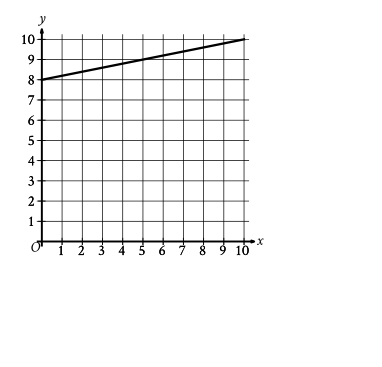
    The line slants gradually up from left to right. The line passes through the following points: (0, 8) (5, 9) (10, 10) What is the y-intercept of the line graphed?

    Correct answer: D

    Choice D is correct. The y-intercept of a line graphed in the xy-plane is the point where the line intersects the y-axis. The line graphed intersects the y-axis at the point \((0, 8)\). Therefore, the y-intercept of the line graphed is \((0, 8)\). Choice A is incorrect and may result from conceptual errors. Choice B is incorrect and may result from conceptual errors. Choice C is incorrect and may result from conceptual errors.
  13. Question 13

    A line passes through the points \((4, 6)\) and \((15, 24)\) in the xy-plane. What is the slope of the line?

    Correct answer: A

    The correct answer is \(18/11\). For a line that passes through the points \((x_1, y_1)\) and \((x_2, y_2)\) in the xy-plane, the slope of the line can be calculated using the slope formula, \(m = y_2 -y_1/x_2 -x_1\). It's given that a line passes through the points \((4, 6)\) and \((15, 24)\) in the xy-plane. Substituting \((4, 6)\) for \((x_1, y_1)\) and \((15, 24)\) for \((x_2, y_2)\) in the slope formula, \(m = y_2 -y_1/x_2 -x_1\), yields \(m = 24 -6/15 -4\), or \(m = 18/11\). Therefore, the slope of the line is \(18/11\). Note that 18/11 and 1.636 are examples of ways to enter a correct answer.
  14. Question 14

    What is the slope of the graph of \(y = 1 fourth(27 x + 15)+ 7 x\) in the xy-plane?

    Correct answer: D

    The correct answer is \(55/4\). In the xy-plane, the graph of an equation in the form \(y = m x + b\), where \(m\) and \(b\) are constants, has a slope of \(m\) and a y-intercept of \((0, b)\). Applying the distributive property to the right-hand side of the given equation yields \(y = 27/4 x + 15/4 + 7 x\). Combining like terms yields \(y = 55/4 x + 15/4\). This equation is in the form \(y = m x + b\), where \(m = 55/4\) and \(b = 15/4\). It follows that the slope of the graph of \(y = 1 fourth(27 x + 15)+ 7 x\) in the xy-plane is \(55/4\). Note that 55/4 and 13.75 are examples of ways to enter a correct answer.
  15. Question 15

    \(2 x + y = 37\) In triangle \(Q R S\), sides \(Q R\) and \(R S\) each have a length of \(x\) centimeters and side \(S Q\) has a length of \(y\) centimeters. The given equation represents this situation. Which of the following is the best interpretation of \(37\) in this context?

    Correct answer: C

    Choice C is correct. It's given that in triangle \(Q R S\), sides \(Q R\) and \(R S\) each have a length of \(x\) centimeters. Therefore, the expression \(2 x\) represents the sum of the lengths, in centimeters, of sides \(Q R\) and \(R S\). It's also given that side \(S Q\) has a length of \(y\) centimeters. Therefore, the expression \(2 x + y\) represents the sum of the lengths, in centimeters, of sides \(Q R\), \(R S\), and \(S Q\). Since \(2 x + y\) is the sum of the lengths, in centimeters, of the three sides of the triangle and \(2 x + y = 37\), it follows that \(37\) is the sum of the lengths, in centimeters, of the three sides of the triangle. Choice A is incorrect. The difference, in centimeters, between the lengths of sides \(Q R\) and \(S Q\) is \(x -y\), not \(37\). Choice B is incorrect. The difference, in centimeters, between the lengths of sides \(Q R\) and \(R S\) is \(x -x\), or \(0\), not \(37\). Choice D is incorrect. The length, in centimeters, of one of the two sides of equal length is \(x\), not \(37\).
  16. Question 16

    How many liters of a 25% saline solution must be added to 3 liters of a 10% saline solution to obtain a 15% saline solution?

    Correct answer: A

    The correct answer is 1.5. The total amount, in liters, of a saline solution can be expressed as the liters of each type of saline solution multiplied by the percent concentration of the saline solution. This gives,, and, where x is the amount, in liters, of 25% saline solution and 10%, 15%, and 25% are represented as 0.10, 0.15, and 0.25, respectively. Thus, the equation must be true. Multiplying 3 by 0.10 and distributing 0.15 to yields . Subtracting 0.15x and 0.30 from each side of the equation gives . Dividing each side of the equation by 0.10 yields . Note that 1.5 and 3/2 are examples of ways to enter a correct answer.
  17. Question 17

    What is the y-coordinate of the y-intercept of the graph of \(3 x/7 = -5 y/9 + 21\) in the xy-plane?

    Correct answer: C

    The correct answer is \(189/5\). A y-intercept of a graph in the xy-plane is a point where the graph intersects the y-axis, which is a point with an x-coordinate of \(0\). Substituting \(0\) for \(x\) in the given equation yields \(3(0)/7 = -5 y/9 + 21\), or \(0 = -5 y/9 + 21\). Subtracting \(21\) from both sides of this equation yields \(-21 = -5 y/9\). Multiplying both sides of this equation by \(-9\) yields \(189 = 5 y\). Dividing both sides of this equation by \(5\) yields \(189/5 = y\). Therefore, the y-coordinate of the y-intercept of the graph of the given equation in the xy-plane is \(189/5\). Note that 189/5 and 37.8 are examples of ways to enter a correct answer.
  18. Question 18

    Jay walks at a speed of \(3\) miles per hour and runs at a speed of \(5\) miles per hour. He walks for \(w\) hours and runs for \(r\) hours for a combined total of \(14\) miles. Which equation represents this situation?

    Correct answer: A

    Choice A is correct. Since Jay walks at a speed of \(3\) miles per hour for \(w\) hours, Jay walks a total of \(3 w\) miles. Since Jay runs at a speed of \(5\) miles per hour for \(r\) hours, Jay runs a total of \(5 r\) miles. Therefore, the total number of miles Jay travels can be represented by \(3 w + 5 r\). Since the combined total number of miles is \(14\), the equation \(3 w + 5 r = 14\) represents this situation. Choice B is incorrect and may result from conceptual errors. Choice C is incorrect and may result from conceptual errors. Choice D is incorrect and may result from conceptual errors.
  19. Question 19

    A neighborhood consists of a \(2\)-hectare park and a \(35\)-hectare residential area. The total number of trees in the neighborhood is \(3,934\). The equation \(2 x + 35 y = 3,934\) represents this situation. Which of the following is the best interpretation of x in this context?

    Correct answer: A

    Choice A is correct. It's given that a neighborhood consists of a \(2\)-hectare park and a \(35\)-hectare residential area and that the total number of trees in the neighborhood is \(3,934\). It's also given that the equation \(2 x + 35 y = 3,934\) represents this situation. Since the total number of trees for a given area can be determined by taking the number of hectares times the average number of trees per hectare, this must mean that the terms \(2 x\) and \(35 y\) correspond to the number of trees in the park and in the residential area, respectively. Since \(2 x\) corresponds to the number of trees in the park, and \(2\) is the size of the park, in hectares, \(x\) must represent the average number of trees per hectare in the park. Choice B is incorrect and may result from conceptual errors. Choice C is incorrect and may result from conceptual errors. Choice D is incorrect and may result from conceptual errors.
  20. Question 20

    \(x\) \(y\) \(-6\) \(n + 184\) \(-3\) \(n + 92\) \(0\) \(n\) The table shows three values of \(x\) and their corresponding values of \(y\), where \(n\) is a constant, for the linear relationship between \(x\) and \(y\). What is the slope of the line that represents this relationship in the xy-plane?

    Correct answer: A

    Choice A is correct. The slope, \(m\), of a line in the xy-plane can be found using two points on the line, \((x_1, y_1)\) and \((x_2, y_2)\), and the slope formula \(m = y_2 -y_1/x_2 -x_1\). Based on the given table, the line representing the relationship between \(x\) and \(y\) in the xy-plane passes through the points \((-6, n + 184)\), \((-3, n + 92)\), and \((0, n)\), where \(n\) is a constant. Substituting two of these points, \((-3, n + 92)\) and \((0, n)\), for \((x_1, y_1)\) and \((x_2, y_2)\), respectively, in the slope formula yields \(m = n -(n + 92)/0 -(-3)\), which is equivalent to \(m = n -n -92/0 + 3\), or \(m = -92/3\). Therefore, the slope of the line that represents this relationship in the xy-plane is \(-92/3\). Choice B is incorrect and may result from conceptual or calculation errors. Choice C is incorrect and may result from conceptual or calculation errors. Choice D is incorrect and may result from conceptual or calculation errors.
  21. Question 21

    A line in the xy-plane has a slope of \(-1 half\) and passes through the point \((0, 3)\). Which equation represents this line?

    Correct answer: B

    Choice B is correct. A line in the xy-plane with a slope of \(m\) and a y-intercept of \((0, b)\) can be represented by the equation \(y = m x + b\). It's given that the line has a slope of \(-1 half\). Therefore, \(m = -1 half\). It's also given that the line passes through the point \((0, 3)\). Therefore, \(b = 3\). Substituting \(-1 half\) for \(m\) and \(3\) for \(b\) in the equation \(y = m x + b\) yields \(y = -1 half x + 3\). Therefore, the equation \(y = -1 half x + 3\) represents this line. Choice A is incorrect. This equation represents a line in the xy-plane that passes through the point \((0, -3)\), not \((0, 3)\). Choice C is incorrect. This equation represents a line in the xy-plane that has a slope of \(1 half\), not \(-1 half\), and passes through the point \((0, -3)\), not \((0, 3)\). Choice D is incorrect. This equation represents a line in the xy-plane that has a slope of \(1 half\), not \(-1 half\).
  22. Question 22

    In the xy-plane, line k is defined by . Line j is perpendicular to line k, and the y-intercept of line j is . Which of the following is an equation of line j ?

    Correct answer: D

    Choice D is correct. It’s given that line j is perpendicular to line k and that line k is defined by the equation . This equation can be rewritten in slope-intercept form,, where m represents the slope of the line and b represents the y-coordinate of the y-intercept of the line, by subtracting x from both sides of the equation, which yields . Thus, the slope of line k is . Since line j and line k are perpendicular, their slopes are opposite reciprocals of each other. Thus, the slope of line j is 1. It’s given that the y-intercept of line j is . Therefore, the equation for line j in slope-intercept form is, which can be rewritten as .Choices A, B, and C are incorrect and may result from conceptual or calculation errors.
  23. Question 23

    In the equation above, F represents the total amount of money, in dollars, a food truck charges for x drinks and y salads. The price, in dollars, of each drink is the same, and the price, in dollars, of each salad is the same. Which of the following is the best interpretation for the number 7.00 in this context?

    Correct answer: B

    Choice B is correct. It’s given that is equal to the total amount of money, in dollars, a food truck charges for x drinks and y salads. Since each salad has the same price, it follows that the total charge for y salads is dollars. When, the value of the expression is, or 7.00. Therefore, the price for one salad is 7.00 dollars.Choice A is incorrect. Since each drink has the same price, it follows that the total charge for x drinks is dollars. Therefore, the price, in dollars, for one drink is 2.50, not 7.00. Choices C and D are incorrect. In the given equation, F represents the total charge, in dollars, when x drinks and y salads are bought at the food truck. No information is provided about the number of drinks or the number of salads that are bought during the day. Therefore, 7.00 doesn’t represent either of these quantities.
  24. Question 24

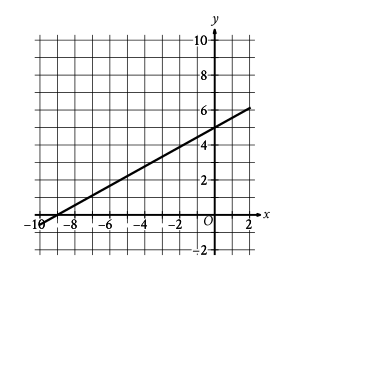
    The line slants gradually up from left to right. The line passes through the following points: (-9, 0) (0, 5) What is the y-intercept of the line graphed?

    Correct answer: C

    Choice C is correct. The y-intercept of a graph is the point where the graph intersects the y-axis. The line graphed intersects the y-axis at the point \((0, 5)\). Therefore, the y-intercept of the line graphed is \((0, 5)\). Choice A is incorrect and may result from conceptual errors. Choice B is incorrect and may result from conceptual errors. Choice D is incorrect and may result from conceptual errors.
  25. Question 25

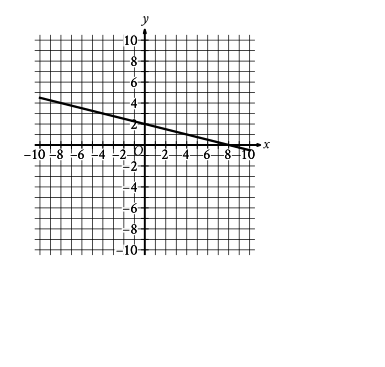
    The line slants gradually down from left to right. The line passes through the following points: (0, 7) (8, 0) The point with coordinates \((d, 4)\) lies on the line shown. What is the value of \(d\)?

    Correct answer: C

    Choice C is correct. It's given from the graph that the points \((0, 7)\) and \((8, 0)\) lie on the line. For two points on a line, \((x_1, y_1)\) and \((x_2, y_2)\), the slope of the line can be calculated using the slope formula \(m = y_2 -y_1/x_2 -x_1\). Substituting \((0, 7)\) for \((x_1, y_1)\) and \((8, 0)\) for \((x_2, y_2)\) in this formula, the slope of the line can be calculated as \(m = 0 -7/8 -0\), or \(m = -7 eighths\). It's also given that the point \((d, 4)\) lies on the line. Substituting \((d, 4)\) for \((x_1, y_1)\), \((8, 0)\) for \((x_2, y_2)\), and \(-7 eighths\) for \(m\) in the slope formula yields \(-7 eighths = 0 -4/8 -d\), or \(-7 eighths = \ -4/8 -d\). Multiplying both sides of this equation by \(8 -d\) yields \(-7 eighths(8 -d)= -4\). Expanding the left-hand side of this equation yields \(-7 + 7 eighths d = -4\). Adding \(7\) to both sides of this equation yields \(7 eighths d = 3\). Multiplying both sides of this equation by \(8 sevenths\) yields \(d = 24/7\). Thus, the value of \(d\) is \(24/7\). Choice A is incorrect. This is the value of \(y\) when \(x = 4\). Choice B is incorrect and may result from conceptual or calculation errors. Choice D is incorrect and may result from conceptual or calculation errors.
  26. Question 26

    What is the y-intercept of the graph of \(y = 34 x + 81\) in the xy-plane?

    Correct answer: A

    Choice A is correct. In the xy-plane, the graph of an equation in the form \(y = m x + b\), where \(m\) and \(b\) are constants, has a slope of \(m\) and a y-intercept of \((0, b)\). Therefore, the y-intercept of the graph of \(y = 34 x + 81\) is \((0, 81)\). Choice B is incorrect and may result from conceptual or calculation errors. Choice C is incorrect and may result from conceptual or calculation errors. Choice D is incorrect and may result from conceptual or calculation errors.
  27. Question 27

    The line with the equation is graphed in the xy‑plane. What is the x-coordinate of the x‑intercept of the line?

    Correct answer: A

    The correct answer is 1.25. The y-coordinate of the x-intercept is 0, so 0 can be substituted for y, giving . This simplifies to . Multiplying both sides of by 5 gives . Dividing both sides of by 4 gives, which is equivalent to 1.25. Note that 1.25 and 5/4 are examples of ways to enter a correct answer.
  28. Question 28

    \(y = 70 x + 8\) Which table gives three values of \(x\) and their corresponding values of \(y\) for the given equation?

    Correct answer: A

    Choice A is correct. Each of the given choices gives three values of \(x\): \(0\), \(2\), and \(4\). Substituting \(0\) for \(x\) in the given equation yields \(y = 70(0)+ 8\), or \(y = 8\). Therefore, when \(x = 0\), the corresponding value of \(y\) for the given equation is \(8\). Substituting \(2\) for \(x\) in the given equation yields \(y = 70(2)+ 8\), or \(y = 148\). Therefore, when \(x = 2\), the corresponding value of \(y\) for the given equation is \(148\). Substituting \(4\) for \(x\) in the given equation yields \(y = 70(4)+ 8\), or \(y = 288\). Therefore, when \(x = 4\), the corresponding value of \(y\) for the given equation is \(288\). Thus, if the three values of \(x\) are \(0\), \(2\), and \(4\), then their corresponding values of \(y\) are \(8\), \(148\), and \(288\), respectively, for the given equation. Choice B is incorrect. This table gives three values of \(x\) and their corresponding values of \(y\) for the equation \(y = 4 x + 70\). Choice C is incorrect and may result from conceptual or calculation errors. Choice D is incorrect and may result from conceptual or calculation errors.
  29. Question 29

    \(2.5 b + 5 r = 80\) The given equation describes the relationship between the number of birds, \(b\), and the number of reptiles, \(r\), that can be cared for at a pet care business on a given day. If the business cares for \(16\) reptiles on a given day, how many birds can it care for on this day?

    Correct answer: A

    Choice A is correct. The number of birds can be found by calculating the value of \(b\) when \(r = 16\) in the given equation. Substituting \(16\) for \(r\) in the given equation yields \(2.5 b + 5(16)= 80\), or \(2.5 b + 80 = 80\). Subtracting \(80\) from both sides of this equation yields \(2.5 b = 0\). Dividing both sides of this equation by \(2.5\) yields \(b = 0\). Therefore, if the business cares for \(16\) reptiles on a given day, it can care for \(0\) birds on this day. Choice B is incorrect and may result from conceptual or calculation errors. Choice C is incorrect and may result from conceptual or calculation errors. Choice D is incorrect and may result from conceptual or calculation errors.
  30. Question 30

    A shipment consists of \(5\)-pound boxes and \(10\)-pound boxes with a total weight of \(220\) pounds. There are \(13\) \(10\)-pound boxes in the shipment. How many \(5\)-pound boxes are in the shipment?

    Correct answer: D

    Choice D is correct. It's given that the shipment consists of \(5\)-pound boxes and \(10\)-pound boxes with a total weight of \(220\) pounds. Let \(x\) represent the number of \(5\)-pound boxes and \(y\) represent the number of \(10\)-pound boxes in the shipment. Therefore, the equation \(5 x + 10 y = 220\) represents this situation. It's given that there are \(13\) \(10\)-pound boxes in the shipment. Substituting \(13\) for \(y\) in the equation \(5 x + 10 y = 220\) yields \(5 x + 10(13)= 220\), or \(5 x + 130 = 220\). Subtracting \(130\) from both sides of this equation yields \(5 x = 90\). Dividing both sides of this equation by \(5\) yields \(18\). Thus, there are \(18\) \(5\)-pound boxes in the shipment. Choice A is incorrect and may result from conceptual or calculation errors. Choice B is incorrect and may result from conceptual or calculation errors. Choice C is incorrect. This is the number of \(10\)-pound boxes in the shipment.
  31. Question 31

    Figure A and figure B are both regular polygons. The sum of the perimeter of figure A and the perimeter of figure B is \(63\) inches. The equation \(3 x + 6 y = 63\) represents this situation, where \(x\) is the number of sides of figure A and \(y\) is the number of sides of figure B. Which statement is the best interpretation of \(6\) in this context?

    Correct answer: A

    Choice A is correct. It’s given that figure A and figure B (not shown) are both regular polygons and the sum of the perimeters of the two figures is \(63 inches\). It’s also given that \(x\) is the number of sides of figure A and \(y\) is the number of sides of figure B, and that the equation \(3 x + 6 y = 63\) represents this situation. Thus, \(3 x\) and \(6 y\) represent the perimeters, in inches, of figure A and figure B, respectively. Since \(6 y\) represents the perimeter, in inches, of figure B and \(y\) is the number of sides of figure B, it follows that each side of figure B has a length of \(6 inches\). Choice B is incorrect. The number of sides of figure B is \(y\), not \(6\). Choice C is incorrect. Since the perimeter, in inches, of figure A is represented by \(3 x\), each side of figure A has a length of \(3 inches\), not \(6 inches\). Choice D is incorrect. The number of sides of figure A is \(x\), not \(6\).
  32. Question 32

    A teacher is creating an assignment worth \(70\) points. The assignment will consist of questions worth \(1\) point and questions worth \(3\) points. Which equation represents this situation, where \(x\) represents the number of \(1\)-point questions and \(y\) represents the number of \(3\)-point questions?

    Correct answer: D

    Choice D is correct. Since \(x\) represents the number of \(1\)-point questions and \(y\) represents the number of \(3\)-point questions, the assignment is worth a total of \(1 dot x + 3 dot y\), or \(x + 3 y\), points. Since the assignment is worth \(70\) points, the equation \(x + 3 y = 70\) represents this situation. Choice A is incorrect and may result from conceptual errors. Choice B is incorrect and may result from conceptual errors. Choice C is incorrect and may result from conceptual errors.
  33. Question 33

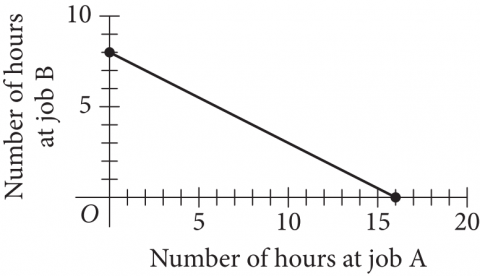
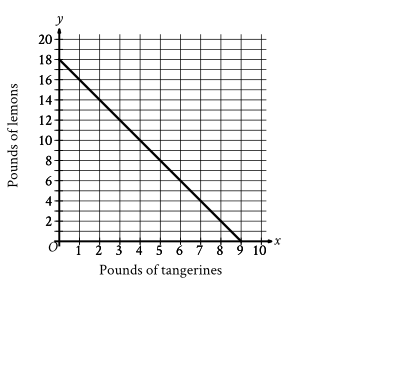
    To earn money for college, Avery works two part-time jobs: A and B. She earns $10 per hour working at job A and $20 per hour working at job B. In one week, Avery earned a total of s dollars for working at the two part-time jobs. The graph above represents all possible combinations of numbers of hours Avery could have worked at the two jobs to earn s dollars. What is the value of s ?

    Correct answer: B

    Choice B is correct. Avery earns $10 per hour working at job A. Therefore, if she works a hours at job A, she will earn dollars. Avery earns $20 per hour working at job B. Therefore, if she works b hours at job B, she will earn dollars. The graph shown represents all possible combinations of the number of hours Avery could have worked at the two jobs to earn s dollars. Therefore, if she worked a hours at job A, worked b hours at job B, and earned s dollars from both jobs, the following equation represents the graph:, where s is a constant. Identifying any point from the graph and substituting the values of the coordinates for a and b, respectively, in this equation yield the value of s. For example, the point, where and, lies on the graph. Substituting 16 for a and 0 for b in the equation yields, or . Similarly, the point, where and, lies on the graph. Substituting 0 for a and 8 for b in the equation yields, or .Choices A, C, and D are incorrect. If the value of s is 128, 200, or 320, then no points on the graph will satisfy this equation. For example, if the value of s is 128 (choice A), then the equation becomes . The point, where and, lies on the graph. However, substituting 16 for a and 0 for b in yields, or, which is false. Therefore, doesn’t satisfy the equation, and so the value of s can’t be 128. Similarly, if (choice C) or (choice D), then substituting 16 for a and 0 for b yields and, respectively, which are both false.
  34. Question 34

    For a camπng trip a group bought \(x\) one-liter bottles of water and \(y\) three-liter bottles of water, for a total of \(240\) liters of water. Which equation represents this situation?

    Correct answer: A

    Choice A is correct. It's given that for a camπng trip a group bought \(x\) one-liter bottles of water and \(y\) three-liter bottles of water. Since the group bought \(x\) one-liter bottles of water, the total number of liters bought from \(x\) one-liter bottles of water is represented as \(1 x\), or \(x\). Since the group bought \(y\) three-liter bottles of water, the total number of liters bought from \(y\) three-liter bottles of water is represented as \(3 y\). It's given that the group bought a total of \(240\) liters; thus, the equation \(x + 3 y = 240\) represents this situation. Choice B is incorrect and may result from conceptual errors. Choice C is incorrect and may result from conceptual errors. Choice D is incorrect. This equation represents a situation where the group bought \(x\) three-liter bottles of water and \(y\) one-liter bottles of water, for a total of \(240\) liters of water.
  35. Question 35

    Line \(k\) is defined by \(y = 1 fourth x + 1\). Line \(j\) is parallel to line \(k\) in the xy-plane. What is the slope of \(j\)?

    Correct answer: D

    The correct answer is \(1 fourth\). It's given that line \(k\) is defined by \(y = 1 fourth x + 1\). It's also given that line \(j\) is parallel to line \(k\) in the xy-plane. A line in the xy-plane represented by an equation in slope-intercept form \(y = m x + b\) has a slope of \(m\) and a y-intercept of \((0, b)\). Therefore, the slope of line \(k\) is \(1 fourth\). Since parallel lines have equal slopes, the slope of line \(j\) is \(1 fourth\). Note that 1/4 and .25 are examples of ways to enter a correct answer.
  36. Question 36

    What is the slope of the graph of \(y = 5 x/13 -23\) in the xy-plane?

    Correct answer: C

    The correct answer is \(5 thirteenths\). The graph of a line in the xy-plane can be represented by the equation \(y = m x + b\), where \(m\) is the slope of the line and \(b\) is the y-coordinate of the y-intercept. The given equation can be written as \(y =(5 thirteenths)x -23\). Therefore, the slope of the graph of this equation in the xy-plane is \(5 thirteenths\). Note that 5/13, .3846, 0.385, and 0.384 are examples of ways to enter a correct answer.
  37. Question 37

    The equation \(x + y = 1,440\) represents the number of minutes of daylight (between sunrise and sunset), \(x\), and the number of minutes of non-daylight, \(y\), on a particular day in Oak Park, Illinois. If this day has \(670\) minutes of daylight, how many minutes of non-daylight does it have?

    Correct answer: B

    Choice B is correct. It’s given that the equation \(x + y = 1,440\) represents the number of minutes of daylight, \(x\), and the number of minutes of non-daylight, \(y\), on a particular day in Oak Park, Illinois. It’s also given that this day has \(670\) minutes of daylight. Substituting \(670\) for \(x\) in the equation \(x + y = 1,440\) yields \(670 + y = 1,440\). Subtracting \(670\) from both sides of this equation yields \(y = 770\). Therefore, this day has \(770\) minutes of non-daylight. Choice A is incorrect. This is the number of minutes of daylight, not non-daylight, on this day. Choice C is incorrect and may result from conceptual or calculation errors. Choice D is incorrect. This is the total number of minutes of daylight and non-daylight.
  38. Question 38

    \(5 G + 45 R = 380\) At a school fair, students can win colored tokens that are worth a different number of points depending on the color. One student won \(G\) green tokens and \(R\) red tokens worth a total of \(380\) points. The given equation represents this situation. How many more points is a red token worth than a green token?

    Correct answer: D

    The correct answer is \(40\). It's given that \(5 G + 45 R = 380\), where \(G\) is the number of green tokens and \(R\) is the number of red tokens won by one student and these tokens are worth a total of \(380\) points. Since the equation represents the situation where the student won points with green tokens and red tokens for a total of \(380\) points, each term on the left-hand side of the equation represents the number of points won for one of the colors. Since the coefficient of \(G\) in the given equation is \(5\), a green token must be worth \(5\) points. Similarly, since the coefficient of \(R\) in the given equation is \(45\), a red token must be worth \(45\) points. Therefore, a red token is worth \(45 -5\) points, or \(40\) points, more than a green token.
  39. Question 39

    \(5 x + 7 y = 1\) \(a x + b y = 1\) In the given pair of equations, \(a\) and \(b\) are constants. The graph of this pair of equations in the xy-plane is a pair of perpendicular lines. Which of the following pairs of equations also represents a pair of perpendicular lines?

    Correct answer: B

    Choice B is correct. Two lines are perpendicular if their slopes are -reciprocals, meaning that the slope of the first line is equal to \(-1\) divided by the slope of the second line. Each equation in the given pair of equations can be written in slope-intercept form, \(y = m x + b\), where \(m\) is the slope of the graph of the equation in the xy-plane and \((0, b)\) is the y-intercept. For the first equation, \(5 x + 7 y = 1\), subtracting \(5 x\) from both sides gives \(7 y = -5 x + 1\), and dividing both sides of this equation by \(7\) gives \(y = -5 sevenths x + 1 seventh\). Therefore, the slope of the graph of this equation is \(-5 sevenths\). For the second equation, \(a x + b y = 1\), subtracting \(a x\) from both sides gives \(b y = -a x + 1\), and dividing both sides of this equation by \(b\) gives \(y = -a/b x + 1/b\). Therefore, the slope of the graph of this equation is \(-a/b\). Since the graph of the given pair of equations is a pair of perpendicular lines, the slope of the graph of the second equation, \(-a/b\), must be the negative reciprocal of the slope of the graph of the first equation, \(-5 sevenths\). The negative reciprocal of \(-5 sevenths\) is \(\ -1/(-5 sevenths)\), or \(7 fifths\). Therefore, \(-a/b = 7 fifths\), or \(a/b = -7 fifths\). Similarly, rewriting the equations in choice B in slope-intercept form yields \(y = -10/7 x + 1 seventh\) and \(y = -a/2 b x + 1/2 b\). It follows that the slope of the graph of the first equation in choice B is \(-10/7\) and the slope of the graph of the second equation in choice B is \(-a/2 b\). Since \(a/b = -7 fifths\), \(-a/2 b\) is equal to \(-(1 half)(-7 fifths)\), or \(7 tenths\). Since \(7 tenths\) is the negative reciprocal of \(-10/7\), the pair of equations in choice B represents a pair of perpendicular lines. Choice A is incorrect and may result from conceptual or calculation errors. Choice C is incorrect and may result from conceptual or calculation errors. Choice D is incorrect and may result from conceptual or calculation errors.
  40. Question 40

    A city is planning to build a rock retaining wall, a monument, and a garden in a park. The table above shows four rock types that will be considered for use in the project. Also shown for each rock type is its weight per volume, in pounds per cubic foot (lb/ft3), and the cost per pound, in dollars. Only basalt, granite, and limestone will be used in the garden. The rocks in the garden will have a total weight of 1,000 pounds. If 330 pounds of granite is used, which of the following equations could show the relationship between the amounts, x and y, in ft3, for each of the other rock types used?

    Correct answer: C

    Choice C is correct. It’s given that the weight of the granite used in the garden is 330 pounds. The weight of the limestone used in the garden is a product of its weight per volume, in lb/ft3, and its volume, in ft3. Therefore, the weight of the limestone used in the garden can be represented by, where x is the volume, in ft3, of the limestone used. Similarly, the weight of the basalt used in the garden can be represented by, where y is the volume, in ft3, of the basalt used. It’s given that the total weight of the rocks used in the garden will be 1,000 pounds. Thus, the sum of the weights of the three rock types used is 1,000 pounds, which can be represented by the equation . Subtracting 330 from both sides of this equation yields .Choice A is incorrect. This equation uses the weight per volume of granite instead of limestone. Choice B is incorrect. This equation uses the weight per volume of granite instead of basalt, and doesn’t take into account the 330 pounds of granite that will be used in the garden. Choice D is incorrect. This equation doesn’t take into account the 330 pounds of granite that will be used in the garden.
  41. Question 41

    The table above shows some pairs of x values and y values. Which of the following equations could represent the relationship between x and y ?

    Correct answer: A

    Choice A is correct. Each of the choices is a linear equation in the form y = mx + b, where m and b are constants. In this equation, m represents the change in y for each increase in x by 1. From the table, it can be determined that the value of y increases by 2 for each increase in x by 1. In other words, for the pairs of x and y in the given table, m = 2. The value of b can be found by substituting the values of x and y from any row of the table and substituting the value of m into the equation y = mx + b and then solving for b. For example, using x = 1, y = 5, and m = 2 yields 5 = 2(1) + b. Solving for b yields b = 3. Therefore, the equation y = 2x + 3 could represent the relationship between x and y in the given table.Alternatively, if an equation represents the relationship between x and y, then when each pair of x and y from the table is substituted into the equation, the result will be a true statement. Of the equations given, the equation y = 2x + 3 in choice A is the only equation that results in a true statement when each of the pairs of x and y are substituted into the equation.Choices B, C, and D are incorrect because when at least one pair of x and y from the table is substituted into the equations given in these choices, the result is a false statement. For example, when the pair x = 4 and y = 11 is substituted into the equation in choice B, the result is 11 = 3(4) – 2, or 11 = 10, which is false.
  42. Question 42

    Line \(h\) is defined by \(1 fifth x + 1 seventh y -70 = 0\). Line \(j\) is perpendicular to line \(h\) in the xy-plane. What is the slope of line \(j\)?

    Correct answer: D

    Choice D is correct. It’s given that line \(h\) is defined by \(1 fifth x + 1 seventh y -70 = 0\). This equation can be written in slope-intercept form \(y = m x + b\), where \(m\) is the slope of line \(h\) and \(b\) is the y-coordinate of the y-intercept of line \(h\). Adding \(70\) to both sides of \(1 fifth x + 1 seventh y -70 = 0\) yields \(1 fifth x + 1 seventh y = 70\). Subtracting \(1 fifth x\) from both sides of this equation yields \(1 seventh y = -1 fifth x + 70\). Multiplying both sides of this equation by \(7\) yields \(y = -7 fifths x + 490\). Therefore, the slope of line \(h\) is \(-7 fifths\). It’s given that line \(j\) is perpendicular to line \(h\) in the xy-plane. Two lines are perpendicular if their slopes are -reciprocals, meaning that the slope of the first line is equal to \(-1\) divided by the slope of the second line. Therefore, the slope of line \(j\) is the negative reciprocal of the slope of line \(h\). The negative reciprocal of \(-7 fifths\) is \(\ -1/(-7 fifths)\), or \(5 sevenths\). Therefore, the slope of line \(j\) is \(5 sevenths\). Choice A is incorrect. This is the slope of a line in the xy-plane that is parallel, not perpendicular, to line \(h\). Choice B is incorrect. This is the reciprocal, not the negative reciprocal, of \(-7 fifths\). Choice C is incorrect. This is the negative, not the negative reciprocal, of \(-7 fifths\).
  43. Question 43

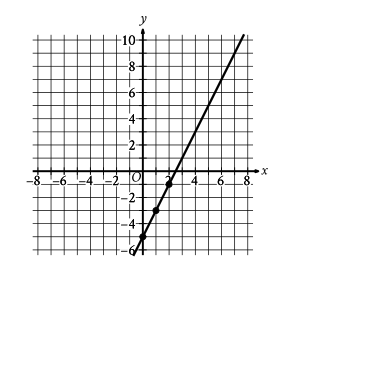
    The line slants sharply up from left to right. The line passes through the following points: (0, -5) (1, -3) (2, -1) The graph shows the linear relationship between \(x\) and \(y\). Which table gives three values of \(x\) and their corresponding values of \(y\) for this relationship?

    Correct answer: D

    Choice D is correct. It’s given that the graph shows the linear relationship between \(x\) and \(y\). The given graph passes through the points \((0, -5)\), \((1, -3)\), and \((2, -1)\). It follows that when \(x = 0\), the corresponding value of \(y\) is \(-5\), when \(x = 1\), the corresponding value of \(y\) is \(-3\), and when \(x = 2\), the corresponding value of \(y\) is \(-1\). Of the given choices, only the table in choice D gives these three values of \(x\) and their corresponding values of \(y\) for the relationship shown in the graph. Choice A is incorrect. This table represents a relationship between \(x\) and \(y\) such that the graph passes through the points \((0, 0)\), \((1, -7)\), and \((2, -9)\). Choice B is incorrect. This table represents a relationship between \(x\) and \(y\) such that the graph passes through the points \((0, 0)\), \((1, -3)\), and \((2, -1)\). Choice C is incorrect. This table represents a linear relationship between \(x\) and \(y\) such that the graph passes through the points \((0, -5)\), \((1, -7)\), and \((2, -9)\).
  44. Question 44

    Vivian bought party hats and cupcakes for \(\\) 71\(. Each package of party hats cost \)$ 3\(, and each cupcake cost \)$ 1\(. If Vivian bought \)10$ packages of party hats, how many cupcakes did she buy?

    Correct answer: A

    The correct answer is \(41\). The number of cupcakes Vivian bought can be found by first finding the amount Vivian spent on cupcakes. The amount Vivian spent on cupcakes can be found by subtracting the amount Vivian spent on party hats from the total amount Vivian spent. The amount Vivian spent on party hats can be found by multiplying the cost per package of party hats by the number of packages of party hats, which yields \(\\) 3 dot 10\(, or \)$ 30\(. Subtracting the amount Vivian spent on party hats, \)$ 30\(, from the total amount Vivian spent, \)$ 71\(, yields \)$ 71 -$ 30\(, or \)$ 41\(. Since the amount Vivian spent on cupcakes was \)$ 41\( and each cupcake cost \)$ 1\(, it follows that Vivian bought \)41$ cupcakes.
  45. Question 45

    A line in the xy-plane has a slope of \(1 ninth\) and passes through the point \((0, 14)\). Which equation represents this line?

    Correct answer: D

    Choice D is correct. The equation of a line in the xy-plane can be written as \(y = m x + b\), where \(m\) represents the slope of the line and \((0, b)\) represents the y-intercept of the line. It's given that the slope of the line is \(1 ninth\). It follows that \(m = 1 ninth\). It's also given that the line passes through the point \((0, 14)\). It follows that \(b = 14\). Substituting \(1 ninth\) for \(m\) and \(14\) for \(b\) in \(y = m x + b\) yields \(y = 1 ninth x + 14\). Thus, the equation \(y = 1 ninth x + 14\) represents this line. Choice A is incorrect. This equation represents a line with a slope of \(-1 ninth\) and a y-intercept of \((0, -14)\). Choice B is incorrect. This equation represents a line with a slope of \(-1 ninth\) and a y-intercept of \((0, 14)\). Choice C is incorrect. This equation represents a line with a slope of \(1 ninth\) and a y-intercept of \((0, -14)\).
  46. Question 46

    The table above shows the coordinates of three points on a line in the xy-plane, where k and n are constants. If the slope of the line is 2, what is the value of ?

    Correct answer: D

    The correct answer is 30. The slope of a line can be found by using the slope formula, . It’s given that the slope of the line is 2; therefore, . According to the table, the points and lie on the line. Substituting the coordinates of these points into the equation gives . Multiplying both sides of this equation by gives, or . Solving for k gives . According to the table, the points and also lie on the line. Substituting the coordinates of these points into gives . Solving for n gives . Therefore,, or 30.
  47. Question 47

    In the xy-plane, line \(k\) passes through the points \((0, -5)\) and \((1, -1)\). Which equation defines line \(k\)?

    Correct answer: D

    Choice D is correct. An equation defining a line in the xy-plane can be written in the form \(y = m x + b\), where \(m\) represents the slope and \((0, b)\) represents the y-intercept of the line. It’s given that line \(k\) passes through the point \((0, -5)\); therefore, \(b = -5\). The slope, \(m\), of a line can be found using any two points on the line, \((x_1, y_1)\) and \((x_2, y_2)\), and the slope formula \(m = y_2 -y_1/x_2 -x_1\). Substituting the points \((0, -5)\) and \((1, -1)\) for \((x_1, y_1)\) and \((x_2, y_2)\), respectively, in the slope formula yields \(m = (-1 -(-5))/(1 -0)\), or \(m = 4\). Substituting \(4\) for \(m\) and \(-5\) for \(b\) in the equation \(y = m x + b\) yields \(y = 4 x -5\). Choice A is incorrect and may result from conceptual or calculation errors. Choice B is incorrect and may result from conceptual or calculation errors. Choice C is incorrect and may result from conceptual or calculation errors.
  48. Question 48

    When line \(n\) is graphed in the xy-plane, it has an x-intercept of \((-4, 0)\) and a y-intercept of \((0, 86/3)\). What is the slope of line \(n\)?

    Correct answer: C

    Choice C is correct. It's given that when line \(n\) is graphed in the xy-plane, it has an x-intercept of \((-4, 0)\) and a y-intercept of \((0, 86/3)\). The slope, \(m\), of a line can be found using any two points on the line, \((x_1, y_1)\) and \((x_2, y_2)\), and the slope formula \(m = y_2 -y_1/x_2 -x_1\). Substituting the points \((-4, 0)\) and \((0, 86/3)\) for \((x_1, y_1)\) and \((x_2, y_2)\), respectively, in the slope formula yields \(m = \86/3 -0/0 -(-4)\), or \(m = 43/6\). Therefore, the slope of line \(n\) is \(43/6\). Choice A is incorrect and may result from conceptual or calculation errors. Choice B is incorrect. This is the slope of a line that has an x-intercept of \((86/3, 0)\) and a y-intercept of \((0, -4)\). Choice D is incorrect and may result from conceptual or calculation errors.
  49. Question 49

    The equation \(46 = 2 x + 2 y\) gives the perimeter of a rectangular rug that has length \(x\), in feet, and width \(y\), in feet. The width of the rug is \(8\) feet. What is the length, in feet, of the rug?

    Correct answer: B

    The correct answer is \(15\). It's given that the equation \(46 = 2 x + 2 y\) gives the perimeter of a rectangular rug that has length \(x\), in feet, and width \(y\), in feet. It's also given that the width of the rug is \(8\) feet. Substituting \(8\) for \(y\) in the equation \(46 = 2 x + 2 y\) yields \(46 = 2 x + 2(8)\), or \(46 = 2 x + 16\). Subtracting \(16\) from both sides of this equation yields \(30 = 2 x\). Dividing both sides of this equation by \(2\) yields \(15 = x\). Since \(x\) represents the length, in feet, of the rug, it follows that the length of the rug is \(15\) feet.
  50. Question 50

    A city is planning to build a rock retaining wall, a monument, and a garden in a park. The table above shows four rock types that will be considered for use in the project. Also shown for each rock type is its weight per volume, in pounds per cubic foot (lb/ft3), and the cost per pound, in dollars. The equation gives the total cost, in dollars, of the rocks used in the project in terms of the number of ft3 of limestone, w, and the number of ft3 of basalt, z. All four rock types are used in the project. Which of the following is the best interpretation of 3,385.80 in this context?

    Correct answer: A

    Choice A is correct. The table shows the cost of limestone is $0.03/lb, and the weight per volume for limestone is 120 lb/ft3. Therefore, the term represents the cost, in dollars, of w ft3 of limestone. Similarly, the term represents the cost, in dollars, of z ft3 of basalt. The given equation shows that the total cost of all the rocks used in the project is $7,576.20. Since it’s given that all four rock types are used in the project, the remaining term, 3,385.80, represents the cost, in dollars, of the granite and sandstone needed for the project.Choice B is incorrect. The cost of basalt and limestone needed for the project can be represented by . Choice C is incorrect. The cost of the basalt needed for the project can be represented by the expression . Choice D is incorrect and may result from neglecting to include granite in the rock types used for the project.
  51. Question 51

    The graph of \(9 x -10 y = 19\) is translated down \(4\) units in the xy-plane. What is the x-coordinate of the x-intercept of the resulting graph?

    Correct answer: A

    The correct answer is \(59/9\). When the graph of an equation in the form \(A x + B y = C\), where \(A\), \(B\), and \(C\) are constants, is translated down \(k\) units in the xy-plane, the resulting graph can be represented by the equation \(A x + B(y + k)= C\). It’s given that the graph of \(9 x -10 y = 19\) is translated down \(4\) units in the xy-plane. Therefore, the resulting graph can be represented by the equation \(9 x -10(y + 4)= 19\), or \(9 x -10 y -40 = 19\). Adding \(40\) to both sides of this equation yields \(9 x -10 y = 59\). The x-coordinate of the x-intercept of the graph of an equation in the xy-plane is the value of \(x\) in the equation when \(y = 0\). Substituting \(0\) for \(y\) in the equation \(9 x -10 y = 59\) yields \(9 x -10(0)= 59\), or \(9 x = 59\). Dividing both sides of this equation by \(9\) yields \(x = 59/9\). Therefore, the x-coordinate of the x-intercept of the resulting graph is \(59/9\). Note that 59/9, 6.555, and 6.556 are examples of ways to enter a correct answer.
  52. Question 52

    A total of \(2\) squares each have side length \(r\). A total of \(6\) equilateral triangles each have side length \(t\). None of these squares and triangles shares a side. The sum of the perimeters of all these squares and triangles is \(210\). Which equation represents this situation?

    Correct answer: C

    Choice C is correct. It’s given that a total of \(2\) squares each have side length \(r\). Therefore, each of the squares has perimeter \(4 r\). Since there are a total of \(2\) squares, the sum of the perimeters of these squares is \(4 r + 4 r\), which is equivalent to \(2(4 r)\), or \(8 r\). It’s also given that a total of \(6\) equilateral triangles each have side length \(t\). Therefore, each of the equilateral triangles has perimeter \(3 t\). Since there are a total of \(6\) equilateral triangles, the sum of the perimeters of these triangles is \(3 t + 3 t + 3 t + 3 t + 3 t + 3 t\), which is equivalent to \(6(3 t)\), or \(18 t\). Since the sum of the perimeters of the squares is \(8 r\) and the sum of the perimeters of the triangles is \(18 t\), the sum of the perimeters of all these squares and triangles is \(8 r + 18 t\). It’s given that the sum of the perimeters of all these squares and triangles is \(210\). Therefore, the equation \(8 r + 18 t = 210\) represents this situation. Choice A is incorrect and may result from conceptual or calculation errors. Choice B is incorrect and may result from conceptual or calculation errors. Choice D is incorrect and may result from conceptual or calculation errors.
  53. Question 53

    In an article about exercise, it is estimated that a 160-pound adult uses 200 calories for every 30 minutes of hiking and 150 calories for every 30 minutes of bicycling. An adult who weighs 160 pounds has completed 1 hour of bicycling. Based on the article, how many hours should the adult hike to use a total of 1,900 calories from bicycling and hiking?

    Correct answer: D

    Choice D is correct. Since a 160-pound adult uses 200 calories for every 30 minutes of hiking, then the same adult uses calories after hiking for h 30-minute periods. Similarly, the same adult uses calories after bicycling for b 30-minute periods. Therefore, the equation represents the situation where a 160-pound adult uses a total of 1,900 calories from hiking for h 30-minute periods and bicycling for b 30-minute periods. It’s given that the adult completes 1 hour, or 2 30-minute periods, of bicycling. Substituting 2 for b in the equation yields, or . Subtracting 300 from both sides of this equation yields . Dividing both sides by 200 yields . Since h represents the number of 30-minute periods spent hiking and there are 2 30-minute periods in every hour, it follows that the adult will need to hike for, or 4 hours to use a total of 1,900 calories from bicycling and hiking.Choice A is incorrect and may result from solving the equation . This represents 0 30-minute periods bicycling instead of 2. Choice B is incorrect and may result from solving the equation . This represents 1 30-minute period of bicycling instead of 2. Choice C is incorrect. This may result from determining that the number of 30-minute periods the adult should hike is 8, but then subtracting 2 from 8, rather than dividing 8 by 2, to find the number of hours the adult should hike.
  54. Question 54

    Tony spends $80 per month on public transportation. A 10-ride pass costs $12.50, and a single-ride pass costs $1.50. If g represents the number of 10-ride passes Tony buys in a month and t represents the number of single-ride passes Tony buys in a month, which of the following equations best represents the relationship between g and t ?

    Correct answer: D

    Choice D is correct. Since a 10-ride pass costs $12.50 and g is the number of 10-ride passes Tony buys in a month, the expression represents the amount Tony spends on 10-ride passes in a month. Since a single-ride pass costs $1.50 and t is the number of single-ride passes Tony buys in a month, the expression represents the amount Tony spends on single-ride passes in a month. Therefore, the sum represents the amount he spends on the two types of passes in a month. Since Tony spends a total of $80 on passes in a month, this expression can be set equal to 80, producing .Choices A and B are incorrect. The expression represents the total number of the two types of passes Tony buys in a month, not the amount Tony spends, which is equal to 80, nor the cost of one of each pass, which is equal to . Choice C is incorrect and may result from reversing the cost for each type of pass Tony buys in a month.
  55. Question 55

    Line \(k\) is defined by \(y = 7 x + 1 eighth\). Line \(j\) is perpendicular to line \(k\) in the xy-plane. What is the slope of line \(j\)?

    Correct answer: B

    Choice B is correct. It's given that line \(k\) is defined by \(y = 7 x + 1 eighth\). For an equation in slope-intercept form \(y = m x + b\), \(m\) represents the slope of the line defined by this equation in the xy-plane and \(b\) represents the y-coordinate of the y-intercept of this line. Therefore, the slope of line \(k\) is \(7\). It’s also given that line \(j\) is perpendicular to line \(k\) in the xy-plane. Therefore, the slope of line \(j\) is the opposite reciprocal of the slope of line \(k\). The opposite reciprocal of \(7\) is \(-1 seventh\). Therefore, the slope of line \(j\) is \(-1 seventh\). Choice A is incorrect. This is the opposite reciprocal of the y-coordinate of the y-intercept, not the slope, of line \(k\). Choice C is incorrect. This is the y-coordinate of the y-intercept of line \(k\), not the slope of line \(j\). Choice D is incorrect. This is the slope of a line that is parallel, not perpendicular, to line \(k\).
  56. Question 56

    Line in the xy-plane is perpendicular to the line with equation . What is the slope of line ?

    Correct answer: A

    Choice A is correct. It is given that line is perpendicular to a line whose equation is x = 2. A line whose equation is a constant value of x is vertical, so must therefore be horizontal. Horizontal lines have a slope of 0, so has a slope of 0.Choice B is incorrect. A line with slope is perpendicular to a line with slope 2. However, the line with equation x = 2 is vertical and has undefined slope (not slope of 2). Choice C is incorrect. A line with slope –2 is perpendicular to a line with slope . However, the line with equation x = 2 has undefined slope (not slope of ). Choice D is incorrect; this is the slope of the line x = 2 itself, not the slope of a line perpendicular to it.
  57. Question 57

    \(x\) \(y\) \(0\) \(18\) \(1\) \(13\) \(2\) \(8\) The table shows three values of \(x\) and their corresponding values of \(y\). There is a linear relationship between \(x\) and \(y\). Which of the following equations represents this relationship?

    Correct answer: D

    Choice D is correct. A linear relationship can be represented by an equation of the form \(y = m x + b\), where \(m\) and \(b\) are constants. It’s given in the table that when \(x = 0\), \(y = 18\). Substituting \(0\) for \(x\) and \(18\) for \(y\) in \(y = m x + b\) yields \(18 = m(0)+ b\), or \(18 = b\). Substituting \(18\) for \(b\) in the equation \(y = m x + b\) yields \(y = m x + 18\). It’s also given in the table that when \(x = 1\), \(y = 13\). Substituting \(1\) for \(x\) and \(13\) for \(y\) in the equation \(y = m x + 18\) yields \(13 = m(1)+ 18\), or \(13 = m + 18\). Subtracting \(18\) from both sides of this equation yields \(-5 = m\). Therefore, the equation \(y = -5 x + 18\) represents the relationship between \(x\) and \(y\). Choice A is incorrect and may result from conceptual or calculation errors. Choice B is incorrect and may result from conceptual or calculation errors. Choice C is incorrect and may result from conceptual or calculation errors.
  58. Question 58

    The equation \(40 x + 20 y = 160\) represents the number of sweaters, \(x\), and number of shirts, \(y\), that Yesenia purchased for \(\\) 160\(. If Yesenia purchased \)2$ sweaters, how many shirts did she purchase?

    Correct answer: B

    Choice B is correct. It's given that the equation \(40 x + 20 y = 160\) represents the number of sweaters, \(x\), and the number of shirts, \(y\), that Yesenia purchased for \(\\) 160\(. If Yesenia purchased \)2\( sweaters, the number of shirts she purchased can be calculated by substituting \)2\( for \)x\( in the given equation, which yields \)40(2)+ 20 y = 160\(, or \)80 + 20 y = 160\(. Subtracting \)80\( from both sides of this equation yields \)20 y = 80\(. Dividing both sides of this equation by \)20\( yields \)y = 4\(. Therefore, if Yesenia purchased \)2\( sweaters, she purchased \)4\( shirts. Choice A is incorrect and may result from conceptual or calculation errors. Choice C is incorrect. This is the number of shirts Yesenia purchased if she purchased \)0$ sweaters. Choice D is incorrect. This is the price, in dollars, for each sweater, not the number of shirts Yesenia purchased.
  59. Question 59

    Which of the following could define the relationship between s and P ?

    Correct answer: C

    Choice C is correct. The relationship between s and P can be modeled by a linear equation of the form P = ks + a, where k and a are constants. The table shows that P increases by 10 when s increases by 3, so k = . To solve for a, substitute one of the given pairs of values for s and P: when s = 3, P = 8, so, which yields a = –2. The solution is therefore .Choice A is incorrect. When s = 3, P = 8, but 3(3) + 10 = 19 ≠︀ 8. Choice B is incorrect. This may result from using the first number given for P in the table as the constant term a in the linear equation P = ks + a, which is true only when s = 0. Choice D is incorrect and may result from using the reciprocal of the slope of the line.
  60. Question 60

    In the xy-plane, a line has a slope of 6 and passes through the point . Which of the following is an equation of this line?

    Correct answer: A

    Choice A is correct. The slope-intercept form of an equation for a line is, where m is the slope of the line and b is the y-coordinate of the y-intercept of the line. It’s given that the slope is 6, so . It’s also given that the line passes through the point on the y-axis, so . Substituting and into the equation gives .Choices B, C, and D are incorrect and may result from misinterpreting the slope-intercept form of an equation of a line.
  61. Question 61

    A gardener buys two kinds of fertilizer. Fertilizer A contains 60% filler materials by weight and Fertilizer B contains 40% filler materials by weight. Together, the fertilizers bought by the gardener contain a total of 240 pounds of filler materials. Which equation models this relationship, where x is the number of pounds of Fertilizer A and y is the number of pounds of Fertilizer B?

    Correct answer: B

    Choice B is correct. Since Fertilizer A contains 60% filler materials by weight, it follows that x pounds of Fertilizer A consists of 0.6x pounds of filler materials. Similarly, y pounds of Fertilizer B consists of 0.4y pounds of filler materials. When x pounds of Fertilizer A and y pounds of Fertilizer B are combined, the result is 240 pounds of filler materials. Therefore, the total amount, in pounds, of filler materials in a mixture of x pounds of Fertilizer A and y pounds of Fertilizer B can be expressed as .Choice A is incorrect. This choice transposes the percentages of filler materials for Fertilizer A and Fertilizer B. Fertilizer A consists of 0.6x pounds of filler materials and Fertilizer B consists of 0.4y pounds of filler materials. Therefore, is equal to 240, not . Choice C is incorrect. This choice transposes the percentages of filler materials for Fertilizer A and Fertilizer B and incorrectly represents how to take the percentage of a value mathematically. Choice D is incorrect. This choice incorrectly represents how to take the percentage of a value mathematically. Fertilizer A consists of 0.6x pounds of filler materials, not 60x pounds of filler materials, and Fertilizer B consists of 0.4y pounds of filler materials, not 40y pounds of filler materials.
  62. Question 62

    A producer is creating a video with a length of \(70\) minutes. The video will consist of segments that are \(1\) minute long and segments that are \(3\) minutes long. Which equation represents this situation, where \(x\) represents the number of \(1\)-minute segments and \(y\) represents the number of \(3\)-minute segments?

    Correct answer: D

    Choice D is correct. Since \(x\) represents the number of \(1\)-minute segments and \(y\) represents the number of \(3\)-minute segments, the total length of the video is \(1 dot x + 3 dot y\), or \(x + 3 y\), minutes. Since the video is \(70\) minutes long, the equation \(x + 3 y = 70\) represents this situation. Choice A is incorrect and may result from conceptual errors. Choice B is incorrect and may result from conceptual errors. Choice C is incorrect and may result from conceptual errors.
  63. Question 63

    Mario purchased 4 binders that cost x dollars each and 3 notebooks that cost y dollars each. If the given equation represents this situation, which of the following is the best interpretation of 24 in this context?

    Correct answer: C

    Choice C is correct. Since Mario purchased 4 binders that cost x dollars each, the expression represents the total cost, in dollars, of the 4 binders he purchased. Since Mario purchased 3 notebooks that cost y dollars each, the expression represents the total cost, in dollars, of the 3 notebooks he purchased. Therefore, the expression represents the total cost, in dollars, for all binders and notebooks he purchased. In the given equation, the expression is equal to 24. Therefore, it follows that 24 is the total cost, in dollars, for all binders and notebooks purchased.Choice A is incorrect. This is represented by the expression in the given equation. Choice B is incorrect. This is represented by the expression in the given equation. Choice D is incorrect. This is represented by the expression .
  64. Question 64

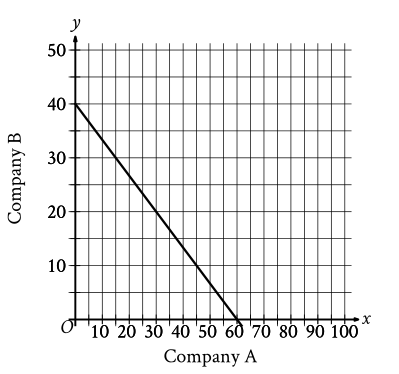
    The line slants down from left to right. The line passes through the following points: (0, 40) (60, 0) The graph shows the relationship between the number of shares of stock from Company A, \(x\), and the number of shares of stock from Company B, \(y\), that Simone can purchase. Which equation could represent this relationship?

    Correct answer: B

    Choice B is correct. The graph shown is a line passing through the points \((0, 40)\) and \((60, 0)\). Since the relationship between \(x\) and \(y\) is linear, if two points on the graph make a linear equation true, then the equation represents the relationship. Substituting \(0\) for \(x\) and \(40\) for \(y\) in the equation in choice B, \(8 x + 12 y = 480\), yields \(8(0)+ 12(40)= 480\), or \(480 = 480\), which is true. Substituting \(60\) for \(x\) and \(0\) for \(y\) in the equation \(8 x + 12 y = 480\) yields \(8(60)+ 12(0)= 480\), or \(480 = 480\), which is true. Therefore, the equation \(8 x + 12 y = 480\) represents the relationship between \(x\) and \(y\). Choice A is incorrect. The point \((0, 40)\) is not on the graph of this equation, since \(40 = 8(0)+ 12\), or \(40 = 12\), is not true. Choice C is incorrect. The point \((0, 40)\) is not on the graph of this equation, since \(40 = 12(0)+ 8\), or \(40 = 8\), is not true. Choice D is incorrect. The point \((0, 40)\) is not on the graph of this equation, since \(12(0)+ 8(40)= 480\), or \(320 = 480\), is not true.
  65. Question 65

    The graph of \(7 x + 2 y = -31\) in the \(x y\)-plane has an \(x\)-intercept at \((a, 0)\) and a \(y\)-intercept at \((0, b)\), where \(a\) and \(b\) are constants. What is the value of \(b/a\)?

    Correct answer: D

    Choice D is correct. The x-coordinate \(a\) of the x-intercept \((a, 0)\) can be found by substituting \(0\) for \(y\) in the given equation, which gives \(7 x + 2(0)= -31\), or \(7 x = -31\). Dividing both sides of this equation by \(7\) yields \(x = -31/7\). Therefore, the value of \(a\) is \(-31/7\). The y-coordinate \(b\) of the y-intercept \((0, b)\) can be found by substituting \(0\) for \(x\) in the given equation, which gives \(7(0)+ 2 y = -31\), or \(2 y = -31\). Dividing both sides of this equation by \(2\) yields \(y = -31/2\). Therefore, the value of \(b\) is \(-31/2\). It follows that the value of \(b/a\) is \(\ -31/2/ -31/7\), which is equivalent to \((31/2)(7 30 firsts)\), or \(7 halves\). Choice A is incorrect and may result from conceptual or calculation errors. Choice B is incorrect and may result from conceptual or calculation errors. Choice C is incorrect and may result from conceptual or calculation errors.
  66. Question 66

    \(x\) \(y\) \(-2 s\) \(24\) \(-s\) \(21\) \(s\) \(15\) The table shows three values of \(x\) and their corresponding values of \(y\), where \(s\) is a constant. There is a linear relationship between \(x\) and \(y\). Which of the following equations represents this relationship?

    Correct answer: B

    Choice B is correct. The linear relationship between \(x\) and \(y\) can be represented by an equation of the form \(y -y_1 = m(x -x_1)\), where \(m\) is the slope of the graph of the equation in the xy-plane and \((x_1, y_1)\) is a point on the graph. The slope of a line can be found using two points on the line and the slope formula \(m = y_2 -y_1/x_2 -x_1\). Each value of \(x\) and its corresponding value of \(y\) in the table can be represented by a point \((x, y)\). Substituting the points \((-s, 21)\) and \((s, 15)\) for \((x_1, y_1)\) and \((x_2, y_2)\), respectively, in the slope formula yields \(m = 15 -21/s -(-s)\), which gives \(m = \ -6/2 s\), or \(m = -3/s\). Substituting \(-3/s\) for \(m\) and the point \((s, 15)\) for \((x_1, y_1)\) in the equation \(y -y_1 = m(x -x_1)\) yields \(y -15 = -3/s(x -s)\). Distributing \(-3/s\) on the right-hand side of this equation yields \(y -15 = -3 x/s + 3\). Adding \(15\) to each side of this equation yields \(y = -3 x/s + 18\). Multiplying each side of this equation by \(s\) yields \(s y = -3 x + 18 s\). Adding \(3 x\) to each side of this equation yields \(3 x + s y = 18 s\). Therefore, the equation \(3 x + s y = 18 s\) represents this relationship. Choice A is incorrect and may result from conceptual or calculation errors. Choice C is incorrect and may result from conceptual or calculation errors. Choice D is incorrect and may result from conceptual or calculation errors.
  67. Question 67

    A food truck buys forks for \(\\) 0.04\( each and plates for \)$ 0.48\( each. The total cost of \)x\( forks and \)y\( plates is \)$ 661.76$. Which equation represents this situation?

    Correct answer: D

    Choice D is correct. It’s given that the food truck buys forks for \(\\) 0.04\( each. Therefore, the cost, in dollars, of \)x\( forks can be represented by the expression \)0.04 x\(. It’s also given that the food truck buys plates for \)$ 0.48\( each. Therefore, the cost, in dollars, of \)y\( plates can be represented by the expression \)0.48 y\(. Since the total cost of \)x\( forks and \)y\( plates is \)$ 661.76\(, the equation \)0.04 x + 0.48 y = 661.76\( represents this situation. Choice A is incorrect and may result from conceptual or calculation errors. Choice B is incorrect and may result from conceptual or calculation errors. Choice C is incorrect. This equation represents a situation in which the food truck buys forks for \)$ 0.48\( each and plates for \)$ 0.04$ each.
  68. Question 68

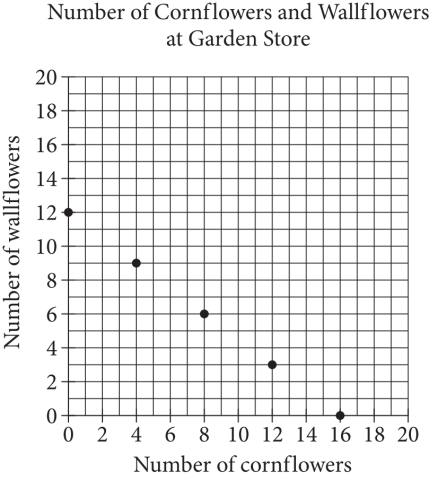
    The points plotted in the coordinate plane above represent the possible numbers of wallflowers and cornflowers that someone can buy at the Garden Store in order to spend exactly $24.00 total on the two types of flowers. The price of each wallflower is the same and the price of each cornflower is the same. What is the price, in dollars, of 1 cornflower?

    Correct answer: D

    The correct answer is 1.5. The point corresponds to the situation where 16 cornflowers and 0 wallflowers are purchased. Since the total spent on the two types of flowers is $24.00, it follows that the price of 16 cornflowers is $24.00, and the price of one cornflower is $1.50. Note that 1.5 and 3/2 are examples of ways to enter a correct answer.
  69. Question 69

    \(y = -4 x + 40\) Which table gives three values of \(x\) and their corresponding values of \(y\) for the given equation?

    Correct answer: C

    Choice C is correct. Each of the given choices gives three values of \(x\): \(0\), \(1\), and \(2\). Substituting \(0\) for \(x\) in the given equation yields \(y = -4(0)+ 40\), or \(y = 40\). Therefore, when \(x = 0\), the corresponding value of \(y\) for the given equation is \(40\). Substituting \(1\) for \(x\) in the given equation yields \(y = -4(1)+ 40\), or \(y = 36\). Therefore, when \(x = 1\), the corresponding value of \(y\) for the given equation is \(36\). Substituting \(2\) for \(x\) in the given equation yields \(y = -4(2)+ 40\), or \(y = 32\). Therefore, when \(x = 2\), the corresponding value of \(y\) for the given equation is \(32\). Choice C gives three values of \(x\), \(0\), \(1\), and \(2\), and their corresponding values of \(y\), \(40\), \(36\), and \(32\), respectively, for the given equation. Choice A is incorrect. This table gives three values of \(x\) and their corresponding values of \(y\) for the equation \(y = -4 x\). Choice B is incorrect. This table gives three values of \(x\) and their corresponding values of \(y\) for the equation \(y = 4 x + 40\). Choice D is incorrect. This table gives three values of \(x\) and their corresponding values of \(y\) for the equation \(y = 4 x\).
  70. Question 70

    In the equation above, a and b are constants and . Which of the following could represent the graph of the equation in the xy-plane?

    Correct answer: C

    Choice C is correct. The given equation can be rewritten in slope-intercept form,, where m represents the slope of the line represented by the equation, and k represents the y-coordinate of the y-intercept of the line. Subtracting ax from both sides of the equation yields, and dividing both sides of this equation by b yields, or . With the equation now in slope-intercept form, it shows that, which means the y-coordinate of the y-intercept is 1. It’s given that a and b are both greater than 0 (positive) and that . Since, the slope of the line must be a value between and 0. Choice C is the only graph of a line that has a y-value of the y-intercept that is 1 and a slope that is between and 0.Choices A, B, and D are incorrect because the slopes of the lines in these graphs aren’t between and 0.
  71. Question 71

    A city’s total expense budget for one year was x million dollars. The city budgeted y million dollars for departmental expenses and 201 million dollars for all other expenses. Which of the following represents the relationship between x and y in this context?

    Correct answer: B

    Choice B is correct. Of the city’s total expense budget for one year, the city budgeted y million dollars for departmental expenses and 201 million dollars for all other expenses. This means that the expression represents the total expense budget, in millions of dollars, for one year. It’s given that the total expense budget for one year is x million dollars. It follows then that the expression is equivalent to x, or . Subtracting y from both sides of this equation yields . By the symmetric property of equality, this is the same as .Choices A and C are incorrect. Because it’s given that the total expense budget for one year, x million dollars, is comprised of the departmental expenses, y million dollars, and all other expenses, 201 million dollars, the expressions and both must be equivalent to a value greater than 201 million dollars. Therefore, the equations and aren’t true. Choice D is incorrect. The value of x must be greater than the value of y. Therefore, can’t represent this relationship.
  72. Question 72

    The line slants gradually down from left to right. The line passes through the following points: (-8, 0) (0, -8) What is an equation of the graph shown?

    Correct answer: C

    Choice C is correct. An equation of a line can be written in the form \(y = m x + b\), where \(m\) is the slope of the line and \((0, b)\) is the y-intercept of the line. The line shown passes through the point \((0, -8)\), so \(b = -8\). The line shown also passes through the point \((-8, 0)\). The slope, \(m\), of a line passing through two points \((x_1, y_1)\) and \((x_2, y_2)\) can be calculated using the equation \(m = y_2 -y_1/x_2 -x_1\). For the points \((0, -8)\) and \((-8, 0)\), this gives \(m = (-8)-0/0 -(-8)\), or \(m = -1\). Substituting \(-8\) for \(b\) and \(-1\) for \(m\) in \(y = m x + b\) yields \(y =(-1)x +(-8)\), or \(y = -x -8\). Therefore, an equation of the graph shown is \(y = -x -8\). Choice A is incorrect. This is an equation of a line with a slope of \(-2\), not \(-1\). Choice B is incorrect. This is an equation of a line with a slope of \(1\), not \(-1\). Choice D is incorrect. This is an equation of a line with a slope of \(2\), not \(-1\).
  73. Question 73

    The line slants sharply down from left to right. The line passes through the following points: (0, 18) (4, 10) (7, 4) (9, 0) The graph shows the possible combinations of the number of pounds of tangerines and lemons that could be purchased for \(\\) 18\( at a certain store. If Melvin purchased lemons and \)4\( pounds of tangerines for a total of \)$ 18$, how many pounds of lemons did he purchase?

    Correct answer: B

    Choice B is correct. It's given that the graph shows the possible combinations of the number of pounds of tangerines, \(x\), and the number of pounds of lemons, \(y\), that could be purchased for \(\\) 18\( at a certain store. If Melvin purchased lemons and \)4\( pounds of tangerines for a total of \)$ 18\(, the number of pounds of lemons he purchased is represented by the y-coordinate of the point on the graph where \)x = 4\(. For the graph shown, when \)x = 4\(, \)y = 10\(. Therefore, if Melvin purchased lemons and \)4\( pounds of tangerines for a total of \)$ 18\(, then he purchased \)10\( pounds of lemons. Choice A is incorrect. This is the number of pounds of tangerines Melvin purchased if he purchased tangerines and \)4\( pounds of lemons for a total of \)$ 18\(. Choice C is incorrect. This is the number of pounds of lemons Melvin purchased if he purchased lemons and \)2\( pounds of tangerines for a total of \)$ 18\(. Choice D is incorrect. This is the number of pounds of lemons Melvin purchased if he purchased lemons and \)1\( pound of tangerines for a total of \)$ 18$.
  74. Question 74

    Keenan made \(32\) cups of vegetable broth. Keenan then filled \(x\) small jars and \(y\) large jars with all the vegetable broth he made. The equation \(3 x + 5 y = 32\) represents this situation. Which is the best interpretation of \(5 y\) in this context?

    Correct answer: C

    Choice C is correct. It’s given that the equation \(3 x + 5 y = 32\) represents the situation where Keenan filled \(x\) small jars and \(y\) large jars with all the vegetable broth he made, which was \(32\) cups. Therefore, \(3 x\) represents the total number of cups of vegetable broth in the small jars and \(5 y\) represents the total number of cups of vegetable broth in the large jars. Choice A is incorrect. The number of large jars Keenan filled is represented by \(y\), not \(5 y\). Choice B is incorrect. The number of small jars Keenan filled is represented by \(x\), not \(5 y\). Choice D is incorrect. The total number of cups of vegetable broth in the small jars is represented by \(3 x\), not \(5 y\).
  75. Question 75

    The line slants gradually down from left to right. The line passes through the following points: (-8, 4) (0, 2) (8, 0) The graph of \(y = f(x)+ 14\) is shown. Which equation defines function \(f\)?

    Correct answer: A

    Choice A is correct. An equation for the graph shown can be written in slope-intercept form \(y = m x + b\), where \(m\) is the slope of the graph and its y-intercept is \((0, b)\). Since the y-intercept of the graph shown is \((0, 2)\), the value of \(b\) is \(2\). Since the graph also passes through the point \((4, 1)\), the slope can be calculated as \(1 -2/4 -0\), or \(-1 fourth\). Therefore, the value of \(m\) is \(-1 fourth\). Substituting \(-1 fourth\) for \(m\) and \(2\) for \(b\) in the equation \(y = m x + b\) yields \(y = -1 fourth x + 2\). It’s given that an equation for the graph shown is \(y = f(x)+ 14\). Substituting \(f(x)+ 14\) for \(y\) in the equation \(y = -1 fourth x + 2\) yields \(f(x)+ 14 = -1 fourth x + 2\). Subtracting \(14\) from both sides of this equation yields \(f(x)= -1 fourth x -12\). Choice B is incorrect and may result from conceptual or calculation errors. Choice C is incorrect and may result from conceptual or calculation errors. Choice D is incorrect and may result from conceptual or calculation errors.
  76. Question 76

    What is the slope of the graph of \(y = 1 third(29 x + 10)+ 5 x\) in the xy-plane?

    Correct answer: B

    The correct answer is \(44/3\). A linear equation can be written in the form \(y = m x + b\), where \(m\) is the slope of the graph of the equation in the xy-plane and \((0, b)\) is the y-intercept. Distributing the \(1 third\) in the equation \(y = 1 third(29 x + 10)+ 5 x\) yields \(y = 29/3 x + 10/3 + 5 x\). Combining like terms on the right-hand side of this equation yields \(y = 44/3 x + 10/3\). This equation is in the form \(y = m x + b\), where \(m = 44/3\) and \(b = 10/3\). Therefore, the slope of the graph of the given equation in the xy-plane is \(44/3\). Note that 44/3, 14.66, and 14.67 are examples of ways to enter a correct answer.
  77. Question 77

    In the xy-plane, line \(ell\) passes through the point \((0, 0)\) and is parallel to the line represented by the equation \(y = 8 x + 2\). If line \(ell\) also passes through the point \((3, d)\), what is the value of \(d\)?

    Correct answer: C

    The correct answer is \(24\). A line in the xy-plane can be defined by the equation \(y = m x + b\), where \(m\) is the slope of the line and \(b\) is the y-coordinate of the y-intercept of the line. It's given that line \(ell\) passes through the point \((0, 0)\). Therefore, the y-coordinate of the y-intercept of line \(ell\) is \(0\). It's given that line \(ell\) is parallel to the line represented by the equation \(y = 8 x + 2\). Since parallel lines have the same slope, it follows that the slope of line \(ell\) is \(8\). Therefore, line \(ell\) can be defined by an equation in the form \(y = m x + b\), where \(m = 8\) and \(b = 0\). Substituting \(8\) for \(m\) and \(0\) for \(b\) in \(y = m x + b\) yields the equation \(y = 8 x + 0\), or \(y = 8 x\) . If line \(ell\) passes through the point \((3, d)\), then when \(x = 3\), \(y = d\) for the equation \(y = 8 x\). Substituting \(3\) for \(x\) and \(d\) for \(y\) in the equation \(y = 8 x\) yields \(d = 8(3)\), or \(d = 24\).
  78. Question 78

    The line slants sharply up from left to right. The line passes through the following points: (0, 5) (1, 9) Line \(j\) is shown in the xy-plane. Line \(k\) (not shown) is parallel to line \(j\). What is the slope of line \(k\)?

    Correct answer: B

    The correct answer is \(4\). It's given that line \(k\) is parallel to line \(j\). It follows that the slope of line \(k\) is equal to the slope of line \(j\). Given two points on a line in the xy-plane, \((x_1, y_1)\) and \((x_2, y_2)\), the slope of the line can be calculated as \(y_2 -y_1/x_2 -x_1\). In the xy-plane shown, the points \((0, 5)\) and \((1, 9)\) are on line \(j\). It follows that the slope of line \(j\) is \(9 -5/1 -0\), or \(4\). Since the slope of line \(j\) is equal to the slope of line \(k\), the slope of line \(k\) is also \(4\).
  79. Question 79

    The y-intercept of the graph of \(12 x + 2 y = 18\) in the xy-plane is \((0, y)\). What is the value of \(y\)?

    Correct answer: A

    The correct answer is \(9\). It's given that the y-intercept of the graph of \(12 x + 2 y = 18\) in the xy-plane is \((0, y)\). Substituting \(0\) for \(x\) in the equation \(12 x + 2 y = 18\) yields \(12(0)+ 2 y = 18\), or \(2 y = 18\). Dividing both sides of this equation by \(2\) yields \(y = 9\). Therefore, the value of \(y\) is \(9\).
  80. Question 80

    At a state fair, attendees can win tokens that are worth a different number of points depending on the shape. One attendee won \(S\) square tokens and \(C\) circle tokens worth a total of \(1,120\) points. The equation \(80 S + 90 C = 1,120\) represents this situation. How many more points is a circle token worth than a square token?

    Correct answer: D

    Choice D is correct. It’s given that the equation \(80 S + 90 C = 1,120\) represents this situation, where \(S\) is the number of square tokens won, \(C\) is the number of circle tokens won, and \(1,120\) is the total number of points the tokens are worth. It follows that \(80 S\) represents the total number of points the square tokens are worth. Therefore, each square token is worth \(80\) points. It also follows that \(90 C\) represents the total number of points the circle tokens are worth. Therefore, each circle token is worth \(90\) points. Since a circle token is worth \(90\) points and a square token is worth \(80\) points, then a circle token is worth \(90 -80\), or \(10\), more points than a square token. Choice A is incorrect and may result from conceptual or calculation errors. Choice B is incorrect. This is the number of points a circle token is worth. Choice C is incorrect. This is the number of points a square token is worth.
  81. Question 81

    \(x\) \(1\) \(2\) \(3\) \(y\) \(11\) \(16\) \(21\) The table shows three values of \(x\) and their corresponding values of \(y\). Which equation represents the linear relationship between \(x\) and \(y\)?

    Correct answer: A

    Choice A is correct. The linear relationship between \(x\) and \(y\) can be represented by the equation \(y = m x + b\), where \(m\) is the slope of the line in the xy-plane that represents the relationship, and \(b\) is the y-coordinate of the y-intercept. The slope can be computed using any two points on the line. The slope of a line between any two points, \((x_1, y_1)\) and \((x_2, y_2)\), on the line can be calculated using the slope formula, \(m = y_2 -y_1/x_2 -x_1\). In the given table, each value of \(x\) and its corresponding value of \(y\) can be represented by a point \((x, y)\). In the given table, when the value of \(x\) is \(1\), the corresponding value of \(y\) is \(11\) and when the value of \(x\) is \(2\), the corresponding value of \(y\) is \(16\). Therefore, the points \((1, 11)\) and \((2, 16)\) are on the line. Substituting \((1, 11)\) and \((2, 16)\) for \((x_1, y_1)\) and \((x_2, y_2)\), respectively, in the slope formula yields \(m = 16 -11/2 -1\), or \(m = 5\). Substituting \(5\) for \(m\) in the equation \(y = m x + b\) yields \(y = 5 x + b\). Substituting the first value of \(x\) in the table, \(1\), and its corresponding value of \(y\), \(11\), for \(x\) and \(y\), respectively, in this equation yields \(11 = 5(1)+ b\), or \(11 = b + 5\). Subtracting \(5\) from both sides of this equation yields \(6 = b\). Substituting \(6\) for \(b\) in the equation \(y = 5 x + b\) yields \(y = 5 x + 6\). Therefore, the equation \(y = 5 x + 6\) represents the linear relationship between \(x\) and \(y\). Choice B is incorrect. For this relationship, when the value of \(x\) is \(1\), the corresponding value of \(y\) is \(16\), not \(11\). Choice C is incorrect. For this relationship, when the value of \(x\) is \(2\), the corresponding value of \(y\) is \(17\), not \(16\). Choice D is incorrect. For this relationship, when the value of \(x\) is \(1\), the corresponding value of \(y\) is \(17\), not \(11\).
  82. Question 82

    On a 210-mile trip, Cameron drove at an average speed of 60 miles per hour for the first x hours. He then completed the trip, driving at an average speed of 50 miles per hour for the remaining y hours. If, what is the value of y ?

    Correct answer: D

    The correct answer is 3. It’s given that Cameron drove 60 miles per hour for x hours; therefore, the distance driven at this speed can be represented by . He then drove 50 miles per hour for y hours; therefore, the distance driven at this speed can be represented by . Since Cameron drove 210 total miles, the equation represents this situation. If, substitution yields, or . Subtracting 60 from both sides of this equation yields . Dividing both sides of this equation by 50 yields .
  83. Question 83

    In the xy-plane, line \(p\) has a slope of \(-5 thirds\) and an x-intercept of \((-6, 0)\). What is the y-coordinate of the y-intercept of line \(p\)?

    Correct answer: B

    The correct answer is \(-10\). A line in the xy-plane can be represented by the equation \(y = m x + b\), where \(m\) is the slope of the line and \(b\) is the y-coordinate of the y-intercept. It's given that line \(p\) has a slope of \(-5 thirds\). Therefore, \(m = -5 thirds\). It's also given that line \(p\) has an x-intercept of \((-6, 0)\). Therefore, when \(x = -6\), \(y = 0\). Substituting \(-5 thirds\) for \(m\), \(-6\) for \(x\), and \(0\) for \(y\) in the equation \(y = m x + b\) yields \(0 =(-5 thirds)(-6)+ b\), which is equivalent to \(0 = 10 + b\). Subtracting \(10\) from both sides of this equation yields \(-10 = b\). Therefore, the y-coordinate of the y-intercept of line \(p\) is \(-10\).
  84. Question 84

    What is the slope of the graph of \(10 x -5 y = -12\) in the xy-plane?

    Correct answer: D

    Choice D is correct. A linear equation can be written in the form \(y = m x + b\), where \(m\) is the slope of the graph of the equation in the xy-plane and \((0, b)\) is the y-intercept. Subtracting \(10 x\) from each side of the given equation, \(10 x -5 y = -12\), yields \(-5 y = -10 x -12\). Dividing each side of this equation by \(-5\) yields \(y = 2 x + 12/5\). This equation is in the form \(y = m x + b\), where \(m = 2\). Therefore, the slope of the graph of the given equation in the xy-plane is \(2\). Choice A is incorrect and may result from conceptual or calculation errors. Choice B is incorrect and may result from conceptual or calculation errors. Choice C is incorrect and may result from conceptual or calculation errors.
  85. Question 85

    An employee at a restaurant prepares sandwiches and salads. It takes the employee \(1.5\) minutes to prepare a sandwich and \(1.9\) minutes to prepare a salad. The employee spends a total of \(46.1\) minutes preparing \(x\) sandwiches and \(y\) salads. Which equation represents this situation?

    Correct answer: B

    Choice B is correct. It’s given that the employee takes \(1.5\) minutes to prepare a sandwich. Multiplying \(1.5\) by the number of sandwiches, \(x\), yields \(1.5 x\), the amount of time the employee spends preparing \(x\) sandwiches. It’s also given that the employee takes \(1.9\) minutes to prepare a salad. Multiplying \(1.9\) by the number of salads, \(y\), yields \(1.9 y\), the amount of time the employee spends preparing \(y\) salads. It follows that the total amount of time, in minutes, the employee spends preparing \(x\) sandwiches and \(y\) salads is \(1.5 x + 1.9 y\). It's given that the employee spends a total of \(46.1\) minutes preparing \(x\) sandwiches and \(y\) salads. Thus, the equation \(1.5 x + 1.9 y = 46.1\) represents this situation. Choice A is incorrect. This equation represents a situation where it takes the employee \(1.9\) minutes, rather than \(1.5\) minutes, to prepare a sandwich and \(1.5\) minutes, rather than \(1.9\) minutes, to prepare a salad. Choice C is incorrect. This equation represents a situation where it takes the employee \(1\) minute, rather than \(1.5\) minutes, to prepare a sandwich and \(1\) minute, rather than \(1.9\) minutes, to prepare a salad. Choice D is incorrect. This equation represents a situation where it takes the employee \(30.7\) minutes, rather than \(1.5\) minutes, to prepare a sandwich and \(24.3\) minutes, rather than \(1.9\) minutes, to prepare a salad.
  86. Question 86

    \(3 fifths x + 3 fourths y = 7\) Which table gives three values of \(x\) and their corresponding values of \(y\) for the given equation?

    Correct answer: D

    Choice D is correct. Each of the tables gives the same three values of \(x\): \(1\), \(2\), and \(4\). Substituting \(1\) for \(x\) in the given equation yields \((3 fifths)(1)+ 3 fourths y = 7\), or \(3 fifths + 3 fourths y = 35/5\). Subtracting \(3 fifths\) from both sides of this equation yields \(3 fourths y = 32/5\). Multiplying both sides of this equation by \(4 thirds\) yields \(y = 128/15\). Therefore, when \(x = 1\), the corresponding value of \(y\) for the given equation is \(128/15\). Substituting \(2\) for \(x\) in the given equation yields \((3 fifths)(2)+ 3 fourths y = 7\), or \(6 fifths + 3 fourths y = 35/5\). Subtracting \(6 fifths\) from both sides of this equation yields \(3 fourths y = 29/5\). Multiplying both sides of this equation by \(4 thirds\) yields \(y = 116/15\). Therefore, when \(x = 2\), the corresponding value of \(y\) for the given equation is \(116/15\). Substituting \(4\) for \(x\) in the given equation yields \((3 fifths)(4)+ 3 fourths y = 7\), or \(12/5 + 3 fourths y = 35/5\). Subtracting \(12/5\) from both sides of this equation yields \(3 fourths y = 23/5\). Multiplying both sides of this equation by \(4 thirds\) yields \(y = 92/15\). Therefore, when \(x = 4\), the corresponding value of \(y\) for the given equation is \(92/15\). The table in choice D gives x-values of \(1\), \(2\), and \(4\) and corresponding y-values of \(128/15\), \(116/15\), and \(92/15\), respectively. Therefore, the table in choice D gives three values of \(x\) and their corresponding values of \(y\) for the given equation. Choice A is incorrect. This table gives three values of \(x\) and their corresponding values of \(y\) for the equation \(3 fifths x + 3 fourths + y = 7\). Choice B is incorrect. This table gives three values of \(x\) and their corresponding values of \(y\) for the equation \(3 fifths x + y = 10\). Choice C is incorrect. This table gives three values of \(x\) and their corresponding values of \(y\) for the equation \(3 fifths x + 3 fourths y = 8\).
  87. Question 87

    Which of the following is an equation of the graph shown in the xy-plane above?

    Correct answer: A

    Choice A is correct. The slope of the line can be found by choosing any two points on the line, such as (4, –2) and (0, –1). Subtracting the y-values results in –2 – (–1) = –1, the change in y. Subtracting the x-values results in 4 – 0 = 4, the change in x. Dividing the change in y by the change in x yields, the slope. The line intersects the y-axis at (0, –1), so –1 is the y-coordinate of the y-intercept. This information can be expressed in slope-intercept form as the equation .Choice B is incorrect and may result from incorrectly calculating the slope and then misidentifying the slope as the y-intercept. Choice C is incorrect and may result from misidentifying the slope as the y-intercept. Choice D is incorrect and may result from incorrectly calculating the slope.
  88. Question 88

    In the xy-plane, line k intersects the y-axis at the point and passes through the point . If the point lies on line k, what is the value of w ?

    Correct answer: B

    The correct answer is 74. The y-intercept of a line in the xy-plane is the ordered pair of the point of intersection of the line with the y-axis. Since line k intersects the y-axis at the point, it follows that is the y-intercept of this line. An equation of any line in the xy-plane can be written in the form, where m is the slope of the line and b is the y-coordinate of the y-intercept. Therefore, the equation of line k can be written as, or . The value of m can be found by substituting the x-and y-coordinates from a point on the line, such as, for x and y, respectively. This results in . Solving this equation for m gives . Therefore, an equation of line k is . The value of w can be found by substituting the x-coordinate, 20, for x in the equation of line k and solving this equation for y. This gives, or . Since w is the y-coordinate of this point, .
  89. Question 89

    The equation models the relationship between the number of differentπeces of music a certainπanist practices, y, during an x-minute practice session. How manyπeces did theπanist practice if the session lasted 30 minutes?

    Correct answer: B

    Choice B is correct. It’s given that the equation models the relationship between the number of differentπeces of music a certainπanist practices, y, and the number of minutes in a practice session, x. Since it’s given that the session lasted 30 minutes, the number ofπeces theπanist practiced can be found by substituting 30 for x in the given equation, which yields, or .Choices A and C are incorrect and may result from misinterpreting the values in the equation. Choice D is incorrect. This is the given value of x, not the value of y.
  90. Question 90

    If the graph of \(27 x + 33 y = 297\) is shifted down \(5\) units in the xy-plane, what is the y-intercept of the resulting graph?

    Correct answer: A

    Choice A is correct. When the graph of an equation in the form \(A x + B y = C\), where \(A\), \(B\), and \(C\) are constants, is shifted down \(k\) units in the xy-plane, the resulting graph can be represented by the equation \(A x + B(y + k)= C\). It's given that the graph of \(27 x + 33 y = 297\) is shifted down \(5\) units in the xy-plane. Therefore, the resulting graph can be represented by the equation \(27 x + 33(y + 5)= 297\), or \(27 x + 33 y + 165 = 297\). Subtracting \(165\) from both sides of this equation yields \(27 x + 33 y = 132\). The y-intercept of the graph of an equation in the xy-plane is the point where the line intersects the y-axis, represented by the point \((0, y)\). Substituting \(0\) for \(x\) in the equation \(27 x + 33 y = 132\) yields \(27(0)+ 33 y = 132\), or \(33 y = 132\). Dividing both sides of this equation by \(33\) yields \(y = 4\). Therefore, if the graph of \(27 x + 33 y = 297\) is shifted down \(5\) units, the y-intercept of the resulting graph is \((0, 4)\). Choice B is incorrect and may result from conceptual or calculation errors. Choice C is incorrect. This is the y-intercept of the graph of \(27 x + 33 y = 297\) shifted up, not down, \(5\) units. Choice D is incorrect and may result from conceptual or calculation errors.
  91. Question 91

    A total of \(364\) paper straws of equal length were used to construct two types of polygons: triangles and rectangles. The triangles and rectangles were constructed so that no two polygons had a common side. The equation \(3 x + 4 y = 364\) represents this situation, where \(x\) is the number of triangles constructed and \(y\) is the number of rectangles constructed. What is the best interpretation of \((x, y)=(24, 73)\) in this context?

    Correct answer: A

    Choice A is correct. It's given that \(364\) paper straws of equal length were used to construct triangles and rectangles, where no two polygons had a common side. It's also given that the equation \(3 x + 4 y = 364\) represents this situation, where \(x\) is the number of triangles constructed and \(y\) is the number of rectangles constructed. The equation \((x, y)=(24, 73)\) means that if \(x = 24\), then \(y = 73\). Substituting \(24\) for \(x\) and \(73\) for \(y\) in \(3 x + 4 y = 364\) yields \(3(24)+ 4(73)= 364\), or \(364 = 364\), which is true. Therefore, in this context, the equation \((x, y)=(24, 73)\) means that if \(24\) triangles were constructed, then \(73\) rectangles were constructed. Choice B is incorrect and may result from conceptual errors. Choice C is incorrect and may result from conceptual errors. Choice D is incorrect and may result from conceptual errors.
  92. Question 92

    Line \(r\) in the xy-plane has a slope of \(4\) and passes through the point \((0, 6)\). Which equation defines line \(r\)?

    Correct answer: D

    Choice D is correct. A line in the xy-plane with a slope of \(m\) and a y-intercept of \((0, b)\) can be defined by an equation in the form \(y = m x + b\). It’s given that line \(r\) has a slope of \(4\) and passes through the point \((0, 6)\). It follows that \(m = 4\) and \(b = 6\). Substituting \(4\) for \(m\) and \(6\) for \(b\) in the equation \(y = m x + b\) yields \(y = 4 x + 6\). Therefore, the equation \(y = 4 x + 6\) defines line \(r\). Choice A is incorrect. This equation defines a line that has a slope of \(-6\), not \(4\), and passes through the point \((0, 4)\), not \((0, 6)\). Choice B is incorrect. This equation defines a line that has a slope of \(6\), not \(4\), and passes through the point \((0, 4)\), not \((0, 6)\). Choice C is incorrect. This equation defines a line that passes through the point \((0, -6)\), not \((0, 6)\).
  93. Question 93

    A machine makes large boxes or small boxes, one at a time, for a total of \(700\) minutes each day. It takes the machine \(10\) minutes to make a large box or \(5\) minutes to make a small box. Which equation represents the possible number of large boxes, \(x\), and small boxes, \(y\), the machine can make each day?

    Correct answer: B

    Choice B is correct. It’s given that it takes the machine \(10\) minutes to make a large box. It's also given that \(x\) represents the possible number of large boxes the machine can make each day. Multiplying \(10\) by \(x\) gives \(10 x\), which represents the amount of time spent making large boxes. It’s given that it takes the machine \(5\) minutes to make a small box. It's also given that \(y\) represents the possible number of small boxes the machine can make each day. Multiplying \(5\) by \(y\) gives \(5 y\), which represents the amount of time spent making small boxes. Combining the amount of time spent making \(x\) large boxes and \(y\) small boxes yields \(10 x + 5 y\). It’s given that the machine makes boxes for a total of \(700\) minutes each day. Therefore \(10 x + 5 y = 700\) represents the possible number of large boxes, \(x\), and small boxes, \(y\), the machine can make each day. Choice A is incorrect and may result from associating the time of \(10\) minutes with small, rather than large, boxes and the time of \(5\) minutes with large, rather than small, boxes. Choice C is incorrect and may result from conceptual errors. Choice D is incorrect and may result from conceptual errors.
  94. Question 94

    In the xy-plane, line \(t\) passes through the points \((0, 9)\) and \((1, 17)\). Which equation defines line \(t\)?

    Correct answer: D

    Choice D is correct. An equation defining a line in the xy-plane can be written in the form \(y = m x + b\), where \(m\) represents the slope and \((0, b)\) represents the y-intercept of the line. It’s given that line \(t\) passes through the point \((0, 9)\); therefore, \(b = 9\). The slope, \(m\), of a line can be found using any two points on the line, \((x_1, y_1)\) and \((x_2, y_2)\), and the slope formula \(m = y_2 -y_1/x_2 -x_1\). Substituting \((0, 9)\) and \((1, 17)\) for \((x_1, y_1)\) and \((x_2, y_2)\), respectively, in the slope formula yields \(m = 17 -9/1 -0\), or \(m = 8\). Substituting \(8\) for \(m\) and \(9\) for \(b\) in the equation \(y = m x + b\) yields \(y = 8 x + 9\). Choice A is incorrect and may result from conceptual or calculation errors. Choice B is incorrect and may result from conceptual or calculation errors. Choice C is incorrect and may result from conceptual or calculation errors.
  95. Question 95

    Line \(t\) in the xy-plane has a slope of \(-1 third\) and passes through the point \((9, 10)\). Which equation defines line \(t\)?

    Correct answer: D

    Choice D is correct. The equation that defines line \(t\) in the xy-plane can be written in slope-intercept form \(y = m x + b\), where \(m\) is the slope of line \(t\) and \((0, b)\) is its y-intercept. It’s given that line \(t\) has a slope of \(-1 third\). Therefore, \(m = -1 third\). Substituting \(-1 third\) for \(m\) in the equation \(y = m x + b\) yields \(y = -1 third x + b\), or \(y = -x/3 + b\). It’s also given that line \(t\) passes through the point \((9, 10)\). Substituting \(9\) for \(x\) and \(10\) for \(y\) in the equation \(y = -x/3 + b\) yields \(10 = -9 thirds + b\), or \(10 = -3 + b\). Adding \(3\) to both sides of this equation yields \(13 = b\). Substituting \(13\) for \(b\) in the equation \(y = -x/3 + b\) yields \(y = -x/3 + 13\). Choice A is incorrect and may result from conceptual or calculation errors. Choice B is incorrect. This equation defines a line that has a slope of \(9\), not \(-1 third\), and passes through the point \((0, 10)\), not \((9, 10)\). Choice C is incorrect. This equation defines a line that passes through the point \((0, 10)\), not \((9, 10)\).
  96. Question 96

    A chemist combines water and acetic acid to make a mixture with a volume of \(56 milliliters(mL)\). The volume of acetic acid in the mixture is \(10 mL\). What is the volume of water, in \(mL\), in the mixture? (Assume that the volume of the mixture is the sum of the volumes of water and acetic acid before they were mixed.)

    Correct answer: C

    The correct answer is \(46\). It's given that a chemist combines water and acetic acid to make a mixture with a volume of \(56\) milliliters (mL) and that the volume of acetic acid in the mixture is \(10\) mL. Let \(x\) represent the volume of water, in mL, in the mixture. The equation \(x + 10 = 56\) represents this situation. Subtracting \(10\) from both sides of this equation yields \(x = 46\). Therefore, the volume of water, in mL, in the mixture is \(46\).
  97. Question 97

    A certain township consists of a \(5\)-hectare industrial park and a \(24\)-hectare neighborhood. The total number of trees in the township is \(4,529\). The equation \(5 x + 24 y = 4,529\) represents this situation. Which of the following is the best interpretation of \(x\) in this context?

    Correct answer: A

    Choice A is correct. It's given that a certain township consists of a \(5\)-hectare industrial park and a \(24\)-hectare neighborhood and that the total number of trees in the township is \(4,529\). It's also given that the equation \(5 x + 24 y = 4,529\) represents this situation. Since the total number of trees for a given area can be determined by taking the size of the area, in hectares, times the average number of trees per hectare, the best interpretation of \(5 x\) is the number of trees in the industrial park and the best interpretation of \(24 y\) is the number of trees in the neighborhood. Since \(5\) is the size of the industrial park, in hectares, the best interpretation of \(x\) is the average number of trees per hectare in the industrial park. Choice B is incorrect and may result from conceptual errors. Choice C is incorrect and may result from conceptual errors. Choice D is incorrect and may result from conceptual errors.
  98. Question 98

    The equation above relates the number of minutes, x, Maria spends running each day and the number of minutes, y, she spends biking each day. In the equation, what does the number 75 represent?

    Correct answer: C

    Choice C is correct. Maria spends x minutes running each day and y minutes biking each day. Therefore, represents the total number of minutes Maria spent running and biking each day. Because, it follows that 75 is the total number of minutes that Maria spent running and biking each day.Choices A and B are incorrect. The number of minutes Maria spent running each day is represented by x and need not be 75. Similarly, the number of minutes that Maria spends biking each day is represented by y and need not be 75. The number of minutes Maria spends running each day and biking each day may vary; however, the total number of minutes she spends each day on these activities is constant and equal to 75. Choice D is incorrect. The number of minutes Maria spent biking for each minute spent running cannot be determined from the information provided.
  99. Question 99

    What is the equation of the line that passes through the point \((0, 5)\) and is parallel to the graph of \(y = 7 x + 4\) in the xy-plane?

    Correct answer: B

    Choice B is correct. The equation of a line in the xy-plane can be written in slope-intercept form \(y = m x + b\), where \(m\) is the slope of the line and \((0, b)\) is its y-intercept. It’s given that the line passes through the point \((0, 5)\). Therefore, \(b = 5\). It’s also given that the line is parallel to the graph of \(y = 7 x + 4\), which means the line has the same slope as the graph of \(y = 7 x + 4\). The slope of the graph of \(y = 7 x + 4\) is \(7\). Therefore, \(m = 7\). Substituting \(7\) for \(m\) and \(5\) for \(b\) in the equation \(y = m x + b\) yields \(y = 7 x + 5\). Choice A is incorrect. The graph of this equation passes through the point \((0, 0)\), not \((0, 5)\), and has a slope of \(5\), not \(7\). Choice C is incorrect. The graph of this equation passes through the point \((0, 0)\), not \((0, 5)\). Choice D is incorrect. The graph of this equation passes through the point \((0, 7)\), not \((0, 5)\), and has a slope of \(5\), not \(7\).
  100. Question 100

    A shipπng company charged a customer $25 to ship some small boxes and some large boxes. The equation above represents the relationship between a, the number of small boxes, and b, the number of large boxes, the customer had shipped. If the customer had 3 small boxes shipped, how many large boxes were shipped?

    Correct answer: B

    Choice B is correct. It’s given that a represents the number of small boxes and b represents the number of large boxes the customer had shipped. If the customer had 3 small boxes shipped, then . Substituting 3 for a in the equation yields or . Subtracting 9 from both sides of the equation yields . Dividing both sides of this equation by 4 yields . Therefore, the customer had 4 large boxes shipped.Choices A, C, and D are incorrect. If the number of large boxes shipped is 3, then . Substituting 3 for b in the given equation yields or . Subtracting 12 from both sides of the equation and then dividing by 3 yields . However, it’s given that the number of small boxes shipped, a, is 3, not, so b cannot equal 3. Similarly, if or, then or, respectively, which is also not true.
  101. Question 101

    \(y = x + 4\) Which table gives three values of \(x\) and their corresponding values of \(y\) for the given equation?

    Correct answer: A

    Choice A is correct. Substituting \(0\) for \(x\) into the given equation yields \(y = 0 + 4\), or \(y = 4\). Therefore, when \(x = 0\), the corresponding value of \(y\) for the given equation is \(4\). Substituting \(1\) for \(x\) into the given equation yields \(y = 1 + 4\), or \(y = 5\). Therefore, when \(x = 1\), the corresponding value of \(y\) for the given equation is \(5\). Substituting \(2\) for \(x\) into the given equation yields \(y = 2 + 4\), or \(y = 6\). Therefore, when \(x = 2\), the corresponding value of \(y\) for the given equation is \(6\). Of the choices given, only the table in choice A gives these three values of \(x\) and their corresponding values of \(y\) for the given equation. Choice B is incorrect. This table gives three values of \(x\) and their corresponding values of \(y\) for the equation \(y = -x + 6\). Choice C is incorrect. This table gives three values of \(x\) and their corresponding values of \(y\) for the equation \(y = -x + 2\). Choice D is incorrect. This table gives three values of \(x\) and their corresponding values of \(y\) for the equation \(y = x\).
  102. Question 102

    Line \(k\) is defined by \(y = 17/7 x + 4\). Line \(j\) is parallel to line \(k\) in the xy-plane. What is the slope of line \(j\)?

    Correct answer: B

    Choice B is correct. It's given that line \(k\) is defined by \(y = 17 x/7 + 4\). For an equation of a line written in the form \(y = m x + b\), \(m\) is the slope of the line and \(b\) is the y-coordinate of the y-intercept of the line. It follows that the slope of line \(k\) is \(17/7\). It's also given that line \(j\) is parallel to line \(k\) in the xy-plane. Since parallel lines have equal slopes, line \(j\) also has a slope of \(17/7\). Choice A is incorrect and may result from conceptual or calculation errors. Choice C is incorrect. This is the y-coordinate of the y-intercept of line \(k\), not the slope of line \(j\). Choice D is incorrect and may result from conceptual or calculation errors.
  103. Question 103

    A mixture consisting of only vitamin D and calcium has a total mass of \(150\) grams. The mass of vitamin D in the mixture is \(50\) grams. What is the mass, in grams, of calcium in the mixture?

    Correct answer: C

    Choice C is correct. Let \(d\) represent the mass, in grams, of vitamin D in the mixture, and let \(c\) represent the mass, in grams, of calcium in the mixture. It’s given that the mixture consists of only vitamin D and calcium and that the total mass of the mixture is \(150\) grams. Therefore, the equation \(d + c = 150\) represents this situation. It’s also given that the mass of vitamin D in the mixture is \(50\) grams. Substituting \(50\) for \(d\) in the equation \(d + c = 150\) yields \(50 + c = 150\). Subtracting \(50\) from both sides of this equation yields \(c = 100\). Therefore, the mass of calcium in the mixture is \(100\) grams. Choice A is incorrect and may result from conceptual or calculation errors. Choice B is incorrect. This is the total mass, in grams, of the mixture, not the mass, in grams, of calcium in the mixture. Choice D is incorrect. This is the mass, in grams, of vitamin D in the mixture, not the mass, in grams, of calcium in the mixture.
  104. Question 104

    Line \(p\) is defined by \(2 y + 18 x = 9\). Line \(r\) is perpendicular to line \(p\) in the xy-plane. What is the slope of line \(r\)?

    Correct answer: C

    Choice C is correct. It’s given that line \(r\) is perpendicular to line \(p\) in the xy-plane. This means that the slope of line \(r\) is the negative reciprocal of the slope of line \(p\). If the equation for line \(p\) is rewritten in slope-intercept form \(y = m x + b\), where \(m\) and \(b\) are constants, then \(m\) is the slope of the line and \((0, b)\) is its y-intercept. Subtracting \(18 x\) from both sides of the equation \(2 y + 18 x = 9\) yields \(2 y = -18 x + 9\). Dividing both sides of this equation by \(2\) yields \(y = -9 x + 9 halves\). It follows that the slope of line \(p\) is \(-9\). The negative reciprocal of a number is \(-1\) divided by the number. Therefore, the negative reciprocal of \(-9\) is \(\ -1/ -9\), or \(1 ninth\). Thus, the slope of line \(r\) is \(1 ninth\). Choice A is incorrect. This is the slope of line \(p\), not line \(r\). Choice B is incorrect. This is the reciprocal, not the negative reciprocal, of the slope of line \(p\). Choice D is incorrect. This is the negative, not the negative reciprocal, of the slope of line \(p\).
  105. Question 105

    Line \(p\) is defined by \(4 y + 8 x = 6\). Line \(r\) is perpendicular to line \(p\) in the xy-plane. What is the slope of line \(r\)?

    Correct answer: D

    The correct answer is \(1 half\). For an equation in slope-intercept form \(y = m x + b\), \(m\) represents the slope of the line in the xy-plane defined by this equation. It's given that line \(p\) is defined by \(4 y + 8 x = 6\). Subtracting \(8 x\) from both sides of this equation yields \(4 y = -8 x + 6\). Dividing both sides of this equation by \(4\) yields \(y = -8 fourths x + 6 fourths\), or \(y = -2 x + 3 halves\). Thus, the slope of line \(p\) is \(-2\). If line \(r\) is perpendicular to line \(p\), then the slope of line \(r\) is the negative reciprocal of the slope of line \(p\). The negative reciprocal of \(-2\) is \(-1/(-2) = 1 half\). Note that 1/2 and .5 are examples of ways to enter a correct answer.
  106. Question 106

    Line \(k\) is defined by \(y = 3 x + 15\). Line \(j\) is perpendicular to line \(k\) in the xy-plane. What is the slope of line \(j\)?

    Correct answer: A

    Choice A is correct. It's given that line \(j\) is perpendicular to line \(k\) in the xy-plane. It follows that the slope of line \(j\) is the opposite reciprocal of the slope of line \(k\). The equation for line \(k\) is written in slope-intercept form \(y = m x + b\), where \(m\) is the slope of the line and \(b\) is the y-coordinate of the y-intercept of the line. It follows that the slope of line \(k\) is \(3\). The opposite reciprocal of a number is \(-1\) divided by the number. Thus, the opposite reciprocal of \(3\) is \(-1 third\). Therefore, the slope of line \(j\) is \(-1 third\). Choice B is incorrect and may result from conceptual or calculation errors. Choice C is incorrect and may result from conceptual or calculation errors. Choice D is incorrect and may result from conceptual or calculation errors.
  107. Question 107

    A store sells two different-sized containers of a certain Greek yogurt. The store’s sales of this Greek yogurt totaled \(1,277.94\) dollars last month. The equation \(5.48 x + 7.30 y = 1,277.94\) represents this situation, where \(x\) is the number of smaller containers sold and \(y\) is the number of larger containers sold. According to the equation, which of the following represents the price, in dollars, of each smaller container?

    Correct answer: A

    Choice A is correct. It's given that the store's sales of a certain Greek yogurt totaled \(1,277.94\) dollars last month. It's also given that the equation \(5.48 x + 7.30 y = 1,277.94\) represents this situation, where \(x\) is the number of smaller containers sold and \(y\) is the number of larger containers sold. Since \(x\) represents the number of smaller containers of yogurt sold, the expression \(5.48 x\) represents the total sales, in dollars, from smaller containers of yogurt. This means that \(x\) smaller containers of yogurt were sold at a price of \(5.48\) dollars each. Therefore, according to the equation, \(5.48\) represents the price, in dollars, of each smaller container. Choice B is incorrect. This expression represents the total sales, in dollars, from selling \(y\) larger containers of yogurt. Choice C is incorrect. This value represents the price, in dollars, of each larger container of yogurt. Choice D is incorrect. This expression represents the total sales, in dollars, from selling \(x\) smaller containers of yogurt.
  108. Question 108

    A certain apprentice has enrolled in \(85\) hours of training courses. The equation \(10 x + 15 y = 85\) represents this situation, where \(x\) is the number of on-site training courses and \(y\) is the number of online training courses this apprentice has enrolled in. How many more hours does each online training course take than each on-site training course?

    Correct answer: B

    The correct answer is \(5\). It's given that the equation \(10 x + 15 y = 85\) represents the situation, where \(x\) is the number of on-site training courses, \(y\) is the number of online training courses, and \(85\) is the total number of hours of training courses the apprentice has enrolled in. Therefore, \(10 x\) represents the number of hours the apprentice has enrolled in on-site training courses, and \(15 y\) represents the number of hours the apprentice has enrolled in online training courses. Since \(x\) is the number of on-site training courses and \(y\) is the number of online training courses the apprentice has enrolled in, \(10\) is the number of hours each on-site course takes and \(15\) is the number of hours each online course takes. Subtracting these numbers gives \(15 -10\), or \(5\) more hours each online training course takes than each on-site training course.
  109. Question 109

    \(x\) \(y\) \(18\) \(130\) \(23\) \(160\) \(26\) \(178\) For line \(h\), the table shows three values of \(x\) and their corresponding values of \(y\). Line \(k\) is the result of translating line \(h\) down \(5\) units in the xy-plane. What is the x-intercept of line \(k\)?

    Correct answer: D

    Choice D is correct. The equation of line \(h\) can be written in slope-intercept form \(y = m x + b\), where \(m\) is the slope of the line and \((0, b)\) is the y-intercept of the line. It’s given that line \(h\) contains the points \((18, 130)\), \((23, 160)\), and \((26, 178)\). Therefore, its slope \(m\) can be found as \(160 -130/23 -18\), or \(6\). Substituting \(6\) for \(m\) in the equation \(y = m x + b\) yields \(y = 6 x + b\). Substituting \(130\) for \(y\) and \(18\) for \(x\) in this equation yields \(130 = 6(18)+ b\), or \(130 = 108 + b\). Subtracting \(108\) from both sides of this equation yields \(22 = b\). Substituting \(22\) for \(b\) in \(y = 6 x + b\) yields \(y = 6 x + 22\). Since line \(k\) is the result of translating line \(h\) down \(5\) units, an equation of line \(k\) is \(y = 6 x + 22 -5\), or \(y = 6 x + 17\). Substituting \(0\) for \(y\) in this equation yields \(0 = 6 x + 17\). Solving this equation for \(x\) yields \(x = -17/6\). Therefore, the x-intercept of line \(k\) is \((-17/6, 0)\). Choice A is incorrect and may result from conceptual or calculation errors. Choice B is incorrect and may result from conceptual or calculation errors. Choice C is incorrect and may result from conceptual or calculation errors.
  110. Question 110

    Line \(ell\) is defined by \(3 y + 12 x = 5\). Line \(n\) is perpendicular to line \(ell\) in the xy-plane. What is the slope of line \(n\)?

    Correct answer: A

    The correct answer is \(1 fourth\). For an equation in slope-intercept form \(y = m x + b\), \(m\) represents the slope of the line in the xy-plane defined by this equation. It's given that line \(ell\) is defined by \(3 y + 12 x = 5\). Subtracting \(12 x\) from both sides of this equation yields \(3 y = -12 x + 5\). Dividing both sides of this equation by \(3\) yields \(y = -12/3 x + 5 thirds\), or \(y = -4 x + 5 thirds\). Thus, the slope of line \(ell\) in the xy-plane is \(-4\). Since line \(n\) is perpendicular to line \(ell\) in the xy-plane, the slope of line \(n\) is the negative reciprocal of the slope of line \(ell\). The negative reciprocal of \(-4\) is \(-1/(-4) = 1 fourth\). Note that 1/4 and .25 are examples of ways to enter a correct answer.
  111. Question 111

    The graph of the equation is a line in the xy-plane, where a and k are constants. If the line contains the points and, what is the value of k ?

    Correct answer: A

    Choice A is correct. The value of k can be found using the slope-intercept form of a linear equation,, where m is the slope and b is the y-coordinate of the y-intercept. The equation can be rewritten in the form . One of the given points,, is the y-intercept. Thus, the y-coordinate of the y-intercept must be equal to . Multiplying both sides by k gives . Dividing both sides by gives .Choices B, C, and D are incorrect and may result from errors made rewriting the given equation.
  112. Question 112

    \(x\) \(y\) \(k\) \(13\) \(k + 7\) \(-15\) The table gives the coordinates of two points on a line in the xy-plane. The y-intercept of the line is \((k -5, b)\), where \(k\) and \(b\) are constants. What is the value of \(b\)?

    Correct answer: A

    The correct answer is \(33\). It’s given in the table that the coordinates of two points on a line in the xy-plane are \((k, 13)\) and \((k + 7, -15)\). The y-intercept is another point on the line. The slope computed using any pair of points from the line will be the same. The slope of a line, \(m\), between any two points, \((x_1, y_1)\) and \((x_2, y_2)\), on the line can be calculated using the slope formula, \(m = (y_2 -y_1)/(x_2 -x_1)\). It follows that the slope of the line with the given points from the table, \((k, 13)\) and \((k + 7, -15)\), is \(m = \ -15 -13/k + 7 -k\), which is equivalent to \(m = \ -28/7\), or \(m = -4\). It's given that the y-intercept of the line is \((k -5, b)\). Substituting \(-4\) for \(m\) and the coordinates of the points \((k -5, b)\) and \((k, 13)\) into the slope formula yields \(-4 = 13 -b/k -(k -5)\), which is equivalent to \(-4 = 13 -b/k -k + 5\), or \(-4 = 13 -b/5\). Multiplying both sides of this equation by \(5\) yields \(-20 = 13 -b\). Subtracting \(13\) from both sides of this equation yields \(-33 = -b\). Dividing both sides of this equation by \(-1\) yields \(b = 33\). Therefore, the value of \(b\) is \(33\).
  113. Question 113

    Line \(k\) is defined by \(y = -17/3 x + 5\). Line \(j\) is perpendicular to line \(k\) in the xy-plane. What is the slope of line \(j\)?

    Correct answer: A

    The correct answer is \(3/17\). It’s given that line \(j\) is perpendicular to line \(k\) in the xy-plane. This means that the slope of line \(j\) is the negative reciprocal of the slope of line \(k\). The equation of line \(k\), \(y = -17/3 x + 5\), is written in slope-intercept form \(y = m x + b\), where \(m\) is the slope of the line and \(b\) is the y-coordinate of the y-intercept of the line. It follows that the slope of line \(k\) is \(-17/3\). The negative reciprocal of a number is \(-1\) divided by the number. Therefore, the negative reciprocal of \(-17/3\) is \(\ -1/ -17/3\), or \(3 seventeenths\). Thus, the slope of line \(j\) is \(3 seventeenths\). Note that 3/17, .1764, .1765, and 0.176 are examples of ways to enter a correct answer.

Want a higher score?

One-on-one tutoring for SAT, online or in person, with a plan built around the questions you missed.

Get Started

Book Your Free Session

5.0
from 38 Google reviews

Call or Text 1 (888) 356-0607