Skip to content

SAT practice test

Linear Equations in one Variable SAT Full Practice Test

  • 96 questions
  • Untimed
  • Answers and explanations
Embed on your site
  • 96 questions
  • No time limit
  • Every answer explained at the end
  1. Question 1

    A candle is made of \(17\) ounces of wax. When the candle is burning, the amount of wax in the candle decreases by \(1\) ounce every \(4\) hours. If \(6\) ounces of wax remain in this candle, for how many hours has it been burning?

    Correct answer: D

    Choice D is correct. It’s given that the candle starts with \(17\) ounces of wax and has \(6\) ounces of wax remaining after a period of time has passed. The amount of wax the candle has lost during the time period can be found by subtracting the remaining amount of wax from the amount of wax the candle was made of, which yields \(17 -6\) ounces, or \(11\) ounces. This means the candle loses \(11\) ounces of wax during that period of time. It’s given that the amount of wax decreases by \(1\) ounce every \(4\) hours. If \(h\) represents the number of hours the candle has been burning, it follows that \(1 fourth = 11/h\). Multiplying both sides of this equation by \(4 h\) yields \(h = 44\). Therefore, the candle has been burning for \(44\) hours. Choice A is incorrect and may result from using the equation \(1 fourth = h/11\) rather than \(1 fourth = 11/h\) to represent the situation, and then rounding to the nearest whole number. Choice B is incorrect. This is the amount of wax, in ounces, remaining in the candle, not the number of hours it has been burning. Choice C is incorrect and may result from using the equation \(1 fourth = 6/h\) rather than \(1 fourth = 11/h\) to represent the situation.
  2. Question 2

    If \(x = 40\), what is the value of \(x + 6\)?

    Correct answer: C

    Choice C is correct. It's given that \(x = 40\). Adding \(6\) to both sides of this equation yields \(x + 6 = 40 + 6\), or \(x + 6 = 46\). Therefore, the value of \(x + 6\) is \(46\). Choice A is incorrect. This is the value of \(x -6\), not \(x + 6\). Choice B is incorrect. This is the value of \(x\), not \(x + 6\). Choice D is incorrect. This is the value of \(x + 24\), not \(x + 6\).
  3. Question 3

    What is the solution to the equation ?

    Correct answer: C

    Choice C is correct. Subtracting 3 from both sides of the given equation yields . Dividing both sides by 2 results in .Choices A and B are incorrect and may result from computational errors. Choice D is incorrect. This is the value of .
  4. Question 4

    If \(5 x = 20\), what is the value of \(15 x\)?

    Correct answer: D

    Choice D is correct. It’s given that \(5 x = 20\). Multiplying both sides of this equation by \(3\) yields \(15 x = 60\). Therefore, the value of \(15 x\) is \(60\). Choice A is incorrect and may result from conceptual errors. Choice B is incorrect and may result from conceptual errors. Choice C is incorrect and may result from conceptual errors.
  5. Question 5

    If \(9(4 -3 x)+ 2 = 8(4 -3 x)+ 18\), what is the value of \(4 -3 x\)?

    Correct answer: D

    Choice D is correct. The value of \(4 -3 x\) can be found by isolating this expression in the given equation. Subtracting \(2\) from both sides of the given equation yields \(9(4 -3 x)= 8(4 -3 x)+ 16\). Subtracting \(8(4 -3 x)\) from both sides of this equation yields \(9(4 -3 x)-8(4 -3 x)= 16\), which gives \(1(4 -3 x)= 16\), or \(4 -3 x = 16\). Therefore, the value of \(4 -3 x\) is \(16\). Choice A is incorrect and may result from conceptual or calculation errors. Choice B is incorrect. This is the value of \(x\), not \(4 -3 x\). Choice C is incorrect and may result from conceptual or calculation errors.
  6. Question 6

    If \(8 x = 6\), what is the value of \(72 x\)?

    Correct answer: C

    Choice C is correct. It’s given that \(8 x = 6\). Multiplying each side of this equation by \(9\) yields \(72 x = 54\). Therefore, the value of \(72 x\) is \(54\). Choice A is incorrect. This is the value of \(4 x\), not \(72 x\). Choice B is incorrect and may result from conceptual or calculation errors. Choice D is incorrect and may result from conceptual or calculation errors.
  7. Question 7

    What value of \(p\) satisfies the equation \(2 p + 275 = 325\)?

    Correct answer: B

    Choice B is correct. Subtracting \(275\) from both sides of the given equation yields \(2 p = 50\). Dividing both sides of this equation by \(2\) yields \(p = 25\). Therefore, the value of \(p\) that satisfies the given equation is \(25\). Choice A is incorrect and may result from conceptual or calculation errors. Choice C is incorrect. This is the value of \(p\) that satisfies the equation \((2 + p)+ 275 = 325\), not \(2 p + 275 = 325\). Choice D is incorrect. This is the value of \(p\) that satisfies the equation \(2 p -275 = 325\), not \(2 p + 275 = 325\).
  8. Question 8

    \(1 fourth(x + 5)-1 third(x + 5)= -7\) What value of \(x\) is the solution to the given equation?

    Correct answer: C

    Choice C is correct. For the given equation, \((x + 5)\) is a factor of both terms on the left-hand side. Therefore, the given equation can be rewritten as \((1 fourth -1 third)(x + 5)= -7\), or \((3 twelfths -4 twelfths)(x + 5)= -7\), which is equivalent to \(-1 twelfth(x + 5)= -7\). Multiplying both sides of this equation by \(-12\) yields \(x + 5 = 84\). Subtracting \(5\) from both sides of this equation yields \(x = 79\). Choice A is incorrect. This is the value of \(x\) for which the left-hand side of the given equation equals \(7 twelfths\), not \(-7\). Choice B is incorrect. This is the value of \(x\) for which the left-hand side of the given equation equals \(0\), not \(-7\). Choice D is incorrect. This is the value of \(x\) for which the left-hand side of the given equation equals \(-209/12\), not \(-7\).
  9. Question 9

    If, what is the value of ?

    Correct answer: A

    Choice A is correct. Adding the like terms on the left-hand side of the given equation yields . Dividing both sides of this equation by 5 yields .Choice B is incorrect and may result from subtracting 5, not dividing by 5, on both sides of the equation . Choice C is incorrect. This is the value of x, not the value of . Choice D is incorrect. This is the value of, not the value of .
  10. Question 10

    A science teacher is preparing the 5 stations of a science laboratory. Each station will have either Experiment A materials or Experiment B materials, but not both. Experiment A requires 6 teaspoons of salt, and Experiment B requires 4 teaspoons of salt. If x is the number of stations that will be set up for Experiment A and the remaining stations will be set up for Experiment B, which of the following expressions represents the total number of teaspoons of salt required?

    Correct answer: C

    Choice C is correct. It is given that x represents the number of stations that will be set up for Experiment A and that there will be 5 stations total, so it follows that 5 – x is the number of stations that will be set up for Experiment B. It is also given that Experiment A requires 6 teaspoons of salt and that Experiment B requires 4 teaspoons of salt, so the total number of teaspoons of salt required is 6x + 4(5 – x), which simplifies to 2x + 20.Choices A, B, and D are incorrect and may be the result of not understanding the description of the context.
  11. Question 11

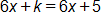
    In the given equation, k is a constant. If the equation has infinitely many solutions, what is the value of k ?

    Correct answer: A

    The correct answer is 5. Subtracting from both sides of the given equation gives, so for any value of x, if and only if . Therefore, if the given equation has infinitely many solutions, the value of k is 5.
  12. Question 12

    A manager is responsible for ordering supplies for a shaved ice shop. The shop's inventory starts with \(4,500\) paper cups, and the manager estimates that \(70\) of these paper cups are used each day. Based on this estimate, in how many days will the supply of paper cups reach \(1,700\)?

    Correct answer: B

    Choice B is correct. It’s given that the shop’s inventory starts with \(4,500\) paper cups and that the manager estimates that \(70\) of these paper cups are used each day. Let \(x\) represent the number of days in which the estimated supply of paper cups will reach \(1,700\). The equation \(4,500 -70 x = 1,700\) represents this situation. Subtracting \(4,500\) from both sides of this equation yields \(-70 x = -2,800\). Dividing both sides of this equation by \(-70\) yields \(x = 40\). Therefore, based on this estimate, the supply of paper cups will reach \(1,700\) in \(40\) days. Choice A is incorrect. After \(20\) days, the estimated supply of paper cups would be \(4,500 -70(20)\), or \(3,100\) cups, not \(1,700\) cups. Choice C is incorrect. After \(60\) days, the estimated supply of paper cups would be \(4,500 -70(60)\), or \(300\) cups, not \(1,700\) cups. Choice D is incorrect. After \(80\) days, the estimated supply of paper cups would be \(4,500 -70(80)\), or \(-1,100\) cups, which isn't possible.
  13. Question 13

    A librarian has 43 books to distribute to a group of children. If he gives each child 2 books, he will have 7 books left over. How many children are in the group?

    Correct answer: B

    Choice B is correct. Subtracting the 7 books left over from the 43 books gives \(43 - 7 = 36\), the number of books given out. Dividing by the 2 books each child got gives \(36 \div 2 = 18\) children. Choice A is incorrect and results from dividing the total number of books by 2, \(43 \div 2 = 21.5\), then subtracting the 7 left over: 14.5. Choice C is incorrect and results from adding the 7 left over to the total, \(43 + 7 = 50\), then dividing by 2: 25. Choice D is incorrect and results from dividing the total by 2, 21.5, then adding the 7 left over: 28.5.
  14. Question 14

    The width of a rectangular dance floor is w feet. The length of the floor is 6 feet longer than its width. Which of the following expresses the perimeter, in feet, of the dance floor in terms of w ?

    Correct answer: B

    Choice B is correct. It is given that the width of the dance floor is w feet. The length is 6 feet longer than the width; therefore, the length of the dance floor is . So the perimeter is .Choice A is incorrect because it is the sum of one length and one width, which is only half the perimeter. Choice C is incorrect and may result from using the formula for the area instead of the formula for the perimeter and making a calculation error. Choice D is incorrect because this is the area, not the perimeter, of the dance floor.
  15. Question 15

    Henry receives a \(\\) 60.00\( gift card to pay for movies online. He uses his gift card to buy \)3\( movies for \)$ 7.50\( each. If he spends the rest of his gift card balance on renting movies for \)$ 1.50$ each, how many movies can Henry rent?

    Correct answer: B

    Choice B is correct. It's given that Henry uses his \(\\) 60.00\( gift card to buy \)3\( movies for \)$ 7.50\( each. Therefore, Henry spends \)3($ 7.50)\(, or \)$ 22.50\(, of his \)$ 60.00\( gift card to buy \)3\( movies. After buying \)3\( movies with his \)$ 60.00\( gift card, Henry has a gift card balance of \)$ 60.00 -$ 22.50\(, or \)$ 37.50\(. It's also given that Henry spends the rest of his gift card balance on renting movies for \)$ 1.50\( each. Therefore, Henry can rent \)$ 37.50/$ 1.50\(, or \)25$, movies. Choice A is incorrect and may result from conceptual or calculation errors. Choice C is incorrect and may result from conceptual or calculation errors. Choice D is incorrect and may result from conceptual or calculation errors.
  16. Question 16

    A rocket contained \(467,000\) kilograms (kg) of propellant before launch. Exactly \(21\) seconds after launch, \(362,105\) kg of this propellant remained. On average, approximately how much propellant, in kg, did the rocket burn each second after launch?

    Correct answer: A

    Choice A is correct. It’s given that the rocket contained \(467,000 kilograms(kg)\) of propellant before launch and had \(362,105 kg\) remaining exactly \(21\) seconds after launch. Finding the difference between the amount, in \(kg\), of propellant before launch and the remaining amount, in \(kg\), of propellant after launch gives the amount, in \(kg\), of propellant burned during the \(21\) seconds: \(467,000 -362,105 = 104,895\). Dividing the amount of propellant burned by the number of seconds yields \(104,895/21 = 4,995\). Thus, an average of \(4,995 kg\) of propellant burned each second after launch. Choice B is incorrect and may result from conceptual or calculation errors. Choice C is incorrect and may result from conceptual or calculation errors. Choice D is incorrect and may result from finding the amount of propellant burned, rather than the amount of propellant burned each second.
  17. Question 17

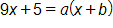
    The equation, where a and b are constants, has no solutions. Which of the following must be true? I. II. III.

    Correct answer: D

    Choice D is correct. For a linear equation in a form to have no solutions, the x-terms must have equal coefficients and the remaining terms must not be equal. Expanding the right-hand side of the given equation yields . Inspecting the x-terms, 9 must equal a, so statement I must be true. Inspecting the remaining terms, 5 can’t equal . Dividing both of these quantities by 9 yields that b can’t equal . Therefore, statement III must be true. Since b can have any value other than, statement II may or may not be true.Choice A is incorrect. For the given equation to have no solution, both and must be true. Choice B is incorrect because it must also be true that . Choice C is incorrect because when, there are many values of b that lead to an equation having no solution. That is, b might be 5, but b isn’t required to be 5.
  18. Question 18

    \(4 x + 12 = a(x + 3)/2\) In the given equation, \(a\) is a constant. If the equation has infinitely many solutions, what is the value of \(a\)?

    Correct answer: C

    Choice C is correct. If an equation has infinitely many solutions, then the two sides of the equation must be equivalent. Multiplying each side of the given equation by \(2\) yields \(8 x + 24 = a(x + 3)\). Since \(8\) is a common factor of both terms on the left-hand side of this equation, the equation can be rewritten as \(8(x + 3)= a(x + 3)\). The two sides of this equation are equivalent when \(a = 8\). Therefore, if the given equation has infinitely many solutions, the value of \(a\) is \(8\). Alternate approach: If the given equation, \(4 x + 12 = a(x + 3)/2\), has infinitely many solutions, then both sides of this equation are equal for any value of \(x\). If \(x = 0\), then substituting \(0\) for \(x\) in the given equation yields \(4(0)+ 12 = a(0 + 3)/2\), or \(12 = 3 halves a\). Dividing both sides of this equation by \(3 halves\) yields \(8 = a\). Choice A is incorrect. If the value of \(a\) is \(0\), the given equation is equivalent to \(4 x + 12 = 0\), which has one solution, not infinitely many solutions. Choice B is incorrect. If the value of \(a\) is \(3\), the given equation is equivalent to \(4 x + 12 = 3(x + 3)/2\), or \(4 x + 12 = 3 halves x + 9 halves\), which has one solution, not infinitely many solutions. Choice D is incorrect. If the value of \(a\) is \(12\), the given equation is equivalent to \(4 x + 12 = 12(x + 3)/2\), or \(4 x + 12 = 6 x + 18\), which has one solution, not infinitely many solutions.
  19. Question 19

    \(66 x = 66 x\) How many solutions does the given equation have?

    Correct answer: C

    Choice C is correct. If the two sides of a linear equation are equivalent, then the equation is true for any value. If an equation is true for any value, it has infinitely many solutions. Since the two sides of the given linear equation \(66 x = 66 x\) are equivalent, the given equation has infinitely many solutions. Choice A is incorrect and may result from conceptual or calculation errors. Choice B is incorrect and may result from conceptual or calculation errors. Choice D is incorrect and may result from conceptual or calculation errors.
  20. Question 20

    If \(5 -7(2 -4 x)= 16 -8(2 -4 x)\), what is the value of \(2 -4 x\)?

    Correct answer: B

    The correct answer is \(11\). Subtracting \(5\) from each side of the given equation yields \(-7(2 -4 x)= 11 -8(2 -4 x)\). Adding \(8(2 -4 x)\) to each side of this equation yields \(2 -4 x = 11\). Therefore, the value of \(2 -4 x\) is \(11\).
  21. Question 21

    \(k + 12 = 336\) What is the solution to the given equation?

    Correct answer: B

    Choice B is correct. Subtracting \(12\) from both sides of the given equation yields \(k = 324\). Therefore, the solution to the given equation is \(324\). Choice A is incorrect and may result from conceptual or calculation errors. Choice C is incorrect and may result from conceptual or calculation errors. Choice D is incorrect and may result from conceptual or calculation errors.
  22. Question 22

    A bowl contains \(20\) ounces of water. When the bowl is uncovered, the amount of water in the bowl decreases by \(1\) ounce every \(4\) days. If \(9\) ounces of water remain in this bowl, for how many days has it been uncovered?

    Correct answer: D

    Choice D is correct. It’s given that the bowl starts with \(20\) ounces of water and has \(9\) ounces of water remaining after a period of time has passed. The amount of water the bowl has lost during the time period can be found by subtracting the remaining amount of water from the amount of water the bowl starts with, which yields \(20 -9\) ounces, or \(11\) ounces. This means the bowl loses \(11\) ounces of water during that period of time. It’s given that the amount of water decreases by \(1\) ounce every \(4\) days. Letting \(t\) represent the number of days the bowl has been uncovered, it follows that \(1 fourth = 11/t\). Multiplying both sides of this equation by \(4 t\) yields \(t = 44\). Therefore, the bowl has been uncovered for \(44\) days. Choice A is incorrect and may result from conceptual or calculation errors. Choice B is incorrect and may result from conceptual or calculation errors. Choice C is incorrect. This is the value of \(t\) for the equation \(1 fourth = 9/t\), not \(1 fourth = 11/t\).
  23. Question 23

    If, what is the value of ?

    Correct answer: A

    The correct answer is 24. Multiplying both sides of the given equation by 3 yields . Using the distributive property to rewrite the left-hand side of this equation yields .
  24. Question 24

    Megan’s regular wage at her job is p dollars per hour for the first 8 hours of work in a day plus 1.5 times her regular hourly wage for work in excess of 8 hours that day. On a given day, Megan worked for 10 hours, and her total earnings for that day were $137.50. What is Megan’s regular hourly wage?

    Correct answer: B

    Choice B is correct. Since p represents Megan’s regular pay per hour, 1.5p represents the pay per hour in excess of 8 hours. Since Megan worked for 10 hours, she must have been paid p dollars per hour for 8 of the hours plus 1.5p dollars per hour for the remaining 2 hours. Therefore, since Megan earned $137.50 for the 10 hours, the situation can be represented by the equation 137.5 = 8p + 2(1.5)p. Distributing the 2 in the equation gives 137.5 = 8p + 3p, and combining like terms gives 137.5 = 11p. Dividing both sides by 11 gives p = 12.5. Therefore, Megan’s regular wage is $12.50.Choices A and C are incorrect and may be the result of calculation errors. Choice D is incorrect and may result from finding the average hourly wage that Megan earned for the 10 hours of work.
  25. Question 25

    \(-49 x = -98 x\) How many solutions does the given equation have?

    Correct answer: B

    Choice B is correct. Adding \(98 x\) to each side of the given equation yields \(49 x = 0\). Dividing each side of this equation by \(49\) yields \(x = 0\). This means that \(0\) is the only solution to the given equation. Therefore, the given equation has exactly one solution. Choice A is incorrect and may result from conceptual or calculation errors. Choice C is incorrect and may result from conceptual or calculation errors. Choice D is incorrect and may result from conceptual or calculation errors.
  26. Question 26

    If \(2 + x = 60\), what is the value of \(16 + 8 x\)?

    Correct answer: A

    The correct answer is \(480\). Multiplying both sides of the given equation by \(8\) yields \(8(2 + x)= 8(60)\), or \(16 + 8 x = 480\). Therefore, if \(2 + x = 60\), the value of \(16 + 8 x\) is \(480\).
  27. Question 27

    \(3 x + 5(x + 4)= 76\) What value of \(x\) is the solution to the given equation?

    Correct answer: A

    Choice A is correct. Applying the distributive property on the left-hand side of the given equation yields \(3 x + 5 x + 20 = 76\), or \(8 x + 20 = 76\). Subtracting \(20\) from each side of this equation yields \(8 x = 56\). Dividing each side of this equation by \(8\) yields \(x = 7\). Choice B is incorrect and may result from conceptual or calculation errors. Choice C is incorrect and may result from conceptual or calculation errors. Choice D is incorrect. This is the solution to the equation \(x + 4 = 76\), not \(3 x + 5(x + 4)= 76\).
  28. Question 28

    If, what is the value of x ?

    Correct answer: C

    Choice C is correct. To make it easier to add like terms on the left-hand side of the given equation, both sides of the equation can be multiplied by 6, which is the lowest common denominator of and . This yields, which can be rewritten as . Dividing both sides of this equation by 2 yields .Choice A is incorrect and may result from subtracting the denominators instead of numerators with common denominators to get, rather than, on the left-hand side of the equation. Choice B is incorrect and may result from rewriting the given equation as instead of . Choice D is incorrect and may result from conceptual or computational errors.
  29. Question 29

    If \(6 sevenths p + 18 = 54\), what is the value of \(7 p\)?

    Correct answer: B

    The correct answer is \(294\). Subtracting \(18\) from each side of the given equation yields \(6 sevenths p = 36\). Multiplying each side of this equation by \(7 sixths\) yields \(p = 42\). Multiplying each side of this equation by \(7\) yields \(7 p = 294\). Therefore, the value of \(7 p\) is \(294\).
  30. Question 30

    \(2.6 + x = 2.8\) What value of \(x\) is the solution to the given equation?

    Correct answer: C

    The correct answer is \(.2\). Subtracting \(2.6\) from each side of the given equation yields \(x = 0.2\). Therefore, the value of \(x\) that's the solution to the given equation is \(0.2\). Note that .2 and 1/5 are examples of ways to enter a correct answer.
  31. Question 31

    If, what is the value of ?

    Correct answer: B

    Choice B is correct. Multiplying both sides of the given equation by 5 yields . Substituting 50 for in the expression yields .Alternate approach: Dividing both sides of by 2 yields . Evaluating the expression for yields .Choice A is incorrect and may result from finding the value of instead of . Choice C is incorrect and may result from finding the value of instead of . Choice D is incorrect and may result from finding the value of instead of .
  32. Question 32

    If \(x + 6/3 = x + 6/13\), the value of \(x + 6\) is between which of the following pairs of values?

    Correct answer: B

    Choice B is correct. Multiplying both sides of the given equation by \((3)(13)\), or \(39\), yields \((39)(x + 6/3)=(39)(x + 6/13)\), or \(13(x + 6)= 3(x + 6)\). Subtracting \(3(x + 6)\) from both sides of this equation yields \(10(x + 6)= 0\). Dividing both sides of this equation by \(10\) yields \(x + 6 = 0\). Therefore, if \(x + 6/3 = x + 6/13\), then the value of \(x + 6\) is \(0\). It follows that of the given choices, the value of \(x + 6\) is between \(-2\) and \(2\). Choice A is incorrect and may result from conceptual or calculation errors. Choice C is incorrect and may result from conceptual or calculation errors. Choice D is incorrect and may result from conceptual or calculation errors.
  33. Question 33

    If \(6 n = 12\), what is the value of \(n + 4\)?

    Correct answer: C

    The correct answer is \(6\). Dividing both sides of the equation \(6 n = 12\) by \(6\) yields \(n = 2\). Substituting \(2\) for \(n\) in the expression \(n + 4\) yields \(2 + 4\), or \(6\).
  34. Question 34

    If \(2(3 t -10)+ t = 40 + 4 t\), what is the value of \(3 t\)?

    Correct answer: A

    The correct answer is \(60\). Subtracting \(t\) from both sides of the given equation yields \(2(3 t -10)= 40 + 3 t\). Applying the distributive property to the left-hand side of this equation yields \(6 t -20 = 40 + 3 t\). Adding \(20\) to both sides of this equation yields \(6 t = 60 + 3 t\). Subtracting \(3 t\) from both sides of this equation yields \(3 t = 60\). Therefore, the value of \(3 t\) is \(60\).
  35. Question 35

    \(-3 x + 21 p x = 84\) In the given equation, \(p\) is a constant. The equation has no solution. What is the value of \(p\)?

    Correct answer: B

    Choice B is correct. A linear equation in one variable has no solution if and only if the equation is false; that is, when there is no value of \(x\) that produces a true statement. It's given that in the equation \(-3 x + 21 p x = 84\), \(p\) is a constant and the equation has no solution for \(x\). Therefore, the value of the constant \(p\) is one that results in a false equation. Factoring out the common factor of \(-3 x\) on the left-hand side of the given equation yields \(-3 x(1 -7 p)= 84\). Dividing both sides of this equation by \(-3\) yields \(x(1 -7 p)= -28\). Dividing both sides of this equation by \((1 -7 p)\) yields \(x = \ -28/1 -7 p\). This equation is false if and only if \(1 -7 p = 0\). Adding \(7 p\) to both sides of \(1 -7 p = 0\) yields \(1 = 7 p\). Dividing both sides of this equation by \(7\) yields \(1 seventh = p\). It follows that the equation \(x = \ -28/1 -7 p\) is false if and only if \(p = 1 seventh\). Therefore, the given equation has no solution if and only if the value of \(p\) is \(1 seventh\). Choice A is incorrect and may result from conceptual or calculation errors. Choice C is incorrect and may result from conceptual or calculation errors. Choice D is incorrect and may result from conceptual or calculation errors.
  36. Question 36

    If, what is the value of ?

    Correct answer: D

    Choice D is correct. Multiplying the given equation by 2 on each side yields . Applying the distributive property, this equation can be rewritten as, or .Choices A, B, and C are incorrect and may result from calculation errors in solving the given equation for and then substituting that value of x in the expression .
  37. Question 37

    \(13 x = 112 -x\) What value of \(x\) is the solution to the given equation?

    Correct answer: A

    The correct answer is \(8\). Adding \(x\) to both sides of the given equation yields \(14 x = 112\). Dividing both sides of this equation by \(14\) yields \(x = 8\).
  38. Question 38

    If \(4 x = 3\), what is the value of \(24 x\)?

    Correct answer: C

    Choice C is correct. It’s given that \(4 x = 3\). Multiplying each side of this equation by \(6\) yields \(24 x = 18\). Therefore, the value of \(24 x\) is \(18\). Choice A is incorrect. This is the value of \(6 x\), not \(24 x\). Choice B is incorrect. This is the value of \(8 x\), not \(24 x\). Choice D is incorrect. This is the value of \(96 x\), not \(24 x\).
  39. Question 39

    Each side of a \(30\)-sided polygon has one of three lengths. The number of sides with length \(8 centimeters(cm)\) is \(5\) times the number of sides \(n\) with length \(3 cm\). There are \(6\) sides with length \(4 cm\). Which equation must be true for the value of \(n\)?

    Correct answer: B

    Choice B is correct. It’s given that each side of a \(30\)-sided polygon has one of three lengths. It's also given that the number of sides with length \(8\) \(centimeters(cm)\) is \(5\) times the number of sides \(n\) with length \(3 cm\). Therefore, there are \(5 \times n\), or \(5 n\), sides with length \(8 cm\). It’s also given that there are \(6\) sides with length \(4 cm\). Therefore, the number of \(3 cm\), \(4 cm\), and \(8 cm\) sides are \(n\), \(6\), and \(5 n\), respectively. Since there are a total of \(30\) sides, the equation \(n + 6 + 5 n = 30\) represents this situation. Combining like terms on the left-hand side of this equation yields \(6 n + 6 = 30\). Therefore, the equation that must be true for the value of \(n\) is \(6 n + 6 = 30\). Choice A is incorrect and may result from conceptual or calculation errors. Choice C is incorrect and may result from conceptual or calculation errors. Choice D is incorrect and may result from conceptual or calculation errors.
  40. Question 40

    The perimeter of an isosceles triangle is \(36\) feet. Each of the two congruent sides of the triangle has a length of \(10\) feet. What is the length, in feet, of the third side?

    Correct answer: C

    Choice C is correct. It’s given that the perimeter of an isosceles triangle is \(36\) feet and that each of the two congruent sides has a length of \(10\) feet. The perimeter of a triangle is the sum of the lengths of its three sides. The equation \(10 + 10 + x = 36\) can be used to represent this situation, where \(x\) is the length, in feet, of the third side. Combining like terms on the left-hand side of this equation yields \(20 + x = 36\). Subtracting \(20\) from each side of this equation yields \(x = 16\). Therefore, the length, in feet, of the third side is \(16\). Choice A is incorrect. This would be the length, in feet, of the third side if the perimeter was \(30\) feet, not \(36\) feet. Choice B is incorrect. This would be the length, in feet, of the third side if the perimeter was \(32\) feet, not \(36\) feet. Choice D is incorrect. This would be the length, in feet, of the third side if the perimeter was \(38\) feet, not \(36\) feet.
  41. Question 41

    If \(6 + x = 9\), what is the value of \(18 + 3 x\)?

    Correct answer: B

    The correct answer is \(27\). Multiplying both sides of the given equation by \(3\) yields \(3(6 + x)= 3(9)\), or \(18 + 3 x = 27\). Therefore, the value of \(18 + 3 x\) is \(27\).
  42. Question 42

    What value of p is the solution of the equation above?

    Correct answer: B

    The correct answer is 1.2. One way to solve the equation is to first distribute the terms outside the parentheses to the terms inside the parentheses: . Next, combine like terms on the left side of the equal sign: . Subtracting 10p from both sides yields . Finally, dividing both sides by gives, which is equivalent to . Note that 1.2 and 6/5 are examples of ways to enter a correct answer.
  43. Question 43

    \(16 x + 30 = 190\) Which equation has the same solution as the given equation?

    Correct answer: C

    Choice C is correct. It’s given that \(16 x + 30 = 190\). Subtracting \(30\) from each side of this equation yields \(16 x = 160\). Therefore, the equation \(16 x = 160\) is equivalent to the given equation and has the same solution. Choice A is incorrect and may result from conceptual or calculation errors. Choice B is incorrect and may result from conceptual or calculation errors. Choice D is incorrect and may result from conceptual or calculation errors.
  44. Question 44

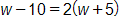
    For what value of w does ?

    Correct answer: D

    Choice D is correct. To solve the equation, use the distributive property to multiply on the right-hand side of the equation which gives w – 10 = 2w + 10. Subtract w from both sides of the equation, which gives –10 = w + 10. Finally, subtract 10 from both sides of the equation, which gives –20 = w.Choices A and B are incorrect and may result from making sign errors. Choice C is incorrect and may result from incompletely distributing the 2 in the expression 2(w + 5).
  45. Question 45

    On the first day of a semester, a film club has \(90\) members. Each day after the first day of the semester, \(10\) new members join the film club. If no members leave the film club, how many total members will the film club have \(4\) days after the first day of the semester?

    Correct answer: B

    Choice B is correct. It’s given that the film club has \(90\) members on the first day of a semester, and \(10\) new members join the film club each day after the first day of the semester. This means that after \(4\) days, \(4 \times 10\), or \(40\), new members will have joined the club. Adding \(40\) members to the original \(90\) club members yields \(130\) members. Thus, the film club will have \(130\) total members \(4\) days after the first day of the semester. Choice A is incorrect. This is the number of members that will have joined the film club \(4\) days after the first day of the semester if \(100\) new members, not \(10\), join the film club each day. Choice C is incorrect. This is the number of members the film club will have \(4\) days after the first day of the semester if \(1\) new member, not \(10\), joins the film club each day. Choice D is incorrect. This is the number of members the film club has on the first day of the semester.
  46. Question 46

    If \(4 x + 2 = 12\), what is the value of \(16 x + 8\)?

    Correct answer: B

    Choice B is correct. Multiplying both sides of the given equation by \(4\) yields \((4)(4 x + 2)=(4)(12)\), or \(16 x + 8 = 48\). Therefore, the value of \(16 x + 8\) is \(48\). Choice A is incorrect and may result from conceptual or calculation errors. Choice C is incorrect and may result from conceptual or calculation errors. Choice D is incorrect and may result from conceptual or calculation errors.
  47. Question 47

    The Townsend Realty Group invested in the five different properties listed in the table above. The table shows the amount, in dollars, the company paid for each property and the corresponding monthly rental price, in dollars, the company charges for the property at each of the five locations. Townsend Realty purchased the Glenview Street property and received a 40% discount off the original price along with an additional 20% off the discounted price for purchasing the property in cash. Which of the following best approximates the original price, in dollars, of the Glenview Street property?

    Correct answer: B

    Choice B is correct. Let x be the original price, in dollars, of the Glenview Street property. After the 40% discount, the price of the property became dollars, and after the additional 20% off the discounted price, the price of the property became . Thus, in terms of the original price of the property, x, the purchase price of the property is . It follows that . Solving this equation for x gives . Therefore, of the given choices, $291,700 best approximates the original price of the Glenview Street property.Choice A is incorrect because it is the result of dividing the purchase price of the property by 0.4, as though the purchase price were 40% of the original price. Choice C is incorrect because it is the closest to dividing the purchase price of the property by 0.6, as though the purchase price were 60% of the original price. Choice D is incorrect because it is the result of dividing the purchase price of the property by 0.8, as though the purchase price were 80% of the original price.
  48. Question 48

    If \(7 x = 28\), what is the value of \(8 x\)?

    Correct answer: B

    Choice B is correct. Dividing both sides of the given equation \(7 x = 28\) by \(7\) yields \(x = 4\). Substituting \(4\) for \(x\) in the expression \(8 x\) yields \(8(4)\), which is equivalent to \(32\). Choice A is incorrect. This is the value of \(21/4 x\). Choice C is incorrect. This is the value of \(42 x\). Choice D is incorrect. This is the value of \(56 x\).
  49. Question 49

    A gym charges its members a onetime \(\\) 36\( enrollment fee and a membership fee of \)$ 19\( per month. If there are no charges other than the enrollment fee and the membership fee, after how many months will a member have been charged a total of \)$ 188$ at the gym?

    Correct answer: C

    Choice C is correct. It’s given that a gym charges its members a onetime \(\\) 36\( enrollment fee and a membership fee of \)$ 19\( per month. Let \)x\( represent the number of months at the gym after which a member will have been charged a total of \)$ 188\(. If there are no charges other than the enrollment fee and the membership fee, the equation \)36 + 19 x = 188\( can be used to represent this situation. Subtracting \)36\( from both sides of this equation yields \)19 x = 152\(. Dividing both sides of this equation by \)19\( yields \)x = 8\(. Therefore, a member will have been charged a total of \)$ 188\( after \)8\( months at the gym. Choice A is incorrect. A member will have been charged a total of \)$(36 + 19 \times 4)\(, or \)$ 112\(, after \)4\( months at the gym. Choice B is incorrect. A member will have been charged a total of \)$(36 + 19 \times 5)\(, or \)$ 131\(, after \)5\( months at the gym. Choice D is incorrect. A member will have been charged a total of \)$(36 + 19 \times 10)\(, or \)$ 226\(, after \)10$ months at the gym.
  50. Question 50

    If \(x = 7\), what is the value of \(x + 20\)?

    Correct answer: C

    Choice C is correct. It’s given that \(x = 7\). Substituting \(7\) for \(x\) into the given expression \(x + 20\) yields \(7 + 20\), which is equivalent to \(27\). Choice A is incorrect. This is the value of \(x + 6\). Choice B is incorrect. This is the value of \(x + 13\). Choice D is incorrect. This is the value of \(x + 27\).
  51. Question 51

    Cathy has n CDs. Gerry has 3 more than twice the number of CDs that Cathy has. In terms of n, how many CDs does Gerry have?

    Correct answer: D

    Choice D is correct. The term 2n represents twice the number of CDs that Cathy has, and adding 3 represents 3 more than that amount.Choices A and B are incorrect. The expression 3n represents three times the number of CDs that Cathy has. Choice C is incorrect. Subtracting 3 represents 3 fewer than twice the number of CDs that Cathy has.
  52. Question 52

    If \(5(x + 4)= 4(x + 4)+ 29\), what is the value of \(x + 4\)?

    Correct answer: C

    Choice C is correct. Subtracting \(4(x + 4)\) from both sides of the given equation yields \(1(x + 4)= 29\), or \(x + 4 = 29\). Therefore, the value of \(x + 4\) is \(29\). Choice A is incorrect and may result from conceptual or calculation errors. Choice B is incorrect. This is the value of \(x\), not \(x + 4\). Choice D is incorrect and may result from conceptual or calculation errors.
  53. Question 53

    How many solutions does the equation \(12(x -3)= -3(x + 12)\) have?

    Correct answer: A

    Choice A is correct. Distributing \(12\) on the left-hand side and \(-3\) on the right-hand side of the given equation yields \(12 x -36 = -3 x -36\). Adding \(3 x\) to each side of this equation yields \(15 x -36 = -36\). Adding \(36\) to each side of this equation yields \(15 x = 0\). Dividing each side of this equation by \(15\) yields \(x = 0\). This means that \(0\) is the only solution to the given equation. Therefore, the given equation has exactly one solution. Choice B is incorrect and may result from conceptual or calculation errors. Choice C is incorrect and may result from conceptual or calculation errors. Choice D is incorrect and may result from conceptual or calculation errors.
  54. Question 54

    \(5(t + 3)-7(t + 3)= 38\) What value of \(t\) is the solution to the given equation?

    Correct answer: C

    The correct answer is \(-22\). The given equation can be rewritten as \(-2(t + 3)= 38\). Dividing both sides of this equation by \(-2\) yields \(t + 3 = -19\). Subtracting \(3\) from both sides of this equation yields \(t = -22\). Therefore, \(-22\) is the value of \(t\) that is the solution to the given equation.
  55. Question 55

    If \(2 x = 12\), what is the value of \(9 x\)?

    Correct answer: C

    The correct answer is \(54\). Dividing both sides of the given equation by \(2\) yields \(x = 6\). Multiplying both sides of this equation by \(9\) yields \(9 x = 54\). Thus, the value of \(9 x\) is \(54\).
  56. Question 56

    A line segment that has a length of \(115 centimeters(cm)\) is divided into three parts. One part is \(47 cm\) long. The other two parts have lengths that are equal to each other. What is the length, in \(cm\), of one of the other two parts of equal length?

    Correct answer: B

    The correct answer is \(34\). It’s given that a line segment has a length of \(115 cm\) and is divided into three parts, where one part is \(47 cm\) long and the other two parts have lengths that are equal. If \(x\) represents the length, in cm, of each of the two parts of equal length, then the equation \(47 + x + x = 115\), or \(47 + 2 x = 115\), represents this situation. Subtracting \(47\) from each side of this equation yields \(2 x = 68\). Dividing each side of this equation by \(2\) yields \(x = 34\). Therefore, the length, in cm, of one of the two parts of equal length is \(34\).
  57. Question 57

    \(x + 40 = 95\) What value of \(x\) is the solution to the given equation?

    Correct answer: D

    The correct answer is \(55\). Subtracting \(40\) from both sides of the given equation yields \(x = 55\). Therefore, the value of \(x\) is \(55\).
  58. Question 58

    How many solutions exist to the equation shown above?

    Correct answer: B

    Choice B is correct. Subtracting 4 from each side of the given equation yields, or, so the equation has a unique solution of .Choice A is incorrect. Since 3 is a value of x that satisfies the given equation, the equation has at least 1 solution. Choice C is incorrect. Linear equations can have 0, 1, or infinitely many solutions; no linear equation has exactly 3 solutions. Choice D is incorrect. If a linear equation has infinitely many solutions, it can be reduced to . This equation reduces to, so there is only 1 solution.
  59. Question 59

    Nasir bought \(9\) storage bins that were each the same price. He used a coupon for \(\\) 63\( off the entire purchase. The cost for the entire purchase after using the coupon was \)$ 27\(. What was the original price, in dollars, for \)1$ storage bin?

    Correct answer: A

    The correct answer is \(10\). It’s given that the cost for the entire purchase was \(\\) 27\( after a coupon was used for \)$ 63\( off the entire purchase. Adding the amount of the coupon to the purchase price yields \)27 + 63 = 90\(. Thus, the cost for the entire purchase before using the coupon was \)$ 90\(. It’s given that Nasir bought \)9\( storage bins. The original price for \)1\( storage bin can be found by dividing the total cost by \)9\(. Therefore, the original price, in dollars, for \)1\( storage bin is \)90/9\(, or \)10$.
  60. Question 60

    \(1 third(x + 6)-1 half(x + 6)= -8\) What value of \(x\) is the solution to the given equation?

    Correct answer: D

    The correct answer is \(42\). The expression \((x + 6)\) is a factor of both terms on the left-hand side of the given equation. Therefore, the given equation can be written as \((x + 6)(1 third -1 half)= -8\), or \((x + 6)(-1 sixth)= -8\). Multiplying each side of this equation by \(-6\) yields \(x + 6 = 48\). Subtracting \(6\) from each side of this equation yields \(x = 42\). Therefore, the value of \(x\) that is the solution to the given equation is \(42\).
  61. Question 61

    An agricultural scientist studying the growth of corn plants recorded the height of a corn plant at the beginning of a study and the height of the plant each day for the next 12 days. The scientist found that the height of the plant increased by an average of 1.20 centimeters per day for the 12 days. If the height of the plant on the last day of the study was 36.8 centimeters, what was the height, in centimeters, of the corn plant at the beginning of the study?

    Correct answer: A

    The correct answer is 22.4. If the height of the plant increased by an average of 1.20 centimeters per day for 12 days, then its total growth over the 12 days was centimeters. The plant was 36.8 centimeters tall after 12 days, so at the beginning of the study its height was centimeters. Note that 22.4 and 112/5 are examples of ways to enter a correct answer.Alternate approach: The equation can be used to represent this situation, where h is the height of the plant, in centimeters, at the beginning of the study. Solving this equation for h yields 22.4 centimeters.
  62. Question 62

    \(2(k x -n)= -28/15 x -36/19\) In the given equation, \(k\) and \(n\) are constants and \(n > 1\). The equation has no solution. What is the value of \(k\)?

    Correct answer: C

    The correct answer is \(-14/15\). A linear equation in the form \(a x + b = c x + d\) has no solution only when the coefficients of \(x\) on each side of the equation are equal and the constant terms are not equal. Dividing both sides of the given equation by \(2\) yields \(k x -n = -28/30 x -36/38\), or \(k x -n = -14/15 x -18/19\). Since it’s given that the equation has no solution, the coefficient of \(x\) on both sides of this equation must be equal, and the constant terms on both sides of this equation must not be equal. Since \(18/19 < 1\), and it's given that \(n > 1\), the second condition is true. Thus, \(k\) must be equal to \(-14/15\). Note that -14/15, -.9333, and -0.933 are examples of ways to enter a correct answer.
  63. Question 63

    \(4 x + 6 = 18\) Which equation has the same solution as the given equation?

    Correct answer: C

    Choice C is correct. Subtracting \(6\) from both sides of the given equation yields \(4 x = 12\), which is the equation given in choice C. Since this equation is equivalent to the given equation, it has the same solution as the given equation. Choice A is incorrect and may result from conceptual or calculation errors. Choice B is incorrect and may result from conceptual or calculation errors. Choice D is incorrect and may result from conceptual or calculation errors.
  64. Question 64

    A total of \(165\) people contributed to a charity event as either a donor or a volunteer. \(130\) people contributed as a donor. How many people contributed as a volunteer?

    Correct answer: A

    Choice A is correct. It’s given that a total of \(165\) people contributed to a charity event as either a donor or a volunteer. It’s also given that \(130\) people contributed as a donor. It follows that \(165 -130\), or \(35\), people contributed as a volunteer. Choice B is incorrect. This is the number of people who contributed as a donor, not a volunteer. Choice C is incorrect. This is the total number of people who contributed as either a donor or a volunteer, not the number of people who contributed as a volunteer. Choice D is incorrect and may result from conceptual or calculation errors.
  65. Question 65

    In the equation above, a and b are constants. If the equation has infinitely many solutions, what are the values of a and b ?

    Correct answer: B

    Choice B is correct. Distributing the a on the left-hand side of the equation gives 3a – b – ax = –1 – 2x. Rearranging the terms in each side of the equation yields –ax + 3a – b = –2x –1. Since the equation has infinitely many solutions, it follows that the coefficients of x and the free terms on both sides must be equal. That is, –a = –2, or a = 2, and 3a – b = –1. Substituting 2 for a in the equation 3a – b = –1 gives 3(2) – b = –1, so b = 7.Choice A is incorrect and may be the result of a conceptual error when finding the value of b. Choices C and D are incorrect and may result from making a sign error when simplifying.
  66. Question 66

    \(3\) more than \(8\) times a number \(x\) is equal to \(83\). Which equation represents this situation?

    Correct answer: D

    Choice D is correct. The given phrase “\(8\) times a number \(x\)” can be represented by the expression \(8 x\). The given phrase “\(3\) more than” indicates an increase of \(3\) to a quantity. Therefore “\(3\) more than \(8\) times a number \(x\)” can be represented by the expression \(8 x + 3\). Since it’s given that \(3\) more than \(8\) times a number \(x\) is equal to \(83\), it follows that \(8 x + 3\) is equal to \(83\), or \(8 x + 3 = 83\). Therefore, the equation that represents this situation is \(8 x + 3 = 83\). Choice A is incorrect. This equation represents \(3\) times the quantity \(8\) times a number \(x\) is equal to \(83\). Choice B is incorrect. This equation represents \(8\) times a number \(x\) is equal to \(3\) more than \(83\). Choice C is incorrect. This equation represents \(8\) more than \(3\) times a number \(x\) is equal to \(83\).
  67. Question 67

    A certain product costs a company $65 to make. The product is sold by a salesperson who earns a commission that is equal to 20% of the sales price of the product. The profit the company makes for each unit is equal to the sales price minus the combined cost of making the product and the commission. If the sales price of the product is $100, which of the following equations gives the number of units, u, of the product the company sold to make a profit of $6,840 ?

    Correct answer: A

    Choice A is correct. The sales price of one unit of the product is given as $100. Because the salesperson is awarded a commission equal to 20% of the sales price, the expression 100(1 – 0.2) gives the sales price of one unit after the commission is deducted. It is also given that the profit is equal to the sales price minus the combined cost of making the product, or $65, and the commission: 100(1 – 0.2) – 65. Multiplying this expression by u gives the profit of u units: (100(1 – 0.2) – 65)u. Finally, it is given that the profit for u units is $6,840; therefore (100(1 – 0.2) – 65)u = $6,840.Choice B is incorrect. In this equation, cost is subtracted before commission and the equation gives the commission, not what the company retains after commission. Choice C is incorrect because the number of units is multiplied only by the cost but not by the sale price. Choice D is incorrect because the value 0.2 shows the commission, not what the company retains after commission.
  68. Question 68

    \(8 x = 88\) What value of \(x\) is the solution to the given equation?

    Correct answer: A

    Choice A is correct. Dividing both sides of the given equation by \(8\) yields \(x = 11\). Therefore, \(11\) is the solution to the given equation. Choice B is incorrect. This is the solution to the equation \(x + 8 = 88\). Choice C is incorrect. This is the solution to the equation \(x -8 = 88\). Choice D is incorrect. This is the solution to the equation \(x/8 = 88\).
  69. Question 69

    A principal used a total of \(25\) flags that were either blue or yellow for field day. The principal used \(20\) blue flags. How many yellow flags were used?

    Correct answer: A

    Choice A is correct. It's given that a principal used a total of \(25\) blue flags and yellow flags. It's also given that of the \(25\) flags used, \(20\) flags were blue. Subtracting the number of blue flags used from the total number of flags used results in the number of yellow flags used. It follows that the number of yellow flags used is \(25 -20\), or \(5\). Choice B is incorrect. This is the number of blue flags used. Choice C is incorrect. This is the total number of flags used. Choice D is incorrect and may result from conceptual or calculation errors.
  70. Question 70

    One pound of grapes costs $2. At this rate, how many dollars will c pounds of grapes cost?

    Correct answer: A

    Choice A is correct. If one pound of grapes costs $2, two pounds of grapes will cost 2 times $2, three pounds of grapes will cost 3 times $2, and so on. Therefore, c pounds of grapes will cost c times $2, which is 2c dollars.Choice B is incorrect and may result from incorrectly adding instead of multiplying. Choice C is incorrect and may result from assuming that c pounds cost $2, and then finding the cost per pound. Choice D is incorrect and could result from incorrectly assuming that 2 pounds cost $c, and then finding the cost per pound.
  71. Question 71

    Which of the following is equivalent to ?

    Correct answer: D

    Choice D is correct. Dividing each side of the original equation by yields, which simplifies to .Choice A is incorrect. Dividing each side of the original equation by gives, which is not equivalent to . Choice B is incorrect. Dividing each side of the original equation by gives, which is not equivalent to . Choice C is incorrect. Dividing each side of the original equation by gives, which is not equivalent to .
  72. Question 72

    \(3(k x + 13)= 48/17 x + 36\) In the given equation, \(k\) is a constant. The equation has no solution. What is the value of \(k\)?

    Correct answer: D

    The correct answer is \(16/17\). It's given that the equation \(3(k x + 13)= 48/17 x + 36\) has no solution. A linear equation in the form \(a x + b = c x + d\), where \(a\), \(b\), \(c\), and \(d\) are constants, has no solution only when the coefficients of \(x\) on each side of the equation are equal and the constant terms aren't equal. Dividing both sides of the given equation by \(3\) yields \(k x + 13 = 48/51 x + 36/3\), or \(k x + 13 = 16/17 x + 12\). Since the coefficients of \(x\) on each side of the equation must be equal, it follows that the value of \(k\) is \(16/17\). Note that 16/17, .9411, .9412, and 0.941 are examples of ways to enter a correct answer.
  73. Question 73

    In the equation above, what is the value of x ?

    Correct answer: A

    Choice A is correct. Multiplying both sides of the equation by 5 results in . Dividing both sides of the resulting equation by 4 results in .Choice B is incorrect and may result from adding 20 and 4. Choice C is incorrect and may result from dividing 20 by 5 and then multiplying the result by 4. Choice D is incorrect and may result from subtracting 5 from 20.
  74. Question 74

    How many solutions does the equation \(10(15 x -9)= -15(6 -10 x)\) have?

    Correct answer: C

    Choice C is correct. Applying the distributive property to each side of the given equation yields \(150 x -90 = -90 + 150 x\). Applying the commutative property of addition to the right-hand side of this equation yields \(150 x -90 = 150 x -90\). Since the two sides of the equation are equivalent, this equation is true for any value of \(x\). Therefore, the given equation has infinitely many solutions. Choice A is incorrect and may result from conceptual or calculation errors. Choice B is incorrect and may result from conceptual or calculation errors. Choice D is incorrect and may result from conceptual or calculation errors.
  75. Question 75

    In the given equation, b is a constant. If the equation has no solution, what is the value of b ?

    Correct answer: A

    Choice A is correct. This equation has no solution when there is no value of x that produces a true statement. Solving the given equation for x by dividing both sides by gives . When, the right-hand side of this equation will be undefined, and the equation will have no solution. Therefore, when, there is no value of x that satisfies the given equation.Choices B, C, and D are incorrect. Substituting 4, 6, and 10 for b in the given equation yields exactly one solution, rather than no solution, for x. For example, substituting 4 for b in the given equation yields, or . Dividing both sides of by 2 yields . Similarly, if or, and, respectively.
  76. Question 76

    If \(3 x = 30\), what is the value of \(3 x -12\)?

    Correct answer: B

    Choice B is correct. Subtracting \(12\) from each side of the given equation yields \(3 x -12 = 30 -12\), or \(3 x -12 = 18\). Therefore, the value of \(3 x -12\) is \(18\). Choice A is incorrect. This is the value of \(x -12\), not \(3 x -12\). Choice C is incorrect. This is the value of \(x + 12\), not \(3 x -12\). Choice D is incorrect. This is the value of \(3 x + 12\), not \(3 x -12\).
  77. Question 77

    The perimeter of an isosceles triangle is \(83\) inches. Each of the two congruent sides of the triangle has a length of \(24\) inches. What is the length, in inches, of the third side?

    Correct answer: C

    The correct answer is \(35\). It’s given that the perimeter of an isosceles triangle is \(83\) inches and that each of the two congruent sides has a length of \(24\) inches. The perimeter of a triangle is the sum of the lengths of its three sides. The equation \(24 + 24 + x = 83\) can be used to represent this situation, where \(x\) is the length, in inches, of the third side. Combining like terms on the left-hand side of this equation yields \(48 + x = 83\). Subtracting \(48\) from both sides of this equation yields \(x = 35\). Therefore, the length, in inches, of the third side is \(35\).
  78. Question 78

    If \(x/8 = 5\), what is the value of \(8/x\)?

    Correct answer: A

    The correct answer is \(1 fifth\). Since the number \(5\) can also be written as \(5 oneths\), the given equation can also be written as \(x/8 = 5 oneths\). This equation is equivalent to \(8/x = 1 fifth\). Therefore, the value of \(8/x\) is \(1 fifth\). Note that 1/5 and .2 are examples of ways to enter a correct answer. Alternate approach: Multiplying both sides of the equation \(x/8 = 5\) by \(8\) yields \(x = 40\). Substituting \(40\) for \(x\) into the expression \(8/x\) yields \(8 fortieths\), or \(1 fifth\).
  79. Question 79

    \(2 x + 16 = a(x + 8)\) In the given equation, \(a\) is a constant. If the equation has infinitely many solutions, what is the value of \(a\)?

    Correct answer: B

    The correct answer is \(2\). An equation with one variable, \(x\), has infinitely many solutions only when both sides of the equation are equal for any defined value of \(x\). It's given that \(2 x + 16 = a(x + 8)\), where \(a\) is a constant. This equation can be rewritten as \(2(x + 8)= a(x + 8)\). If this equation has infinitely many solutions, then both sides of this equation are equal for any defined value of \(x\). Both sides of this equation are equal for any defined value of \(x\) when \(2 = a\). Therefore, if the equation has infinitely many solutions, the value of \(a\) is \(2\). Alternate approach: If the given equation, \(2 x + 16 = a(x + 8)\), has infinitely many solutions, then both sides of this equation are equal for any value of \(x\). If \(x = 0\), then substituting \(0\) for \(x\) in \(2 x + 16 = a(x + 8)\) yields \(2(0)+ 16 = a(0 + 8)\), or \(16 = 8 a\). Dividing both sides of this equation by \(8\) yields \(2 = a\).
  80. Question 80

    A tree had a height of 6 feet when it was planted. The equation above can be used to find how many years n it took the tree to reach a height of 14 feet. Which of the following is the best interpretation of the number 2 in this context?

    Correct answer: B

    Choice B is correct. The height of the tree at a given time is equal to its height when it was planted plus the number of feet that the tree grew. In the given equation, 14 represents the height of the tree at the given time, and 6 represents the height of the tree when it was planted. It follows that represents the number of feet the tree grew from the time it was planted until the time it reached a height of 14 feet. Since n represents the number of years between the given time and the time the tree was planted, 2 must represent the average number of feet the tree grew each year.Choice A is incorrect and may result from interpreting the coefficient 2 as doubling instead of as increasing by 2 each year. Choice C is incorrect. The height of the tree when it was 1 year old was feet, not 2 feet. Choice D is incorrect. No information is given to connect the growth of one particular tree to the growth of similar trees.
  81. Question 81

    Alan drives an average of 100 miles each week. His car can travel an average of 25 miles per gallon of gasoline. Alan would like to reduce his weekly expenditure on gasoline by $5. Assuming gasoline costs $4 per gallon, which equation can Alan use to determine how many fewer average miles, m, he should drive each week?

    Correct answer: D

    Choice D is correct. Since gasoline costs $4 per gallon, and since Alan’s car travels an average of 25 miles per gallon, the expression gives the cost, in dollars per mile, to drive the car. Multiplying by m gives the cost for Alan to drive m miles in his car. Alan wants to reduce his weekly spending by $5, so setting m equal to 5 gives the number of miles, m, by which he must reduce his driving.Choices A, B, and C are incorrect. Choices A and B transpose the numerator and the denominator in the fraction. The fraction would result in the unit miles per dollar, but the question requires a unit of dollars per mile. Choices A and C set the expression equal to 95 instead of 5, a mistake that may result from a misconception that Alan wants to reduce his driving by 5 miles each week; instead, the question says he wants to reduce his weekly expenditure by $5.
  82. Question 82

    A factory makes \(9\)-inch, \(7\)-inch, and \(4\)-inch concrete screws. During a certain day, the number of \(9\)-inch concrete screws that the factory makes is \(5\) times the number \(n\) of \(7\)-inch concrete screws, and the number of \(4\)-inch concrete screws is \(22\). During this day, the factory makes \(100\) concrete screws total. Which equation represents this situation?

    Correct answer: D

    Choice D is correct. It's given that during a certain day at a factory, the number of \(7\)-inch concrete screws the factory makes is \(n\) and the number of \(4\)-inch concrete screws the factory makes is \(22\). It's also given that during this day the number of \(9\)-inch concrete screws the factory makes is \(5\) times the number of \(7\)-inch concrete screws, or \(5 n\). Therefore, the total number of \(7\)-inch, \(9\)-inch, and \(4\)-inch concrete screws is \(n + 5 n + 22\), or \(6 n + 22\). It's given that during this day, the factory makes \(100\) concrete screws total. Thus, the equation \(6 n + 22 = 100\) represents this situation. Choice A is incorrect. This equation represents a situation where the total length, in inches, of all the concrete screws, rather than the total number of concrete screws, is \(100\). Choice B is incorrect and may result from conceptual or calculation errors. Choice C is incorrect. This equation represents a situation where the total number of \(9\)-inch concrete screws and \(4\)-inch concrete screws, not including the \(7\)-inch concrete screws, is \(100\).
  83. Question 83

    If x is the solution to the equation above, what is the value of ?

    Correct answer: B

    Choice B is correct. Because 2 is a factor of both and 6, the expression can be rewritten as . Substituting for on the left-hand side of the given equation yields, or . Subtracting from both sides of this equation yields . Adding 11 to both sides of this equation yields . Dividing both sides of this equation by 2 yields .Alternate approach: Distributing 3 to the quantity on the left-hand side of the given equation and distributing 4 to the quantity on the right-hand side yields, or . Subtracting from both sides of this equation yields . Adding 29 to both sides of this equation yields . Dividing both sides of this equation by 2 yields . Therefore, the value of is, or .Choice A is incorrect. This is the value of x, not . Choices C and D are incorrect. If the value of is or, it follows that the value of x is or, respectively. However, solving the given equation for x yields . Therefore, the value of can’t be or .
  84. Question 84

    \(3 x + 21 = 3 x + k\) In the given equation, \(k\) is a constant. The equation has infinitely many solutions. What is the value of \(k\)?

    Correct answer: C

    The correct answer is \(21\). It's given that the equation \(3 x + 21 = 3 x + k\) has infinitely many solutions. If an equation in one variable has infinitely many solutions, then the equation is true for any value of the variable. Subtracting \(3 x\) from both sides of the given equation yields \(k = 21\). Since this equation must be true for any value of \(x\), the value of \(k\) is \(21\).
  85. Question 85

    Lorenzo purchased a box of cereal and some strawberries at the grocery store. Lorenzo paid \(\\) 2\( for the box of cereal and \)$ 1.90\( per pound for the strawberries. If Lorenzo paid a total of \)$ 9.60\( for the box of cereal and the strawberries, which of the following equations can be used to find \)p$, the number of pounds of strawberries Lorenzo purchased? (Assume there is no sales tax.)

    Correct answer: A

    Choice A is correct. It's given that \(p\) represents the number of pounds of strawberries Lorenzo purchased and Lorenzo paid \(\\) 1.90\( per pound for the strawberries. It follows that the total amount, in dollars, Lorenzo paid for strawberries can be represented by \)1.90 p\(. It’s given that Lorenzo paid \)$ 2\( for the box of cereal. If Lorenzo paid a total of \)$ 9.60\( for the box of cereal and strawberries, it follows that the equation \)1.90 p + 2 = 9.60\( can be used to find \)p$. Choice B is incorrect and may result from conceptual errors. Choice C is incorrect and may result from conceptual errors. Choice D is incorrect and may result from conceptual errors.
  86. Question 86

    John paid a total of \(\\) 165\( for a microscope by making a down payment of \)$ 37\( plus \)p\( monthly payments of \)$ 16$ each. Which of the following equations represents this situation?

    Correct answer: C

    Choice C is correct. It’s given that John made a \(\\) 16\( payment each month for \)p\( months. The total amount of these payments can be represented by the expression \)16 p\(. The down payment can be added to that amount to find the total amount John paid, yielding the expression \)16 p + 37\(. It’s given that John paid a total of \)$ 165\(. Therefore, the expression for the total amount John paid can be set equal to that amount, yielding the equation \)16 p + 37 = 165$. Choice A is incorrect and may result from conceptual or calculation errors. Choice B is incorrect and may result from conceptual or calculation errors. Choice D is incorrect and may result from conceptual or calculation errors.
  87. Question 87

    \(4 x + 5 = 165\) What is the solution to the given equation?

    Correct answer: D

    The correct answer is \(40\). Subtracting \(5\) from both sides of the given equation yields \(4 x = 160\). Dividing both sides of this equation by \(4\) yields \(x = 40\). Therefore, the solution to the given equation is \(40\).
  88. Question 88

    \((p + 3)+ 8 = 10\) What value of \(p\) is the solution to the given equation?

    Correct answer: A

    Choice A is correct. Subtracting \(8\) from both sides of the given equation yields \(p + 3 = 2\). Subtracting \(3\) from both sides of this equation yields \(p = -1\). Choice B is incorrect and may result from conceptual or calculation errors. Choice C is incorrect and may result from conceptual or calculation errors. Choice D is incorrect and may result from conceptual or calculation errors.
  89. Question 89

    \(w + 7 = 357\) What value of \(w\) is the solution to the given equation?

    Correct answer: B

    Choice B is correct. Subtracting \(7\) from each side of the given equation yields \(w = 350\). Therefore, the value of \(w\) that is the solution to the given equation is \(350\). Choice A is incorrect. This is the value of \(w\) that is the solution to the equation \(7 w = 357\), not \(w + 7 = 357\). Choice C is incorrect. This is the value of \(w\) that is the solution to the equation \(w -7 = 357\), not \(w + 7 = 357\). Choice D is incorrect and may result from conceptual or calculation errors.
  90. Question 90

    \(8 x -7 x + 130 = 260\) What value of \(x\) is the solution to the given equation?

    Correct answer: A

    The correct answer is \(130\). It’s given that \(8 x -7 x + 130 = 260\). Combining like terms on the left-hand side of this equation yields \(x + 130 = 260\). Subtracting \(130\) from each side of this equation yields \(x = 130\). Therefore, the value of \(x\) that's the solution to the given equation is \(130\).
  91. Question 91

    If \(3 x -27 = 24\), what is the value of \(x -9\)?

    Correct answer: B

    Choice B is correct. Dividing each side of the given equation by \(3\) yields \(x -9 = 8\). Therefore, the value of \(x -9\) is \(8\). Choice A is incorrect and may result from conceptual or calculation errors. Choice C is incorrect. This is the value of \(3 x -27\), not \(x -9\). Choice D is incorrect and may result from conceptual or calculation errors.
  92. Question 92

    What value of \(p\) satisfies the equation \(5 p + 180 = 250\)?

    Correct answer: A

    Choice A is correct. Subtracting \(180\) from both sides of the given equation yields \(5 p = 70\). Dividing both sides of this equation by \(5\) yields \(p = 14\). Therefore, the value of \(p\) that satisfies the equation \(5 p + 180 = 250\) is \(14\). Choice B is incorrect. This value of \(p\) satisfies the equation \(5 p + 180 = 505\). Choice C is incorrect. This value of \(p\) satisfies the equation \(5 p + 180 = 610\). Choice D is incorrect. This value of \(p\) satisfies the equation \(5 p + 180 = 1,430\).
  93. Question 93

    \(7(2 x -3)= 63\) Which equation has the same solution as the given equation?

    Correct answer: A

    Choice A is correct. Dividing each side of the given equation by \(7\) yields \(7(2 x -3)/7 = 63/7\), or \(2 x -3 = 9\). Therefore, the equation \(2 x -3 = 9\) is equivalent to the given equation and has the same solution. Choice B is incorrect. This equation is equivalent to \(7(2 x -3)= 392\), not \(7(2 x -3)= 63\). Choice C is incorrect. Distributing \(7\) on the left-hand side of the given equation yields \(14 x -21 = 63\), not \(2 x -21 = 63\). Choice D is incorrect. Distributing \(7\) on the left-hand side of the given equation yields \(14 x -21 = 63\), not \(2 x -21 = 70\).
  94. Question 94

    If \(4 x -28 = -24\), what is the value of \(x -7\)?

    Correct answer: C

    Choice C is correct. Dividing all terms in the given equation by \(4\) yields \(4 x/4 -28/4 = -24/4\), or \(x -7 = -6\). Therefore, the value of \(x -7\) is \(-6\). Choice A is incorrect. This is the value of \(4 x -28\), not \(x -7\). Choice B is incorrect and may result from conceptual or calculation errors. Choice D is incorrect and may result from conceptual or calculation errors.
  95. Question 95

    Hector used a tool called an auger to remove corn from a storage bin at a constant rate. The bin contained 24,000 bushels of corn when Hector began to use the auger. After 5 hours of using the auger, 19,350 bushels of corn remained in the bin. If the auger continues to remove corn at this rate, what is the total number of hours Hector will have been using the auger when 12,840 bushels of corn remain in the bin?

    Correct answer: D

    Choice D is correct. After using the auger for 5 hours, Hector had removed 24,000 – 19,350 = 4,650 bushels of corn from the storage bin. During the 5-hour period, the auger removed corn from the bin at a constant rate of bushels per hour. Assuming the auger continues to remove corn at this rate, after x hours it will have removed 930x bushels of corn. Because the bin contained 24,000 bushels of corn when Hector started using the auger, the equation 24,000 – 930x = 12,840 can be used to find the number of hours, x, Hector will have been using the auger when 12,840 bushels of corn remain in the bin. Subtracting 12,840 from both sides of this equation and adding 930x to both sides of the equation yields 11,160 = 930x. Dividing both sides of this equation by 930 yields x = 12. Therefore, Hector will have been using the auger for 12 hours when 12,840 bushels of corn remain in the storage bin. Choice A is incorrect. Three hours after Hector began using the auger, 24,000 – 3(930) = 21,210 bushels of corn remained, not 12,840. Choice B is incorrect. Seven hours after Hector began using the auger, 24,000 – 7(930) = 17,490 bushels of corn will remain, not 12,840. Choice C is incorrect. Eight hours after Hector began using the auger, 24,000 – 8(930) = 16,560 bushels of corn will remain, not 12,840.
  96. Question 96

    If \(2 x + 3 = 9\), what is the value of \(6 x -1\)?

    Correct answer: A

    The correct answer is \(17\). It’s given that \(2 x + 3 = 9\). Multiplying each side of this equation by \(3\) yields \(3(2 x + 3)= 3(9)\), or \(6 x + 9 = 27\). Subtracting \(10\) from each side of this equation yields \(6 x + 9 -10 = 27 -10\), or \(6 x -1 = 17\). Therefore, the value of \(6 x -1\) is \(17\).

Want a higher score?

One-on-one tutoring for SAT, online or in person, with a plan built around the questions you missed.

Get Started

Book Your Free Session

5.0
from 38 Google reviews

Call or Text 1 (888) 356-0607