Skip to content

SAT practice test

Circles on the SAT

  • 39 questions
  • Untimed
  • Answers and explanations
Embed on your site
  • 39 questions
  • No time limit
  • Every answer explained at the end
  1. Question 1

    What is the value of \(sin(42π)\)?

    Correct answer: A

    Choice A is correct. The sine of a number \(t\) is the y-coordinate of the point arrived at by traveling a distance of \(t\) units counterclockwise around the unit circle from the starting point \((1, 0)\). Since the unit circle has a circumference of \(2π\) units, it follows that one full rotation around the circle is equal to a distance of \(2π\) units. Therefore, a distance of \(42π\) units around the circle from the starting point \((1, 0)\) would result in exactly \(21\) full rotations, arriving back at the point \((1, 0)\). So, \(sine 42π\) is equal to the y-coordinate of the point \((1, 0)\), which is \(0\). Choice B is incorrect and may result from conceptual or calculation errors. Choice C is incorrect and may result from conceptual or calculation errors. Choice D is incorrect. This is the value of \(cosine 42π\), not \(sine 42π\).
  2. Question 2

    \(x^2 + 14 x + y^2 = 6 y + 109\) In the xy-plane, the graph of the given equation is a circle. What is the length of the circle's radius?

    Correct answer: C

    Choice C is correct. It's given that in the xy-plane, the graph of the given equation is a circle. The equation of a circle in the xy-plane can be written in the form \((x -h)^2 +(y -k)^2 = r ^2\), where \((h, k)\) is the center of the circle and \(r\) is the length of the circle's radius. Subtracting \(6 y\) from both sides of the equation \(x ^2 + 14 x + y ^2 = 6 y + 109\) yields \(x ^2 + 14 x + y ^2 -6 y = 109\). By completing the square, this equation can be rewritten as \((x ^2 + 14 x +(14/2)^2)+(y ^2 -6 y +( -6/2)^2)= 109 +(14/2)^2 +( -6/2)^2\). This equation can be rewritten as \((x ^2 + 14 x + 49)+(y ^2 -6 y + 9)= 109 + 49 + 9\), or \((x + 7)^2 +(y -3)^2 = 167\). Therefore, \(r ^2 = 167\). Taking the square root of both sides of this equation yields \(r = √167\) and \(r = -√167\). Since \(r\) is the length of the circle's radius, \(r\) must be positive. Therefore, the length of the circle's radius is \(√167\). Choice A is incorrect and may result from conceptual or calculation errors. Choice B is incorrect and may result from conceptual or calculation errors. Choice D is incorrect and may result from conceptual or calculation errors.
  3. Question 3

    A circle in the xy-plane has its center at \((-4, 5)\) and the point \((-8, 8)\) lies on the circle. Which equation represents this circle?

    Correct answer: D

    Choice D is correct. A circle in the xy-plane can be represented by an equation of the form \((x -h)^2 +(y -k)^2 = r ^2\), where \((h, k)\) is the center of the circle and \(r\) is the length of a radius of the circle. It's given that the circle has its center at \((-4, 5)\). Therefore, \(h = -4\) and \(k = 5\). Substituting \(-4\) for \(h\) and \(5\) for \(k\) in the equation \((x -h)^2 +(y -k)^2 = r ^2\) yields \((x -(-4))^2 +(y -5)^2 = r ^2\), or \((x + 4)^2 +(y -5)^2 = r ^2\). It's also given that the point \((-8, 8)\) lies on the circle. Substituting \(-8\) for \(x\) and \(8\) for \(y\) in the equation \((x + 4)^2 +(y -5)^2 = r ^2\) yields \((-8 + 4)^2 +(8 -5)^2 = r ^2\), or \((-4)^2 +(3)^2 = r ^2\), which is equivalent to \(16 + 9 = r ^2\), or \(25 = r ^2\). Substituting \(25\) for \(r ^2\) in the equation \((x + 4)^2 +(y -5)^2 = r ^2\) yields \((x + 4)^2 +(y -5)^2 = 25\). Thus, the equation \((x + 4)^2 +(y -5)^2 = 25\) represents the circle. Choice A is incorrect. The circle represented by this equation has its center at \((4, -5)\), not \((-4, 5)\), and the point \((-8, 8)\) doesn't lie on the circle. Choice B is incorrect. The point \((-8, 8)\) doesn't lie on the circle represented by this equation. Choice C is incorrect. The circle represented by this equation has its center at \((4, -5)\), not \((-4, 5)\), and the point \((-8, 8)\) doesn't lie on the circle.
  4. Question 4

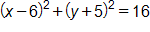
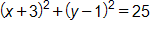
    A circle in the xy-plane has equation . Which of the following points does NOT lie in the interior of the circle?

    Correct answer: D

    Choice D is correct. The circle with equation has center and radius 5. For a point to be inside of the circle, the distance from that point to the center must be less than the radius, 5. The distance between and is, which is greater than 5. Therefore, does NOT lie in the interior of the circle.Choice A is incorrect. The distance between and is, which is less than 5, and therefore lies in the interior of the circle. Choice B is incorrect because it is the center of the circle. Choice C is incorrect because the distance between and is, which is less than 5, and therefore in the interior of the circle.
  5. Question 5

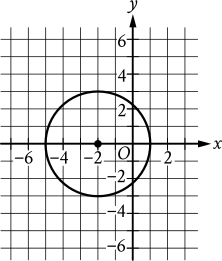
    The center of the circle is the point (-2, 0). Clockwise from top, the circle passes through the following points: (-2, 3) (1, 0) (-2, -3) (-5, 0) Circle A (shown) is defined by the equation \((x + 2)^2 + y ^2 = 9\). Circle B (not shown) is the result of shifting circle A down \(6\) units and increasing the radius so that the radius of circle B is \(2\) times the radius of circle A. Which equation defines circle B?

    Correct answer: A

    Choice A is correct. According to the graph, the center of circle A has coordinates \((-2, 0)\), and the radius of circle A is \(3\). It’s given that circle B is the result of shifting circle A down \(6\) units and increasing the radius so that the radius of circle B is \(2\) times the radius of circle A. It follows that the center of circle B is \(6\) units below the center of circle A. The point that's \(6\) units below \((-2, 0)\) has the same x-coordinate as \((-2, 0)\) and has a y-coordinate that is \(6\) less than the y-coordinate of \((-2, 0)\). Therefore, the coordinates of the center of circle B are \((-2, 0 -6)\), or \((-2, -6)\). Since the radius of circle B is \(2\) times the radius of circle A, the radius of circle B is \((2)(3)\). A circle in the xy-plane can be defined by an equation of the form \((x -h)^2 +(y -k)^2 = r ^2\), where the coordinates of the center of the circle are \((h, k)\) and the radius of the circle is \(r\). Substituting \(-2\) for \(h\), \(-6\) for \(k\), and \((2)(3)\) for \(r\) in this equation yields \((x -(-2))^2 +(y -(-6))^2 =((2)(3))^2\), which is equivalent to \((x + 2)^2 +(y + 6)^2 =(2)^2(3)^2\), or \((x + 2)^2 +(y + 6)^2 =(4)(9)\). Therefore, the equation \((x + 2)^2 +(y + 6)^2 =(4)(9)\) defines circle B. Choice B is incorrect and may result from conceptual or calculation errors. Choice C is incorrect. This equation defines a circle that’s the result of shifting circle A up, not down, by \(6\) units and increasing the radius. Choice D is incorrect and may result from conceptual or calculation errors.
  6. Question 6

    Points A and B lie on a circle with radius 1, and arc has length . What fraction of the circumference of the circle is the length of arc ?

    Correct answer: C

    The correct answer is . The circumference, C, of a circle is, where r is the length of the radius of the circle. For the given circle with a radius of 1, the circumference is, or . To find what fraction of the circumference the length of arc is, divide the length of the arc by the circumference, which gives . This division can be represented by . Note that 1/6, .1666, .1667, 0.166, and 0.167 are examples of ways to enter a correct answer.
  7. Question 7

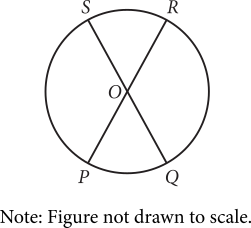
    The center of the circle is point O. Points S, R, Q, and P are on the circle. Line segment P R is a diameter of the circle. Line segment Q S is a diameter of the circle. Diameters P R and Q S intersect at point O. A note indicates the figure is not drawn to scale. The circle shown has center \(O\), circumference \(144π\), and diameters \(line segment P R\) and \(line segment Q S\). The length of arc \(P S\) is twice the length of arc \(P Q\). What is the length of arc \(Q R\)?

    Correct answer: B

    Choice B is correct. Since \(Line Segment P R\) and \(Line Segment Q S\) are diameters of the circle shown, \(Line Segment O S\), \(Line Segment O R\), \(Line Segment O P\), and \(Line Segment O Q\) are radii of the circle and are therefore congruent. Since \(angle S O P\) and \(angle R O Q\) are vertical angles, they are congruent. Therefore, arc \(P S\) and arc \(Q R\) are formed by congruent radii and have the same angle measure, so they are congruent arcs. Similarly, \(angle S O R\) and \(angle P O Q\) are vertical angles, so they are congruent. Therefore, arc \(S R\) and arc \(P Q\) are formed by congruent radii and have the same angle measure, so they are congruent arcs. Let \(x\) represent the length of arc \(S R\). Since arc \(S R\) and arc \(P Q\) are congruent arcs, the length of arc \(P Q\) can also be represented by \(x\). It’s given that the length of arc \(P S\) is twice the length of arc \(P Q\). Therefore, the length of arc \(P S\) can be represented by the expression \(2 x\). Since arc \(P S\) and arc \(Q R\) are congruent arcs, the length of arc \(Q R\) can also be represented by \(2 x\). This gives the expression \(x + x + 2 x + 2 x\). Since it's given that the circumference is \(144π\), the expression \(x + x + 2 x + 2 x\) is equal to \(144π\). Thus \(x + x + 2 x + 2 x = 144π\), or \(6 x = 144π\). Dividing both sides of this equation by \(6\) yields \(x = 24π\). Therefore, the length of arc \(Q R\) is \(2(24π)\), or \(48π\). Choice A is incorrect. This is the length of arc \(P Q\), not arc \(Q R\). Choice C is incorrect and may result from conceptual or calculation errors. Choice D is incorrect and may result from conceptual or calculation errors.
  8. Question 8

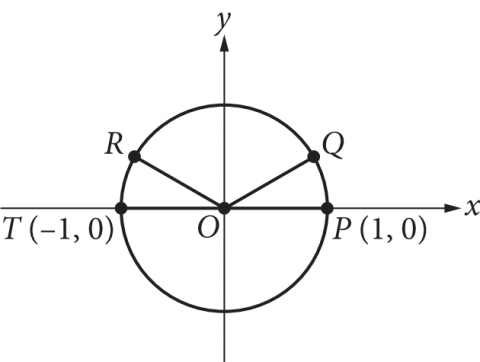
    In the xy-plane above, points P, Q, R, and T lie on the circle with center O. The ° measures of angles and are each 30°. What is the radian measure of angle ?

    Correct answer: C

    Choice C is correct. Because points T, O, and P all lie on the x-axis, they form a line. Since the angles on a line add up to, and it’s given that angles POQ and ROT each measure, it follows that the measure of angle QOR is . Since the arc of a complete circle is or radians, a proportion can be set up to convert the measure of angle QOR from °s to radians:, where x is the radian measure of angle QOR. Multiplying each side of the proportion by gives . Solving for x gives, or .Choice A is incorrect and may result from subtracting only angle POQ from to get a value of and then finding the radian measure equivalent to that value. Choice B is incorrect and may result from a calculation error. Choice D is incorrect and may result from calculating the sum of the angle measures, in radians, of angles POQ and ROT.
  9. Question 9

    The equation \(x ^2 +(y -2)^2 = 36\) represents circle A. Circle B is obtained by shifting circle A down \(4\) units in the xy-plane. Which of the following equations represents circle B?

    Correct answer: A

    Choice A is correct. The standard form of an equation of a circle in the xy-plane is \((x -h)^2 +(y -k)^2 = r ^2\), where the coordinates of the center of the circle are \((h, k)\) and the length of the radius of the circle is \(r\). The equation of circle A, \(x ^2 +(y -2)^2 = 36\), can be rewritten as \((x -0)^2 +(y -2)^2 = 6 ^2\). Therefore, the center of circle A is at \((0, 2)\) and the length of the radius of circle A is \(6\). If circle A is shifted down \(4\) units, the y-coordinate of its center will decrease by \(4\); the radius of the circle and the x-coordinate of its center will not change. Therefore, the center of circle B is at \((0, 2 -4)\), or \((0, -2)\), and its radius is \(6\). Substituting \(0\) for \(h\), \(-2\) for \(k\), and \(6\) for \(r\) in the equation \((x -h)^2 +(y -k)^2 = r ^2\) yields \((x -0)^2 +(y -(-2))^2 =(6)^2\), or \(x ^2 +(y + 2)^2 = 36\). Therefore, the equation \(x ^2 +(y + 2)^2 = 36\) represents circle B. Choice B is incorrect. This equation represents a circle obtained by shifting circle A up, rather than down, \(4\) units. Choice C is incorrect. This equation represents a circle obtained by shifting circle A right, rather than down, \(4\) units. Choice D is incorrect. This equation represents a circle obtained by shifting circle A left, rather than down, \(4\) units.
  10. Question 10

    In the xy-plane, a circle has center \(C\) with coordinates \((h, k)\). Points \(A\) and \(B\) lie on the circle. Point \(A\) has coordinates \((h + 1, k + √102 )\), and \(angle A C B\) is a right angle. What is the length of \(line segment A B\)?

    Correct answer: A

    Choice A is correct. It's given that points \(A\) and \(B\) lie on the circle with center \(C\). Therefore, \(line segment A C\) and \(line segment B C\) are both radii of the circle. Since all radii of a circle are congruent, \(line segment A C\) is congruent to \(line segment B C\). The length of \(line segment A C\), or the distance from point \(A\) to point \(C\), can be found using the distance formula, which gives the distance between two points, \((x_1, y_1)\) and \((x_2, y_2)\), as \(√(x_1 -x_2)^2 +(y_1 -y_2)^2\). Substituting the given coordinates of point \(A\), \((h + 1, k + √102 )\), for \((x_1, y_1)\) and the given coordinates of point \(C\), \((h, k)\), for \((x_2, y_2)\) in the distance formula yields \(√(h + 1 -h)^2 +(k + √102 -k)^2\), or \(√1 ^2 +(√102 )^2\), which is equivalent to \(√1 + 102\), or \(√103\). Therefore, the length of \(line segment A C\) is \(√103\) and the length of \(line segment B C\) is \(√103\). It's given that angle \(A C B\) is a right angle. Therefore, triangle \(A C B\) is a right triangle with legs \(line segment A C\) and \(line segment B C\) and hypotenuse \(line segment A B\). By the Pythagorean theorem, if a right triangle has a hypotenuse with length \(c\) and legs with lengths \(a\) and \(b\), then \(a ^2 + b ^2 = c ^2\). Substituting \(√103\) for \(a\) and \(b\) in this equation yields \((√103 )^2 +(√103 )^2 = c ^2\), or \(103 + 103 = c ^2\), which is equivalent to \(206 = c ^2\). Taking the positive square root of both sides of this equation yields \(√206 = c\). Therefore, the length of \(line segment A B\) is \(√206\). Choice B is incorrect and may result from conceptual or calculation errors. Choice C is incorrect. This would be the length of \(line segment A B\) if the length of \(line segment A C\) were \(103\), not \(√103\). Choice D is incorrect and may result from conceptual or calculation errors.
  11. Question 11

    A circle in the xy-plane has its center at \((-5, 2)\) and has a radius of \(9\). An equation of this circle is \(x ^2 + y ^2 + a x + b y + c = 0\), where \(a\), \(b\), and \(c\) are constants. What is the value of \(c\)?

    Correct answer: B

    The correct answer is \(-52\). The equation of a circle in the xy-plane with its center at \((h, k)\) and a radius of \(r\) can be written in the form \((x -h)^2 +(y -k)^2 = r ^2\). It's given that a circle in the xy-plane has its center at \((-5, 2)\) and has a radius of \(9\). Substituting \(-5\) for \(h\), \(2\) for \(k\), and \(9\) for \(r\) in the equation \((x -h)^2 +(y -k)^2 = r ^2\) yields \((x -(-5))^2 +(y -2)^2 = 9 ^2\), or \((x + 5)^2 +(y -2)^2 = 81\). It's also given that an equation of this circle is \(x ^2 + y ^2 + a x + b y + c = 0\), where \(a\), \(b\), and \(c\) are constants. Therefore, \((x + 5)^2 +(y -2)^2 = 81\) can be rewritten in the form \(x ^2 + y ^2 + a x + b y + c = 0\). The equation \((x + 5)^2 +(y -2)^2 = 81\), or \((x + 5)(x + 5)+(y -2)(y -2)= 81\), can be rewritten as \(x ^2 + 5 x + 5 x + 25 + y ^2 -2 y -2 y + 4 = 81\). Combining like terms on the left-hand side of this equation yields \(x ^2 + y ^2 + 10 x -4 y + 29 = 81\). Subtracting \(81\) from both sides of this equation yields \(x ^2 + y ^2 + 10 x -4 y -52 = 0\), which is equivalent to \(x ^2 + y ^2 + 10 x +(-4)y +(-52)= 0\). This equation is in the form \(x ^2 + y ^2 + a x + b y + c = 0\). Therefore, the value of \(c\) is \(-52\).
  12. Question 12

    In the xy-plane, the graph of the equation above is a circle. Point P is on the circle and has coordinates . If is a diameter of the circle, what are the coordinates of point Q ?

    Correct answer: A

    Choice A is correct. The standard form for the equation of a circle is, where are the coordinates of the center and r is the length of the radius. According to the given equation, the center of the circle is . Let represent the coordinates of point Q. Since point P and point Q are the endpoints of a diameter of the circle, the center lies on the diameter, halfway between P and Q. Therefore, the following relationships hold: and . Solving the equations for and, respectively, yields and . Therefore, the coordinates of point Q are .Alternate approach: Since point P on the circle and the center of the circle have the same y-coordinate, it follows that the radius of the circle is . In addition, the opposite end of the diameter must have the same y-coordinate as P and be 4 units away from the center. Hence, the coordinates of point Q must be .Choices B and D are incorrect because the points given in these choices lie on a diameter that is perpendicular to the diameter . If either of these points were point Q, then would not be the diameter of the circle. Choice C is incorrect because is the center of the circle and does not lie on the circle.
  13. Question 13

    Which of the following equations represents a circle in the xy-plane that intersects the y-axis at exactly one point?

    Correct answer: C

    Choice C is correct. The graph of the equation \((x -h)^2 +(y -k)^2 = r ^2\) in the xy-plane is a circle with center \((h, k)\) and a radius of length \(r\). The radius of a circle is the distance from the center of the circle to any point on the circle. If a circle in the xy-plane intersects the y-axis at exactly one point, then the perpendicular distance from the center of the circle to this point on the y-axis must be equal to the length of the circle's radius. It follows that the x-coordinate of the circle's center must be equivalent to the length of the circle's radius. In other words, if the graph of \((x -h)^2 +(y -k)^2 = r ^2\) is a circle that intersects the y-axis at exactly one point, then \(r = StartAbsoluteValue h EndAbsoluteValue\) must be true. The equation in choice C is \((x -4)^2 +(y -9)^2 = 16\), or \((x -4)^2 +(y -9)^2 = 4 ^2\). This equation is in the form \((x -h)^2 +(y -k)^2 = r ^2\), where \(h = 4\), \(k = 9\), and \(r = 4\), and represents a circle in the xy-plane with center \((4, 9)\) and radius of length \(4\). Substituting \(4\) for \(r\) and \(4\) for \(h\) in the equation \(r = StartAbsoluteValue h EndAbsoluteValue\) yields \(4 = StartAbsoluteValue 4 EndAbsoluteValue\), or \(4 = 4\), which is true. Therefore, the equation in choice C represents a circle in the xy-plane that intersects the y-axis at exactly one point. Choice A is incorrect. This is the equation of a circle that does not intersect the y-axis at any point. Choice B is incorrect. This is an equation of a circle that intersects the x-axis, not the y-axis, at exactly one point. Choice D is incorrect. This is the equation of a circle with the center located on the y-axis and thus intersects the y-axis at exactly two points, not exactly one point.
  14. Question 14

    In the xy-plane, a circle with radius 5 has center . Which of the following is an equation of the circle?

    Correct answer: B

    Choice B is correct. An equation of a circle is, where the center of the circle is and the radius is r. It’s given that the center of this circle is and the radius is 5. Substituting these values into the equation gives, or .Choice A is incorrect. This is an equation of a circle that has center . Choice C is incorrect. This is an equation of a circle that has center and radius . Choice D is incorrect. This is an equation of a circle that has radius .
  15. Question 15

    A circle has center \(O\), and points \(A\) and \(B\) lie on the circle. The measure of arc \(AB\) is \(45∘\) and the length of arc \(AB\) is \(3\) inches. What is the circumference, in inches, of the circle?

    Correct answer: D

    Choice D is correct. It’s given that the measure of arc \(A B\) is \(45 °\) and the length of arc \(A B\) is \(3 inches\). The arc measure of the full circle is \(360 °\). If \(x\) represents the circumference, in inches, of the circle, it follows that \(45 °/360 ° = 3 inches/x inches\). This equation is equivalent to \(45/360 = 3/x\), or \(1 eighth = 3/x\). Multiplying both sides of this equation by \(8 x\) yields \(1(x)= 3(8)\), or \(x = 24\). Therefore, the circumference of the circle is \(24 inches\). Choice A is incorrect. This is the length of arc \(A B\). Choice B is incorrect and may result from multiplying the length of arc \(A B\) by \(2\). Choice C is incorrect and may result from squaring the length of arc \(A B\).
  16. Question 16

    A circle has center \(G\), and points \(M\) and \(N\) lie on the circle. Line segments \(M H\) and \(N H\) are tangent to the circle at points \(M\) and \(N\), respectively. If the radius of the circle is \(168\) millimeters and the perimeter of quadrilateral \(G M H N\) is \(3,856\) millimeters, what is the distance, in millimeters, between points \(G\) and \(H\)?

    Correct answer: D

    Choice D is correct. It's given that the radius of the circle is \(168\) millimeters. Since points \(M\) and \(N\) both lie on the circle, segments \(G M\) and \(G N\) are both radii. Therefore, segments \(G M\) and \(G N\) each have length \(168\) millimeters. Two segments that are tangent to a circle and have a common exterior endpoint have equal length. Therefore, segment \(M H\) and segment \(N H\) have equal length. Let \(x\) represent the length of segment \(M H\). Then \(x\) also represents the length of segment \(N H\). It's given that the perimeter of quadrilateral \(G M H N\) is \(3,856\) millimeters. Since the perimeter of a quadrilateral is equal to the sum of the lengths of the sides of the quadrilateral, \(3,856 = 168 + 168 + x + x\), or \(3,856 = 336 + 2 x\). Subtracting \(336\) from both sides of this equation yields \(3,520 = 2 x\), and dividing both sides of this equation by \(2\) yields \(1,760 = x\). Therefore, the length of segment \(M H\) is \(1,760\) millimeters. A line segment that's tangent to a circle is perpendicular to the radius of the circle at the point of tangency. Therefore, segment \(G M\) is perpendicular to segment \(M H\). Since perpendicular segments form right angles, angle \(G M H\) is a right angle. Therefore, triangle \(G M H\) is a right triangle with legs of length \(1,760\) millimeters and \(168\) millimeters, and hypotenuse \(G H\). By the Pythagorean theorem, if a right triangle has a hypotenuse with length \(c\) and legs with lengths \(a\) and \(b\), then \(a ^2 + b ^2 = c ^2\). Substituting \(1,760\) for \(a\) and \(168\) for \(b\) in this equation yields \(1,760 ^2 + 168 ^2 = c ^2\), or \(3,125,824 = c ^2\). Taking the square root of both sides of this equation yields \(+ or -1,768 = c\). Since \(c\) represents a length, which must be positive, the value of \(c\) is \(1,768\). Therefore, the length of segment \(G H\) is \(1,768\) millimeters, so the distance between points \(G\) and \(H\) is \(1,768\) millimeters. Choice A is incorrect. This is the distance between points \(G\) and \(M\) and between points \(G\) and \(N\), not the distance between points \(G\) and \(H\). Choice B is incorrect and may result from conceptual or calculation errors. Choice C is incorrect. This is the distance between points \(M\) and \(H\) and between points \(N\) and \(H\), not the distance between points \(G\) and \(H\).
  17. Question 17

    What is the value of \(tangent 92π/3\)?

    Correct answer: A

    Choice A is correct. A trigonometric ratio can be found using the unit circle, that is, a circle with radius \(1\) unit. If a central angle of a unit circle in the xy-plane centered at the origin has its starting side on the positive x-axis and its terminal side intersects the circle at a point \((x, y)\), then the value of the tangent of the central angle is equal to the y-coordinate divided by the x-coordinate. There are \(2π\) radians in a circle. Dividing \(92π/3\) by \(2π\) yields \(92/6\), which is equivalent to \(15 + 2 thirds\). It follows that on the unit circle centered at the origin in the xy-plane, the angle \(92π/3\) is the result of \(15\) revolutions from its starting side on the positive x-axis followed by a rotation through \(2π/3\) radians. Therefore, the angles \(92π/3\) and \(2π/3\) are coterminal angles and \(tangent(92π/3)\) is equal to \(tangent(2π/3)\). Since \(2π/3\) is greater than \(π/2\) and less than \(π\), it follows that the terminal side of the angle is in quadrant II and forms an angle of \(π/3\), or \(60 °\), with the -x-axis. Therefore, the terminal side of the angle intersects the unit circle at the point \((-1 half, √3 /2)\). It follows that the value of \(tangent(2π/3)\) is \(\√3 /2/ -1 half\), which is equivalent to \(-√3\). Therefore, the value of \(tangent(92π/3)\) is \(-√3\). Choice B is incorrect. This is the value of \(1/tangent(92π/3)\), not \(tangent(92π/3)\). Choice C is incorrect. This is the value of \(1/tangent(π/3)\), not \(tangent(92π/3)\). Choice D is incorrect. This is the value of \(tangent(π/3)\), not \(tangent(92π/3)\).
  18. Question 18

    The equation \(x ^2 +(y -1)^2 = 49\) represents circle A. Circle B is obtained by shifting circle A down \(2\) units in the xy-plane. Which of the following equations represents circle B?

    Correct answer: D

    Choice D is correct. The graph in the xy-plane of an equation of the form \((x -h)^2 +(y -k)^2 = r ^2\) is a circle with center \((h, k)\) and a radius of length \(r\). It's given that circle A is represented by \(x ^2 +(y -1)^2 = 49\), which can be rewritten as \(x ^2 +(y -1)^2 = 7 ^2\). Therefore, circle A has center \((0, 1)\) and a radius of length \(7\). Shifting circle A down two units is a rigid vertical translation of circle A that does not change its size or shape. Since circle B is obtained by shifting circle A down two units, it follows that circle B has the same radius as circle A, and for each point \((x, y)\) on circle A, the point \((x, y -2)\) lies on circle B. Moreover, if \((h, k)\) is the center of circle A, then \((h, k -2)\) is the center of circle B. Therefore, circle B has a radius of \(7\) and the center of circle B is \((0, 1 -2)\), or \((0, -1)\). Thus, circle B can be represented by the equation \(x ^2 +(y + 1)^2 = 7 ^2\), or \(x ^2 +(y + 1)^2 = 49\). Choice A is incorrect. This is the equation of a circle obtained by shifting circle A right \(2\) units. Choice B is incorrect. This is the equation of a circle obtained by shifting circle A up \(2\) units. Choice C is incorrect. This is the equation of a circle obtained by shifting circle A left \(2\) units.
  19. Question 19

    The measure of angle \(R\) is \(2π/3\) radians. The measure of angle \(T\) is \(5π/12\) radians greater than the measure of angle \(R\). What is the measure of angle \(T\), in °s?

    Correct answer: C

    Choice C is correct. It’s given that the measure of angle \(R\) is \(2π/3\) radians, and the measure of angle \(T\) is \(5π/12\) radians greater than the measure of angle \(R\). Therefore, the measure of angle \(T\) is equal to \(2π/3 + 5π/12\) radians. Multiplying \(2π/3\) by \(4 fourths\) to get a common denominator with \(5π/12\) yields \(8π/12\). Therefore, \(2π/3 + 5π/12\) is equivalent to \(8π/12 + 5π/12\), or \(13π/12\). Therefore, the measure of angle \(T\) is \(13π/12\) radians. The measure of angle \(T\), in °s, can be found by multiplying its measure, in radians, by \(180/π\). This yields \(13π/12 times 180/π\), which is equivalent to \(195\) °s. Therefore, the measure of angle \(T\) is \(195\) °s. Choice A is incorrect. This is the number of °s that the measure of angle \(T\) is greater than the measure of angle \(R\). Choice B is incorrect. This is the measure of angle \(R\), in °s. Choice D is incorrect and may result from conceptual or calculation errors.
  20. Question 20

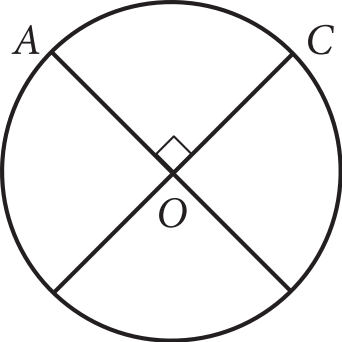
    The circle above with center O has a circumference of 36. What is the length of minor arc ?

    Correct answer: A

    Choice A is correct. A circle has 360 °s of arc. In the circle shown, O is the center of the circle and is a central angle of the circle. From the figure, the two diameters that meet to form are perpendicular, so the measure of is . Therefore, the length of minor arc is of the circumference of the circle. Since the circumference of the circle is 36, the length of minor arc is .Choices B, C, and D are incorrect. The perpendicular diameters divide the circumference of the circle into four equal arcs; therefore, minor arc is of the circumference. However, the lengths in choices B and C are, respectively, and the circumference of the circle, and the length in choice D is the length of the entire circumference. None of these lengths is the circumference.
  21. Question 21

    An angle has a measure of \(16π/15\) radians. What is the measure of the angle, in °s?

    Correct answer: C

    The correct answer is \(192\). The measure of an angle, in °s, can be found by multiplying its measure, in radians, by \(180 °s/π radians\). Multiplying the given angle measure, \(16π/15 radians\), by \(180 °s/π radians\) yields \((16π/15 radians)(180 °s/π r a d i a n s)\), which simplifies to \(192\) °s.
  22. Question 22

    An angle has a measure of \(9π/20\) radians. What is the measure of the angle in °s?

    Correct answer: D

    The correct answer is \(81\). The measure of an angle, in °s, can be found by multiplying its measure, in radians, by \(180 °s/π radians\). Multiplying the given angle measure, \(9π/20\) radians, by \(180 °s/π radians\) yields \((9π/20 radians)(180 °s/π radians)\), which is equivalent to \(81\) °s.
  23. Question 23

    In the xy-plane, the graph of is a circle. What is the radius of the circle?

    Correct answer: A

    Choice A is correct. One way to find the radius of the circle is to rewrite the given equation in standard form,, where is the center of the circle and the radius of the circle is r. To do this, divide the original equation,, by 2 to make the leading coefficients of and each equal to 1: . Then complete the square to put the equation in standard form. To do so, first rewrite as . Second, add 2.25 and 0.25 to both sides of the equation: . Since,, and, it follows that . Therefore, the radius of the circle is 5.Choices B, C, and D are incorrect and may be the result of errors in manipulating the equation or of a misconception about the standard form of the equation of a circle in the xy-plane.
  24. Question 24

    A circle has center \(O\), and points \(R\) and \(S\) lie on the circle. In triangle \(O R S\), the measure of \(angle R O S\) is \(88 °\). What is the measure of \(angle R S O\), in °s? (Disregard the ° symbol when entering your answer.)

    Correct answer: D

    The correct answer is \(46\). It's given that \(O\) is the center of a circle and that points \(R\) and \(S\) lie on the circle. Therefore, \(ModifyingAbove O R With bar\) and \(ModifyingAbove O S With bar\) are radii of the circle. It follows that \(O R = O S\). If two sides of a triangle are congruent, then the angles opposite them are congruent. It follows that the angles \(angle R S O\) and \(angle O R S\), which are across from the sides of equal length, are congruent. Let \(x °\) represent the measure of \(angle R S O\). It follows that the measure of \(angle O R S\) is also \(x °\). It's given that the measure of \(angle R O S\) is \(88 °\). Because the sum of the measures of the interior angles of a triangle is \(180 °\), the equation \(x ° + x ° + 88 ° = 180 °\), or \(2 x + 88 = 180\), can be used to find the measure of \(angle R S O\). Subtracting \(88\) from both sides of this equation yields \(2 x = 92\). Dividing both sides of this equation by \(2\) yields \(x = 46\). Therefore, the measure of \(angle R S O\), in °s, is \(46\).
  25. Question 25

    The number of radians in a 720-° angle can be written as, where a is a constant. What is the value of a ?

    Correct answer: B

    The correct answer is 4. There are radians in a angle. An angle measure of is 4 times greater than an angle measure of . Therefore, the number of radians in a angle is .
  26. Question 26

    A circle in the xy-plane has its center at \((-4, -6)\). Line \(k\) is tangent to this circle at the point \((-7, -7)\). What is the slope of line \(k\)?

    Correct answer: A

    Choice A is correct. A line that's tangent to a circle is perpendicular to the radius of the circle at the point of tangency. It's given that the circle has its center at \((-4, -6)\) and line \(k\) is tangent to the circle at the point \((-7, -7)\). The slope of a radius defined by the points \((q, r)\) and \((s, t)\) can be calculated as \(t -r/s -q\). The points \((-7, -7)\) and \((-4, -6)\) define the radius of the circle at the point of tangency. Therefore, the slope of this radius can be calculated as \((-6)-(-7)/(-4)-(-7)\), or \(1 third\). If a line and a radius are perpendicular, the slope of the line must be the negative reciprocal of the slope of the radius. The negative reciprocal of \(1 third\) is \(-3\). Thus, the slope of line \(k\) is \(-3\). Choice B is incorrect and may result from conceptual or calculation errors. Choice C is incorrect. This is the slope of the radius of the circle at the point of tangency, not the slope of line \(k\). Choice D is incorrect and may result from conceptual or calculation errors.
  27. Question 27

    A circle in the xy-plane has the equation \((x -13)^2 +(y -k)^2 = 64\). Which of the following gives the center of the circle and its radius?

    Correct answer: A

    Choice A is correct. For a circle in the xy-plane that has the equation \((x -h)^2 +(y -k)^2 = r ^2\), where \(h\), \(k\), and \(r\) are constants, \((h, k)\) is the center of the circle and the positive value of \(r\) is the radius of the circle. In the given equation, \(h = 13\) and \(r ^2 = 64\). Taking the square root of each side of \(r ^2 = 64\) yields \(r = + or -8\). Therefore, the center of the circle is at \((13, k)\) and the radius is \(8\). Choice B is incorrect. This gives the center and radius of a circle with equation \((x -k)^2 +(y -13)^2 = 64\), not \((x -13)^2 +(y -k)^2 = 64\). Choice C is incorrect. This gives the center and radius of a circle with equation \((x -k)^2 +(y -13)^2 = 4,096\), not \((x -13)^2 +(y -k)^2 = 64\). Choice D is incorrect. This gives the center and radius of a circle with equation \((x -13)^2 +(y -k)^2 = 4,096\), not \((x -13)^2 +(y -k)^2 = 64\).
  28. Question 28

    The equation defines a circle in the xy‑plane. What is the radius of the circle?

    Correct answer: A

    The correct answer is 11. A circle with equation, where a, b, and r are constants, has center and radius r. Therefore, the radius of the given circle is, or 11.
  29. Question 29

    Point \(O\) is the center of a circle. The measure of arc \(R S\) on this circle is \(100 °\). What is the measure, in °s, of its associated angle \(R O S\)?

    Correct answer: A

    The correct answer is \(100\). It's given that point \(O\) is the center of a circle and the measure of arc \(R S\) on the circle is \(100 °\). It follows that points \(R\) and \(S\) lie on the circle. Therefore, \(ModifyingAbove O R With bar\) and \(ModifyingAbove O S With bar\) are radii of the circle. A central angle is an angle formed by two radii of a circle, with its vertex at the center of the circle. Therefore, \(angle R O S\) is a central angle. Because the ° measure of an arc is equal to the measure of its associated central angle, it follows that the measure, in °s, of \(angle R O S\) is \(100\).
  30. Question 30

    What is the diameter of the circle in the xy-plane with equation \((x -5)^2 +(y -3)^2 = 16\)?

    Correct answer: B

    Choice B is correct. The standard form of an equation of a circle in the xy-plane is \((x -h)^2 +(y -k)^2 = r ^2\), where the coordinates of the center of the circle are \((h, k)\) and the length of the radius of the circle is \(r\). For the circle in the xy-plane with equation \((x -5)^2 +(y -3)^2 = 16\), it follows that \(r ^2 = 16\). Taking the square root of both sides of this equation yields \(r = 4\) or \(r = -4\). Because \(r\) represents the length of the radius of the circle and this length must be positive, \(r = 4\). Therefore, the radius of the circle is \(4\). The diameter of a circle is twice the length of the radius of the circle. Thus, \(2(4)\) yields \(8\). Therefore, the diameter of the circle is \(8\). Choice A is incorrect. This is the radius of the circle. Choice C is incorrect. This is the square of the radius of the circle. Choice D is incorrect and may result from conceptual or calculation errors.
  31. Question 31

    Circle A in the xy-plane has the equation \((x + 5)^2 +(y -5)^2 = 4\). Circle B has the same center as circle A. The radius of circle B is two times the radius of circle A. The equation defining circle B in the xy-plane is \((x + 5)^2 +(y -5)^2 = k\), where \(k\) is a constant. What is the value of \(k\)?

    Correct answer: D

    The correct answer is \(16\). An equation of a circle in the xy-plane can be written as \((x -t)^2 +(y -u)^2 = r ^2\), where the center of the circle is \((t, u)\), the radius of the circle is \(r\), and where \(t\), \(u\), and \(r\) are constants. It’s given that the equation of circle A is \((x + 5)^2 +(y -5)^2 = 4\), which is equivalent to \((x + 5)^2 +(y -5)^2 = 2 ^2\). Therefore, the center of circle A is \((-5, 5)\) and the radius of circle A is \(2\). It’s given that circle B has the same center as circle A and that the radius of circle B is two times the radius of circle A. Therefore, the center of circle B is \((-5, 5)\) and the radius of circle B is \(2(2)\), or \(4\). Substituting \(-5\) for \(t\), \(5\) for \(u\), and \(4\) for \(r\) into the equation \((x -t)^2 +(y -u)^2 = r ^2\) yields \((x + 5)^2 +(y -5)^2 = 4 ^2\), which is equivalent to \((x + 5)^2 +(y -5)^2 = 16\). It follows that the equation of circle B in the xy-plane is \((x + 5)^2 +(y -5)^2 = 16\). Therefore, the value of \(k\) is \(16\).
  32. Question 32

    A circle in the xy-plane has a diameter with endpoints \((2, 4)\) and \((2, 14)\). An equation of this circle is \((x -2)^2 +(y -9)^2 = r ^2\), where \(r\) is a positive constant. What is the value of \(r\)?

    Correct answer: B

    The correct answer is \(5\). The standard form of an equation of a circle in the xy-plane is \((x -h)^2 +(y -k)^2 = r ^2\), where \(h\), \(k\), and \(r\) are constants, the coordinates of the center of the circle are \((h, k)\), and the length of the radius of the circle is \(r\). It′s given that an equation of the circle is \((x -2)^2 +(y -9)^2 = r ^2\). Therefore, the center of this circle is \((2, 9)\). It’s given that the endpoints of a diameter of the circle are \((2, 4)\) and \((2, 14)\). The length of the radius is the distance from the center of the circle to an endpoint of a diameter of the circle, which can be found using the distance formula, \(√(x_1 -x_2)^2 +(y_1 -y_2)^2\). Substituting the center of the circle \((2, 9)\) and one endpoint of the diameter \((2, 4)\) in this formula gives a distance of \(√(2 -2)^2 +(9 -4)^2\), or \(√0 ^2 + 5 ^2\), which is equivalent to \(5\). Since the distance from the center of the circle to an endpoint of a diameter is \(5\), the value of \(r\) is \(5\).
  33. Question 33

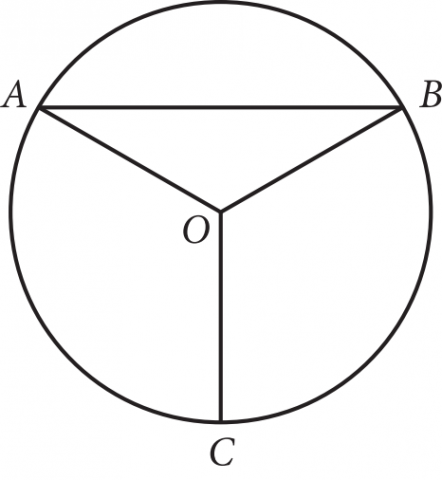
    Point O is the center of the circle above, and the measure of is . If the length of is 18, what is the length of arc ?

    Correct answer: B

    Choice B is correct. Because segments OA and OB are radii of the circle centered at point O, these segments have equal lengths. Therefore, triangle AOB is an isosceles triangle, where angles OAB and OBA are congruent base angles of the triangle. It’s given that angle OAB measures . Therefore, angle OBA also measures . Let represent the measure of angle AOB. Since the sum of the measures of the three angles of any triangle is, it follows that, or . Subtracting from both sides of this equation yields, or radians. Therefore, the measure of angle AOB, and thus the measure of arc, is radians. Since is a radius of the given circle and its length is 18, the length of the radius of the circle is 18. Therefore, the length of arc can be calculated as, or .Choices A, C, and D are incorrect and may result from conceptual or computational errors.
  34. Question 34

    The equation above defines a circle in the xy-plane. What are the coordinates of the center of the circle?

    Correct answer: B

    Choice B is correct. The standard equation of a circle in the xy-plane is of the form, where are the coordinates of the center of the circle and r is the radius. The given equation can be rewritten in standard form by completing the squares. So the sum of the first two terms,, needs a 100 to complete the square, and the sum of the second two terms,, needs a 64 to complete the square. Adding 100 and 64 to both sides of the given equation yields, which is equivalent to . Therefore, the coordinates of the center of the circle are .Choices A, C, and D are incorrect and may result from computational errors made when attempting to complete the squares or when identifying the coordinates of the center.
  35. Question 35

    \((x + 4)^2 +(y -19)^2 = 121\) The graph of the given equation is a circle in the xy-plane. The point \((a, b)\) lies on the circle. Which of the following is a possible value for \(a\)?

    Correct answer: B

    Choice B is correct. An equation of the form \((x -h)^2 +(y -k)^2 = r ^2\), where \(h\), \(k\), and \(r\) are constants, represents a circle in the xy-plane with center \((h, k)\) and radius \(r\). Therefore, the circle represented by the given equation has center \((-4, 19)\) and radius \(11\). Since the center of the circle has an x-coordinate of \(-4\) and the radius of the circle is \(11\), the least possible x-coordinate for any point on the circle is \(-4 -11\), or \(-15\). Similarly, the greatest possible x-coordinate for any point on the circle is \(-4 + 11\), or \(7\). Therefore, if the point \((a, b)\) lies on the circle, it must be true that \(-15 < or = a < or = 7\). Of the given choices, only \(-14\) satisfies this inequality. Choice A is incorrect and may result from conceptual or calculation errors. Choice C is incorrect and may result from conceptual or calculation errors. Choice D is incorrect and may result from conceptual or calculation errors.
  36. Question 36

    The graph of \(x ^2 + x + y ^2 + y = 199/2\) in the xy-plane is a circle. What is the length of the circle’s radius?

    Correct answer: A

    The correct answer is \(10\). It's given that the graph of \(x ^2 + x + y ^2 + y = 199/2\) in the xy-plane is a circle. The equation of a circle in the xy-plane can be written in the form \((x -h)^2 +(y -k)^2 = r ^2\), where the coordinates of the center of the circle are \((h, k)\) and the length of the radius of the circle is \(r\). The term \((x -h)^2\) in this equation can be obtained by adding the square of half the coefficient of \(x\) to both sides of the given equation to complete the square. The coefficient of \(x\) is \(1\). Half the coefficient of \(x\) is \(1 half\). The square of half the coefficient of \(x\) is \(1 fourth\). Adding \(1 fourth\) to each side of \((x ^2 + x)+(y ^2 + y)= 199/2\) yields \((x ^2 + x + 1 fourth)+(y ^2 + y)= 199/2 + 1 fourth\), or \((x + 1 half)^2 +(y ^2 + y)= 199/2 + 1 fourth\). Similarly, the term \((y -k)^2\) can be obtained by adding the square of half the coefficient of \(y\) to both sides of this equation, which yields \((x + 1 half)^2 +(y ^2 + y + 1 fourth)= 199/2 + 1 fourth + 1 fourth\), or \((x + 1 half)^2 +(y + 1 half)^2 = 199/2 + 1 fourth + 1 fourth\). This equation is equivalent to \((x + 1 half)^2 +(y + 1 half)^2 = 100\), or \((x + 1 half)^2 +(y + 1 half)^2 = 10 ^2\). Therefore, the length of the circle's radius is \(10\).
  37. Question 37

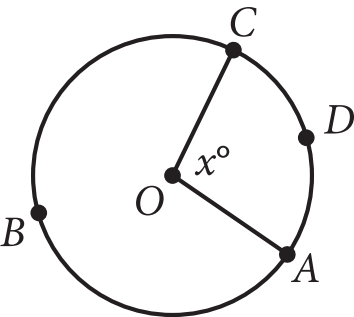
    The circle above has center O, the length of arc is, and . What is the length of arc ?

    Correct answer: B

    Choice B is correct. The ratio of the lengths of two arcs of a circle is equal to the ratio of the measures of the central angles that subtend the arcs. It’s given that arc is subtended by a central angle with measure 100°. Since the sum of the measures of the angles about a point is 360°, it follows that arc is subtended by a central angle with measure . If s is the length of arc, then s must satisfy the ratio . Reducing the fraction to its simplest form gives . Therefore, . Multiplying both sides of by yields .Choice A is incorrect. This is the length of an arc consisting of exactly half of the circle, but arc is greater than half of the circle. Choice C is incorrect. This is the total circumference of the circle. Choice D is incorrect. This is half the length of arc, not its full length.
  38. Question 38

    Points \(Q\) and \(R\) lie on a circle with center \(P\). The radius of this circle is \(9\) inches. Triangle \(P Q R\) has a perimeter of \(31\) inches. What is the length, in inches, of \(line segment Q R\)?

    Correct answer: B

    Choice B is correct. Since it's given that \(P\) is the center of a circle with a radius of \(9\) inches, and that points \(Q\) and \(R\) lie on that circle, it follows that \(line segment P Q\) and \(line segment R P\) of triangle \(P Q R\) each have a length of \(9\) inches. Let the length of \(line segment Q R\) be \(x\) inches. It follows that the perimeter of triangle \(P Q R\) is \(9 + 9 + x\) inches. Since it's given that the perimeter of triangle \(P Q R\) is \(31\) inches, it follows that \(9 + 9 + x = 31\), or \(18 + x = 31\). Subtracting \(18\) from both sides of this equation gives \(x = 13\). Therefore, the length, in inches, of \(line segment Q R\) is \(13\). Choice A is incorrect and may result from conceptual or calculation errors. Choice C is incorrect and may result from conceptual or calculation errors. Choice D is incorrect and may result from conceptual or calculation errors.
  39. Question 39

    A circle in the xy-plane has its center at \((-1, 1)\). Line \(t\) is tangent to this circle at the point \((5, -4)\). Which of the following points also lies on line \(t\)?

    Correct answer: C

    Choice C is correct. It’s given that the circle has its center at \((-1, 1)\) and that line \(t\) is tangent to this circle at the point \((5, -4)\). Therefore, the points \((-1, 1)\) and \((5, -4)\) are the endpoints of the radius of the circle at the point of tangency. The slope of a line or line segment that contains the points \((a, b)\) and \((c, d)\) can be calculated as \(d -b/c -a\). Substituting \((-1, 1)\) for \((a, b)\) and \((5, -4)\) for \((c, d)\) in the expression \(d -b/c -a\) yields \(\ -4 -1/5 -(-1)\), or \(-5 sixths\). Thus, the slope of this radius is \(-5 sixths\). A line that’s tangent to a circle is perpendicular to the radius of the circle at the point of tangency. It follows that line \(t\) is perpendicular to the radius at the point \((5, -4)\), so the slope of line \(t\) is the negative reciprocal of the slope of this radius. The negative reciprocal of \(-5 sixths\) is \(6 fifths\). Therefore, the slope of line \(t\) is \(6 fifths\). Since the slope of line \(t\) is the same between any two points on line \(t\), a point lies on line \(t\) if the slope of the line segment connecting the point and \((5, -4)\) is \(6 fifths\). Substituting choice C, \((10, 2)\), for \((a, b)\) and \((5, -4)\) for \((c, d)\) in the expression \(d -b/c -a\) yields \(\ -4 -2/5 -10\), or \(6 fifths\). Therefore, the point \((10, 2)\) lies on line \(t\). Choice A is incorrect. The slope of the line segment connecting \((0, 6 fifths)\) and \((5, -4)\) is \(\ -4 -6 fifths/5 -0\), or \(-26/25\), not \(6 fifths\). Choice B is incorrect. The slope of the line segment connecting \((4, 7)\) and \((5, -4)\) is \(\ -4 -7/5 -4\), or \(-11\), not \(6 fifths\). Choice D is incorrect. The slope of the line segment connecting \((11, 1)\) and \((5, -4)\) is \(\ -4 -1/5 -11\), or \(5 sixths\), not \(6 fifths\).

About this practice test

Here is a list of medium and hard labeled circle questions that appear on the SAT

Want a higher score?

One-on-one tutoring for SAT, online or in person, with a plan built around the questions you missed.

Get Started

Book Your Free Session

5.0
from 38 Google reviews

Call or Text 1 (888) 356-0607