Skip to content

SAT practice test

11th Grade SAT Math Diagnostic Quiz

  • 18 questions
  • Untimed
  • Answers and explanations
Embed on your site
  • 18 questions
  • No time limit
  • Every answer explained at the end
  1. Question 1

    Given the function \(g(x) = \sqrt{x^2 - 9}\), what is the range of \(g(x)\)?

    Correct answer: A

    The expression under the square root must be non-negative, so \(x^2 - 9 \geq 0\). This means \(x \leq -3\) or \(x \geq 3\). The range of \(g(x)\) starts from \(0\) and extends to infinity.
  2. Question 2

    Which expression is equivalent to \(17(x ^2 -100 y ^2)\)?

    Correct answer: D

    Choice D is correct. Expressions in the form \(a ^2 -b ^2\) follow the difference of two squares pattern and can be factored as \((a -b)(a + b)\). In the given expression, \(17(x ^2 -100 y ^2)\), the expression \(x ^2 -100 y ^2\) follows the difference of two squares pattern. It follows that the expression \(x ^2 -100 y ^2\) can be rewritten as \((x -10 y)(x + 10 y)\). Therefore, the expression \(17(x -10 y)(x + 10 y)\) is equivalent to \(17(x ^2 -100 y ^2)\). Choice A is incorrect. This expression is equivalent to \(17(x ^2 -52 x y + 100 y ^2)\), not \(17(x ^2 -100 y ^2)\). Choice B is incorrect. This expression is equivalent to \(17(x ^2 + 48 x y -100 y ^2)\), not \(17(x ^2 -100 y ^2)\). Choice C is incorrect. This expression is equivalent to \(17(x ^2 -20 x y + 100 y ^2)\), not \(17(x ^2 -100 y ^2)\).
  3. Question 3

    What is the solution set for the inequality \(2x^2 - 5x - 3 \geq 0\)?

    Correct answer: C

    First solve the equality \(2x^2 - 5x - 3 = 0\) to find critical points, then test intervals around these points. The critical points are \(x = -\frac{1}{2}\) and \(x = 3\). Testing intervals gives the solution \(x \leq -\frac{1}{2}\) or \(x \geq 3\).
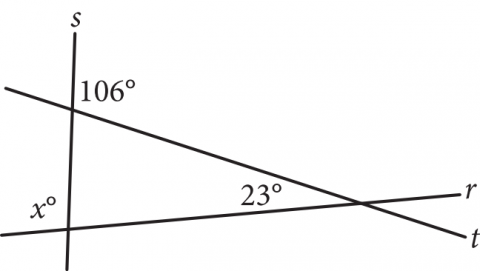
  4. Question 4

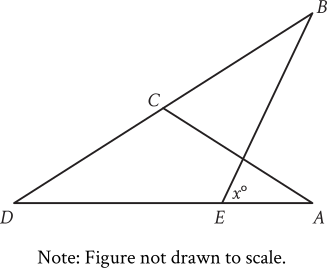
    What is the value of x ?

    Correct answer: D

    The correct answer is 97. The intersecting lines form a triangle, and the angle with measure of is an exterior angle of this triangle. The measure of an exterior angle of a triangle is equal to the sum of the measures of the two nonadjacent interior angles of the triangle. One of these angles has measure of and the other, which is supplementary to the angle with measure, has measure of . Therefore, the value of x is .
  5. Question 5

    The length of each edge of a box is \(2\) inches. Each side of the box is in the shape of a square. The box does not have a lid. What is the exterior surface area, in square inches, of this box without a lid?

    Correct answer: B

    The correct answer is \(4,205\). The exterior surface area of a figure is the sum of the areas of all its faces. It's given that the box does not have a lid and that each side of the box is in the shape of a square. Therefore, the box consists of \(5\) congruent square faces. It's also given that the length of each edge is \(29\) inches. Let \(s\) represent the length of an edge of a square. It follows that the area of a square is equal to \(s ^2\). Therefore, the area of each of the \(5\) square faces is equal to \(29 ^2\), or \(841\), square inches. Since the box consists of \(5\) congruent square faces, it follows that the sum of the areas of all its faces, or the exterior surface area of this box without a lid, is \(5(841)\), or \(4,205\), square inches.
  6. Question 6

    Triangle A C D partially overlaps triangle E B D. Point C is on line segment B D. Point E is on line segment A D. The measure of angle A E B is x°. A note indicates the figure is not drawn to scale. In the figure, \(A C = C D\). The measure of angle \(E B C\) is \(45 °\), and the measure of angle \(A C D\) is \(104 °\). What is the value of \(x\)?

    Correct answer: B

    The correct answer is \(83\). It's given that in the figure, \(A C = C D\). Thus, triangle \(A C D\) is an isosceles triangle and the measure of angle \(C D A\) is equal to the measure of angle \(C A D\). The sum of the measures of the interior angles of a triangle is \(180 °\). Thus, the sum of the measures of the interior angles of triangle \(A C D\) is \(180 °\). It's given that the measure of angle \(A C D\) is \(104 °\). It follows that the sum of the measures of angles \(C D A\) and \(C A D\) is \((180 -104)°\), or \(76 °\). Since the measure of angle \(C D A\) is equal to the measure of angle \(C A D\), the measure of angle \(C D A\) is half of \(76 °\), or \(38 °\). The sum of the measures of the interior angles of triangle \(B D E\) is \(180 °\). It's given that the measure of angle \(E B C\) is \(45 °\). Since the measure of angle \(B D E\), which is the same angle as angle \(C D A\), is \(38 °\), it follows that the measure of angle \(D E B\) is \((180 -45 -38)°\), or \(97 °\). Since angle \(D E B\) and angle \(A E B\) form a straight line, the sum of the measures of these angles is \(180 °\). It's given in the figure that the measure of angle \(A E B\) is \(x °\). It follows that \(97 + x = 180\). Subtracting \(97\) from both sides of this equation yields \(x = 83\).
  7. Question 7

    A candle is made of \(17\) ounces of wax. When the candle is burning, the amount of wax in the candle decreases by \(1\) ounce every \(4\) hours. If \(6\) ounces of wax remain in this candle, for how many hours has it been burning?

    Correct answer: D

    Choice D is correct. It’s given that the candle starts with \(17\) ounces of wax and has \(6\) ounces of wax remaining after a period of time has passed. The amount of wax the candle has lost during the time period can be found by subtracting the remaining amount of wax from the amount of wax the candle was made of, which yields \(17 -6\) ounces, or \(11\) ounces. This means the candle loses \(11\) ounces of wax during that period of time. It’s given that the amount of wax decreases by \(1\) ounce every \(4\) hours. If \(h\) represents the number of hours the candle has been burning, it follows that \(1 fourth = 11/h\). Multiplying both sides of this equation by \(4 h\) yields \(h = 44\). Therefore, the candle has been burning for \(44\) hours. Choice A is incorrect and may result from using the equation \(1 fourth = h/11\) rather than \(1 fourth = 11/h\) to represent the situation, and then rounding to the nearest whole number. Choice B is incorrect. This is the amount of wax, in ounces, remaining in the candle, not the number of hours it has been burning. Choice C is incorrect and may result from using the equation \(1 fourth = 6/h\) rather than \(1 fourth = 11/h\) to represent the situation.
  8. Question 8

    At a conference, there are a total of \(275\) attendees. Each attendee is assigned to either group A, group B, or group C. If one of these attendees is selected at random, the probability of selecting an attendee who is assigned to group A is \(0.44\) and the probability of selecting an attendee who is assigned to group B is \(0.24\). How many attendees are assigned to group C?

    Correct answer: B

    The correct answer is \(88\). It's given that there are a total of \(275\) attendees and each attendee is assigned to either group A, group B, or group C. It's also given that if one of these attendees is selected at random, the probability of selecting an attendee who is assigned to group A is \(0.44\) and the probability of selecting an attendee who is assigned to group B is \(0.24\). It follows that there are \(0.44(275)\), or \(121\), attendees who are assigned to group A and \(0.24(275)\), or \(66\), attendees who are assigned to group B. The number of attendees who are assigned to group C is the number of attendees who are not assigned to group A or group B. In other words, the number of attendees who are assigned to group C is the total number of attendees minus the number of attendees who are assigned to group A and group B. Therefore, the number of attendees who are assigned to group C is \(275 -121 -66\), or \(88\).
  9. Question 9

    If \(9(4 -3 x)+ 2 = 8(4 -3 x)+ 18\), what is the value of \(4 -3 x\)?

    Correct answer: D

    Choice D is correct. The value of \(4 -3 x\) can be found by isolating this expression in the given equation. Subtracting \(2\) from both sides of the given equation yields \(9(4 -3 x)= 8(4 -3 x)+ 16\). Subtracting \(8(4 -3 x)\) from both sides of this equation yields \(9(4 -3 x)-8(4 -3 x)= 16\), which gives \(1(4 -3 x)= 16\), or \(4 -3 x = 16\). Therefore, the value of \(4 -3 x\) is \(16\). Choice A is incorrect and may result from conceptual or calculation errors. Choice B is incorrect. This is the value of \(x\), not \(4 -3 x\). Choice C is incorrect and may result from conceptual or calculation errors.
  10. Question 10

    The equation above is true for all x, where a and b are constants. What is the value of ab ?

    Correct answer: C

    Choice C is correct. If the equation is true for all x, then the expressions on both sides of the equation will be equivalent. Multiplying the polynomials on the left-hand side of the equation gives . On the right-hand side of the equation, the only -term is . Since the expressions on both sides of the equation are equivalent, it follows that, which can be rewritten as . Therefore,, which gives .Choice A is incorrect. If, then the coefficient of on the left-hand side of the equation would be, which doesn’t equal the coefficient of,, on the right-hand side. Choice B is incorrect. If, then the coefficient of on the left-hand side of the equation would be, which doesn’t equal the coefficient of,, on the right-hand side. Choice D is incorrect. If, then the coefficient of on the left-hand side of the equation would be, which doesn’t equal the coefficient of,, on the right-hand side.
  11. Question 11

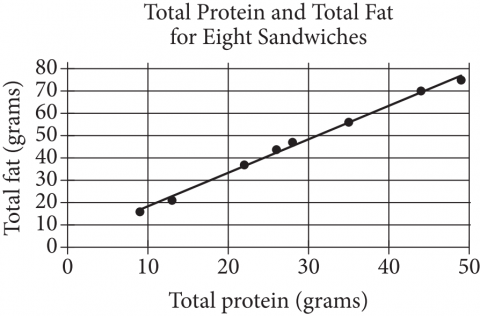
    The scatterplot above shows the numbers of grams of both total protein and total fat for eight sandwiches on a restaurant menu. The line of best fit for the data is also shown. According to the line of best fit, which of the following is closest to the predicted increase in total fat, in grams, for every increase of 1 gram in total protein?

    Correct answer: C

    Choice C is correct. The predicted increase in total fat, in grams, for every increase of 1 gram in total protein is represented by the slope of the line of best fit. Any two points on the line can be used to calculate the slope of the line as the change in total fat over the change in total protein. For instance, it can be estimated that the points and are on the line of best fit, and the slope of the line that passes through them is, or 1.4. Of the choices given, 1.5 is the closest to the slope of the line of best fit.Choices A, B, and D are incorrect and may be the result of incorrectly finding ordered pairs that lie on the line of best fit or of incorrectly calculating the slope.
  12. Question 12

    What is the value of \(sin(42π)\)?

    Correct answer: A

    Choice A is correct. The sine of a number \(t\) is the y-coordinate of the point arrived at by traveling a distance of \(t\) units counterclockwise around the unit circle from the starting point \((1, 0)\). Since the unit circle has a circumference of \(2π\) units, it follows that one full rotation around the circle is equal to a distance of \(2π\) units. Therefore, a distance of \(42π\) units around the circle from the starting point \((1, 0)\) would result in exactly \(21\) full rotations, arriving back at the point \((1, 0)\). So, \(sine 42π\) is equal to the y-coordinate of the point \((1, 0)\), which is \(0\). Choice B is incorrect and may result from conceptual or calculation errors. Choice C is incorrect and may result from conceptual or calculation errors. Choice D is incorrect. This is the value of \(cosine 42π\), not \(sine 42π\).
  13. Question 13

    Last week, an interior designer earned a total of \(\\) 1,258\( from consulting for \)x\( hours and drawing up plans for \)y\( hours. The equation \)68 x + 85 y = 1,258\( represents this situation. Which of the following is the best interpretation of \)68$ in this context?

    Correct answer: A

    Choice A is correct. It's given that \(68 x + 85 y = 1,258\) represents the situation where an interior designer earned a total of \(\\) 1,258\( last week from consulting for \)x\( hours and drawing up plans for \)y\( hours. Thus, \)68 x\( represents the amount earned, in dollars, from consulting for \)x\( hours, and \)85 y\( represents the amount earned, in dollars, from drawing up plans for \)y\( hours. Since \)68 x\( represents the amount earned, in dollars, from consulting for \)x\( hours, it follows that the interior designer earned \)$ 68\( per hour consulting last week. Choice B is incorrect. The interior designer worked \)y\( hours, not \)68\( hours, drawing up plans last week. Choice C is incorrect. The interior designer earned \)$ 85\( per hour, not \)$ 68\( per hour, drawing up plans last week. Choice D is incorrect. The interior designer worked \)x\( hours, not \)68$ hours, consulting last week.
  14. Question 14

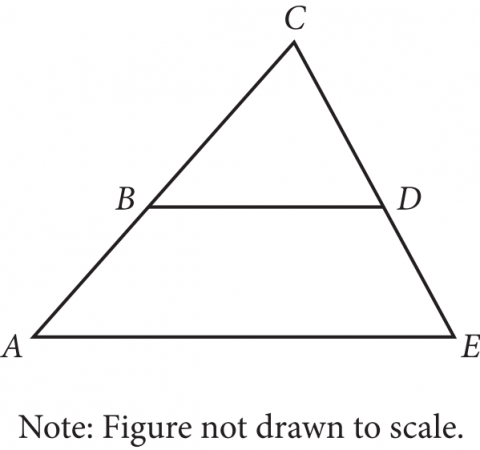
    In the figure above, segments AE and BD are parallel. If angle BDC measures 58° and angle ACE measures 62°, what is the measure of angle CAE ?

    Correct answer: B

    Choice B is correct. It’s given that angle ACE measures . Since segments AE and BD are parallel, angles BDC and CEA are congruent. Therefore, angle CEA measures . The sum of the measures of angles ACE, CEA, and CAE is since the sum of the interior angles of triangle ACE is equal to . Let the measure of angle CAE be . Therefore,, which simplifies to . Thus, the measure of angle CAE is .Choice A is incorrect. This is the measure of angle AEC, not that of angle CAE. Choice C is incorrect. This is the measure of angle ACE, not that of CAE. Choice D is incorrect. This is the sum of the measures of angles ACE and CEA.
  15. Question 15

    The number of coins in a collection increased from \(9\) to \(90\). What was the percent increase in the number of coins in this collection?

    Correct answer: D

    Choice D is correct. It's given that the number of coins in the collection increased from \(9\) to \(90\). It follows that the number of coins in the collection increased by \(90 -9\), or \(81\). Let \(x percent sign\) represent the percentage that \(81\) is of \(9\). The value of \(x\) can be found using the proportion \(81/9 = x/100\), or \(9 = x/100\). Multiplying both sides of this equation by \(100\) yields \(900 = x\). Thus, when the number of coins in the collection increased from \(9\) to \(90\), the percent increase was \(900 percent sign\). Choice A is incorrect and may result from conceptual or calculation errors. Choice B is incorrect and may result from conceptual or calculation errors. Choice C is incorrect and may result from conceptual or calculation errors.
  16. Question 16

    For which of the following data sets is the mean greater than the median? Note: If you are manually calculating the mean for each answer, you are doing it wrong. You need to be time efficient on the SAT. Think in terms of "what would make the mean of a dataset incresase significantly"?

    Correct answer: C

    Choice C is correct. If the values in a data set are ordered from least to greatest, the median of the data set will be the middle value. Since each data set in the choices is ordered and contains exactly 9 data values, the 5th value in each is the median. It follows that the median of the data set in choice C is 32. The sum of the positive differences between 32 and each of the values that are less than 32 is significantly smaller than the sum of the positive differences between 32 and each of the values that are greater than 32. If 32 were the mean, these sums would have been equal to each other. Therefore, the mean of this data set must be greater than 32. This can also be confirmed by calculating the mean as the sum of the values divided by the number of values in the data set: .Choices A and B are incorrect. Each of the data sets in these choices is symmetric with respect to its median, so the mean and the median for each of these choices are equivalent. Choice D is incorrect. The median of this data set is 207. Since the sum of the positive differences between 207 and each of the values less than 207 is greater than the sum of the positive differences between 207 and each value greater than 207 in this data set, the mean must be less than the median.
  17. Question 17

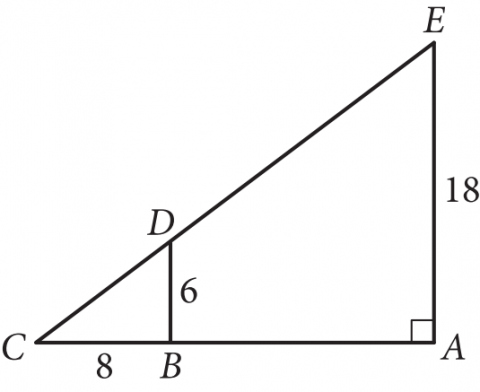
    In the figure above, BD is parallel to AE . What is the length of CE?

    Correct answer: A

    The correct answer is 30. In the figure given, since is parallel to and both segments are intersected by, then angle BDC and angle AEC are corresponding angles and therefore congruent. Angle BCD and angle ACE are also congruent because they are the same angle. Triangle BCD and triangle ACE are similar because if two angles of one triangle are congruent to two angles of another triangle, the triangles are similar. Since triangle BCD and triangle ACE are similar, their corresponding sides are proportional. So in triangle BCD and triangle ACE, corresponds to and corresponds to . Therefore, . Since triangle BCD is a right triangle, the Pythagorean theorem can be used to give the value of CD: . Taking the square root of each side gives . Substituting the values in the proportion yields . Multiplying each side by CE, and then multiplying by yields . Therefore, the length of is 30.
  18. Question 18

    Which of the following expressions is equivalent to \((sine 24 °)(cosine 66 °)+(cosine 24 °)(sine 66 °)\)?

    Correct answer: C

    Choice C is correct. The sine of an angle is equal to the cosine of its complementary angle. Since angles with measures \(24 °\) and \(66 °\) are complementary to each other, \(sine 24 °\) is equal to \(cosine 66 °\) and \(sine 66 °\) is equal to \(cosine 24 °\). Substituting \(cosine 66 °\) for \(sine 24 °\) and \(cosine 24 °\) for \(sine 66 °\) in the given expression yields \((cosine 66 °)(cosine 66 °)+(cosine 24 °)(cosine 24 °)\), or \((cosine 66 °)^2 +(cosine 24 °)^2\). Choice A is incorrect and may result from conceptual or calculation errors. Choice B is incorrect and may result from conceptual or calculation errors. Choice D is incorrect and may result from conceptual or calculation errors.

Want a higher score?

One-on-one tutoring for SAT, online or in person, with a plan built around the questions you missed.

Get Started

Book Your Free Session

5.0
from 38 Google reviews

Call or Text 1 (888) 356-0607