Skip to content

SAT practice test

10th Grade SAT Math Diagnostic Assessment

  • 15 questions
  • Untimed
  • Answers and explanations
Embed on your site
  • 15 questions
  • No time limit
  • Every answer explained at the end
  1. Question 1

    \(q = \frac{m}{10a + 3b}\). The given equation relates the distinct positive numbers \(q, m, a,\) and \(b\). Which equation correctly expresses \(10a + 3b\) in terms of \(q\) and \(m\)?

    Correct answer: A

    Isolate \(10a + 3b\) by multiplying both sides by \((10a + 3b)\), resulting in \(m = q(10a + 3b)\). Dividing by \(q\) gives \(10a + 3b = \frac{m}{q}\).
  2. Question 2

    What is the solution set for the inequality 2x + 3 < 7x - 5 ?

    Correct answer: A

    To solve \(2x + 3 < 7x - 5\), rearrange the terms to isolate x: \(3 + 5 < 7x - 2x\) leading to \(8 < 5x\) or \(x > \frac{8}{5}\).
  3. Question 3

    If \(5 x = 20\), what is the value of \(15 x\)?

    Correct answer: D

    Choice D is correct. It’s given that \(5 x = 20\). Multiplying both sides of this equation by \(3\) yields \(15 x = 60\). Therefore, the value of \(15 x\) is \(60\). Choice A is incorrect and may result from conceptual errors. Choice B is incorrect and may result from conceptual errors. Choice C is incorrect and may result from conceptual errors.
  4. Question 4

    A manager is responsible for ordering supplies for a shaved ice shop. The shop's inventory starts with \(4,500\) paper cups, and the manager estimates that \(70\) of these paper cups are used each day. Based on this estimate, in how many days will the supply of paper cups reach \(1,700\)?

    Correct answer: B

    Choice B is correct. It’s given that the shop’s inventory starts with \(4,500\) paper cups and that the manager estimates that \(70\) of these paper cups are used each day. Let \(x\) represent the number of days in which the estimated supply of paper cups will reach \(1,700\). The equation \(4,500 -70 x = 1,700\) represents this situation. Subtracting \(4,500\) from both sides of this equation yields \(-70 x = -2,800\). Dividing both sides of this equation by \(-70\) yields \(x = 40\). Therefore, based on this estimate, the supply of paper cups will reach \(1,700\) in \(40\) days. Choice A is incorrect. After \(20\) days, the estimated supply of paper cups would be \(4,500 -70(20)\), or \(3,100\) cups, not \(1,700\) cups. Choice C is incorrect. After \(60\) days, the estimated supply of paper cups would be \(4,500 -70(60)\), or \(300\) cups, not \(1,700\) cups. Choice D is incorrect. After \(80\) days, the estimated supply of paper cups would be \(4,500 -70(80)\), or \(-1,100\) cups, which isn't possible.
  5. Question 5

    Which expression is equivalent to \(12 x + 27\)?

    Correct answer: C

    Choice C is correct. Each term in the given expression, \(12 x + 27\), has a common factor of \(3\). Therefore, the expression can be rewritten as \(3(4 x)+ 3(9)\), or \(3(4 x + 9)\). Thus, the expression \(3(4 x + 9)\) is equivalent to the given expression. Choice A is incorrect. This expression is equivalent to \(108 x + 12\), not \(12 x + 27\). Choice B is incorrect. This expression is equivalent to \(324 x + 27\), not \(12 x + 27\). Choice D is incorrect. This expression is equivalent to \(27 x + 72\), not \(12 x + 27\).
  6. Question 6

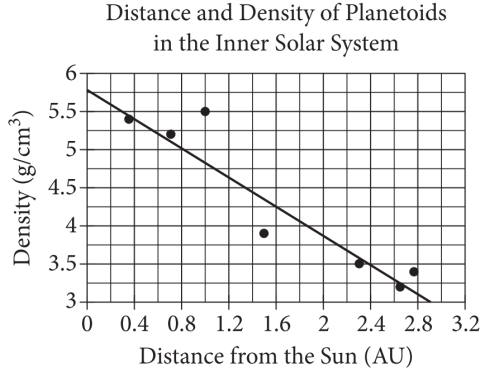
    The scatterplot above shows the densities of 7 planetoids, in grams per cubic centimeter, with respect to their average distances from the Sun in astronomical units (AU). The line of best fit is also shown. An astronomer has discovered a new planetoid about 1.2 AU from the Sun. According to the line of best fit, which of the following best approximates the density of the planetoid, in grams per cubic centimeter?

    Correct answer: C

    Choice C is correct. According to the line of best fit, a planetoid with a distance from the Sun of 1.2 AU has a predicted density between and . The only choice in this range is 4.6.Choices A, B, and D are incorrect and may result from misreading the information in the scatterplot.
  7. Question 7

    At a conference, there are a total of \(275\) attendees. Each attendee is assigned to either group A, group B, or group C. If one of these attendees is selected at random, the probability of selecting an attendee who is assigned to group A is \(0.44\) and the probability of selecting an attendee who is assigned to group B is \(0.24\). How many attendees are assigned to group C?

    Correct answer: B

    The correct answer is \(88\). It's given that there are a total of \(275\) attendees and each attendee is assigned to either group A, group B, or group C. It's also given that if one of these attendees is selected at random, the probability of selecting an attendee who is assigned to group A is \(0.44\) and the probability of selecting an attendee who is assigned to group B is \(0.24\). It follows that there are \(0.44(275)\), or \(121\), attendees who are assigned to group A and \(0.24(275)\), or \(66\), attendees who are assigned to group B. The number of attendees who are assigned to group C is the number of attendees who are not assigned to group A or group B. In other words, the number of attendees who are assigned to group C is the total number of attendees minus the number of attendees who are assigned to group A and group B. Therefore, the number of attendees who are assigned to group C is \(275 -121 -66\), or \(88\).
  8. Question 8

    An airplane descends from an altitude of \(9,500\) feet to \(5,000\) feet at a constant rate of \(400\) feet per minute. What type of function best models the relationship between the descending airplane's altitude and time?

    Correct answer: B

    Choice B is correct. It′s given that the airplane descends at a constant rate of \(400 feet per minute\). Since the altitude decreases by a constant amount during each fixed time period, the relationship between the airplane′s altitude and time is linear. Since the airplane descends from an altitude of \(9,500 feet\) to \(5,000 feet\), the airplane′s altitude is decreasing with time. Thus, the relationship is best modeled by a decreasing linear function. Choice A is incorrect and may result from conceptual or calculation errors. Choice C is incorrect and may result from conceptual or calculation errors. Choice D is incorrect and may result from conceptual or calculation errors.
  9. Question 9

    To determine the mean number of children per household in a community, Tabitha surveyed 20 families at a playground. For the 20 families surveyed, the mean number of children per household was 2.4. Which of the following statements must be true?

    Correct answer: C

    Choice C is correct. In order to use a sample mean to estimate the mean for a population, the sample must be representative of the population (for example, a simple random sample). In this case, Tabitha surveyed 20 families in a playground. Families in the playground are more likely to have children than other households in the community. Therefore, the sample isn’t representative of the population. Hence, the sampling method is flawed and may produce a biased estimate.Choices A and D are incorrect because they incorrectly assume the sampling method is unbiased. Choice B is incorrect because a sample of size 20 could be large enough to make an estimate if the sample had been representative of all the families in the community.
  10. Question 10

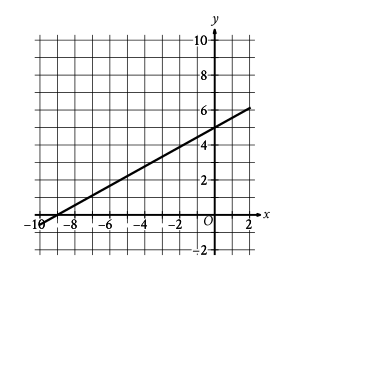
    The line slants gradually up from left to right. The line passes through the following points: (-9, 0) (0, 5) What is the y-intercept of the line graphed?

    Correct answer: C

    Choice C is correct. The y-intercept of a graph is the point where the graph intersects the y-axis. The line graphed intersects the y-axis at the point \((0, 5)\). Therefore, the y-intercept of the line graphed is \((0, 5)\). Choice A is incorrect and may result from conceptual errors. Choice B is incorrect and may result from conceptual errors. Choice D is incorrect and may result from conceptual errors.
  11. Question 11

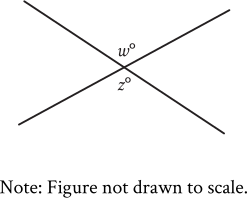
    At the intersection of the 2 lines, the angles are labeled clockwise from top as follows: Top: w° Right: unlabeled Bottom: z° Left: unlabeled A note indicates the figure is not drawn to scale. In the figure, two lines intersect at a point. If \(w = 136\), what is the value of \(z\)?

    Correct answer: D

    Choice D is correct. In the figure shown, the angles with measures \(w °\) and \(z °\) are vertical angles. Since vertical angles are congruent, \(w = z\). Therefore, if \(w = 136\), the value of \(z\) is \(136\). Choice A is incorrect and may result from conceptual or calculation errors. Choice B is incorrect. This is the measure, in °s, of an angle that's supplementary, not congruent, to the angle with measure \(w °\). Choice C is incorrect and may result from conceptual or calculation errors.
  12. Question 12

    The number of coins in a collection increased from \(9\) to \(90\). What was the percent increase in the number of coins in this collection?

    Correct answer: D

    Choice D is correct. It's given that the number of coins in the collection increased from \(9\) to \(90\). It follows that the number of coins in the collection increased by \(90 -9\), or \(81\). Let \(x percent sign\) represent the percentage that \(81\) is of \(9\). The value of \(x\) can be found using the proportion \(81/9 = x/100\), or \(9 = x/100\). Multiplying both sides of this equation by \(100\) yields \(900 = x\). Thus, when the number of coins in the collection increased from \(9\) to \(90\), the percent increase was \(900 percent sign\). Choice A is incorrect and may result from conceptual or calculation errors. Choice B is incorrect and may result from conceptual or calculation errors. Choice C is incorrect and may result from conceptual or calculation errors.
  13. Question 13

    For which of the following data sets is the mean greater than the median? Note: If you are manually calculating the mean for each answer, you are doing it wrong. You need to be time efficient on the SAT. Think in terms of "what would make the mean of a dataset incresase significantly"?

    Correct answer: C

    Choice C is correct. If the values in a data set are ordered from least to greatest, the median of the data set will be the middle value. Since each data set in the choices is ordered and contains exactly 9 data values, the 5th value in each is the median. It follows that the median of the data set in choice C is 32. The sum of the positive differences between 32 and each of the values that are less than 32 is significantly smaller than the sum of the positive differences between 32 and each of the values that are greater than 32. If 32 were the mean, these sums would have been equal to each other. Therefore, the mean of this data set must be greater than 32. This can also be confirmed by calculating the mean as the sum of the values divided by the number of values in the data set: .Choices A and B are incorrect. Each of the data sets in these choices is symmetric with respect to its median, so the mean and the median for each of these choices are equivalent. Choice D is incorrect. The median of this data set is 207. Since the sum of the positive differences between 207 and each of the values less than 207 is greater than the sum of the positive differences between 207 and each value greater than 207 in this data set, the mean must be less than the median.
  14. Question 14

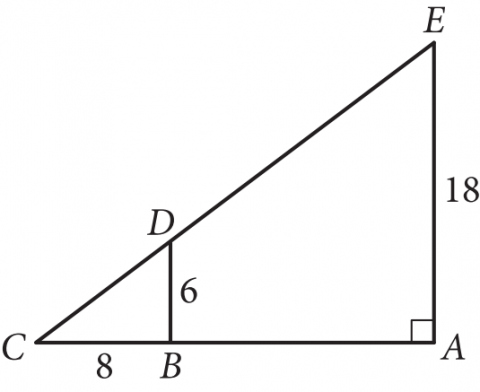
    In the figure above, BD is parallel to AE . What is the length of CE?

    Correct answer: A

    The correct answer is 30. In the figure given, since is parallel to and both segments are intersected by, then angle BDC and angle AEC are corresponding angles and therefore congruent. Angle BCD and angle ACE are also congruent because they are the same angle. Triangle BCD and triangle ACE are similar because if two angles of one triangle are congruent to two angles of another triangle, the triangles are similar. Since triangle BCD and triangle ACE are similar, their corresponding sides are proportional. So in triangle BCD and triangle ACE, corresponds to and corresponds to . Therefore, . Since triangle BCD is a right triangle, the Pythagorean theorem can be used to give the value of CD: . Taking the square root of each side gives . Substituting the values in the proportion yields . Multiplying each side by CE, and then multiplying by yields . Therefore, the length of is 30.
  15. Question 15

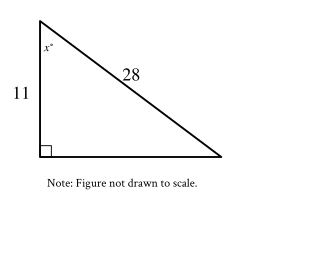
    One angle is a right angle. The measure of a second angle is x°. The length of the hypotenuse is 28. The length of the leg adjacent to the angle with measure x° is 11. A note indicates the figure is not drawn to scale. In the triangle shown, what is the value of \(cosine(x)°\)?

    Correct answer: B

    The correct answer is \(11/28\). The cosine of an acute angle in a right triangle is defined as the ratio of the length of the leg adjacent to the angle to the length of the hypotenuse. In the triangle shown, the length of the leg adjacent to the angle with measure \(x °\) is \(11\) units and the length of the hypotenuse is \(28\) units. Therefore, the value of \(cosine x °\) is \(11/28\). Note that 11/28, .3928, .3929, 0.392, and 0.393 are examples of ways to enter a correct answer.

Want a higher score?

One-on-one tutoring for SAT, online or in person, with a plan built around the questions you missed.

Get Started

Book Your Free Session

5.0
from 38 Google reviews

Call or Text 1 (888) 356-0607